RM - Instrumental Variables
 Call Kai
 Learn
Learn Practice Test
 Spaced Repetition
 Match
Match Flashcards
 Knowt Play
1/46

There's no tags or description
Looks like no tags are added yet.
Name | Mastery | Learn | Test | Matching | Spaced | Call with Kai | Chat |
|---|
No analytics yet
Send a link to your students to track their progress
47 Terms
OLS estimator (formula words)
causal + selection
beta OLS
beta + Cov(e,D) / Var(D)
Selection bias in OLS estimator (formula)
COV(e,D) / Var (D)
OLS estimator if we have imperfect randomization
does not reflect the causal effect of taking the treatment but is biased by a selection term
Endogeneity (words)
the covariance of the treatment and the error term is not zero = OLS problematic
Exogenous (condition + OLS)
Covariance between the treatment and the error term is 0 = OLS no problem
IV method
uses three assumptions to characterise a chain reaction leading from the instrument to outcome
Three IV assumptions
1) Relevance of the instrument
2) independence assumption
3) exclusion restriction
IV Assumption 1 - Relevance
the instrument is correlated with the treatment
COV(Z, D) is unequal 0
IV assumption 2 - Independence
The instrument is not correlated with errors
IV assumption 3 - Exclusion restriction
The instrument only affects the outcome Y through the treatment D
Testing IV assumption
1) can be directly tested via regression from data
2) & 3) cannot be directly tested, the researcher needs to argue why this holds
Instrument is strong enough when
f-statistic of first regression > 10
OLS estimator (formula)
COV(D,Y) / Var(D)
IV estimator OLS (formula)
COV (Z,Y) /COV (Z,D)
IV estimator (words)
ratio of two OLS estimators (rho and phi)
Phi (formula)
COV(Z,D) /Var (Z)
Phi (words)
Covariance of Instrument and Treatment divided by variance of Instrument
Rho (formula) - (co)variances
COV (Z,Y) / Var (Z)
Rho (words)
Covariance of the Instrument and Outcome divide by Variance of Instrument
Rho also called
reduced form
intent to treat
Phi also called
first stage
to get causal effect via manual IV
estimate both regressions (reduced and first stage) and divide the reduced by the first one
RHO written as Expectations (formula)
E[Y | Z = 1] - E[Y | Z = 0]
Phi written as expectations (formula)
E [ D | Z = 1] - E[ D| Z = 0]
RHO in terms of expectations (words)
The expected outcome of those who have the instrument MINUS the expected outcome of those without the instrument
PHI in terms of expectations (words)
The likelihood of getting the treatment when having the instrument MINUS the likelihood of getting the treatment when NOT having the instrument
Why do we need a strong first stage?
so we do not divide by zero
How does IV get rid of the selection bias?
BECAUSE of the assumption that the instrument is not correlated with the error (the thing causing selection bias)
How does the 2SLS get rid of selection bias?
using the fitted values for the treatment gets rid of the error (because fitted values are predicted values, not real ones = no error)
PHI when we have perfect compliance
is 1
When Phi < 1
we are dealing with incomplete compliance
= the Intent to Treat is bigger than the local average treatment effect
LATE formula
gamma = rho / phi
Why are we estimating only the effect of compliers with IV?
because we only have variation in the treatment (e.g. we only observe treatment on those who otherwise would not get it)
never takers
those who would never take the treatment
always takers
those who would always take the treatment
Assumption needed to interpret IV beta as LATE
Monotonicity assumption
Monotonicity assumption
there are no defiers
Defiers
those who would only take treatment if they do not get the instrument (randomization)
Two-stage least squares
alternative way of computing ratio of rho and phi by means of a sequence of two regressions
Regression in the two-stage least squares
1) Regress the instrument on the treatment variable
2) save the predicted values from Regression 1 and regress the outcome variable on these predicted values
Advantages of 2SLS
1) allows as many control variables as you’d like
2) allows to efficiently use more than 1 instrument per exogenous covariate
Steps to 2SLS
1) test instrument
2) estimate the impact of instrument on treatment
3) Use fitted values of treatment for second-stage equation
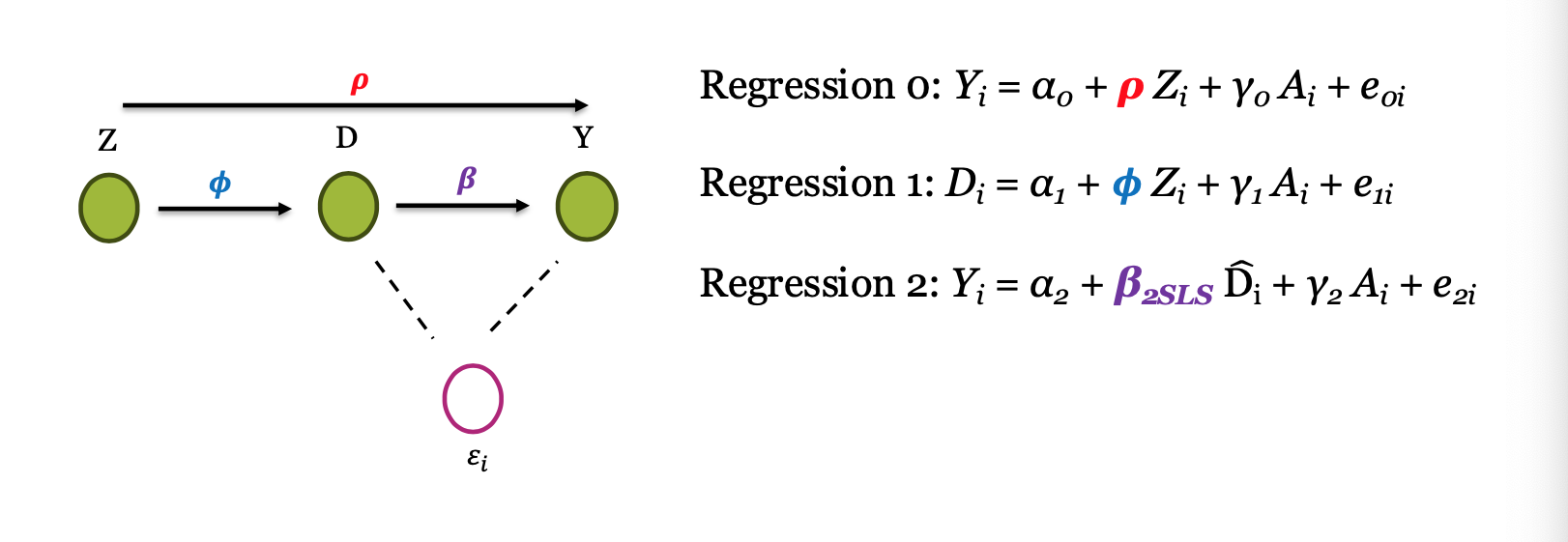
2SLS - Regression 0
Yi = a0 + rho * Zi + y0 Ai + e0i
2SLS - Regression 1 (formula)
Di = a1 + Phi * Zi + y1Ai + e1i
2SLS - Regression 2
Yi = a2 + beta(2SLS) D^HAT + y2Ai + e2i
Parameters in 2SLS
rho = overall effect of instrument on outcome
phi = effect of instrument on treatment
beta = true causal effect of treatment on outcome
ei = confounder that affects relationship of treatment and outcome