BioPsy: Finals L2.1 - Vision
 Call Kai
 Learn
Learn Practice Test
 Spaced Repetition
 Match
Match Flashcards
 Knowt Play
1/28

Earn XP
Description and Tags
Name | Mastery | Learn | Test | Matching | Spaced | Call with Kai | Chat |
|---|
No analytics yet
Send a link to your students to track their progress
29 Terms
Light
A type of electromagnetic wave that is one of the stimulus for the sense of sight.
Somewhere in between the electromagnetic spectrum.
Electromagnetic Spectrum
The full range of electromagnetic radiation, organized by frequency or wavelength.
Blue/Violet
400 nanometers
Short wavelength
Green/Yellow
520 nanometers
Medium Wavelength
Red/Orange
700 nanometers
Long Wavelength
Periphery
Where the rods are located.
Photoreceptors
Specialized type of cells that transforms stimulus into a neural impulse.
Photoreceptor: Rods
Very sensitive to light
Responsible for our night vision
Responsible for grayscale sight (Black and White)
Found in our periphery
Responsible for seeing at the sides
120 million
Very slow recovery rate
Photoreceptor: Cones
Color vision
Red, Green, and Blue
Found in the small region that is called Fovea.
6 million
Fast Recovery Rate
Fovea
The region that is responsible for us to see in details. Where the cones are located.
Optic Plate
The structure inside a rod.
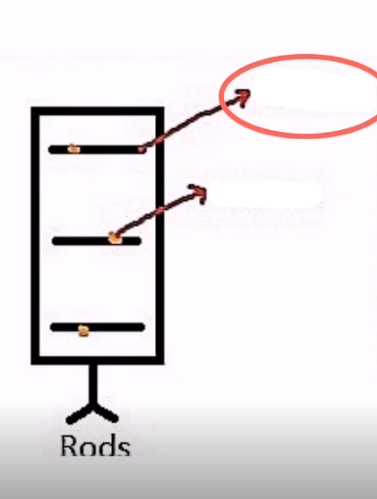
Rhodopsin
The protein of rods.
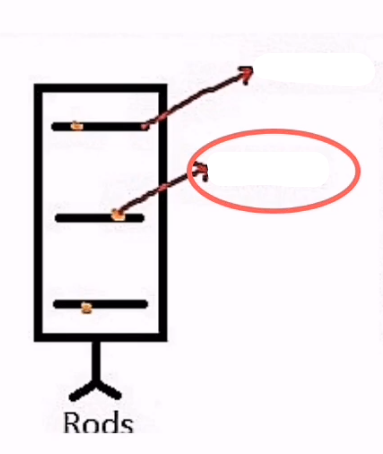
Photopsin
The protein of cones.
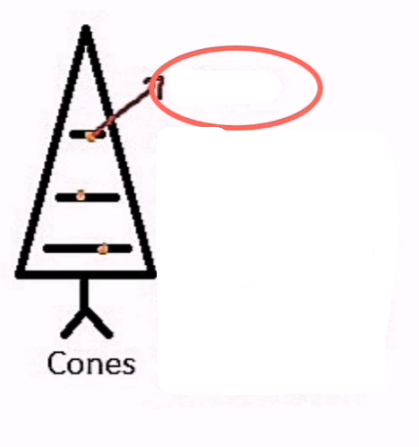
Sunlight
The most basic type of light that our eyes perceive.
Pupils
Dilates in low light to receive more and shrinks in high light to filter the vision.
Retina
The back of our eyes, where light hits once entering the eyes.
Optic Nerves
Anything that is perceived by the eyes is relayed through our _____.
Phototransduction Cascade
When there is/are no stimulus, the rod is turned on. But, when light suddenly hits the rod, it will suddenly turn off. This process is called _______.
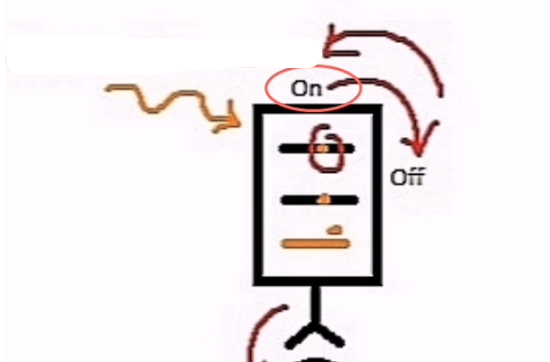
Bipolar Cell
When the rod is turned off, the rhodopsin in our rods will send a signal and therefore will turn on ________.
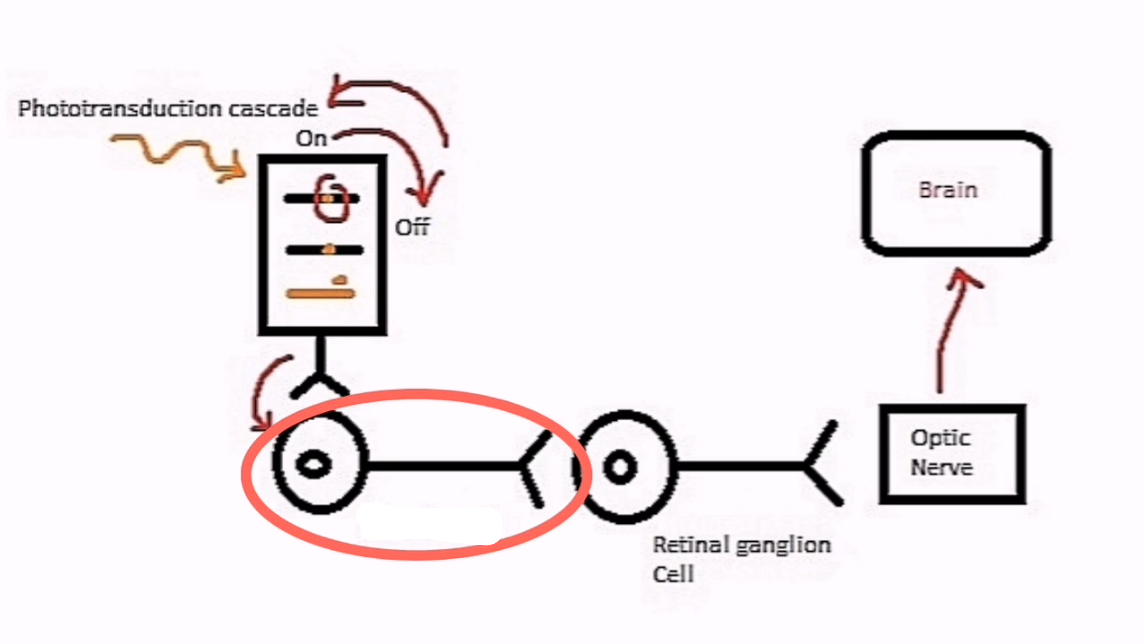
Retinal Ganglion Cell
Once the bipolar cell is turned on, this will activate an action potential that will communicate with the ___________.
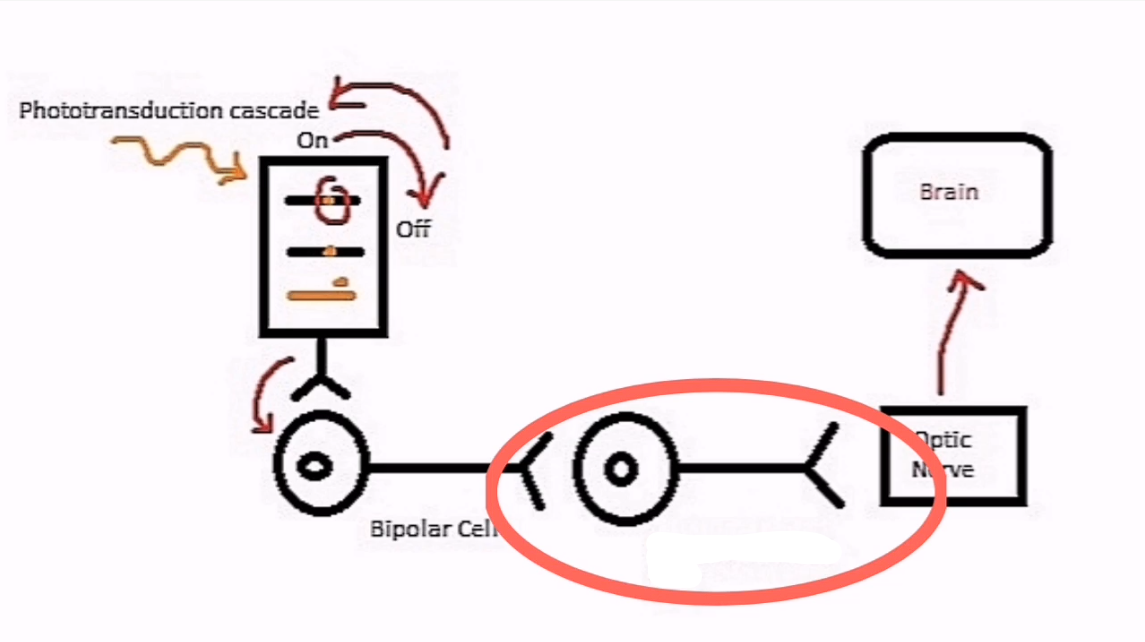
Optic Nerve
Once the Retinal Ganglion Cell has been activated by the action potential of the Bipolar Cell, the Retinal Ganglion cell will fire its own action potential and then those signals will now be transmitted to the ____________.
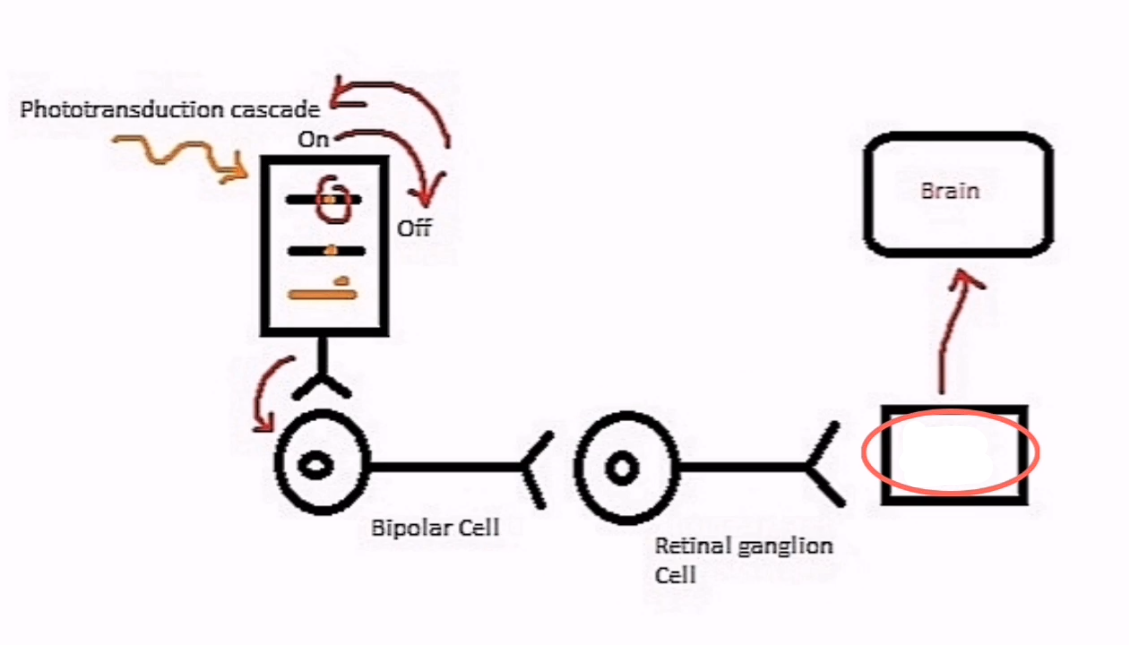
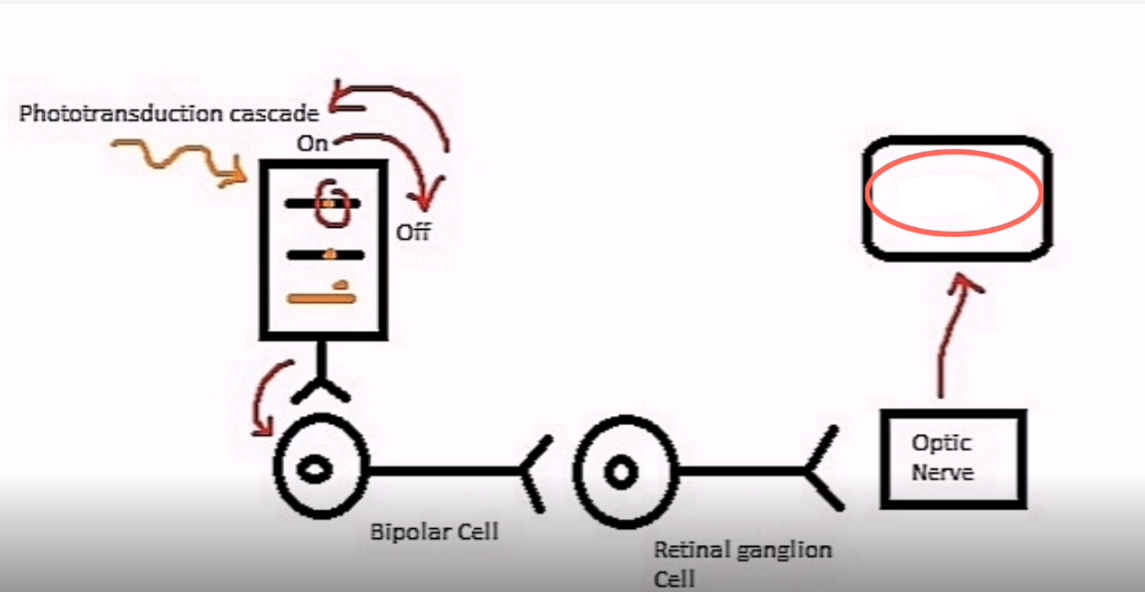
Brain
Signals are sent here after going through the Optic Nerve. Things we see are now interpreted.
Primary Visual Cortex
Found in the Occipital Lobe, the exact location of where the signals of the Optic Nerves are sent to interpret things that we see or the light that we have perceived through our eyes.
The most attractive colors to the eyes
Red/Orange
Long Wavelength colors in general are attractive to the eyes.
This is the reason why it is used as a marketing strategy (e.g., Jollibee uses mostly red colors)
Color Blindness (Color Deficiency)
The inability to see certain shades of color.
Since male Chromosomes are XY, no compensations are made to the X chromosome; Hence, more common in male.
Carried by the X Chromosome.
Agnosia
Impairment in sensations due to brain damage.
Visual Agnosia
Impairment in recognizing visually presented objects, despite otherwise normal visual field, acuity, color vision, brightness discrimination, language, and memory.
Prosopagnosia
Inability to recognize faces.
A person has a problem in their visual cortex and temporal lobe.
Knows the relationship with a person, but cannot recognize their faces—even their own face.
Object Agnosia
Inability to recognize objects.
A person has a problem in their visual cortex.