EP Signal and Recording
 Call Kai
 Learn
Learn Practice Test
 Spaced Repetition
 Match
Match Flashcards
 Knowt Play
1/30

There's no tags or description
Looks like no tags are added yet.
Name | Mastery | Learn | Test | Matching | Spaced | Call with Kai | Chat |
|---|
No analytics yet
Send a link to your students to track their progress
31 Terms
Where is HRA catheter placed?
- SVC, used to evaluate sinus node
Where is the His bundle catheter placed?
- Over tricuspid valve, time to go through atrium and AV node
Where is CS catheter placed?
- In AV groove, records A and V signals, atrial activation sequence proximal to distal
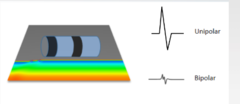
Bipolar Signals
- Sum of positive and negative end
- Electrodes are so close together most noise is measured equally
- Unaffected by FF signals
- Sees higher frequency
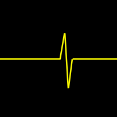
Unipolar Signals
- Reference is far away
- Can see FF signals
- Propagation towards electrode results in positive deflection and away in negative deflection
- Provides directionality information
Bipolar Blindness
- EGMs diminish in amplitude when catheter perpendicular to wavefront
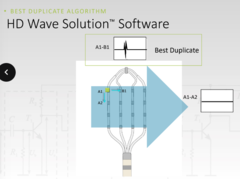
HD Grid ] Bipolar Blindness solution
Signal amplitudes remain unchanged regardless of catheter
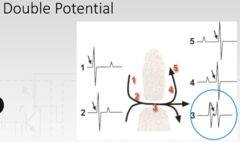
Double potential
3 shows the double potential; the high frequency signal in between resulting from the gap in the line of block
Signal Processing: Gain
Increases amplitude of all signals
Signal Processing: High pass filters
Filters out signals below a certain frequency (30 Hz)
Signal Processing: Low pass filters
filters out signals above a certain frequency (500 Hz)
Signal Processing: Band pass filter
Filters out signals outside of range of frequencies (30-500hz)
Signal Processing: Notch pass filter
Filters out a specificity frequency (60hz b/c we have 60hz electrical system in USA)
Label Waveforms
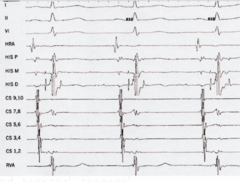
P-A Interval
- 1st evidence of SA node depol
- Conduction time from SA node to AVN 20-60ms
A-H Interval
- Atrial deflection HB EGM to his
- AVN conduction time 50-120ms
- Sympathetic stimulation = shorter A-H conduction time
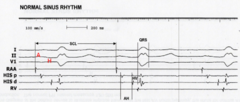
H-V Interval
- His potential to earliest ventricular activation
- 35-55ms
Overdrive Pacing
- Stimuli delivered at constant rate (PCL), must be faster than intrinsic rhythm
Burst pacing
- Stimuli delivered at constant rate for short duration, but successively faster rates with each burst
Stepwise decremental pacing
- Pace at a given rate for number of stimuli or seconds
- Intervening pauses between each rate increase
Ramp pacing
- Gradual decrease of PCL every several paced complexes
Extrastimulus pacing
- Drive train of paced complexes followed by a extrastimulus at a shorter cycle length
- To find refractory periods
SA Recovery
- SA node resumes discharge at a slower rate and gradually speeds up in reponse to overdrive pacing
Response to decremental atrial pacing
- Find AVN refractory times
- Find atrial refractory period
AV Connections during atrial pacing
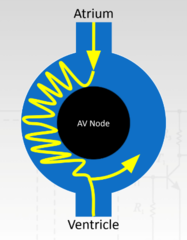
- Fast pathway
How to identify if person has dual nodal pathway
- Faster pacing occurs in longer A-H interval times
- A-H interval jump >35ms
Echo beat
Occurs when fast pathway is completely out of refractory by the time the slow pathway reaches it
Ventricular pacing purpose
- To find VERP, VAERP
- To find retrograde conduction
Ventricular fast pathway
Ventricular slow pathway
>150ms
SVTs involve retrograde or antegrade pathways?
Both