9 - Gram Negative Bacilli
 Call Kai
 Learn
Learn Practice Test
 Spaced Repetition
 Match
Match Flashcards
 Knowt Play
1/99

There's no tags or description
Looks like no tags are added yet.
Name | Mastery | Learn | Test | Matching | Spaced | Call with Kai | Chat |
|---|
No analytics yet
Send a link to your students to track their progress
100 Terms
Enteric
Respiratory
Zoonotic
Others
Gram negative bacilli are classified into these major categories
a. Spore-forming and non spore-forming
b. Enteric, Respiratory, Zoonotic, Others
c. Alpha, Beta, Gamma hemolytic
d. Aerobic, Anaerobic, Facultative
Enterobacteriaceae
Vibrio
Pseudomonas spp.
Bacteroides spp.
Enteric Gram Negative Bacilli include _____ [4]
E. coli
Proteus
Shigella
Salmonella
Klebsiella
Examples of Enterobacteriaceae
a. Vibrio, C. jejuni, H. pylori
b. Brucella, Francisella, Bartonella
c. E. coli, Proteus, Shigella, Salmonella, Klebsiella
d. H. influenzae, B. pertussis, L. pneumophila
Vibrio cholerae
Campylobacter jejuni
Helicobacter pylori
Examples of Vibrio [3]
H. influenzae
B. Pertussis
L. pneumophila
Respiratory Gram Negative Bacilli include _____ [3]
Brucella spp.
Francisella spp.
Bartonella spp.
Pasteurella spp.
Yersinia spp.
Zoonotic Gram Negative Bacilli include _____ [5]
H. ducreyi
K. granulomatis
G. vaginalis
Other Gram Negative Bacilli include ______ [3]
c. GIT
[Enteric Gram Negative Bacilli]
Enteric Gram negative bacilli primarily affects this system
a. Respiratory tract
b. Urinary tract
c. GIT
d. Central nervous system
Capsular K Antigen
Somatic O Antigen
Flagellar H Antigen
P Fimbriae
Enterotoxin
[Enteric Gram Negative Bacilli]
Virulence factors of E. coli [5]
a. Heat-stable enterotoxin
[Enteric Gram Negative Bacilli]
Enterotoxin of E. coli that increases cGMP
a. Heat-stable enterotoxin
b. Heat-labile enterotoxin
b. Heat-labile enterotoxin
[Enteric Gram Negative Bacilli]
Enterotoxin of E. coli that increases cAMP
a. Heat-stable enterotoxin
b. Heat-labile enterotoxin
d. Fecal-oral
[Enteric Gram Negative Bacilli]
Route of transmission of E. coli causing acute gastroenteritis
a. Droplet
b. Vector-borne
c. Direct contact
d. Fecal-oral
a. ETEC (Enterotoxigenic E. coli)
[Enteric Gram Negative Bacilli]
Traveller's diarrhea
a. ETEC (Enterotoxigenic E. coli)
b. EIEC (Enteroinvasive E. coli)
c. EPEC (Enteropathogenic E. coli)
d. EAEC (Enteroaggregative E. coli)
b. EIEC (Enteroinvasive E. coli)
[Enteric Gram Negative Bacilli]
Identical to shigellosis (dysentery)
a. ETEC (Enterotoxigenic E. coli)
b. EIEC (Enteroinvasive E. coli)
c. EPEC (Enteropathogenic E. coli)
d. EAEC (Enteroaggregative E. coli)
c. EPEC (Enteropathogenic E. coli)
[Enteric Gram Negative Bacilli]
Pediatric diarrhea
a. ETEC (Enterotoxigenic E. coli)
b. EIEC (Enteroinvasive E. coli)
c. EPEC (Enteropathogenic E. coli)
d. EAEC (Enteroaggregative E. coli)
d. EAEC (Enteroaggregative E. coli)
[Enteric Gram Negative Bacilli]
Diarrhea in AIDS patient
a. ETEC (Enterotoxigenic E. coli)
b. EIEC (Enteroinvasive E. coli)
c. EPEC (Enteropathogenic E. coli)
d. EAEC (Enteroaggregative E. coli)
d. EAEC (Enteroaggregative E. coli)
[Enteric Gram Negative Bacilli]
Persistent infant (<1yr) diarrhea
a. ETEC (Enterotoxigenic E. coli)
b. EIEC (Enteroinvasive E. coli)
c. EPEC (Enteropathogenic E. coli)
d. EAEC (Enteroaggregative E. coli)
ORS
Zinc sulfate
Probiotics (Bacillus clausii)
[Enteric Gram Negative Bacilli]
Treatment for E. coli acute gastroenteritis
a. Penicillin G and Metronidazole
b. Ciprofloxacin and Doxycycline
c. Vancomycin and Clindamycin
d. ORS, zinc sulfate, probiotics (Bacillus clausii)
b. To strengthen the child so diarrhea will not recur
[Enteric Gram Negative Bacilli]
Reason zinc sulfate is given in E. coli gastroenteritis treatment
a. To kill the bacteria
b. To strengthen the child so diarrhea will not recur
c. To replace lost electrolytes
d. To prevent dehydration
d. E. coli O157:H7
[Enteric Gram Negative Bacilli]
EHEC (Enterohemorrhagic E. coli) serotype
a. E. coli O55:H7
b. E. coli O157:H1
c. E. coli O111:H7
d. E. coli O157:H7
c. Verotoxin (shiga-like toxin)
[Enteric Gram Negative Bacilli]
Toxin produced by EHEC (Enterohemorrhagic E.coli)
a. Heat-stable enterotoxin
b. Heat-labile enterotoxin
c. Verotoxin (shiga-like toxin)
d. Alpha toxin
b. Hemolytic uremic syndrome
[Enteric Gram Negative Bacilli]
Watch out for complication of EHEC (Enterohemorrhagic E.coli) infection
a. Pseudomembranous colitis
b. Hemolytic uremic syndrome
c. Traveller's diarrhea
d. Pediatric diarrhea
c. Pyelonephritis
[Enteric Gram Negative Bacilli]
E. coli causing UTI that affects the kidney with fever
a. Cystitis
b. Asymptomatic bacteriuria
c. Pyelonephritis
d. Urethritis
d. Quinolones (Ciprofloxacin)
[Enteric Gram Negative Bacilli]
Treatment for E. coli pyelonephritis
a. Nitrofurantoin and Fosfomycin
b. Ampicillin and Gentamicin
c. Vancomycin and Metronidazole
d. Quinolones (Ciprofloxacin)
d. Cystitis
[Enteric Gram Negative Bacilli]
E. coli causing UTI affecting the bladder with no fever
a. Pyelonephritis
b. Urethritis
c. Asymptomatic bacteriuria
d. Cystitis
Nitrofurantoin
Fosfomycin
[Enteric Gram Negative Bacilli]
Treatment for E. coli cystitis
a. Quinolones (Ciprofloxacin)
b. Nitrofurantoin and Fosfomycin
c. Ampicillin and Gentamicin
d. Vancomycin and Metronidazole
d. Asymptomatic bacteriuria
[Enteric Gram Negative Bacilli]
E. coli UTI that does not require antibiotic treatment under normal circumstances
a. Pyelonephritis
b. Cystitis
c. Urethritis
d. Asymptomatic bacteriuria
Will undergo urologic procedure
Pregnant
[Enteric Gram Negative Bacilli]
Conditions where asymptomatic bacteriuria requires antibiotic treatment
a. Immunocompromised and elderly
b. Diabetic and hypertensive patients
c. Will undergo urologic procedure and pregnant
d. Pediatric and geriatric patients
b. Proteus spp.
[Enteric Gram Negative Bacilli]
The organism identified by swarming motility and a positive urease test
a. Escherichia coli
b. Proteus spp.
c. Shigella dysenteriae
d. Salmonella typhi
b. Proteus spp.
[Enteric Gram Negative Bacilli]
The organism associated with urinary tract infection and nephrolithiasis
a. Escherichia coli
b. Proteus spp.
c. Shigella dysenteriae
d. Salmonella typhi
UTI
Nephrolithiasis
[Enteric Gram Negative Bacilli]
Complications to watch out for in Proteus spp. infection
a. Pneumonia and bacteremia
b. Sepsis and meningitis
c. UTI and nephrolithiasis
d. Gas gangrene and sepsis
c. Shigella dysenteriae
[Enteric Gram Negative Bacilli]
The organism that is:
Non-motile
Does not produce hydrogen sulfide
a. Salmonella typhi
b. Proteus spp.
c. Shigella dysenteriae
d. Escherichia coli
d. Fecal-oral
[Enteric Gram Negative Bacilli]
Route of transmission of Shigella dysenteriae
a. Droplet
b. Vector-borne
c. Direct contact
d. Fecal-oral
c. Shiga toxin
[Enteric Gram Negative Bacilli]
Toxin produced by Shigella dysenteriae
a. Heat-stable enterotoxin
b. Verotoxin = shiga-like toxin
c. Shiga toxin
d. Heat-labile enterotoxin
b. Inhibits protein synthesis by targeting the 60s ribosomal subunit
[Enteric Gram Negative Bacilli]
Mechanism of action of Shiga toxin produced by Shigella dysenteriae
a. Inhibits protein synthesis by targeting the 50s ribosomal subunit
b. Inhibits protein synthesis by targeting the 60s ribosomal subunit
c. Inhibits DNA replication by targeting DNA gyrase
d. Inhibits cell wall synthesis by targeting peptidoglycan
b. Shigellosis (dysentery + fever)
[Enteric Gram Negative Bacilli]
Clinical manifestation of Shigella dysenteriae infection
a. Traveller's diarrhea
b. Shigellosis (dysentery + fever)
c. Pediatric diarrhea
d. Hemolytic uremic syndrome
Hydration
Ciprofloxacin
[Enteric Gram Negative Bacilli]
Treatment for Shigella dysenteriae
a. ORS, zinc sulfate, probiotics
b. Penicillin G and Metronidazole
c. Hydration, ciprofloxacin
d. Ampicillin and Gentamicin
b. Salmonella typhi
[Enteric Gram Negative Bacilli]
The organism that is:
Motile
Produces hydrogen sulfide
a. Shigella dysenteriae
b. Salmonella typhi
c. Proteus spp.
d. Escherichia coli
b. It is motile
[Enteric Gram Negative Bacilli]
The reason Salmonella typhi is described as "salmon swims"
a. It is non-motile
b. It is motile
c. It produces hydrogen sulfide
d. It produces shiga toxin
d. Fecal-oral → Vi antigen
[Enteric Gram Negative Bacilli]
Route of transmission of Salmonella typhi and its associated antigen
a. Fecal-oral → M protein
b. Droplet → Vi antigen
c. Direct contact → Vi antigen
d. Fecal-oral → Vi antigen
b. Vi antigen
[Enteric Gram Negative Bacilli]
The antigen possessed by Salmonella typhi
a. Shiga toxin
b. Vi antigen
c. Urease
d. Heat-stable enterotoxin
Salmonellosis
Typhoid fever (≥2 weeks fever)
Rose or salmon colored spot (stomach)
[Enteric Gram Negative Bacilli]
Complications to watch out for in Salmonella typhi infection [3]
Widal test
Culture
[Enteric Gram Negative Bacilli]
Diagnostic test for Salmonella typhi include _____ [3]
c. Widal test
[Enteric Gram Negative Bacilli]
Diagnostic test for Salmonella typhi that is serologic but obsolete
a. Elek test
b. Schick test
c. Widal test
d. Dick test
d. Culture (blood, urine, stool, bone marrow)
[Enteric Gram Negative Bacilli]
Gold standard diagnosis for Salmonella typhi
a. Blood culture only
b. Widal test
c. Stool culture only
d. Culture (blood, urine, stool, bone marrow)
d. Bone marrow
[Enteric Gram Negative Bacilli]
Best specimen for culture in Salmonella typhi diagnosis
a. Blood
b. Urine
c. Stool
d. Bone marrow
Ceftriaxone
Azithromycin
[Enteric Gram Negative Bacilli]
Empiric treatment for Salmonella typhi used while awaiting culture results
a. Ciprofloxacin
b. Amoxicillin, chloramphenicol
c. Ceftriaxone, azithromycin
d. Ampicillin and Gentamicin
d. Ciprofloxacin
[Enteric Gram Negative Bacilli]
Treatment for Salmonella typhi if culture result shows ciprofloxacin susceptible
a. Ceftriaxone, azithromycin
b. Amoxicillin, chloramphenicol
c. Ampicillin and Gentamicin
d. Ciprofloxacin
Amoxicillin
Chloramphenicol
[Enteric Gram Negative Bacilli]
Alternative treatment for Salmonella typhi
a. Ciprofloxacin
b. Ceftriaxone, azithromycin
c. Ampicillin and Gentamicin
d. Amoxicillin, chloramphenicol
c. Continue empiric (ceftriaxone, azithromycin)
[Enteric Gram Negative Bacilli]
Treatment for Salmonella typhi if ciprofloxacin resistant
a. Ciprofloxacin
b. Amoxicillin, chloramphenicol
c. Continue empiric (ceftriaxone, azithromycin)
d. Ampicillin and Gentamicin
d. 50%
[Enteric Gram Negative Bacilli]
Efficacy of typhoid vaccine for prevention of Salmonella typhi
a. 25%
b. 75%
c. 100%
d. 50%
c. Klebsiella pneumoniae
[Enteric Gram Negative Bacilli]
The organism identified by a capsule and mucoid colonies with a candle-like appearance
a. Escherichia coli
b. Pseudomonas aeruginosa
c. Klebsiella pneumoniae
d. Proteus spp.
d. ESBL organism
[Enteric Gram Negative Bacilli]
Klebsiella pneumoniae is classified as this type of organism
a. Vancomycin resistant organism
b. Methicillin resistant organism
c. Carbapenem resistant organism
d. ESBL organism
c. Carbapenem
[Enteric Gram Negative Bacilli]
Treatment for Klebsiella pneumoniae
a. Ciprofloxacin
b. Vancomycin and Metronidazole
c. Carbapenem
d. Ampicillin and Gentamicin
c. Klebsiella pneumoniae
[Enteric Gram Negative Bacilli]
The organism that causes:
Aspiration pneumonia
Liver or lung abscess
a. Streptococcus pneumoniae
b. Pseudomonas aeruginosa
c. Klebsiella pneumoniae
d. Staphylococcus aureus
b. Aspiration pneumonia
[Enteric Gram Negative Bacilli]
In Klebsiella pneumoniae:
Alcoholic patients are at risk for this complication
a. Acute endocarditis
b. Aspiration pneumonia
c. Abscess (liver, lungs)
d. Acute gastroenteritis
d. Abscess (liver, lungs)
[Enteric Gram Negative Bacilli]
In Klebsiella pneumoniae:
Diabetic patients are at risk for this complication
a. Aspiration pneumonia
b. Acute gastroenteritis
c. Acute endocarditis
d. Abscess (liver, lungs)
a. Vibrio cholerae
[Enteric Gram Negative Bacilli]
Identified by:
Comma-shaped morphology
Monotrichous flagella arrangement
a. Vibrio cholerae
b. Campylobacter jejuni
c. Helicobacter pylori
d. Salmonella typhi
b. Comma-shaped
[Enteric Gram Negative Bacilli]
ID of Vibrio cholerae based on its shape
a. Box car shaped
b. Comma-shaped
c. Lollipop, drumstick, tennis racket
d. Lancet-shaped diplococci
c. Monotrichous
[Enteric Gram Negative Bacilli]
Flagella arrangement of Vibrio cholerae
a. Amphitrichous
b. Peritrichous
c. Monotrichous
d. Lophotrichous
d. Surface water
[Enteric Gram Negative Bacilli]
Number one source of Vibrio cholerae in the environment
a. Soil
b. Colon
c. Domestic animals
d. Surface water
c. Shooting star motility
[Enteric Gram Negative Bacilli]
Motility pattern of Vibrio cholerae
a. Tumbling motility
b. Swarming motility
c. Shooting star motility
d. Gliding motility
b. Thiosulfate citrate bile sucrose agar
[Enteric Gram Negative Bacilli]
Culture medium used for Vibrio cholerae
a. MacConkey agar
b. Thiosulfate citrate bile sucrose agar
c. Blood agar
d. Chocolate agar
a. (+) yellow colonies
[Enteric Gram Negative Bacilli]
Colony appearance of Vibrio cholerae on thiosulfate citrate bile sucrose agar.
a. (+) yellow colonies
b. (+) green colonies
c. (+) black colonies
d. (+) colorless colonies
c. Low gastric acidity (patient taking antacids)
[Enteric Gram Negative Bacilli]
Risk factor for Vibrio cholerae infection
a. Chronic antibiotic use
b. Type 2 DM
c. Low gastric acidity (patient taking antacids)
d. Immunocompromised state
b. Fecal-oral route
[Enteric Gram Negative Bacilli]
Route of transmission for Vibrio cholerae is:
a. Droplet
b. Fecal-oral route
c. Sexual
d. Bloodborne
a. Choleragen (heat-labile toxin = ↑ cAMP)
[Enteric Gram Negative Bacilli]
The toxin of Vibrio cholerae is:
a. Choleragen
b. Neurotoxin
c. Enterotoxin
d. Cytotoxin
a. Heat-labile toxin that increases cAMP
[Enteric Gram Negative Bacilli]
Choleragen.
a. Heat-labile toxin that increases cAMP
b. Heat-stable toxin that decreases cAMP
c. Neurotoxin that blocks acetylcholine release
d. Endotoxin that activates the complement system
Rice watery diarrhea
Washer woman hand sign (kulubot kamay)
[Enteric Gram Negative Bacilli]
Clinical manifestations of cholera caused by Vibrio cholerae
a. Dysentery + fever
b. Traveller's diarrhea
c. Rice watery diarrhea,(+) washer woman hand sign (kulubot kamay)
d. Sandpaper rash, strawberry tongue
c. Dehydration
[Enteric Gram Negative Bacilli]
Complication to watch out for in Vibrio cholerae infection
a. Hemolytic uremic syndrome
b. Guillain-Barre syndrome
c. Dehydration
d. Nephrolithiasis
Hydration
Doxycycline (shorten duration of illness)
[Enteric Gram Negative Bacilli]
Treatment for Vibrio cholerae infection
a. ORS, zinc sulfate, probiotics
b. Hydration, doxycycline (shorten duration of illness)
c. Ciprofloxacin and Doxycycline
d. Ampicillin and Gentamicin
b. Campylobacter jejuni
[Enteric Gram Negative Bacilli]
The organism identified by:
Amphitrichous flagella
"Gull wing" appearance
a. Vibrio cholerae
b. Campylobacter jejuni
c. Helicobacter pylori
d. Salmonella typhi
c. Domestic animals
[Enteric Gram Negative Bacilli]
Source of Campylobacter jejuni infection
a. Canned goods
b. Surface water
c. Domestic animals
d. Soil
b. Fecal-oral
[Enteric Gram Negative Bacilli]
Route of transmission of Campylobacter jejuni
a. Droplet
b. Fecal-oral
c. Direct contact
d. Vector-borne
Hydration
Erythromycin
[Enteric Gram Negative Bacilli]
Treatment for Campylobacter jejuni infection
a. Ampicillin and Gentamicin
b. Ciprofloxacin and Doxycycline
c. Vancomycin and Metronidazole
d. Hydration, Erythromycin
c. Skirrow's media
[Enteric Gram Negative Bacilli]
Diagnostic medium used for Campylobacter jejuni
a. Loeffler's agar
b. MacConkey agar
c. Skirrow's media
d. Thiosulfate citrate bile sucrose agar
Guillain-Barre syndrome
[Enteric Gram Negative Bacilli]
Complication to watch out for in Campylobacter jejuni infection
a. Dehydration
b. Hemolytic uremic syndrome
c. Guillain-Barre syndrome
d. Nephrolithiasis
Guillain-Barré syndrome
[Enteric Gram Negative Bacilli]
The condition characterized by ascending paralysis
a. Shigellosis
b. Typhoid fever
c. Guillain-Barré syndrome
d. Cholera
c. IV Ig
[Enteric Gram Negative Bacilli]
Treatment for Guillain-Barre syndrome caused by Campylobacter jejuni
a. Erythromycin
b. Ciprofloxacin
c. IV Ig
d. Penicillin G
b. Helicobacter pylori
[Enteric Gram Negative Bacilli]
The organism identified by lophotrichous flagella
a. Campylobacter jejuni
b. Helicobacter pylori
c. Vibrio cholerae
d. Salmonella typhi
Fecal-oral
Gastro-oral
Oral-oral
[Enteric Gram Negative Bacilli]
Routes of transmission of Helicobacter pylori
a. Droplet, airborne, vector-borne
b. Fecal-oral, gastro-oral, oral-oral
c. Direct contact, fecal-oral, vector-borne
d. Airborne, fecal-oral, direct contact
c. (+) protease, (-) alt mucus, (+) urease
[Enteric Gram Negative Bacilli]
Virulence characteristics of Helicobacter pylori
a. (+) protease, (+) alt mucus, (+) urease
b. (-) protease, (-) alt mucus, (+) urease
c. (+) protease, (-) alt mucus, (+) urease
d. (-) protease, (+) alt mucus, (-) urease
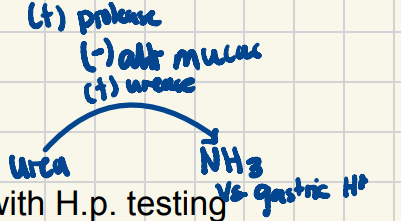
b. NH₃
[Enteric Gram Negative Bacilli]
Mechanism of H. pylori causing gastric damage:
Urease converts urea into _____ , which neutralizes gastric H+
a. CO₂
b. NH₃
c. H₂S
d. HCl
d. PUD (peptic ulcer disease)
[Enteric Gram Negative Bacilli]
Complication to watch out for in Helicobacter pylori infection
a. Nephrolithiasis
b. Guillain-Barre syndrome
c. Hemolytic uremic syndrome
d. PUD (peptic ulcer disease)
c. Upper GI endoscopy with H.p. testing
[Enteric Gram Negative Bacilli]
Diagnostic test for Helicobacter pylori
a. Widal test
b. Elek test
c. Upper GI endoscopy with H.p. testing
d. Skirrow's media = culture
c. Urea breath test
[Enteric Gram Negative Bacilli]
Monitoring test for Helicobacter pylori treatment response
a. Widal test
b. Upper GI endoscopy
c. Urea breath test
d. Elek test
PPI
Levofloxacin
Antibiotics (CLAM)
[Enteric Gram Negative Bacilli]
Treatment for H. pylori if (+) PUD known as "triple therapy"
a. ORS, zinc sulfate, probiotics
b. Ciprofloxacin, Doxycycline, Metronidazole
c. PPI, Levofloxacin, Antibiotics (CLAM)
d. Ampicillin, Gentamicin, Metronidazole
Clarithromycin
Levofloxacin
Amoxicillin
Metronidazole
📌Mnemonic: “CLAM”
[Enteric Gram Negative Bacilli]
Antibiotics included in regimen for H. pylori triple therapy [4]
b. Pseudomonas aeruginosa
[Enteric Gram Negative Bacilli]
The organism identified by:
Aerobic growth
Pyogenic properties
a. Escherichia coli
b. Pseudomonas aeruginosa
c. Bacteroides fragilis
d. Klebsiella pneumoniae
b. Fruity odor
[Enteric Gram Negative Bacilli]
Characteristic odor of Pseudomonas auruginosa
a. Foul odor
b. Fruity odor
c. Musty odor
d. Sulfur odor
c. Exotoxin A vs live
[Enteric Gram Negative Bacilli]
Virulence factor of Pseudomonas auruginosa that targets the liver
a. Endotoxin
b. Alpha toxin
c. Exotoxin A
d. Shiga-like toxin
b. Pseudomonas aeruginosa
[Enteric Gram Negative Bacilli]
The organism that is the number one cause of nosocomial infection
a. Escherichia coli
b. Pseudomonas aeruginosa
c. Staphylococcus aureus
d. Bacteroides fragilis
b. Pseudomonas aeruginosa
[Enteric Gram Negative Bacilli]
The organism that is the number two cause of burn infection
a. Escherichia coli
b. Pseudomonas aeruginosa
c. Staphylococcus aureus
d. Bacteroides fragilis
Nosocomial infection
Burn infection
Malignant otitis media
Ecthymaga gangrenosum
Hot tub folliculitis
Osteomyelitis
[Enteric Gram Negative Bacilli]
Complications to watch out for in Pseudomonas auruginosa infection [6]
c. Ceftazidime
[Enteric Gram Negative Bacilli]
Treatment for Pseudomonas auruginosa
a. Ciprofloxacin and Doxycycline
b. Carbapenem
c. Ceftazidime
d. Vancomycin and Metronidazole
c. Bacteroides fragilis
[Enteric Gram Negative Bacilli]
The organism that is the number one colonic flora
a. Escherichia coli
b. Pseudomonas aeruginosa
c. Bacteroides fragilis
d. Klebsiella pneumoniae
d. Anaerobic
[Enteric Gram Negative Bacilli]
ID of Bacteroides fragillis based on its oxygen requirement
a. Aerobe
b. Microaerophile
c. Facultative anaerobe
d. Anaerobic
b. Abnormal surgery
[Enteric Gram Negative Bacilli]
Risk factor for Bacteroides fragillis infection
a. Chronic antibiotic use
b. Abnormal surgery
c. Immunocompromised state
d. Type 2 DM
c. Abscess
[Enteric Gram Negative Bacilli]
Complication to watch out for in Bacteroides fragillis infection
a. Hemolytic uremic syndrome
b. Guillain-Barre syndrome
c. Abscess
d. Nephrolithiasis
d. Metronidazole
[Enteric Gram Negative Bacilli]
Treatment for Bacteroides fragillis
a. Ciprofloxacin
b. Ceftazidime
c. Carbapenem
d. Metronidazole