EMT Certification -- Skills Drills
 Call Kai
 Learn
Learn Practice Test
 Spaced Repetition
 Match
Match Flashcards
 Knowt Play
1/8

Earn XP
Description and Tags
Written steps for skills days
Name | Mastery | Learn | Test | Matching | Spaced | Call with Kai | Chat |
|---|
No analytics yet
Send a link to your students to track their progress
9 Terms
Proper Glove Removal Technique (Skill Drill 2-1)
Partially remove the first glove by pinching at the wrist. Be careful to touch only the outside of the glove.
Remove the second glove by pinching the exterior with your partially gloved hand.
Pull the second glove inside out toward the fingertips.
Grasp both gloves with your free hand, touching only the clean, interior surfaces.
Managing a Potential Exposure (Skill Drill 2-2)
En route to the scene, make sure that PPE is out and available.
On arrival, identify and address safety hazards, then perform a rapid scan of the patient, noting whether any blood or body fluids are present. Select the proper PPE according to the tasks you are likely to perform. Typically, gloves and protective eyewear will be used for all patient contacts.
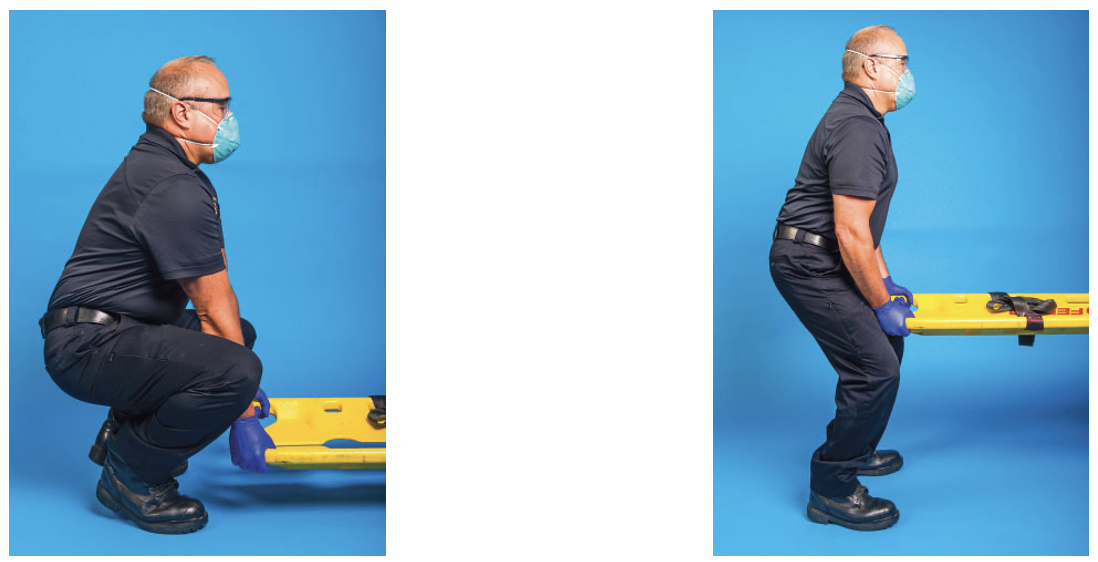
Performing the Power Lift (Skill Drill 8-1)
Lock your back in a slight curve. Spread and bend your legs. Grasp the backboard, palms up and just in front of you. Balance and center the weight between your arms.
Position your feet, straddle the object, and distribute your weight evenly. Lift by straightening your legs, keeping your back locked in.
Performing the Diamond Carry (Skill Drill 8-2)
Position yourselves facing the patient.
The providers at each side turn the head-end hand palm down and release the other hand.
The providers at each side turn toward the foot end. The provider at the foot end turns to face forward.

Performing the One-Handed (Skill Drill 8-3)
Face each other and use both hands.
Lift the backboard to carrying height.
Turn in the direction you will walk, and switch to using one hand.

Using a Stair Chair (Skill Drill 8-4)
Position and secure the patient on the chair with straps. Take your places at the head and foot of the chair.
Lower the chair to roll on landings and for transfer to the stretcher.

Carrying a Patient on Stairs (Skill Drill 8-5)
Strap the patient securely. Make sure one strap is tight across the upper torso, under the arms, and secured to the handles to prevent the patient from sliding.
Carry a patient down stairs with the foot end first, always keeping the head elevated. Unless the patient is completely conscious and cooperative, hands need to be secured for safety and to prevent the patient from grabbing onto the railing of the stairs or the patient's hands from falling off the side of the board.

Loading a Stretcher Into an Ambulance (Skill Drill 8-6)
Lift the stretcher into the load position, and place it into the patient compartment with the wheels on the floor and the safety bar latched on the hook.
The second EMT on the side of the stretcher releases the undercarriage lock and lifts the undercarriage. Some newer powered stretchers lift the undercarriage with the push of a button.
Roll the stretcher into the back of the ambulance.
Secure the stretcher to the clamps mounted in the ambulance.

Performing the Rapid Extrication Technique (Skill Drill 8-7)
The first provider provides in-line manual support of the head and cervical spine.
The second provider gives commands, applies a cervical collar, and performs the primary assessment.
The second provider supports the torso. The third provider frees the patient’s legs from the pedals and moves the legs together, without moving the pelvis or spine.
The second provider and the third provider rotate the patient as a unit in several short, coordinated moves. The first provider (relieved by the fourth provider as needed) supports the patient’s head and neck during rotation (and later steps).
The first (or fourth) provider places the backboard on the seat against the patient’s buttocks. (Use of a backboard may depend on local protocols.)
The third provider moves to an effective position for sliding the patient. The second and the third providers slide the patient along the backboard in coordinated 8- to 12-inch (20- to 30-cm) moves until the patient’s hips rest on the backboard.
The third provider exits the vehicle and moves to the backboard opposite the second provider. They continue to slide the patient until the patient is fully on the backboard.
The first (or fourth) provider continues to stabilize the head and neck while the second provider and the third provider carry the patient away from the vehicle and onto the prepared stretcher.