developmental 17
 Studied by 0 people
 Call Kai
 Learn
Learn Practice Test
 Spaced Repetition
 Match
Match Flashcards
 Knowt Play
1/10

There's no tags or description
Looks like no tags are added yet.
Name | Mastery | Learn | Test | Matching | Spaced |
|---|
No study sessions yet.
11 Terms
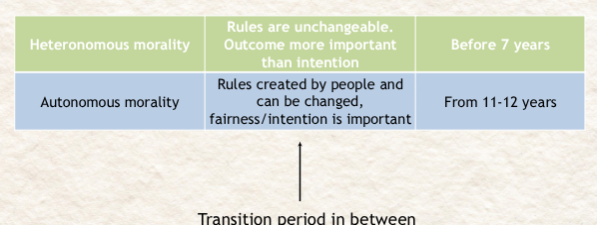
Piaget's theory of moral reasoning
Rigid acceptance of rules to recognition that social context can change morality
Punishment is the important part – the bigger the crime, the bigger the consequence
Rules are made from an authority
Move on from heteronomous to autonomous morality -> stages
Transition period may be in between, but once you have moved on, you don't go back
• Parents use unilateral, coercive rules for young children
• Cognitively, rules as “solid things”
evidence and critiques
Evidence:
• Increasing recognition of complexity with age
• More punitive parents = less mature moral behaviour (Laible et al., 2008)
Critiques:
• More accessible presentation (videos) = higher reasoning (e.g. Grueneich, 1982) -> e.g. trampoline park safety videos
• Young children consider intentionality in subsequent behaviours – adults who deliberately or accidentally hurt another (Vaish et al., 2010)
Kohlberg’s Theory of Moral Reasoning
• Following on from Piaget – a more detailed understanding of the development over time
• Used moral dilemmas to understand decisions and reasoning behind them
• Interviewed (boys) between 10 and 16 years.
• Heinz dilemma – Heinz’s wife is sick, he hasn’t money for a drug to save her. Should he steal it?
• “What should he do?”
• “Would it be wrong to steal?”
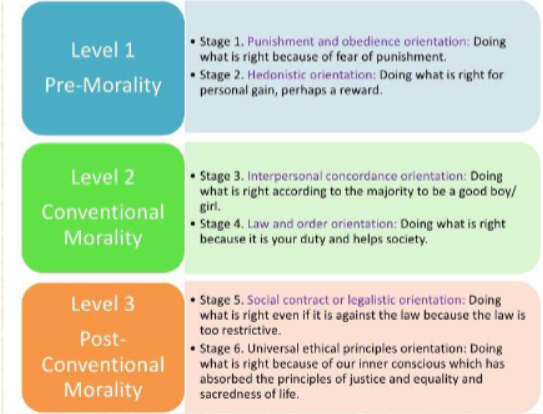
3 levels, 6 stages
stage 6 is very rare that people reason like this
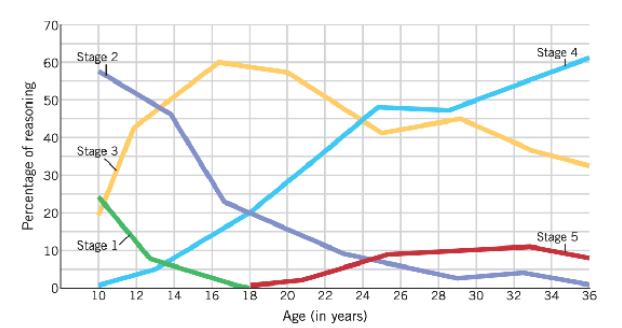
Percentage of reasoning can be a crossover, but still fits in with each of Kohlberg's theory
Individual differences and levels of reasoning
Need to allow for individual differences -> wrong that we're only in one stage at a time
• Not all individuals reach all stages.
• Some indication that higher stages associated with IQ and education
• Discontinuous development and “higher” stages
Cultural differences (Snarey, 1985) Kohlsberg
• Kohlberg claimed universality – research in 5 settings – e.g. US, Taiwan, rural and populated areas
• Adapted dilemmas to be more applicable (x3 versions)
• Additional adaptations (e.g. fishing as work) -> Nigerian samples, Joe's scenario is cultually specific
• Gibbs et al., (2007) 75 countries, same stages seen
Cultural differences in expectations (Kibbutz vs Patriarchal societies) -> if an elder says something you have to do it no matter how you personally feel
-> conflicting evidence
Gender differences - Kohlsberg’s theory
• Biased against females? Authority vs caring (Gilligan et al., 1982)
• No real evidence of different stages, but orientations more about caring for females > justice for males (e.g. Hyde, 2005)
Social domain theory
Moving away from stages
Can be developed in some domains more than others, in different places and different times
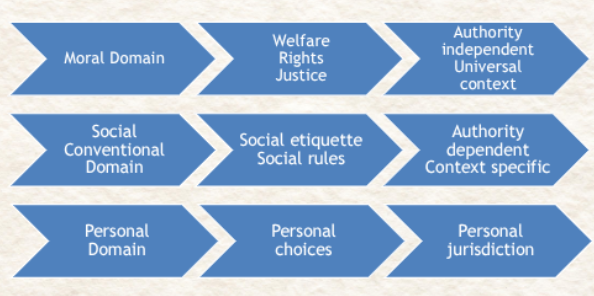
• Even young children (5-years) can distinguish different types of morality and authority:
– Teachers allowing hitting in school (moral domain)
– Teachers choosing clothing in hot weather (societal domain) – (Turiel, 1987)
• Moral domain judgements typically similar across cultures
• Some differences in societal and personal domain choices:
– Indian children – moral obligation to help others,
– US children – personal obligation to help (Miller et al., 1990)
• Blake et al (2016): Parents modelling stingy or generous behaviour
– Comparison of imitation of parents in US and Indian children
– N=163 (US), N=154 (Rural India) parent-child pairs
– Three age groups 3-4years, 2-5 years, 7-8 years
– Splitting sweets for themselves and a stranger
– Parents modelled generous (9:1) or stingy (1:9) behaviour (control situation, no modelling)
– Children then distributed their sweets (in private)
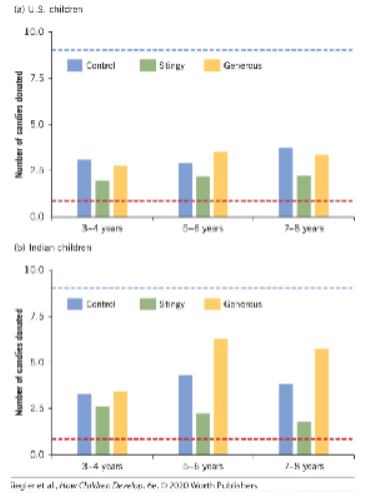
results of Blake et al (2016)
US children were no more generous in the generous condition than control condition, but were influenced in the stingy condition than control condition
Indian children significantly more generous when they saw the parent being generous, still stingy in the stingy condition, compared to the control
More generous in the 5-6 and 7-8 age group than 3-4