Advanced Human Anatomy Exam 1
 Call Kai
 Learn
Learn Practice Test
 Spaced Repetition
 Match
Match Flashcards
 Knowt Play
1/158

There's no tags or description
Looks like no tags are added yet.
Name | Mastery | Learn | Test | Matching | Spaced | Call with Kai | Chat |
|---|
No analytics yet
Send a link to your students to track their progress
159 Terms
Anatomy
Dissect
GREEK
*ana - apart*
*tomy - cut*
LATIN
*dis- apart*
*sectare - cut*
Subdivisons of Anatomy (3)
*cytology* - study of cells
*histology* - study of tissues
*gross anatomy* - study of structure visible to naked eye
organization of the body...
*CELL* - smallest unit of living matter/characteristic building block of all plant and animal tissues (MICROANATOMY)
*TISSUE* - collection of cells of similar structure and function (MICROANATOMY)
*GROSS ANATOMY*
*ORGAN* - consist of one/more tissues blended in such a way as to form a structure which can perform one function or related functions
--> kidney (gross anatomy)
*ORGAN SYSTEMS* - consist of one/more organs that act together in performing a major function of the body
--> R + L kidney, R + L ureters, urinary bladder, urethra = urinary system)
*BODY* - composed of 12 organ systems

Methods of studying human body
Regional or systemic
Regional
*According to the natural subdivisions of the body*
1. Head: facial region, cranium
2. Neck
3. Thorax (chest)
4. Abdomen
5. Pelvis
6. Back
7. Trunk (combo of thorax, abdomen, pelvis and back)
8. Upper limb (extremity): pectoral region, arm, forearm and hand
9. Lower limb (extremity): gluteal region, thigh, leg, and foot
Systemic
*According to the 12 major body systems: collections of organs that perform related fxns*
1. *Articular* (joints)
2. *Cardiovascular or circulatory* (heart and blood vessels)
3. *Digestive* (mouth, esophagus, stomach, and intestines)
4. *Endocrine*(ductless glands)
5. *Reproductive* (reproductive and associated organs)
6. *Integumentary* (skin, subcutaneous tissue)
7. *Lymphatic* (vessels draining lymph, and lymph nodes)
8. *Muscular* (muscles and tendons)
9. *Nervous* (brain, spinal cord, and nerves)
10. *Respiratory* (trachea, bronchi, and lungs)
11. *Skeletal* (bones and cartilage)
12. *Urinary* (kidneys, ureters, bladder, and urethra)
*Articular*
-structures
-function
-joints
-movement of the body
*Cardiovascular or circulatory*
-structures
-function
-heart, blood vessels
-transports nutrients and oxygen to cells
-removes waste molecules that are excreted from the body
*Digestive*
-structures
-function
-mouth, esophagus, stomach, small and large intestine, teeth, tongue, salivary glands, liver, gallbladder, pancreas
-receives food and digests it into nutrient molecules which enter the cells
*Endocrine*
-structures
-function
-hormones, endocrine glands
-secretes chemicals (messengers between body parts)
-maintains proper functioning of reproductive organs
*Reproductive*
-structures
-function
-reproductive organs
-reproduction
*Integumentary*
-structures
-function
-skin, hair, nails, sebaceous glands, sweat glands, subcutaneous tissue
-provides support and protects underlying tissues
-helps regulate body temp
-contains receptors
*Lymphatic*
-structures
-function
-lymphatic vessels, nodes, supporting lymphocytes and the lymphoid organs
-protects body from disease by purifying fluid
-involved wbc that produce antibodies
*Muscular*
-structures
-function
-muscles
-movement of the body
*Nervous*
-structures
-function
-brain, spinal cord, nerves
-conducts nerve impulses to muscles and glands
-receives impulses
*Respiratory*
-structures
-function
-lungs, pharynx, larynx, trachea
-conducts ait
-brings O2 into lungs
-takes CO2 out
*Skeletal*
-structures
-function
-bones of the skeleton
-framework
-movement of body
*Urinary*
-structures
-function
-kidneys, ureters, bladder, urethra
-rids body of nitrogenous wastes
-helps regulate fluid level and chemical content of the body
*anatomical position*
-define
-criteria
*refers to the position of the body must be in when using anatomical planes and terms of reference*
1. Body longitudinal
2. Upper limbs by side
3. Eyes directed forward
4. Palms directed forward
5. Toes directed forward

planes of reference
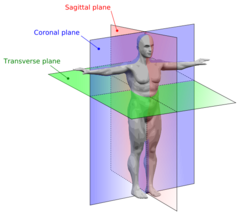
*planes that subdivide the total body or organs* (4)
1. Median: (midsagittal) 1 vertical plane passing through the body dividing in into *equal* right and left
2. Sagittal plane: any vertical plane that parallels the median plane (so it is lateral to the median plane) and divides the body into *unequal* parts (infinity)
3. Frontal (coronal) plane: any vertical plane at a right angle to the median plane that divides the body into *front and back parts* (infinity)
4. Horizontal (Transverse) plane: any plane at a right angle to both the median and frontal plants that divides the body into *upper and lower parts* (infinity)
*terms of reference*
-must be used with
medial/lateral
anterior/posterior
*must be used with the body in anatomical position*
1.
*medial*: nearer to the median
*lateral*: farther away from the median plane
ex: neck lies medial the shoulder
2.
*Anterior* (ventral): nearer the front
*Posterior* (dorsal): nearer the back
ex: umbilicus lies anterior to our back
*terms of reference*
-superior/inferior
-proximal/distal
3.
*Superior* (cephalic): nearer the upper (head) end
*Inferior* (caudal): nearer the lower (tail) end
ex: umbilicus is inferior to the neck
--> cephalic etc used for brain
4.
*Proximal*: nearer the attached end of a limb
*Distal*: farther away from the attached end of a limb
ex: shoulder lies proximal to our elbow
*terms of reference*
-internal/external
-superficial/deep
5.
*Internal*: nearer the center of an organ or cavity
*External*: farther away from the center of an organ or cavity
6.
*Superficial*: nearer the surface of the body
*Deep*: farther away from the surface of the body
-ex: flexor digitorum superficialis (closer) flexor digitorum profundus (further)
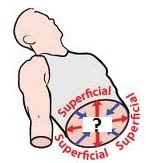
supine vs prone
SUPINE position: lying on back, belly upward
PRONE position: lying on front, back is upward

know how to label the integumentary system
-skin percentage
15% of entire weight

functions of the skin
A. Protection of underlying tissues (barrier to ultraviolet light, bacteria,
radiation, water)
B. A site of sensory nerve receptors (pain, heat, cold, touch, pressure)
C. Regulation of body temperature (erect hairs, sweat)
D. Water excretion (sweat)
E. Formation of vitamin D, which is essential for calcium to be absorbed from the foods we eat
*skin layers*
*epidermis and dermis*
-underneath is subcutaneous tissue
integumentary= e, d, s
skin layers = e, d

skin thickest vs thinest
thickest: back 1/2 cm
thinnest: eyelid 1/2 mm
what is epidermis made of
-vascular?
*outermost layer*
-stratified (layered) squamous (flat) keratinized (waterproof) epithelium
*avascular but does have nerve receptors*
deepest layer of epidermis...
*have cells that undergo mitosis and migrate to the outermost layers*
-become desiccated, convert to keratin, and slough off
(30 days from birth to slough)
(epithelium is constantly regenerating)
deeper layers of epidermis...
*contain melanocytes*
-dark pigment producer, melanin (This pigment is responsible for skin color and protects the individual from the harmful effects of ultraviolet light.)
keratin is _______ on ____ and _____ and form?
keratin is *thick* on the *palms* and *soles* and forms *papillary ridges* that occur in characteristic patterns (fingerprints, toe prints).
*what is dermis composed of*
-percent thickness
-contains
*dense irregular CT that contains b.v and nerves*
-80% thickness of skin
-collagen fibers, sweat glands, hair follicles
*deepest layer of integumentary system*
-location
-composed of
*subcutaneous tissue*
-lies deep to the dermis
-loose connective tissue with an abundance of adipose cells.
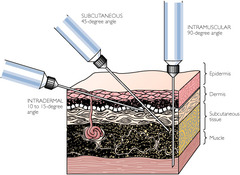
*subcutaneous layer has*
-composed of more _____ in _______
--> fxn
*b.v and cutaneous nerves that course their way to the dermis*
-adipose tissue is more abundant in females than in males --> provides insulation, conserves body heat, and acts as a shock absorber.
*hair follicles*
(Associated structures in integument)
-derived from... go down where
-contain _____ that are formed by
-when a follicle becomes inactive?
-are derived from the epidermis and grow down into the dermis and subcutaneous tissue.
1. They contain hairs that are formed by follicle cells undergoing
mitosis (papilla)
2. when follicle becomes inactive, the hair it produces becomes
lost.

*sebaceous glands* (Associated structures in integument)
-define
-creates...
--> passed how
*oil-producing glands that result from disintegration of some gland cells.*
-creates the oily secretion, sebum
- is passed by a duct into the neck of the hair follicle.
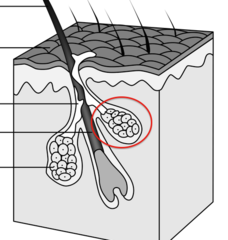
*arrector pilorum muscles* (Associated structures in integument)
-contraction why
*smooth muscles attached to the hair follicle and the epidermal-dermal junction*
-due to cold weather causes the hairs to stand erect and trap a layer of air within the hairs (which acts as an insulator to keep heat inside the body)

*sweat glands*
(Associated structures in integument)
-secretion part where, ducts pass through _____ open to _____
-sweat composition and function
*have their secretion part in the dermis and their ducts passing through the epidermis to open at pores on the skin surface*
1. Sweat is water and sodium chloride (NaCl)
-it cools the body as it evaporates.
*Nails* (Associated structures in integument)
-function
protective structures of hard keratin located at the tips of
fingers and toes
*skeletal system definition*
-composed of
*forms solid framework around which the body is built*
-composed of bones and cartilaginous structures
functions of skeleton
1. *SUPPORT* of the body
2. *ATTACHMENT* for skeletal muscles (non-moveable, insertion-moveable)
3. *PROTECTIONS* of certain vital organs (brain by skull and heart by thoracic cage)
4. *MANUFACTURE* of certain blood cells (hemopoiesis, bone marrow)
5. *STORAGE* of chemical substances
-calcium and phosphate
types of bones
*LONG bones* - a bone in which the length exceeds the width
-have medullary (marrow) canal (ex: humerus)
*SHORT bones* - length equals the width (carpals)
*FLAT bones* - expanded into one plane (scapula)
*IRREGULAR bones* - does not fit into any other category (vertebrae)
Divisions of skeleton
-axial
*axial: part of the skeleton that occupies the central axis of the body (80 bones total)*
1. skull and hyoid - 23 bones
2. vertebral column (26 bones total = 7 cervical, 12 thoracic, 5 lumbar, sacrum, coccyx)
3. ribs and sternum (12 pairs of ribs + sternum = 25 bones)
4. bones of middle ear (6 bones)
Divisions of skeleton
-appendicular (UPPER)
*is the part of the skeleton that comprises the appendages (126 bones total)*
*Bones of the upper limb (64 bones)*
1. Clavicle (collar bone)
2. Scapula (shoulder blade)
3. Humerus (arm)
4. Ulna and radius (forearm)
5. 8 carpal bones (wrist)
6. 5 metacarpal bones (palm)
7. 14 phalanges (fingers)

Divisions of skeleton
-appendicular (LOWER)
Bones of the lower limb *(62 bones)*
1. Hip bone
2. Femur (thigh)
3. Patella
4. Tibia and fibula (leg)
5. 7 tarsal bones (ankle)
6. 5 metatarsal bones (foot)
7. 14 phalanges (toes)

*total bones in body*
-special bones
*206*
*sesamoid bones* located in tendon (patella)
*ectopic bone* pathological bone formation
Epiphysis (long bone)
Diaphysis (long bone)
-The two ends of a long bone.
-These are wider than the
shaft and take part in the formation of a joint.
-The shaft of a long bone.

*LONG BONE*
*compact bone*
-characteristics
-forms?
-found?
*spongy bone*
-characteristics
-found where
-Bone laid down in concentric layers, making it appear solid.
-This type of bone forms the outer surface of all bones
-found in the diaphysis.
-Thin plates of bone that meet other plates of bone at various angles, leaving spaces between them.
-found in the epiphysis, and metaphysis.

LONG BONE
periosteum
--> define
--> layers (function)
*Connective tissue sheath composed of two layers*
1. Outer layer: tough fibrous layer
-serves as a place of insertion for muscle tendons
2. Inner layer: delicate cellular layer producing growth in the diameter of the bone
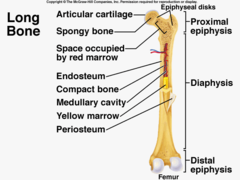
LONG BONE
endosteum
-define/found where
-function
*Thin, cellular layer found lining the medullary cavity and the cavities of spongy bone*
-destroys bone
--> allowing for growth in the diameter of the marrow cavity, which prevents bone from becoming too solid and heavy as it increases in size.

LONG BONE
medullary cavity
*Cavity running the length of the diaphysis that contains*
-red marrow (that actively forms blood
cells)
-yellow marrow (where fat cells are stored)
-or combinations of both.

LONG BONE
articular cartilage
-define
-function
*Thin layer of hyaline cartilage covering the articular surface of each epiphysis*
-The resiliency of this material cushions the joint during movement.

LONG BONE
articular capsule
-function
-layers
*Capsule connecting the two bones and completely encircling the joint*
-thus enclosing a joint cavity or synovial cavity.
-The capsule itself is composed of two layers:
1. OUTER LAYER: fibrous continuous layer with the periosteum of bone
2. INNER LAYER: The *synovial membrane*, which lines the inside of the fibrous layer
-quite vascular.
-produces synovial fluid that fills the cavity to lubricate the joint and nourish the articular cartilage.
LONG BONE
epiphyseal disc
-found in who
-where
-function
*in embryo or growing child*
-a cartilaginous plate located at the junction of the epiphysis and diaphysis
-allows for growth in the length of bone. *****This disc is not present when growth is complete.
LONG BONE
metaphysis
-located where
*Spongy bone tissue located at the junction of the diaphysis and the epiphyseal disc*
-In the adult, the bony tissue of the metaphysis is continuous with the epiphysis.
Cartilage (bone and skeleton)
-definition
-tough connective tissue composed of cells embedded in a firm gel-like intercellular substance
-it is not as hard as bone
-exhibits some degree of flexibility.
cartilage characteristics
-called gristle by the laymen
-lacks nerves
-lacks b.v: nutrients diffuse through the intracelllular substance
-entire embryo skeleton is initially cartilage, but it is replaced
by bone during growth (ossification).
classification of cartilage due to
*histological appearance of the intercellular matrix*
-hyaline
-fibrocartilage
-elastic cartilage
Hyaline cartilage - name origin
-examples
*named because it has a glassy, translucent appearance*
Examples include the following:
i. Embryo
ii. Epiphyseal discs (growth in length)
iii. Articular cartilages
iv. Costal cartilages (between ribs and sternum)
v. Larynx, trachea, and bronchi (respiratory system)
vi. Nasal cartilages

Fibrocartilage - examples
i. Interpubic disc (pubic symphysis)
ii. Intervertebral discs (between adjacent vertebrae)
Elastic cartilage - examples
i. Auricle (part of external ear)
ii. Auditory tube (connects ear and pharynx)
iii. Epiglottis (lap that keeps food from entering lungs)
muscular system is composed of...
-is concered with
all muscles of the body
is concerned with movements of the total body, as well as movements within the body.
contractility vs extensibility vs elasticity
*Contractility*
-is the ability of muscle tissue to shorten or contract.
*Extensibility*
-is the ability of muscle tissue to be extended or
stretched within limits.
*Elasticity*
-is the ability of muscle tissue to return to its original state after being stretched.
irritability vs tonus
*Irritability*
- is the susceptibility of muscle tissue to react to external
stimuli.
*Tonus*
-a muscle is partially contracted, allowing it to react instantly when stimulated.
classification of muscle based on nervous control
-classify and example
*Involuntary muscle*
-is not subject to the control of the will.
ex: Cardiac and smooth muscle are of this type.
*Voluntary muscle*
-is subject to the control of the will.
ex: Skeletal muscle is of this type.
*smooth muscle*
-consists of
-nucleus number
-striations?
-long spindles thick in the center and pointed at the ends.
-one nucleus per cell.
-no striations.
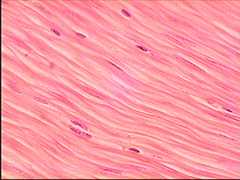
*smooth muscle found _________ and* _________
*walls of the internal organs and vessels*
1. When circularly arranged around an organ or vessel, the resulting contraction obliterates the cavity or lumen of the organ.
*cardiac muscle*
-striated?
-nucleus count
-location
-striated
-one nucleus
-located in heart
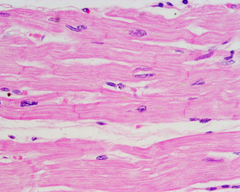
*skeletal muscle*
-composed of
-nucleus number
-Skeletal muscle is composed of long cells (up to 4 cm in length).
-more than one nucleus is needed to carry out cellular functions (because these cells are long) = the cells are multinucleated.

*skeletal muscle*
-attached to
-function
-striations?
-attached to the skeleton (and other structures)
- allows movement of skeletal elements when they contract.
-they have highly visible striations.
fascia
*connective tissue layer that surrounds muscles and adjacent muscles*
-It is just external to the epimysium (outer portion of muscle) and is often fused with it.
fascia functions
1. Fascia permits gliding of one muscle over another.
2. It provides pathways for passage of vessels and nerves.
3. Fascia has a rich blood and nerve supply.
nomenclature of muscles
Muscles have seven criteria for classiication: Dana Found Shells Laying Near Sleeping Penguins
1. Direction of fibers (e.g., rectus abdominis)
2. Function (e.g., lexor digitorum profundus)
3. Shape (e.g., rhomboid major)
4. Location (e.g., tibialis anterior)
5. Number of heads of origin (e.g., biceps brachii)
6. Size of the muscle (e.g., gluteus maximus, gluteus medius,
and gluteus minimus)
7. Points of attachment (e.g., sternocleidomastoid)
characteristics of individual muscles
1. *Origin*—Nonmovable point of attachment
2. *Insertion*—Movable point of attachment
3. *Action*—Movement a particular muscle produces
4. *Innervation*—Nerve supply to a muscle
muscle attachment types
1. Bone
2. Cartilage
3. Skin
4. Fascia
5. Ligaments (attaching bone to bone)
6. Tendons (attaching muscle to bone)
7. Aponeurosis (flattened tendon)
*vertebral column defintion*
-functions
*located in the posterior portion of the trunk*
A. Posture
B. Support of weight
C. Protection for the spinal cord and spinal nerves
D. Partial protection for thoracic and abdominal organs
3 types of bones in the back (vertebral column)
*1. Moveable presacral vertebrae* (24 bones)
-cervical (7 bones)
-thoracic (12 bones)
-lumbar (5 bones)
--> intervertebral discs: fibrocartilaginous structures found between the bodies of adjacent vertebrae.
*2. Sacrum* (5 fused vertebrae)
*3. Coccyx* (4 fused vertebrae)

total number of bones *before fusion* of sacrum and coccyx in vertebrae
*after fusion*
33
26 (24 pre-sacral vertebrae, 1 sacrum, 1 coccyx)
*curvatures of the vertebral column*
-in fetus
--> name/why
one curvature, concave anteriorly (convex posteriorly) = PRIMARY CURVATURE 1°
---> curvature is a result of differences in the height between the anterior and the posterior aspects of the *vertebral bodies*.
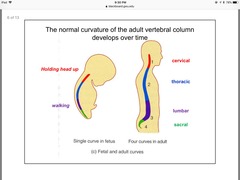
*curvatures of the vertebral column*
-in adults
--> which are primary or secondary and why
*four curvatures*
1. cervical (2˚)
2. thoracic (1˚)
3. lumbar (2˚)
4., sacral (1˚)
---> secondary curvature is concave posteriorly due to differences
plate in the heights between the anterior and the posterior aspects of *intervertebral discs* (seen in cervical and lumbar vertebrae)

*typical vertebrae* (see excel spreadsheet) LABEL
-body
-vertebral arch (and more)
*body* large round mass of vertebra; forms anterior aspect of the vertebra
*vertebral arch* (posterior to the body)
-formed by 2 pedicles and 2 laminae
1. *Pedicle* is a bridge of bone extending from the posterior aspect of the body
2. *Lamina* flat plate of bone extending from the pedicle; 2 laminae fuse together in the median plane
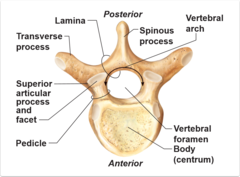
*typical vertebrae* (see excel spreadsheet) LABEL
-vertebral foramen (boundaries)
-vertebral canal
*vertebral foramen*
-hole in the center of the vertebra that houses the spinal cord.
-Boundaries of the vertebral foramen
a. Anterior: body
b. Posterior: laminae
c. Lateral: pedicles
*vertebral canal*
- is formed by the individual vertebral foramina when the 24 presacral vertebrae are articulated.

typical vertebrae
-processes that come off the arch 1 of 2
spinous processes -single process that projects posteriorly from each vertebral arch at the junction of the two laminae.
Transverse processes -two processes that project laterally from the junction of a lamina and a pedicle.
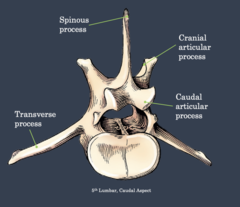
typical vertebrae
-processes that come off the arch 2 of 2
Superior articular processes - two processes that project
superiorly to articulate with the inferior articular process of the suprajacent vertebra.
Inferior articular processes - two processes that project inferiorly to articulate with the superior articular process of the infrajacent vertebra.
-Lying between the superior and inferior articular processes is the zygapophyseal or "facet" joint.
typical vertebrae
-vertebral notches
--> found
--> form
found on the superior and inferior surface of the pedicle.
-When two vertebrae articulate, the notches form a foramen called the intervertebral foramen, which transmits the spinal nerve.

*typical cervical vertebrae* SEE SPREADSHEET/DIAGRAMS
*transverse foramen*
-is found in the transverse process of all cervical vertebrae.
-The *vertebral artery* ascends through this foramen from *CV6-CV1*
*bifid spinous process*
- divides into two smaller projections.
-found on cervical vertebrae *CV2-CV6*
*bifid transverse processes*
-divided into two projections
1. anterior
2. posterior tubercles
-found on cervical vertebrae *CV3-CV6*
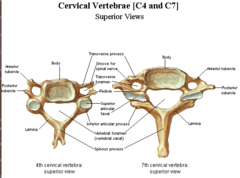
*specialized cervical vertebrae* SEE SPREADSHEET/DIAGRAMS
-CV1 (atlas)
GREEK atalo = endure or sustain, to bear, carry
NO body; (it is replaced by the dens of CV2).
NO laminae or spinous processes. (They are replaced by an arch of bone, the posterior arch)
-superior articular processes are concave for articulation with the occipital condyles.

*specialized cervical vertebrae* SEE SPREADSHEET/DIAGRAMS
-CV2 (axis)
(Latin axis = an axle or pivot)
-prominent *superior projection*, the *dens process* or *odontoid process* , extends to the atlas.
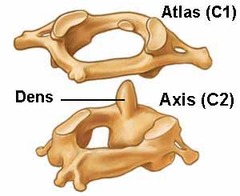
*specialized cervical vertebrae* SEE SPREADSHEET/DIAGRAMS
-CV7 (second name?)
*VERTEBRA PROMINENS longest and most prominent spinous process of all the cervical vertebrae, AND it does not bifurcate*
-important in counting vertebrae.
-*vertebral vein* is the only vessel coursing through its transverse foramen.

thoracic vertebrae SEE SPREADSHEET/DIAGRAMS
transverse costal facets on the transverse processes for articulation with the ribs (12 thoracic vertebrae, 12 pairs of ribs).
-NO foramina in the transverse processes.

thoracic vertebrae SEE SPREADSHEET/DIAGRAMS
-articulations with ribs
Costovertebral joint— head of the rib articulates with the
body of the vertebra.
Costotransverse joint— tubercle of the rib articulates
with the transverse process of the vertebra.

*lumbar vertebrae* SEE SPREADSHEET/DIAGRAMS
-NO foramina in transverse processes
-NO facets on transverse processes
-largest in size

*lumbar vertebrae* SEE SPREADSHEET/DIAGRAMS
-why is it largest in size
-shape
-presacral vertebrae increase in size going superior to inferior.
-because each successive vertebra must support all structures superior to it.
-After the weight has been transmitted to the pelvis and the lower limbs in the lumbosacral region, the vertebrae inferior to this region do not support the body weight.
-sacrum and coccygeal vertebrae decrease in size moving inferiorly.
-spinous processes are quadrangular

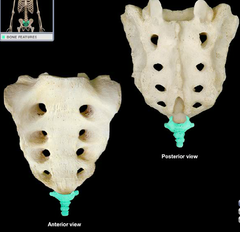
*sacrum vertebrae* SEE SPREADSHEET/DIAGRAMS
-vertebrae #
-articulations
*The sacrum consists of five fused vertebrae*
*Articulations*
1. *Superior*—the intervertebral disc inferior to LV5 articulates with the *sacral promontory*
2. Lateral—*ala* of the sacrum that articulates with the ilium of the hip bone
--> Auricular Surface—a smooth surface on the lateral portion of the ala. It forms the sacro-iliac (SI) joint with the ilium.
3. *Inferior*—coccyx

sacrum vertebrae SEE SPREADSHEET/DIAGRAMS
-surfaces
PELVIC SURFACE
-Pelvic sacral foramina —four pairs of openings for the ventral rami of S1 to S4.
DORSAL SURFACE
-Median sacral crest —a ridge that is remnant of the spinous processes of the superior 3 to 4 sacral vertebrae.
- Dorsal sacral foramina—four pairs of foramina for the dorsal rami of S1 to S4.
- Sacral hiatus—an opening due to the absence of laminae on the 5th sacral segment.
*coccyx vertebrae* SEE SPREADSHEET/DIAGRAMS
4 fused vertebrae
bones involved in back muscle attachment
Oscar Ventures South of Here to Clean Sticky Honey
1. Occipital bone of the skull
2. Vertebrae (cervical, thoracic, lumbar)
3. Sacrum
4. Hip bone (Iliac crest)
5. Clavicle
6. Scapula
7. Humerus (intertubercular groove is found between the greater tubercle and the lesser tubercle)
*bones involved in back muscle attachment*
-vertebrae
*Vertebrae (cervical, thoracic, lumbar)*
1. spine or spinous process is a single posterior projection from the junction of the two laminae.
2. transverse process is a lateral projection from the junction of a pedicle and a lamina. It is paired.
*bones involved in back muscle attachment*
-scapula
SCAPULA
*1. acromion* is the ledge that overlies the shoulder joint.
*2. scapular spine* is a prominent ridge continuous laterally
with the acromion. Its posterior surface is its crest, the edges of which are the upper lip and the lower lip.
*3. medial border* parallels the vertebral column.
