Speech and Hearing Sci - Chapter TWO Motion
 Call Kai
 Learn
Learn Practice Test
 Spaced Repetition
 Match
Match Flashcards
 Knowt Play
1/54

Earn XP
Description and Tags
Describing and Explaining Motion
Name | Mastery | Learn | Test | Matching | Spaced | Call with Kai | Chat |
|---|
No analytics yet
Send a link to your students to track their progress
55 Terms
Speeh is movement made…
audible
speech requires what systems?
neural, respiratory, phonatory, resonatory, atrticulatory, auditiory systems
sound wave is a disturbance that…
propagates energy via a medium.
ex: in water will be different than in air
velocity
speed (distance travelled in a a given unit of time
acceleration
rate of change of velocity
how speech production include velocity
velocity of mandibular closure
velocity of apical tongue movement
..think of tone, cadence
laws of motion (first)
object in motion stays in motion unless acted upon by an external force
this tendency to resist chance in a state of motion is inertia.
law of motion (second)
acceleration of an object occurs in the same direction as the net force and is inversely porportional to the mass of the object
F=M * A
in terms of speech:
movement of the tongue for trill /r/
heavy tongue vs lighter tongue
law of motion (third)
with every action there is an equal and opposite reaction
in terms of speech:
opening/closing of VF
EX: VF '“snapping back” after subglottal pressure
momentum
quantity of motion measure as a product of mass and velocity
force of subglottall pressure is higher initally because the momentum carries out the vibration once the minimum is reached.
energy is
ability to do work
displacement caused by the application of force
potential vs kinetic energy
in terms of speech the effort require to move an articulator. energy transfer is ESSENTIAL. total energy does not change unless there is friction.
person 20 ft away from you has a lot of friction. energy is lost=sound is less.
states of matter in terms of speech
air molecules can change speech perception.
normal air, vs sauna vs underwater. EFFECTS VELOCITY OF SOUND
air molecules in vocal tract collide against each other EFFECTS DENSITY
air/pressure in terms of speech
air molecu exert force on the walls of the vocal tract
pressure- force per unit area. air pressure in different locations are almost equal. **think subglottal presssure, atomspheric pressure, etc
stifness
degree to which an object resists being deformed
elasticity
ability of an object to return to its resting shape once forces are removed
what is sound
pressure wave
regions of high and low pressure. audible to human ear
speech is composed of sound waves. sound waves are vibrations of particles
total energy remains the same under what conditions
no friction!!
in reality - frictional forces are always present. energy will be reduced every successive cycle of vibration or oscillation
EXCEPTION:
presence of external forces that continues to provide energy
mechanical waves(aka sound) require a ___
medium.
remember! characteristics of medium affect the speed of propagation.
what would be a single disturbance
pulse, pulse wave
what is a transverse wave
up and down; perpendicular
Think of a stadium wave
what is a longitudinal wave
direction of movement of particles in the medium is PARALLEL to the direction of the wave
this is how sound waves travel
think of a wave pool, left to right
high pressure in a wave are
COMPRESSIONS - regions of increased density and air pressure
low pressure in a wave
RAREFACTIONS - regions of decreased density and air pressure a
a sinusoidal wave or sine wave is a
series of simple oscillations/vibrations W/O friction
what are waveform axises
x axis = time
y axis = amplitude (pressure) remember high/low
four terms describing a wave
frequency/phase - # of cycles of vibration PER SECOND
period - time between successive points of low or high pressure T= 1/f
wavelength - distance traveled by one cycle of vibration. wavelen = c/f. c is velocity f is freq.
intensity - amount of energy transferred from one particle to next. intensity = power/ area. this depends on the amplitude of displacement of particles
IN PHASE
Beginning matches the end.
amplitude reduce with…
distancee from the source of sound
*sound intentisy is relative measure i
intenstiy is propotional to
AREA
speech intensity is measured in —-. why?
dB SPL.
range of hearing is too large to use traditional measure of WAtts per meter sq.
unit of loudness
phon
loudness doubles per 10 phons
intensitys physiological correlates to
loudness
human ear notices chnages better at
lower frequencies
freq psychological sorrelate to
pitch
a 10 hz pure tone implies that there are __ vibration cycles per 10 seconds.
100!
10 hz × 10 seconds = 100
amplitude increases as the sq of the intensity. t/f
FALSE
pure tone
result of vibration at single freq
simple harmonicc
complex tone
result of vibrations at two or more frequencies
the 2 lower waves combine to make the top wave. lowest f is f0.
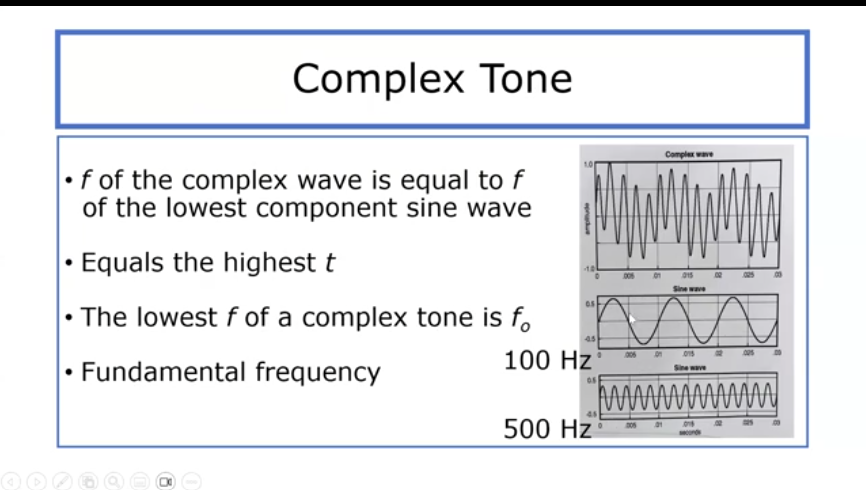
if there is a mathematical relationship IN A COMPLEX WAVE between each period between (for an example) 100hz 200 hz 300hz etc then…..
its not just a complex wave it is a complex periodic wave
2 spectrums
a spectrum is a representation of frequency on the x axis and amplitude on the y axis.
line spectrum - bar graph that represents the nergy at one point in time
continuous spectrum - no pattern, aperiodic. tbh a mess
aperiodic sound
no periodicity
no arithmetic relationship
most natural sound
SPEECH
a continuous [power spectrum is best used to represent ___.
NOISE
Constructive vs Destructive Interference
con- superimposed, same freq but higher amplicity.
des- OUT OF PHASE. combined= no movement.
in/out phase is crucial
complex interference
amplitude is compounded on AND negated.
how do sound waves change behvaiors
boundaries - from water to air
reflection- echo? incident wave
diffraction - sound wave bends arond obstacle
transmission - sound wave go thru boundary
speech is primarily reflection and transmissionre
resonance
phenomenon that explains the ease with objects are set into vibration.
standing waves - a type of interfernece by the ___ and __ wave. this causes
incident and reflective wave
this causes resonant patterns
**think of whiping a string up and down.
standing waves have
nodes and anti nodes
points of no movement = nodes!!!!!
max movement = antinodes
**complex tones have multiple standing waves
what does a forced vibration do to a wave (in temrs of resonance)
one medium vibrates away from the natural resonant frequency this leads to reduced displacement/amplitude. t
this behavior of sound waves is responsible for standing waves
reflection
when the amplitude of a sound wave doubles the intensity is halved. T/F
False.
Amplitude doubles = intensity doubles.
wavelength equation
wavelength = velocity of sound / frequency of sound
wavelength is what distance
distance travelled of one cycle of vibration
wavelength increases, frequency ____
decreases
when you superimpose a wavelength with same '“start” does the frequency double or stay the same
stays the same .
amplitude increases