5b - perception of action, imitation
 Call Kai
 Learn
Learn Practice Test
 Spaced Repetition
 Match
Match Flashcards
 Knowt Play
1/32

There's no tags or description
Looks like no tags are added yet.
Name | Mastery | Learn | Test | Matching | Spaced | Call with Kai | Chat |
|---|
No analytics yet
Send a link to your students to track their progress
33 Terms
what is a unique human ability
we are really good at imitating other peoples’ actions - this is called perception-action mapping
we map visual respresentations onto our motor systems (crossmodal transfer)
crossmodal transfer
visual representations being mapped onto our motor systems
what is evidence for perception-action mapping
infants can imitate caregiver’s facial expressions, hand and mouth movements etc.
meltzoff and moore found this was present in babies as young as 12 days old (tongue protrusion) whilst piaget thought it occurred no earlier than 1 year
what evidence is there against neonate imitation
more rigorous study challenges previous evidence Oostenbroek - found true imitation may emerge at 6-9 months
what is Active Intermodal Matching (AIM)
neonates recognise equivalences between body transformations they see and those of their own body that they ‘feel’ themselves make
babys emotional expressions induce adults to produce similar expressions, which provides the infant with a visual input to match their motor output
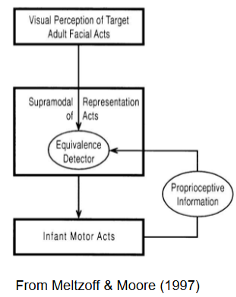
how does AIM compare to other models
AIM involves:
a perception and action having independent coding/representation
a ‘specialist’ module for imitation
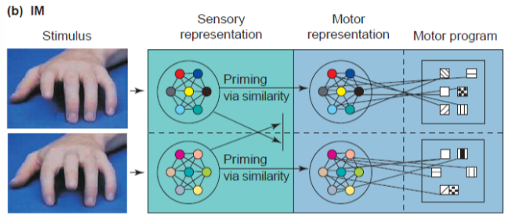
other theories (IM and ASL) suggest:
common coding for perception and action
imitation part of generalist processes for motor control and learning
outline Ideomotor (IM) theory
Associative Sequence Learning (ASL) - emphasises learning through experience e.g. see consequence of own hand action
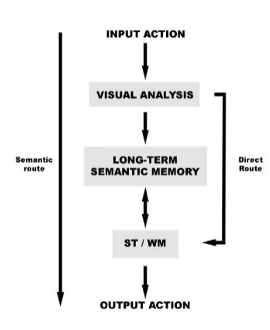
what is the dual route of imitation
incorporates aspects of the other models
SEMANTIC: meaningful actions stored in repetoire
VISUOMOTOR/DIRECT: meaningless actions/mirror neurons
what are mirror neurons
same neurones found to be active when the monkey performed and watched an action
when did Umlita et al find regarding mirror neurons
mirror neurons active during observation of even partially hidden actions
predicts action outcome even in absence of complete visual information
no response in the absence of an object
what did Kohler et al. (2002) find regarding audio-visual mirror neurons
responded to the sound typically produced by the action → BUT for sound only, there is less MN action beforehand as they can’t predict the action
where are mirror neurones in monkeys and humans
in monkeys: f5 area of premotor coretex and inferior parietal lobe
in humans: broca’s area BA44, ventral inferior frontal gyrus (BA6), posterior parietal lobe and superior temporal lobe
somatotopically (according to body part) organised
what actions do mirror neurons react to
goal-directed
what indirect and direct evidence is there for human mirror neurones
indirect: close link between perception and action, behavioural, brain imaging fMRI, transcranial magnetic stimulation (TMS)
direct: recoding from neurones
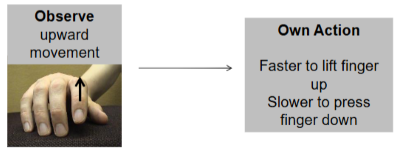
what behavioural evidence is there for MNs
faster responses when compatibiity between observed and executed movements
known as ‘automatic imitation’
what did Buccino et al find regarding somatotopic activation
activation of pre-motor and parietal cortex - corresponded to observations of actions of different body parts
what did Harwick et al find about perception-action overlap
motor imagery imagined movement without actionn
overlap in brain activity in imagined, obsreved and excecuted movements (meta-analysis)
how is the Human MNs affected by tms
used motor evoked potentials to show that observing an action produced increased motor excitability
outline mukamels study
recorded 1177 neurons in 21 epilepsy patients undergoing surgery for epilepsy
observed and excecuted grasping actions and facial gestures
action observation related ‘mirror’ neurons found in medial frontal lobe (supplementary motor area (SMA) and medial temporal lobe (hippocampus)
also found that some respond with inhibition during observation
what are other purposes for mirror neurons aside from movement
evolution of language
empathy and social cognition (broken mirror theories of autism and schizophrenia)
what is intersubjectivity
imitation, empathy, intention (mind-reading) - allow us to predict the behaviours of others
Gallese - ‘like me’ embodied simuation analogy between self and others which forms the basis of social congition
based on the process of crossmodal transfer and the mirror matching system
outline empathy
relates not only to how you are feeling ‘emotionally’ but also ‘sensorily’ → when you see someone hurt themselves you will move to that part of your own body as if you were hurt too
where is the overlap for seen and felt pain
direct mapping of viewing pain in others and feeling pain in yourself in the cingulate cortex (BA24b)
how was motor empathy measured
4 videos; hand/sponge touched by needle/cotton bud → pps alternated pressing and releasing after each video
pps were faster to press responses than release responses except when people viewed the needle touching hand
what are limitations of primate data
small number of examples
often qualitative rather than quantitative
need more studies to distinguish how well cells can distinguish pairs of movement
need evidence of MNs firing in spontanous social interaction
what are limitations with human data in MNs
many areas outside MN areas activated during action observation → TMS effects could be produced by areas outside MN
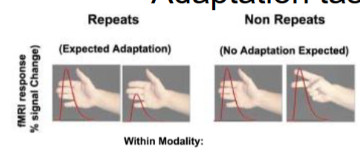
outline adaptation tasks in MN research
adaptation can be used to see if the same area is involved in different tasks → overlap in areas adapting for observed and executed (e.g. anterior inferior frontal sulcus, ventral premotor and posterior lobe.
no evidence found for adaptation across modalities
evaluate the existence of MNs
Hickok: motor theories arent new, over-emphasis on ‘action-understanding function’
sound experiement could be an association
hidden actions could just represent working memory
there isnt a measurement of understanding
what other areas could be responsible for action understanding
STS superior temporal sulcus may be more crucial for action understanding (dot people)
F5 also responds to objects
what are human-monkey differences in MN
higher cognitive function attributed to MNs are not seen in monkeys
assumed that MN in humans has developed to include action understanding and imitation
cant assume that conclusions from monkey MNs apply in humans
how does human action understanding dissociate from MN areas
human, monkey and dog actions:
same areas activated for movements common in all species e.g. biting
speech and lip-smacking activates same area but not dog barking
but surely humans understood dog bark
how did expert actions represent in MNs
Ballet dancers v Capoeira - greater activation for experts
there was greater activation in the ventral and dorsal pre-motor areas, inferior parietal sulcus, posterior STS
actions only done by male ballet dancers was less prominently mirrored in female brain
can we understand intention without action
yes → heider-simmel, bully triangles
we can also understand more than one agent - cannot simulate both actions