3.1 Display Components & Attributes
 Call Kai
 Learn
Learn Practice Test
 Spaced Repetition
 Match
Match Flashcards
 Knowt Play
1/19

There's no tags or description
Looks like no tags are added yet.
Name | Mastery | Learn | Test | Matching | Spaced | Call with Kai | Chat |
|---|
No analytics yet
Send a link to your students to track their progress
20 Terms
What are the two primary types of mobile display units?
Liquid crystal display: Light shines through liquid crystals
Organic light-emitting diode:
How does LCD work?
Uses a current passed though a semi-cystalline liquid sandwiched between two glass plates to produce images. Crystals do not produce light and require a backlight to display the image. Most common backlight is LED
LCD Advantages
Lightweight, lower power, inexpensive
LCD Disadvantages
Poor black levels, requires a separate backlight (florescent, LED) which can be difficult to replace
What are the three popular variants of LCD technology?
In Plane Switching (IPS LCD), Twisted Nematic (TN LCD), Vertical Alignment (VA LCD)
All use liquid crystals and transistors to form patterns in different ways
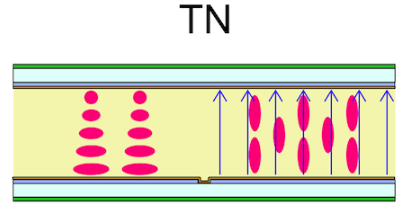
TN LCD (Twisted Nematic)
Crystals rotate 90 degrees when voltage applied, the original LCD technology
Pro: Fast response times and inexpensive (good for gaming, office use)
Con: Poor viewing angles causes color shift
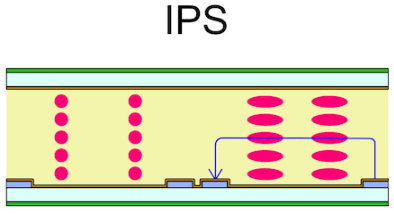
IPS LCD (In Plane Switching)
Crystals turn parallel when voltage is applied, letting light pass though
Pro: Widest viewing angle and best color representation (vertical mounting, graphic/video artists)
Con: More expensive than TN LCD
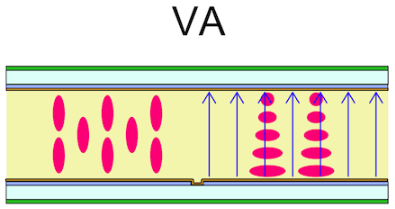
VA LCD (Vertical Alignment)
Crystals turn vertical when voltage applied, Good compromise between TN and IPS
Pro: Good color representation, best contrast ratio
Con: Slower response time than TN
OLED
Organic compound is an image producing component and light source in one panel, emits light when receiving an electric current. Popular in smaller devices and high end devices. (Any device labelled as LED will be LCD, not OLED)
Pros: No backlight so truer blacks and contrast ratio, lower power consumption that LCDs, thinner and lighter, flexible for curved displays
Cons: Expensive
Mini-LED
Backlight technology used with LCD displays to create higher precision in light control by using a high density of very small led lights. Increased contrast, brightness, color accuracy, and better blacks than traditional LEDs
Touch Screen/Digitizer
Takes analog input in the form of touch, with finger/stylus, and converts it to digital. Can be built into display or as an overlay for the display screen
Inverter
A small circuit board behind an LCD panel that turns DC into AC used by florescent backlight
What is wrong if your screen is flickering?
Common problem with inverter malfunction for florescent backlights
What if screen is dim but you can make out image when shine light on it?
May be problem with backlight
Pixel Density
The number of pixels contained in a display unit, pixels per inch (PPI) and dots per inch (DPI). High pixel density, sharper image.
How to calculate pixel density
The number of diagonal in pixels divided by the diagonal size of the screen
Refresh Rates
The number of times a screen is updated per second, which higher rates creating smoother image transitions for rapidly moving content. Measured in Hz (# of refreshes/second, cycles/second, frames/second FPS). Common is 60 Hz, gaming has rates up to 240 Hz (movies 24, tv 30)
What is the maximum refresh rate determined by?
Maximum refresh rate is determined by the video adapter/processor and the display device, as well as the connection between them. HMDI and DP support 4K at 144 Hz
Screen resolution
The number of pixels that can be contained in a display horizontally and vertically (width x height), 16:9 ratio common. More pixels means sharper display output. Common screen resolutions include 1080p (HD), 1920 x 1080; 1440p, which is 2560 x 1440; and 4K, 3840 x 2160.
Color Gamut
The color range a display is able to produce, affects color representation. Compared to existing color standards for the display, give a gamut compatibility percentage. Common standards are sRGB (standard RGB), Adobe RGB, and DCI-P3. Higher percentage tend to be more expensive, OLED provide widest color gamut.