lab 1 - anatomical terminology & tissues
 Call Kai
 Learn
Learn Practice Test
 Spaced Repetition
 Match
Match Flashcards
 Knowt Play
1/97

Earn XP
Description and Tags
the anatomical positions, directions & regions + tissues (for post-lab quiz #1)
Name | Mastery | Learn | Test | Matching | Spaced | Call with Kai | Chat |
|---|
No analytics yet
Send a link to your students to track their progress
98 Terms
deep
away from the body surface; more internal to another structure
[EX] the heart is deep to the rib cage
dorsal
toward or at the backside of the body; behind
[EX] the spinal cord is on the dorsal side of the body
distal
farther from the origin of a body part of the point of attachment of a limb to the body trunk
[EX] the wrist is distal to the elbow
inferior
away from the head end or toward the lower part of a structure or body
[EX] the stomach is inferior to the heart
lateral
away from the midline of the body; on the outer side
[EX] the arms are lateral to the heart
medial
toward or at the midline of the body; on the inner side
[EX] the lungs are medial to the shoulders
proximal
close to the origin of the body part or the point of attachment of a limb to the body trunk
[EX] the elbow is proximal to the hand
superficial
closer to the outside; external to another structure
the skin is superficial to the biceps brachii muscle
superior
toward the head end of upper part of the structure or body; above
[EX] the chest is superior to the pelvis
ventral
toward the belly side of the human body or at the front of the body
[EX] the umbilicus (belly button) is on the ventral side of the body
the epigastric region is ______ (direction) to the stomach, where the hypogastric region is _____ (direction) to the stomach
superior, inferior
anterior
in front of; toward the front surface
[EX] the stomach is anterior to the spinal cord
posterior
in back of; toward the back surface
[EX] the heart is posterior to the sternum
cranial (cephalic)
toward the head end
[EX] the shoulders are cranial to the feet
caudal
toward the rear end
[EX] the buttocks are caudal to the head
rostral
toward the nose or mouth
[EX] the frontal lobe of the brain is rostral to the back of the head
ipsilateral
on the same side
[EX] the right arm is ipsilateral to the right leg
contralateral
on the opposite side
[EX] the right arm is contralateral to the left leg
abdominal
region inferior to the thorax & superior to the pelvic brim of the hip bones
antebrachial
forearm - the portion of the upper limb between the elbow and the wrist
antecubital
region anterior to the elbow; also known as the cubital region (triangular depression on the front side of the elbow joint)
axillary
armpit
brachial
arm - portion of the upper limb between the shoulder and the elbow
calcaneal
heel of the foot
carpal
wrist
cephalic
head
cervical
neck
cranial
skull
crural
leg - the portion of the lower limb between the knee and ankle
deltoid
shoulder
digital
finger or toes (also referred to as phalangeal)
dorsal/dorsum
back
facial
face
femoral
thigh
fibular
lateral aspect of the leg
frontal
forehead
gluteal
buttock
hallux
big toe
hip
lateral region between trunk & thigh
inguinal
groin - sometimes used to indicate the crease between the thigh & the trunk
lumbar
the “small of the back”; the inferior part of the back between the ribs and pelvis
mammary
breast
manus
hand
mental
chin
nasal
nose
occipital
turn yo big head BACK around & tf BACK to your seat
aka the posterior aspect of the head
olecranal
posterior aspect of the elbow
oral
mouth
orbital
eye
palmar
palm (anterior surface) of the hand
patellar
kneecap
pectoral
chest; includes mammary region
pelvic
pelvis; region inferior to the pelvic brim of the hip bones
perineal
diamond shapes region between the thighs that contains the anus & external reproductive organs
pes
foot
plantar
sole of the foot
pollex
thumb
popliteal
area posterior to the knee
pubic (hypogastric) region
anterior region of the pelvis
radial
lateral aspect (thumb side) of forearm
sacral
posterior region between the hip bones
scapular
shoulder blade
sternal
anterior middle region of the thorax
sural
calf (posterior part of the leg)
tarsal
proximal part of the foot and ankle
thoracic
part of torso superior to thoracic diaphragm; contains pectoral, axillary, and sternal regions
tibial
medial aspect of leg
ulnar
medial aspect (pinky side) of the forearm
umbilical
naval
vertebral
spinal column
buccal
cheek
acromial
bony tip or highest point of the shoulder blade
metacarpals
five long bones that form the structure of the palm in the human hand
metatarsals
five long bones in the middle of the foot that connect the ankle region to the toes
coxal
relating to the hip, hip bone, or hip joint in human

write out the names of the abdominal regions (from right to left as pictured)
right hypochondriac, epigastric, left hypochondriac
right lumbar (lateral), umbilical, left lumbar (lateral)
right iliac (inguinal), hypogastric (pelvic) , left iliac (inguinal)
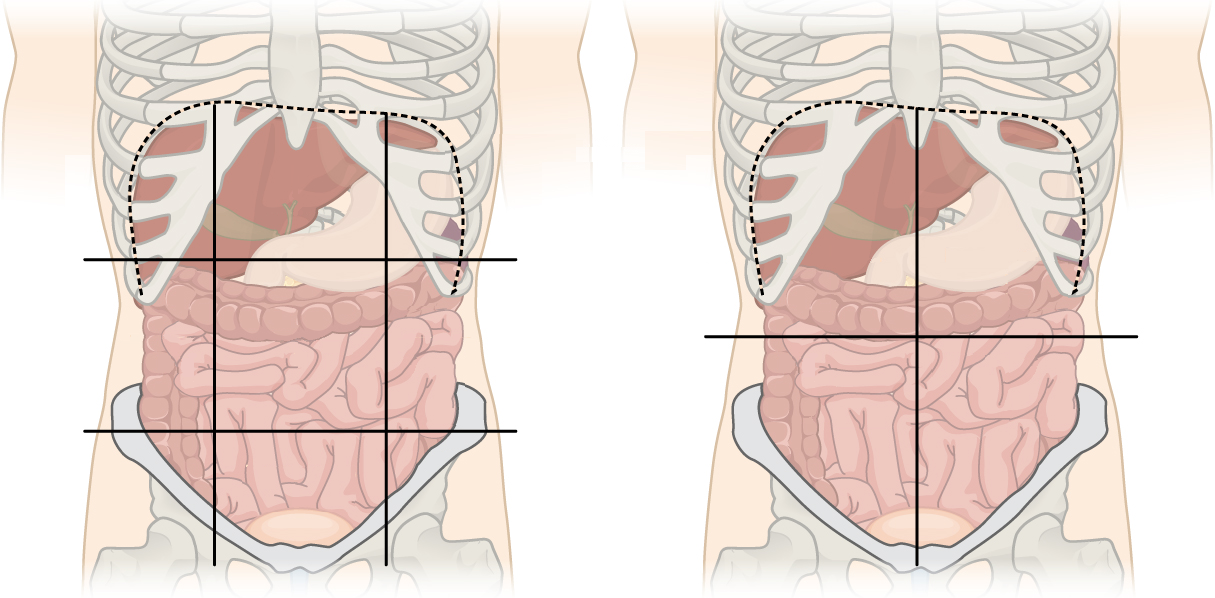
write out the names of the abdominopelvic quadrants
right upper quadrant, left lower quadrant
right lower quadrant; left lower quadrant
dorsal body cavity (posterior aspect)
continuous internal space located on the posterior side of the human body that houses and protects elements of the central nervous system
cranial cavity
large, hollow space inside the skull that holds & protects the human brain
vertebral cavity
the long, hollow space inside the backbone that houses & protects the spinal cord
ventral body cavity
the large anterior space in the human body that house and protects the internal organs
thoracic cavity
hollow space in the chest enclosed by the ribs, spine, breastbone, and separated from the abdomen by the diaphragm
pleural cavity
small, fluid-filled space between the two thin membranes that surround each lung inside the chest
pericardial cavity
small, fluid-filled space located between the outer and inner layers of the serous pericardium that surrounds the heart
diaphragm
large, dome-shaped sheet of muscle and tendon located the below the lungs that serves as the primary muscle for breathing and separates the chest cavity from the abdomen
abdominopelvic cavity
the largest hollow space in the human body, stretching from the diaphragm down to the pelvic floor
abdominal cavity
a large body space located below the chest & above the pelvis that houses and protects major digestive, urinary, and endocrine organs
pelvic cavity
bowl shaped space located at the base of the trunk, sitting directly below the abdominal cavity
parietal layer
the outer part of a serous membrane that lines the walls of a body cavity
visceral layer
the inner layer of a serous membrane that wraps directly around an organ in the body’s cavities
identify anatomical planes from which tissue is cut to visualize its defining characteristic
what are the specific directions that anatomical planes divide the body/tissue into?
what are the 4 tissue types found in the human body
epithelial → connective → muscle → nervous (mnemonic: every cell makes nutrition)
what is the general order of the 4 tissue types from superficial to deep
epithelial → connective → muscle → nervous
what is 1 unique characteristic of each tissue type?
epithelial - cells are tightly packed with little to no extracellular space
connective - lots of extracellular matrix
muscle - cells are specialized for contraction (movement)
nervous - specialized for electrical signaling (communication)
describe how epithelial and connective tissues are classified
epithelial: by number of cell layers (single, stratified, pseudostratified) & shape (squamous, cuboidal, columnar)
connective: by extracellular matrix (made of fibers, ground substance, fluid), loose vs dense connective tissue, supporting (cartilage & bone) fluid (blood)
what is at least 1 function of epithelial and connective tissue in the human body
epithelial - protection, absorption, secretion, filtration, sensation
connective - support, binding tissues together, protection, energy storage, transportation, immune defense