L3 Hepatobiliary and Pancreatic problem
 Call Kai
 Learn
Learn Practice Test
 Spaced Repetition
 Match
Match Flashcards
 Knowt Play
1/52

Earn XP
Description and Tags
p.5-10, 12-13, 30-34 physiology skipped
Name | Mastery | Learn | Test | Matching | Spaced | Call with Kai | Chat |
|---|
No analytics yet
Send a link to your students to track their progress
53 Terms
Which gallbladder disease does the following description refers to ?
Steady RUQ/epigastric pain;
no fever/infection.
Biliary Colic
What is the primary mechanism of Biliary Colic
Transient blockage of the cystic duct by a stone.
Which gallbladder disease does the following description refers to ?
Persistent RUQ pain, fever,
positive Murphy’s sign.
Assess RUQ pain / tenderness
Press your fingertips under the liver border at the right costal margin
Ask the client to inhale deeply
Note the degree of tenderness
+ve Murphy’s sign: Sharp pain that causes the client to hold the breath (inspiratory arrest 吸氣停止)
Cholecystitis
What is the primary mechanism of Cholecystitis
Prolonged blockage of the cystic duct; gallbladder becomes inflamed/infected.
Which gallbladder disease does the following description refers to ?
Pain + Jaundice
Choledocholithiasis
What is the primary mechanism of Choledocholithiasis
Stone in the Common Bile Duct (CBD).

Which gallbladder disease does the following description refers to ?
Charcot’s Triad:
Fever, Jaundice, RUQ pain.
Cholangitis
What is the primary mechanism of Cholangitis
Infected obstruction of the CBD.
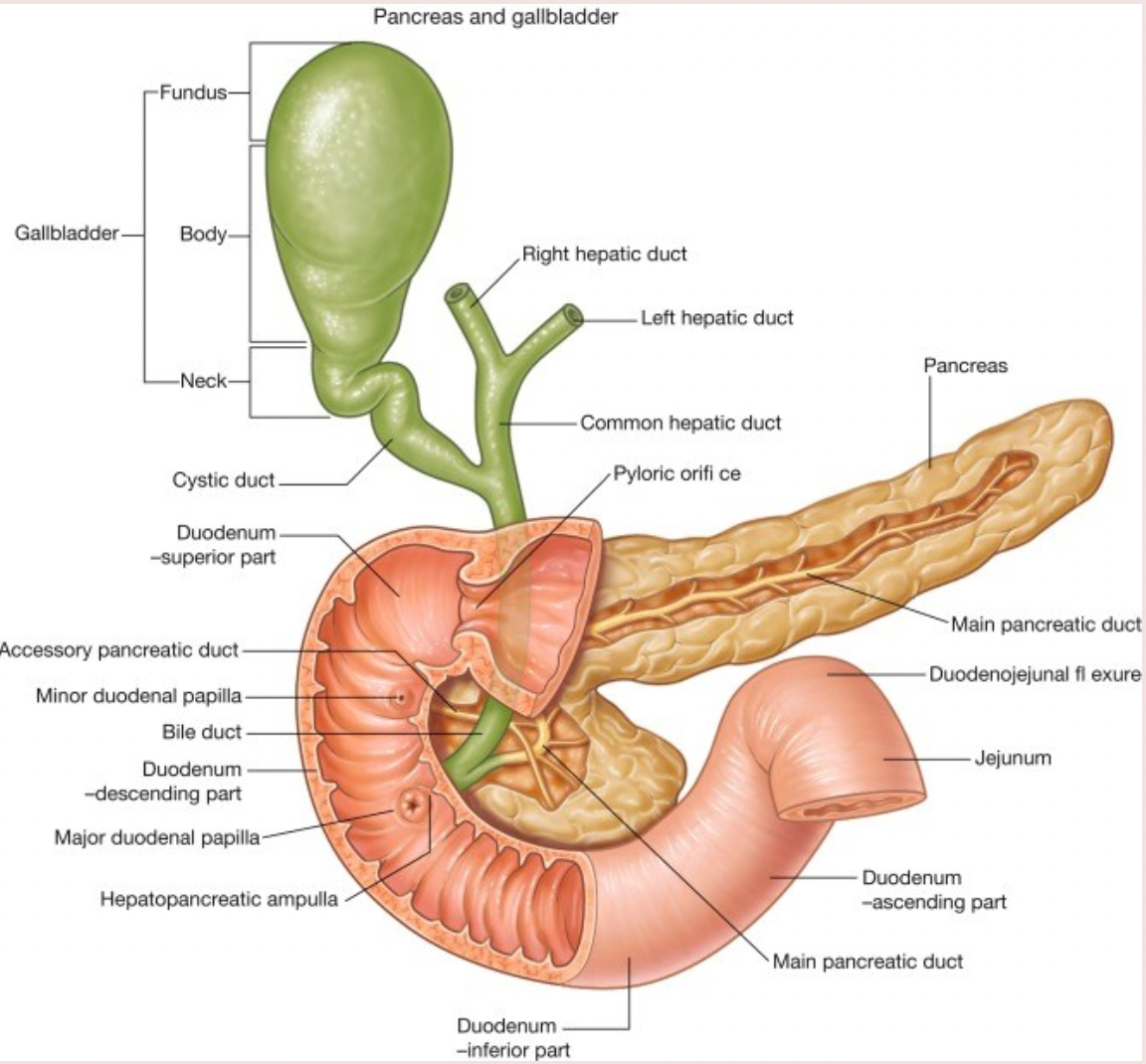
Which gallbladder disease does the following description refers to ?
Severe epigastric pain radiating to back; elevated pancreatic enzymes.
Biliary Pancreatitis
What is the primary mechanism of Biliary Pancreatitis
Stone blocks the pancreatic duct outflow.
Which gallbladder disease is a clinical emergency (Life-threatening)
Cholangitis
Infected obstruction of the CBD.
Charcot’s Triad:
Fever, Jaundice, RUQ pain.
In LFT, what does the marker “ Bilirubin” indicates ?
a marker of haem catabolism
The level of conjugated (direct) bilirubin reflects biliary obstruction,
unconjugated (indirect) bilirubin is a reflection of haemolysis
In LFT, what is “ Albumin, prothrombn” ?
markers of protein synthesis.
In LFT, what does the marker “Bilirubin” (total ± direct) indicates / reflect?
jaundice severity (production, processing, or drainage problem)
In LFT, what does the marker “Albumin + INR (PT)” indicates / reflect?
synthetic liver function (severity/chronicity)
In LFT, what does the marker “ Transaminases” refers to & indicates?
Serum aspartate aminotransferase (AST) and alanine aminotransferase (ALT)
markers of hepatocellular damage
“cell leak” enzymes
In LFT, what does the marker “ ALP, GGT” indicates ?
Hepatic alkaline phosphatase (ALP) and γ-glutaryl transpeptidase levels (GGT)
reflect cholestasis / bile duct obstruction (bile flow problem)
ALP could also be raised in bone disease
In LFT, what does the marker “Urea and anmmonia” indicates?
markers of protein catabolism
In LFT, what does the marker “Haemoglobin” indicates? (2)
anaemia associated with chronic bleeding from oesophageal varices;
macrocytosis associated with abnormal lipid synthesis, which occurs in alcoholism
In LFT, what does the marker “Cholesterol & triglycerides” indicates?
reflect abnormal lipid metabolism
In LFT, what does the marker “Immunoglobulins” indicates?
raised concentrations reflect the reduced phagocytosis of absorbed antigen by Kupffer cells
Kupffer cells phagocytose and catalyze bacterial and other antigens absorbed from the GI tract
resulting in increased activity at other antibody-producing sites
In LFT, what does the marker “alpha 1 antitrypsin” indicates?
deficiency associated with cirrhosis
a protective protein made by the liver that travels through the bloodstream to shield the lungs from destructive inflammatory enzymes
In LFT, what does the marker “Alpha fetoprotein” indicates?
marker of hepatocellular carcinoma
In LFT, what is the purpose of checking drug half-life
sometimes measured where drug metabolism is compromised
A patient has jaundice and pruritus.
Which lab pattern most strongly suggests biliary obstruction?
ALP ↑↑ + GGT ↑↑ with direct (conjugated) bilirubin ↑, ALT/AST mild–moderate ↑
First nursing priority in a cirrhotic patient with confusion:
Perform an ABCD assessment, check vital signs + capillary blood glucose, and assess for immediate deterioration
Airway: Is the patient protecting it? Aspiration risk? GCS trend
if drowsy/vomiting → side position, suction ready,
consider NBM.
Breathing: RR, SpO2, work of breathing; give O2 if needed.
Circulation: BP, HR, perfusion, temperature; consider sepsis screening.
Disability: Capillary blood glucose (fast, reversible), GCS/AVPU, pupils.
Exposure: Look for bleeding, infection sources, trauma, needle marks
Put on monitoring: SpO2, ECG, BP cycling, temperature
What will you suspect / think about if the patient show confusion ?
Hypoxia, hypotension/shock, sepsis, hypoglycaemia, drug toxicity,
intracranial event, or HE.
Stabilize and rule out immediately reversible threats first
When assessing the airway, if GCS is = / < 7, what will we consider ?
Intubation
What is the nursing priority for a cirrhosis patent with confusion after performing the ABCDE assessment ?
Establish IV access and prepare fluid
because hypotension will become more difficult to set up IV HB
What is the purpose of giving lactulose in manageing a cirrhotic patient with confusion ? Suggest whether it is appropriate to be the first priority decision/
Lactulose is appropriate if hepatic encephalopathy is likely, but after initial stabilization
if reduced consciousness or aspiration risk
→oral lactulose may be unsafe without airway assessment
If severe HE, may need NG administration under appropriate precautions
Explain the use of lactulose in treating hepatic encephalopathy
Non-absorbable disaccharide that acidifies the colon, converting ammonia (NH3) to ammonium (NH4+) and reducing absorption
Dose: 20–30 mL orally every 1–2 hours until 2–3 soft stools/day
Rectal enema: For Grade III/IV HE or when oral route not possible
What is the purpose of urgent CT brain in manageing a cirrhotic patient with confusion ? Suggest whether it is appropriate to be the first priority decision/
Consider CT if: head trauma/fall, focal neurology, anticoagulation, sudden severe headache, seizure etc..
Still: stabilize first (ABCD) before transport/imaging.
What is the purpose of start rifaximin in manageing a cirrhotic patient with confusion ? Suggest whether it is appropriate to be the first priority decision/
adjunct, not first-line in acute moment
It is usually add-on for recurrent HE or after lactulose.
Not an immediate “first priority” action in an unstable/confused patient.
Explain the use of rifaximin in treating hepatic encephalopathy
Antibiotic with minimal absorption in the gastrointestinal tract
resulting in high concentrations within the intestines
reduce ammonia production by targeting and eliminating ammonia-producing
bacteria in the colon
works by binding to bacterial DNA-dependent RNA polymerase, inhibiting bacterial RNA synthesis
often considered for patients who do not respond to lactulose / those who
experience intolerance
Describe the pathophysiology of Hepatic Encephalopathy
Ammonia that results from bacterial and enzymatic deamination
of amino acids in the intestines normally goes to the liver via
the portal circulation where it is converted to urea, and to be excreted by the kidney
When blood is shunted past the liver via the collateral vessels or the
liver is so damaged that it is unable to convert ammonia to urea
Ammonia levels in the systemic circulation increase & accumulate
The ammonia crosses the blood-brain barrier and produces neurologic manifestations.
neurotoxic effects of ammonia includes: abnormal
neurotransmission, astrocyte swelling, and inflammatory cytokines
List & explain the risk factors of Hepatic Encephalopathy (10)
Cerebral depressants (e.g., opioids) | ↓ Metabolism by liver, causing ↑ drug levels and cerebral depression |
Constipation | ↑ Ammonia production from bacterial action on feces |
Dehydration / diuretic overuse | Potentiates ammonia toxicity |
GI bleeding | ↑ Ammonia in GI tract |
Hypokalemia | Potassium needed by brain to metabolize ammonia |
Hypovolemia | ↑ Ammonia because of hepatic hypoxia |
Infection | ↑ Metabolic rate and cerebral sensitivity to toxins |
Metabolic alkalosis | Facilitate transport of ammonia across blood-brain barrier , ↑ Renal production of ammonia |
↑ Metabolism | ↑ Workload of liver |
Uremia (renal failure) | Retention of nitrogenous metabolites |
List the nursing management after administrating lactulose in treating hepatic encephalopathy (4)
LOC and mental status
Bowel frequency (target 2–3/day)
Electrolyte imbalances (especially potassium)
Signs of dehydration
Suggest the s/s for Grade II Hepatic Encephalopathy
Confusion, lethargy, disorientation to time, and presence of asterixis (flapping tremor)
List the nutritional nursing management for hepatic encephalopathy (2)
NO NEED protein intake restriction
should maintain protein intake at around 1.2 to 1.5 gm/kg/d.
Small meals throughout the day to prevent fasting, which can increase ammonia production

Suggest the best diagnosis base on the following assessment findings: (+ explain why not the others conditions)
Acute Biliary Pancreatitis (most likely)
Gallstones + dilated CBD + elevated enzymes
Acute Cholangitis
Jaundice + fever (though no fever yet)
Peptic Ulcer Perforation
Less likely, no peritoneal signs
Hepatitis
Unlikely with high lipase/amylase
p.48-