bio 202 unit 1
 Call Kai
 Learn
Learn Practice Test
 Spaced Repetition
 Match
Match Flashcards
 Knowt Play
1/36

There's no tags or description
Looks like no tags are added yet.
Name | Mastery | Learn | Test | Matching | Spaced | Call with Kai | Chat |
|---|
No analytics yet
Send a link to your students to track their progress
37 Terms
element
a substance that cannot be broken down to other substances by chemical reactions
compound
a substance consisting of two or more elements in a fixed ratio
isotopes
two atoms of an element that differ in the number of neutrons. can be stable or unstable (radioactive)
when unstable can decay spontaneously, giving off particles and energy
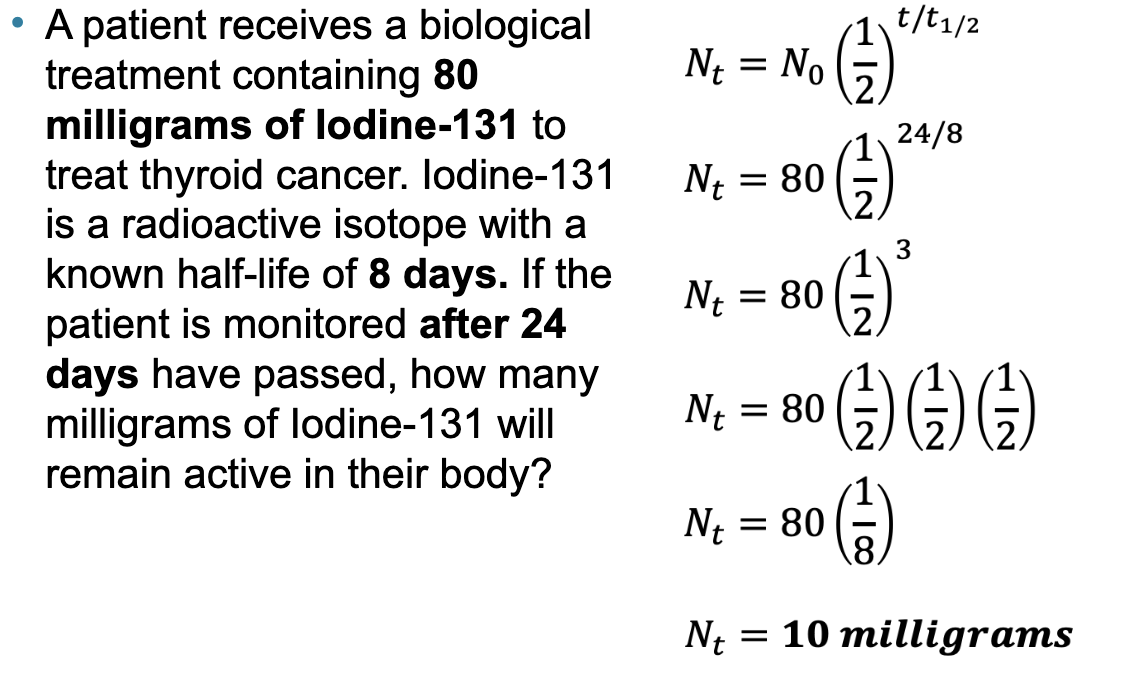
half-life isotope
a “parent” isotope decays into its “daughter” isotope at a fixed rate
values vary from seconds to years for some isotopes
electronegativity
atom’s abillity to attract and pull electrons toward itself
nonpolar covalent bond = small difference (electrons are shared equally, no charge separation) eg. O2
polar covalent bond = difference (electrons are shared unequally, partial charges form) eg. HCl
ionic bond = large difference (electrons are transferred, full charges form) eg. KBr
covalent bond
single bond = sharing of one pair of valence electrons
double or triple bond = sharing of two or three pairs of valence electrons
can form between atoms of the same element or atoms of different elements
nonpolar = atoms ahare the electron equally
polar = one atom is more electronegative, and the atoms do not share the electron equally
unequal sharing of electrons causes a partial positive or negative charge for each atom or molecule
ionic bond
atoms sometimes strip electrons from their bonding partners
the two resulting oppositely charged atoms or molecules are called ions
postively charged = cation
negatively charge = anion
cations and anions attract each other, this attraction is an ____
ionic compounds
compounds formed by ionic bonds (salts like NaCl)
most salts are quite stable when dry, but dissociate easily in water
hydrogen bond
forms when a hydrogen atom covalently bonded to one electronegative atom (are both attracted to each other)
van der waals interactions
occurs due to temporary or permanent shiftes in electrical charges that make nearby particles pull on each other (dipole moment)
weakest type of chemcial bond or intramolecular interaction
induced dipole - dipole interaction
acid
a substance that increase H+ concentration of a solution
base
a substance that increases the OH- concentration of a solution
pH scale
acidic solutions = >7
basic solutions = <7
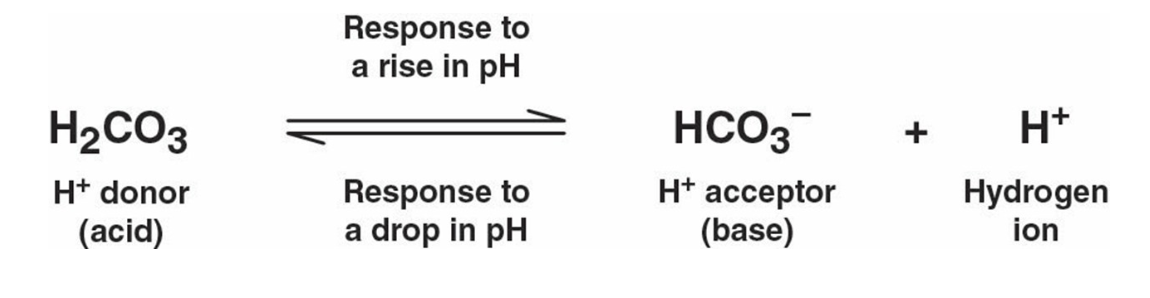
buffers
substances that minimize changes in H+ and OH- by neutralizing the effects of the acid or base added
typically a weak acid and base that work by absorbing H+ protons when they are in excess or donating them when they are depleted
bonds with carbon
with 4 valence electrons, carbon can form 4 covalent bonds with a variety of atoms
allows carbon to form large, complex molecules
most frequent bonding partners = hydrogen, oxygen, and nitrogen
isomers
compounds with the same molecular formula but different structures and properties
structural = have different covalent arrangements of their atoms
cis-trans (geometric) = have the same covalent bonds but differ in their saptial arrangements
enantiomers = mirror images of each other
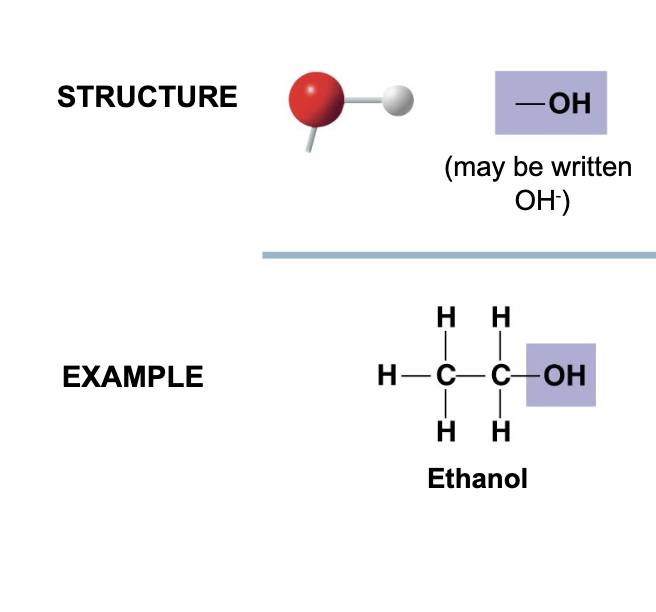
chemical groups: hydroxyl
alcohols
is polar beacuse of the electrons spending more time near the electronegative oxygen (highly electronegative) atom
can form hydrogen bonds with water molecules, helping dissolve organic compounds such as sugars
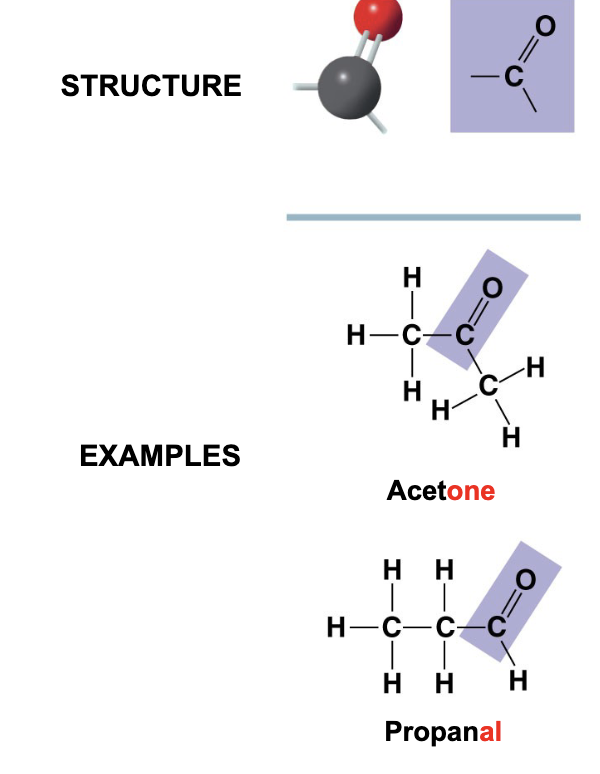
chemical groups: carbonyl
compound name: carboxylic acids or organic acids
acts as an acid, can donate an H+ because the covalent bond between oxygen and hydrogen is so polar
ketones = if carbonyl group is within a carbon skeleton (end in -one)
aldehydes = if carbonyl group is at the end of the carbon skeleton (end in -al)
both groups are also found in sugars
both groups may be structural isomers with different properties
chemical groups: amino
compound name: amines
acts as a base, can pick up an H+ from the surround solution (water, in living organisms)
found in cells in the ionized form with a charge of 1+
chemical groups: sulfhydryl
compound name: thiols
2 groups can react, forming a covalent bond
this cross-linking helps stabilize protein structure
chemical groups: phosphate
compound name: organic phosphates
contribute negative charge to the molecule of which it is a part (2- when at the end of a molecule, 1- when located internally in a chain of phosphates)
molecules containing phosphate groups have the potential to react with water, releasing energy
chemical groups: methyl
compound name = methylated compound
methylation of DNA affects gene expression
affect the structure and function of biological molecule, including hormones
marcomolecules
have unique properties that arise from the orderly arrangement of their atoms
4 classes:
carbohydrates (polymer)
lipids
proteins (polymer)
nucleic acides (polymer)
repeating units that serve as building blocks of polymers are monomers
carbohydrates
includes sugar and polymers of sugars
simplest = monosaccharides or simple sugars
have molecular formulas that are usually multiples of CH2O
eg. glucose
are polysaccrharides, polymers composed of many sugar building blocks
monosaccharides
classified by
location of carbonyl group (as aldose or ketose)
the number of carbons in the carbon skeleton
alpha and beta monodsccharides
the carbon that orginally had C=O now has a newly formed OH group = anomeric carbon
because the linear carbonyl was planar, the new OH can end up pointing in either of 2 directions when the ring forms
alpha = opposite side as CH2OH
beta = same side as CH2OH
once one sugar is linked to another, the alpha or bet form is fixed (frozen)
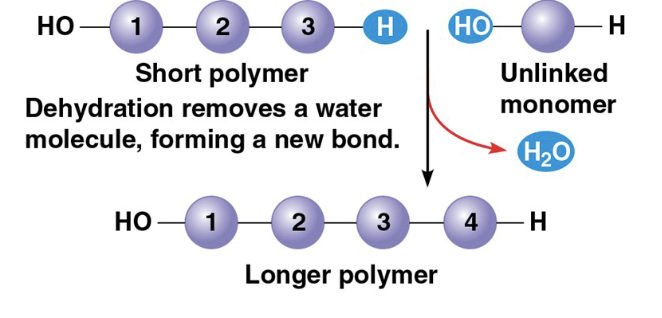
dehydration reaction
occurs when 2 monomers bond together through the loss of a water molecule
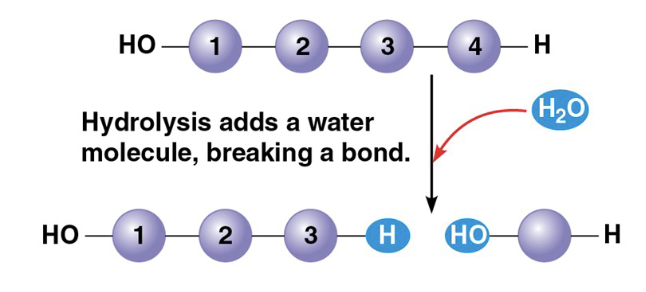
hydrolysis
polymer disassembled to monomers
a reaction that breaks down the polymer by adding a water molecule, breaking a bond
polysaccrharides
are long polymers composed of many monosaccharide units and have important storage and structural roles
architecture and function are determined by its sugar monomers and the positions of it glycosidic linkages
energy storage: starch and glycogen
in a potato tuber cell = plastids containing starch granules
in muscle tissue = glycogen granules stored
structural support: cellulose
starch (alpha configuration) is largely helical
cellulose (beta configuration) is straight and unbranched
the orientation of Beta-1,4 linkges forms straight polymers which are stabilized by hydroggen bonds
gives cellulose fibers the strength to support weight and stress
source: plant
subunit: beta-glucose
bonds: 1-4
branches: NO
starch
amylose
source: plant
subunit: alpha-glucose
bonds:1-4
branches: NO
amylopectin
source: plant
subunit: alpha-glucose
bonds:1-4 and 1-6
branches: YES (~per 20 subunits)
glycogen
source: animal
subunit: alpha-glucose
bonds: 1-4, 1-6
branches: YES (~per 10 subunits)