Ap Government Unit 1
 Studied by 0 people
 Call Kai
 Learn
Learn Practice Test
 Spaced Repetition
 Match
Match Flashcards
 Knowt Play
1/54

There's no tags or description
Looks like no tags are added yet.
Name | Mastery | Learn | Test | Matching | Spaced | Call with Kai |
|---|
No study sessions yet.
55 Terms
Articles of Confederation
1st Constitution of the U.S. 1781-1788 (weaknesses-no executive, no judicial, no power to tax, no power to regulate trade) Each state retained sovereignty, the ability to act independently of the Confederation. Each state had equal representation in a unicameral (single house) legislature.
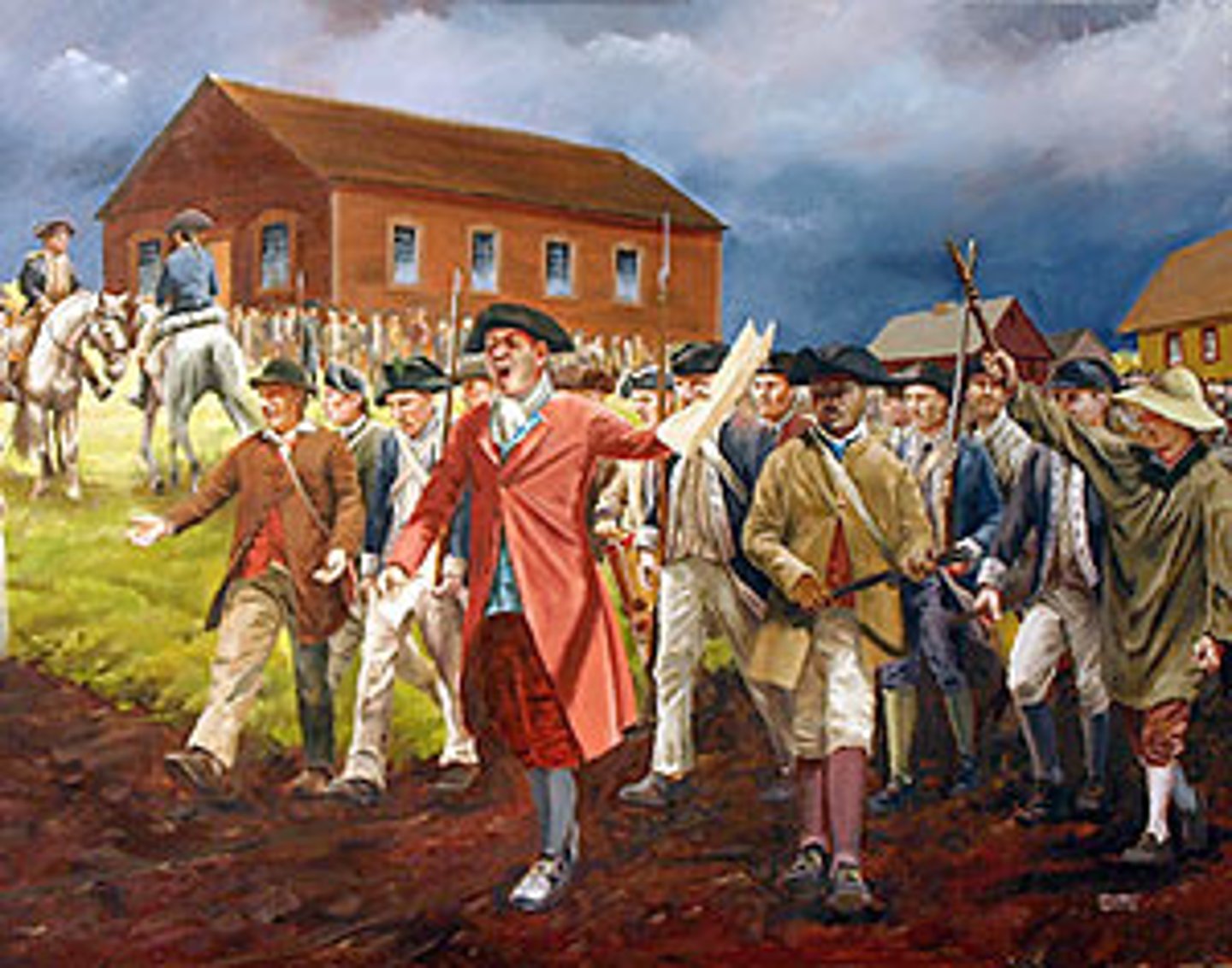
Shays' rebellion
Rebellion led by farmers in western Massachusetts in 1786-1787, protesting mortgage foreclosures. It highlighted the need for a strong national government just as the call for the Constitutional Convention went out.
Checks and Balances
A system that allows each branch of government to limit the powers of the other branches in order to prevent abuse of power
Separation of powers
A way of dividing the power of government among the legislative, executive, and judicial branch to prevent tyranny.
Popular sovereignty
A government in which the people rule by their own consent.
Bicameral
A legislature consisting of two parts, or houses with separate rules
Federalists
Those who favored a stronger national government and weaker state governments. Supported the ratification of the Constitution.
Anti-Federalist
Those who favored strong state governments and a weaker national government. Advocated for a bill of rights to formally address individual and state rights. Concerned about the concentration of power in a central government under the Constitution.
Federalism
A system of government in which power and responsibilty is divided between the federal and state governments
Supremacy clause
Article VI of the Constitution, which makes the Constitution, national laws, and treaties supreme over state laws when the national government is acting within its constitutional limits.
(ex. McCulloch v. Maryland)
Virginia Plan
Initial proposal at the Constitutional Convention made by the Virginia delegation for a strong central government with a bicameral legislature dominated by the big states.
New Jersey Plan
Proposal at the Constitutional Convention made by William Paterson of New Jersey for a central government with a single-house legislature in which each state would be represented equally.
Connecticut or Great Compromise
Compromise agreement by states at the Constitutional Convention for a bicameral legislature with a lower house in which representation would be based on population and an upper house in which each state would have two senators.
Republican Democracy
Format chosen by Founding Fathers. People vote for representatives who then make laws. People do not vote directly on legislation.
Three fifths clause
slave counted as 3/5 of a person for population counts to determine how many representatives.
Federalist Papers
A collection of 85 articles written by Alexander Hamilton, John Jay, and James Madison under the name "Publius" to defend the Constitution in detail.
Federalist Paper #10
Written by James Madison to convince people to support the ratification of the constitution. Argued that factions were inevitable but were best controlled by a large republic that employed a Federalist structure. Argued that competition among factions would limit their negative impacts.
Bill of Rights
A formal statement of the fundamental rights of the people of the United States, incorporated in the Constitution as Amendments 1-10. Satisfied Anti-federalist concerns.
Elastic clause
AKA the "Necessary and Proper Clause" Article I, Section 8, of the Constitution, which allows Congress to make all laws that are "necessary and proper" to carry out the powers of the Constitution. Has allowed the federal government to expand its power over time.
Commerce clause
The clause in the Constitution (Article I, Section 8, Clause 1) that gives Congress the power to regulate all business activities that cross state lines or affect more than one state or other nations. Has helped the Federal government expand its power over time.
Concurrent powers
Powers held jointly by the national and state governments. For example, the powers to tax, pass laws and borrow funds
cooperative federalism
A system of government in which powers and policy assignments are shared between states and the national government.
Dual Federalism
A system of government in which both the states and the national government remain supreme within their own spheres, each responsible for some policies.
Expressed Powers/Enumerated powers
Powers the Constitution specifically granted to one of the branches of the national government. Listed explicitly in the Constitution. Ex: right to coin money, declare war, regulate foreign and interstate trade, tax, etc.
Implied powers
Powers not specifically mentioned in the constitution;
Powers inferred from the express powers that allow Congress to carry out its functions. Has Constitutional basis in Necessary and Proper/Elastic Clause
Inherent powers
powers that exist for the national government because the government is sovereign. Ex: The Louisiana Purchase
McCulloch v. Maryland (1819)
The court ruled that the states did not have the power to tax the national bank. Used the backing of the Supremacy Clause to argue that states could not interfere with legitimate federal laws
Reserved Powers
belong to the states and the people;
Powers not specifically granted to the federal government or denied to the states. Granted by the 10th Amendment. For example, regulating voting and administering elections at the state level.
Unitary System
A government that gives all key powers to the national or central government
Block grants
Federal money given to the states with limited spending guidelines. Allows the states power to decide how to spend funds within relatively loose guidelines. Ex: funds for transportation and state chooses how to allocate.
Categorical Grants
Federal money given to the states with specific spending guidelines. Gives the federal government the power to decide how funds are spent within the state. Ex: funds for highway repairs, cannot be used for other purposes.
Devolution
The transfer of power from a high level political office to a lower level; central government to regional, state, or local governments. Example-Welfare Reform Act of 1996
Gibbons v. Ogden
Commerce clause case (1824). Decision greatly enlarged Congress' interstate commerce clause power by broadly defining the meaning of "commerce" to include virtually all types of economic activity.
The 10th Amendment
Reserves powers to the states. Has been used successfully by the states to get the federal courts to strike down federal laws that violate this principle.
1st Amendment
Guarantees many individual rights including the right to expression and freedom of the press, freedom of religion, the right to petition the government, and the right to peaceful assembly.
The Motor Voter Law
An example of a mandate, an order given by the federal government that states must follow.
The Americans with Disabilities Act
An example of an unfunded mandate, an order given by the federal government that states must follow and pay for
Ratification
The Constitutional process by which the states must approve amendments to the Constitution. Three-quarters of the states must approve an amendment before it is ratified and officially becomes part of the Constitution. Another example of federalism in the Constitution's structure.
Conditions of Aid
Federal rules attached to the grants that states receive. States must agree to abide by these rules in order to receive the grants.
Constitutional Convention
Meeting held in 1787, originally meant to revise the Articles of Confederation but created a new plan of government instead
Intrastate commerce
Commerce WITHIN A STATEcommercial activity regulated at the state level
Interstate commerce
Commerce between different states, can be regulated by Congress.
Welfare Reform Act
An example of devolution, giving states the authority to determine how to implement Welfare Programs and determine eligibility locally. Still use federal money.
Political Culture
a set of attitudes and practices held by a people that shapes their political behavior. It includes moral judgments, political myths, beliefs, and ideas about what makes for a good society.
Direct democracy
people vote on laws and make decisions for the community as a group (no representatives)
Oligarchy
rule by the few, done in their own interest and not for the collective good of a community
Conservative
One who generally favors limited government intervention, particularly in economic affairs.
Liberal
One who favors greater government intervention, particularly in economic affairs and in providing social services
Social Conservative
One who favors government support for traditional moral teachings
Moderate
One who takes middle of the road positions on most political issues
Libertarian
one who believes in limited government interference in the economy and personal liberties
16th Amendment
Allowed the federal government to collect income taxes from individuals. This greatly enhanced the power of the federal government by making it possible for them to spend more funds on policies of their choosing.
17th Amendment
Direct election of Senators. This amendment took the power to appoint senators away from state governments and gave it to the people of the state.
United States v Lopez
The Supreme Court ruled that Congress had exceeded its constitutional authority under the Commerce Clause when it passed a law prohibiting gun possession in local school zones. This increased state powers to regulate such matters while decreasing federal power
Marbury v Madison
Court case that established the Supreme Court's power to strike down federal laws that violated the constitution. This has allowed for continuous interpretation of the Constitution by the Supreme Court (informal amendment)