Pulmonary Examination Overview for NPTE
 Call Kai
 Learn
Learn Practice Test
 Spaced Repetition
 Match
Match Flashcards
 Knowt Play
1/49

There's no tags or description
Looks like no tags are added yet.
Name | Mastery | Learn | Test | Matching | Spaced | Call with Kai | Chat |
|---|
No analytics yet
Send a link to your students to track their progress
50 Terms
Tidal volume (TV)
500 mL - Air inspired during normal, relaxed breathing
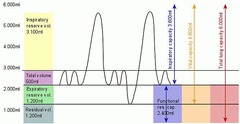
Inspiratory reserve volume (IRV)
3,100 mL - Additional air that can be forcibly inhaled after the inspiration of a normal tidal volume
Expiratory reserve volume (ERV)
1,200 mL - The additional air that can be forcibly exhaled after the expiration of a normal tidal volume
Residual volume (RV)
1,200 mL - Volume of air remaining in the lungs after the expiratory reserve volume is exhaled
Total lung capacity (TLC)
6,000 mL - Maximum amount of air that can fill the lungs (TLC = TV + IRV + ERV + RV)
Vital capacity (VC)
4,800 mL - Total amount of air that can be expired after fully inhaling (VC = TV + IRV + ERV = approximately 80% TLC)
Inspiratory capacity (IC)
3,600 mL - Maximum amount of air that can be inspired (IC = TV + IRV)
Functional residual capacity (FRC)
2,400 mL - Amount of air remaining in the lungs after a normal expiration (FRC = RV + ERV)
Spirometry
A test used to assess lung function by measuring the volume of air inhaled and exhaled
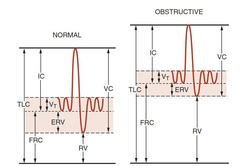
Restrictive pulmonary disease
A condition that restricts lung expansion, leading to decreased lung volume
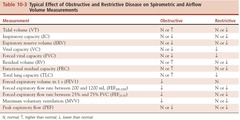
Obstructive pulmonary disease
A condition characterized by obstruction of airflow, leading to difficulty in exhaling
Increased tidal volume
A potential finding on a pulmonary function test.
Decreased inspiratory reserve volume
A potential finding on a pulmonary function test.
Increased residual volume
A potential finding on a pulmonary function test.
Increased functional residual capacity
A potential finding on a pulmonary function test.
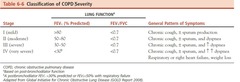
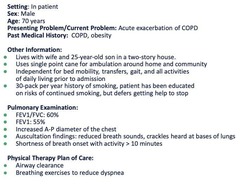
FEV1/FVC
A ratio used to assess lung function, in this case, measured at 60%.
FEV1
Forced expiratory volume in one second, measured at 55%.
Increased A-P diameter of the chest
A physical examination finding indicative of COPD.
Reduced breath sounds
Auscultation finding in a pulmonary examination.
Crackles heard at bases of lungs
Auscultation finding in a pulmonary examination.
Shortness of breath onset with activity
Occurs after more than 10 minutes of activity.
Airway clearance
A component of the physical therapy plan of care.
Breathing exercises
Intended to reduce dyspnea.
COPD severity classification
According to GOLD classification, can be categorized as very severe, severe, moderate, or mild.
Assisted coughing in the supine position
An appropriate method to help clear secretions in a patient with a weak wet cough.
Postural drainage in the side lying position
An appropriate method to help clear secretions in a patient with a weak wet cough.
Huffing
An appropriate method to help clear secretions in a patient with a weak wet cough.
Mechanical percussion
An appropriate method to help clear secretions in a patient with a weak wet cough.

Vesicular sounds
Low pitch, soft sounds heard over most of the lungs.
Broncho-vesicular sounds
Sounds where inspiratory and expiratory sounds are equal, heard between the 1st and 2nd interspace anteriorly and between the scapulae.
Bronchial sounds
Loud, high-pitched sounds where expiratory sounds are longer than inspiratory ones, heard over the manubrium.
Tracheal sounds
Very loud, relatively high sounds where both inspiratory and expiratory are equal, heard over the trachea in the neck.
Rhonchi
Continuous low-pitched, rattling lung sounds that often resemble snoring.
Wheeze
A high-pitched sound heard in expiration, caused by airway obstruction (asthma, COPD, or aspiration of any foreign body). In severe constriction it may be heard in inspiration as well.
Crackles
Brief, discontinuous, popping lung sounds that are high pitched. Crackles, previously termed rales, can be heard in both phases of respiration.
Pleural rub
Auscultation in the lower lateral chest areas it occurs with each inspiration and expiration. It can be an indication of pleural inflammation.
Bronchophony
Increased vocal resonance with greater clarity and loudness of spoken words. Example '99'.
Egophony
A form of bronchophony in which the spoken long 'E' sounds changes to a long, nasal sounding 'A'.
Whispered pectoriloquy
An increased loudness of whispering. Recognition of whispered words '1, 2, 3'.
pH
Normal range is 7.35 - 7.45;
PaCO2
Normal range is 35 - 45 mmHg; >45 indicates acid,
HCO3
Normal range is 22 - 26 mEq/L;
Uncompensated metabolic acidosis
Condition where the pH is
Uncompensated respiratory alkalosis
Condition where the pH is >7.45, PaCO2 is
Uncompensated respiratory acidosis
Condition where the pH is
Uncompensated metabolic alkalosis
Condition where the pH is >7.45, HCO3 is >26, and PaCO2 is normal.
Partially Compensated
Condition where none of the three (pH, PaCO2, HCO3) are normal.
COPD ABG changes
Increased PaCO2, decreased PaO2, and decreased pH.
CHF S3 heart sound
A high-pitched breath sound that is most likely associated with the diagnosis of CHF.
Normal Gait Class
Scheduled for Saturday, 02/24 at 8.30 am PST (FREE CLASS to attend).