Final Exam Review - ENGR 54
 Call Kai
 Learn
Learn Practice Test
 Spaced Repetition
 Match
Match Flashcards
 Knowt Play
1/36

There's no tags or description
Looks like no tags are added yet.
Name | Mastery | Learn | Test | Matching | Spaced | Call with Kai | Chat |
|---|
No analytics yet
Send a link to your students to track their progress
37 Terms
Periodic Trends
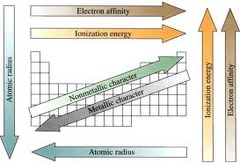
Ionic Character

What is the relationship between elastic modulus (E) and thermal expansion coefficient (a)?
Materials that are easier to stretch (small E) generally shower bigger thermal expansion (a). The elastic modulus is directly related to the stiffness of the material so you could also say the more stiff a material is, the smaller thermal expansion it will have
What ionic character suggests a covalent bonded material and which suggests an ionic bonded material?
- 25% > I.C. suggest a covalent bond
- 25% < I.C. suggest an ionic bond
What is the side length (a) and APF for a simple cubic?
a = 2R
APF = 52%
What is the side length (a) and APF for body centered cubic?
a = 4R/sqrt3
APF = 68%
What is the side length (a) and APF for face centered cubic?
a = 2Rsqrt2
What is the crystallographic notation for direction?
[1 1 1]
What is the crystallographic notation for a plane?
(1 1 1)
XRD selection rules
BCC: (h+k+l) even
FCC: h, k ,l either all even or all odd
SC: All
What are point defects?
- vacancies
- interstitial atoms
- substitutional atoms
What are line defects?
- dislocations
What are area defects?
- free surfaces
- grain boundaries
What are the conditions for substitutional solid solutions (Hume-Rothery Rules)?
- change in atomic radius < 15%
- similar electronegativities (proximity in periodic table)
- same crystal structure
- valency
What is needed for diffusion to occur?
activation energy which is the energy required to overcome the energy maximum in order for the jump to occur
What is the difference between tensile and ultimate strength?
Tensile stress refers to any stress under a tensile load and ultimate stress refers to the highest tensile strength the material can take before failure mechanisms like necking or fracture occur
Given a strain-stress curve, how is young modulus (E) calculated?
- the slope during the linear portion of the graph
Given a stress-strain curve, how is resilience calculated?
- area under the elastic part, or linear portion, of the graph right before it begins to curve
Given a stress-strain curve, how is toughness calculated?
- entire area under the stress-strain curve from 0 to fracture
What is yield strength?
stress at which plastic deformation begins
What is the difference between engineering and true stress-strain?
Engineering uses a constant area causing the curve to drop after ultimate tensile stress and length AND true uses instantaneous area and length causing the curve to continue rising after necking
What does poisson's ratio tell us about a material?
A material with a high poisson's ratio is easier to pull and a material with a low poisson's ratio is easier to compress
When does slip occur?
when the shear stress exceeds the critically resolved shear stress
How can we prevent deformation?
alloying
grain size reduction
coldworking
For alloying, what is the difference between solid solution strengthening and precipitate strengthening?
solid solution strengthening: substituting one material for another with small or large impurities
precipitate strengthening: introducing new particles
What are the three stages of annealing?
recovery
recrystallization
grain growth
What is fatigue life?
the number of cycles until failure
What are the three stages of creep
primary creep: dislocation motion
secondary creep: steady-state (most important)
tertiary creep: rupture
What is the relationship between coordination number and cation/anion ratio?
Coordination number increases with increasing cation to anion ratio
What defines a frenkel defect?
a cation vacancy-cation interstitial pair
What defines a schottky defect?
a paired set of cation and anion vacancies
Is elastic deformation permanent? Is it recoverable?
No, it is not permanent
Yes, it is recoverable
Is non-elastic deformation permanent? Is it recoverable?
Yes, it is permanent
No, it is not recoverable
What is fatigue limit?
the point at which there is no change in S (stress amplitude) over a certain number of cycles
What is fatigue strength?
the stress level at which failure will occur for some specified
Annealing
What is the number of atoms per unit cell for SC, BCC, and FCC?
SC: 1
BCC: 2
FCC: 4