Topic 7A (aerobic and anaerbic respiration, krebs cycle, chemiosmosis)
 Call Kai
 Learn
Learn Practice Test
 Spaced Repetition
 Match
Match Flashcards
 Knowt Play
1/6

There's no tags or description
Looks like no tags are added yet.
Name | Mastery | Learn | Test | Matching | Spaced | Call with Kai | Chat |
|---|
No analytics yet
Send a link to your students to track their progress
7 Terms
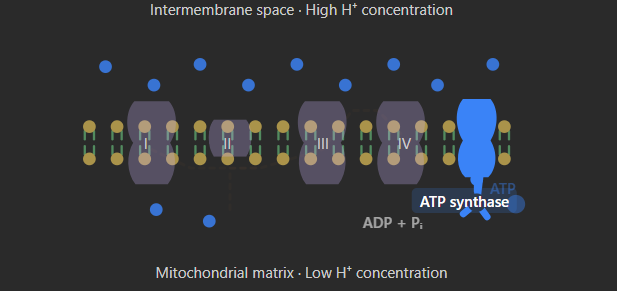
Describe how chemiosmosis is involved in the synthesis of ATP
(5 marks)
- H+ ions and electrons are transported to the ETC
- via reduced NAD and FAD (coenzymes), this allows H+ ions to be pumped to intermembrane space
- creating an electrochemical gradient
- H⁺ ions/ protons move through ATP synthase
- this gives the energy needed to catalyse the conversion of ADP + Pi into ATP
(aka → phosphorylation of ADP)
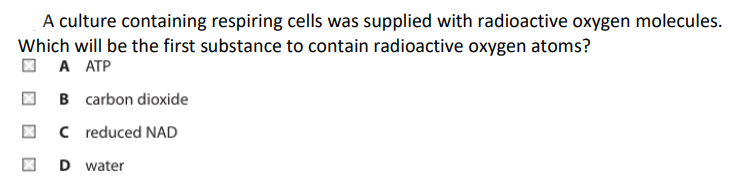
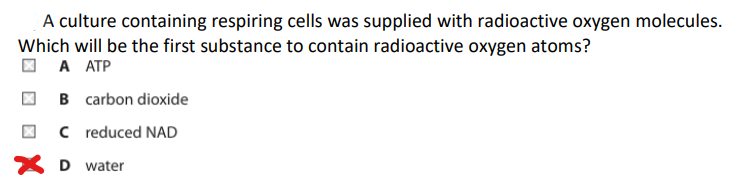
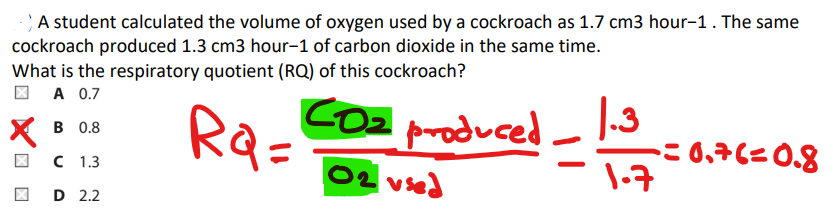
ATP ❌ → made using ATP synthase; oxygen is not directly added.
CO₂ ❌: produced from decarboxylation in the link reaction/Krebs cycle. oxygen originates from other sources
Reduced NAD ❌ → NAD accepts hydrogen/electrons, not oxygen.
water ✅:
O₂ is used in respiration (in ETC), where it accepts electrons and H⁺ to form water
thus water is the first to have radioactive O atoms.
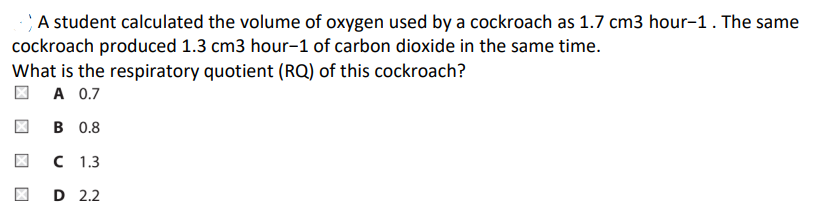
because:
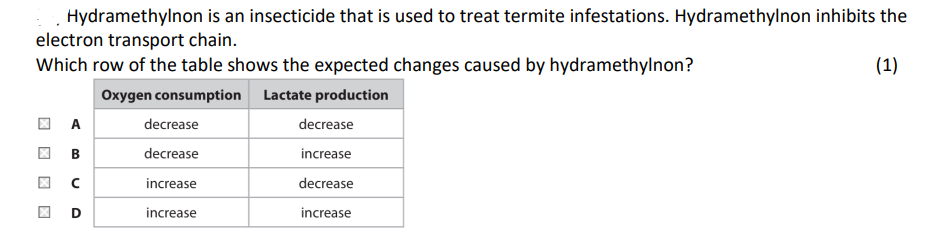
ETC inhibited, therefore less H+ pumped and thus less ATP produced
also less o2 accepts e- [Oxygen is the final electron acceptor]
more anaerobic respiration(glycolysis and fermentation) occurs so more lactate is produced
![<p>because:</p><p>ETC inhibited, therefore less H+ pumped and thus less ATP produced<br>also less o2 accepts e- [<strong><u>Oxygen is the final electron acceptor</u></strong>]</p><p>more anaerobic respiration(glycolysis and fermentation) occurs so more lactate is produced</p>](https://assets.knowt.com/user-attachments/05c543a0-1c4d-4060-99df-2d93d77ba934.png)
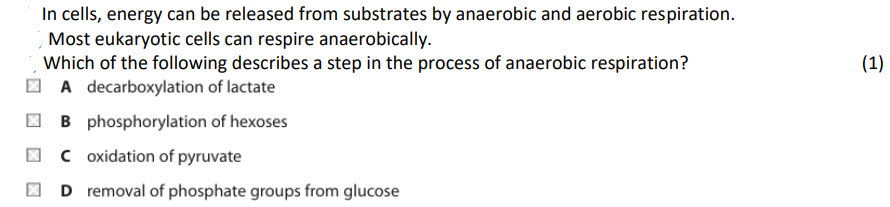
Anaerobic respiration summary:
1 glucose → phosphorylation of glucose → splits into two 3C molecules → converted to form 2 pyruvate → 2 lactate molecules
→ phosphorylation is addition of phosphate group, i.e to glucose which is a hexose sugar as its 6C
ANS: phosphorylation of hexoses (like glucose) ✅
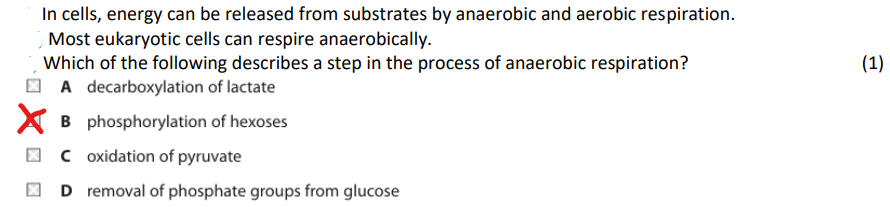
State what is meant by Decarboxylation, Oxidation and Phosphorylation
Decarboxylation = removal of CO₂ molecule from a compound
Oxidation = loss of electrons (also: gain of o2 and loss hydrogen atoms)
Phosphorylation = addition of a phosphate group to a molecule
(e.g. ADP + Pi → ATP)

link reaction produces 2 molecules of acetyl CoA which are 2C (and 2 molecules of NADH)
[2C = 2 carbon containing]
![<p><strong><u>link reaction</u></strong> produces 2 molecules of <strong><u><mark data-color="yellow" style="background-color: yellow; color: inherit;">acetyl CoA which are </mark><mark data-color="green" style="background-color: green; color: inherit;">2C</mark></u></strong> (and 2 molecules of NADH)<br>[2C = 2 carbon containing]<br></p>](https://assets.knowt.com/user-attachments/a3d026d0-6698-4433-b774-dbe93ef1fdf6.png)