VMED7040 Week 1: Cel Excitability 1 +2
 Call Kai
 Learn
Learn Practice Test
 Spaced Repetition
 Match
Match Flashcards
 Knowt Play
1/29

There's no tags or description
Looks like no tags are added yet.
Name | Mastery | Learn | Test | Matching | Spaced | Call with Kai | Chat |
|---|
No analytics yet
Send a link to your students to track their progress
30 Terms
transport mechnisms across the cell membrane: characteristics
chemical nature of the molecule: lipid soluble (hydrophobic, water hating, non-polar), lipid insoluble (hydrophilic, water loving, polar)
driving force: concentration (chemical) gradient, electrical gradient, electrochemical gradient
passive transport (diffusion):
simple diffusion: through lipid bilayer or through channel
facilitated diffusion: through uniporter
osmosis: high concentration area to less concentrated area
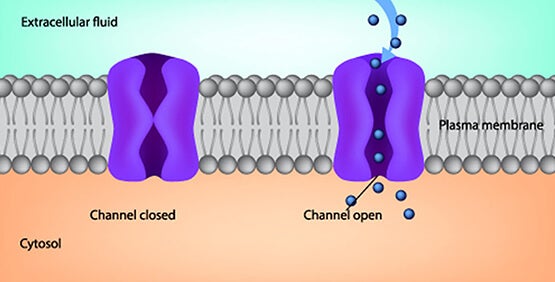
membrane channels
passive transport
allow a controlled diffusion through a cell membrane
selective (only allow one kind of ion, molecule or atom, mainly small inorganic ions)
driving force is the electro-chemical gradient (same charges repel, opposite charges attract)
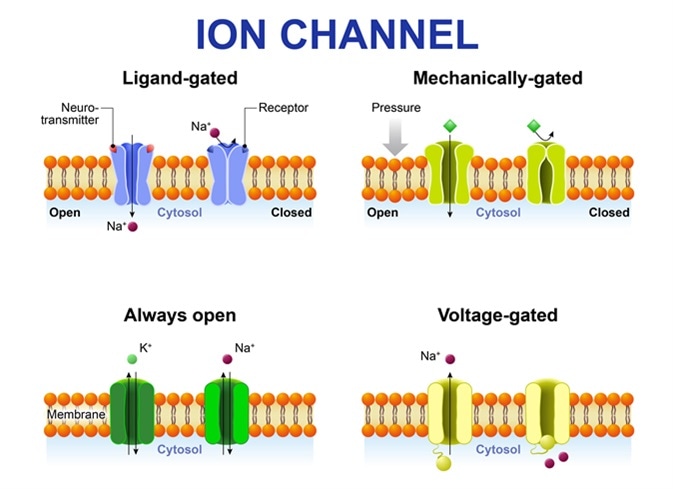
non-gated vs gated membrane channels
non-gated: opens all the time, leak channels
gated:
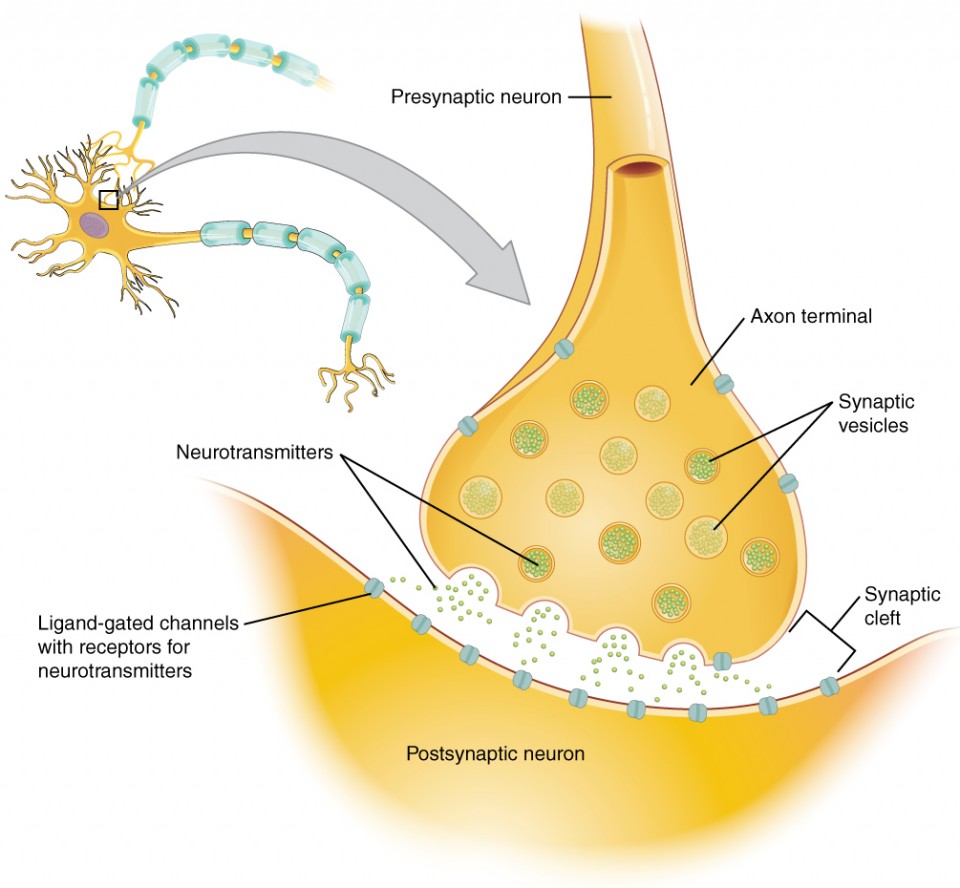
ligand gated ion channels open when a chemical ligand, such as a neurotransmitter, binds to the receptor
technically gated channels open in response to the physical deformation of the receptor, as in sensory receptors of touch or pressure
voltage gated channels open and close in response to changes in membrane potential (voltage difference surrounding the cell membrane)
cell membrane charge key concept
extracellular boarder right around cell membrane s positive while intracellular boarder has a negative charge
cation vs anion
cation: positive charge
anion: negative charge
active transport mechanism
employed to generate a gradient or to maintain it
transport direction is “uphill”, that is against the gradient (chemical or electrical)
energy is required
the transporters, called “pumps” use TAP as a source of energy. they are integral membrane proteins which bind to one or more ions at one side of the membrane and release them at the opposite side
example: sodium potassium pump
sodium-potassium pump (Na+/K+)
transports 3 Na+ from the cytoplasm to the extracellular fluid (ECF) against its electrochemical gradient.
Simultaneously, takes 2 K+ into the cell against its chemical gradient only
extracellular concentrations:
Na+: 145 mEq/L
K+: 4 mEq/L
glucose: 5 mol/L
Ca++: 2.5 mEq/L (ionized)
Intracellular concentrations:
Na+: 12 mEq/L
K+: 120 mEq/L
glucose: 2 mol/L
Ca++: 0.001 mEq/L (ionized)
active vs passive transport
active transport:
transporter is conducted against a concentration/ electrical gradient and energy is required
primary active transport: Uses ATP splitting directly, Na+/K+
secondary active transport: does not use ATP directly, it uses the electrochemical gradient created by primary active transport to transport other substrates, Na+/Ca++ anti porter
Passive transport
transport is only driven by the concentration/electrical gradient, no energy required
simple diffusion (through membrane or leak channel)
facilitated diffusion (through uniporter)

experimental facts: membrane potenial
A basic experiment-measurement of the membrane potential.
• After penetration of the cell membrane, the active electrode records a negative potential of -70mV. This potential is in reference to the fluid in the Petri dish.
• In a tissue, the extracellular fluid is considered the reference; related to this reference, the intracellular potential is negative. That is why we talk about a “negative membrane potential”.

distribution of electrical charges around the cell membrane: electroneutrality
electroneutrality principle: the total number of positive and negative charges int he extracellular fluid is equal
there is only an accumulation of positive charges at the outside (ECF) and negative charges at the side (ICF) in the immediate vicinity of the cell membrane
Cations (+ charge) create a negatively charged membrane potential
ion concentration gradient causes the efflux (from in to out) of potassium (K+) and the influx of (from out to in) of sodium (Na+)
potassium ions diffuse through leak channels (leak back out of cell to follow gradient) more easily than sodium ions

the sodium potassium pump is electrogenic
the membrane potential is based on a difference in positive charges
the Na+/K+ pump moves sodium out of the cell and potassium into the cell, thus generating a high Na+ concentration at the extracellular side and a high K+ concentration at the intracellular side
it exchanges 3Na+ for 2K+ thus generating differences in their concentrations inside (ICF) and outside (ECF)
some K+ leaks back out of the cell driven by its concentration gradient
the cytosol loses more positive charges than it gains, leading to the negative resting membrane potential
Summary image

Summary pt1
what determines the distribution of electrical charges around the cell membrane of excitable cells?
electrochemical gradients for different ions
semi permeability of the cell membrane
describe the creation of cell membrane potential and action potential in neurons
potassium leak channels
sodium/potassium pump
integrate the pathophysiology of potassium plasma concentration disturbances leading to changes in he excitability of cells suing clinically relevant examples
hypercalcemia = depolarization
hypokalcemia = hyperpolarization
Calculation of the electrical potential generated by a single kind of ion
Nernst equation: diffusion of ions based on chemical gradient will continue until the contracting electrical gradient equals the chemical gradient. The electrical potential of this balanced state for one univalent ion can be determined from the following formula

Nernst equation for K+ and Na+
the resting membrane potential after equilibrium (K+, 4mmol/L outside and 120mmol/L inside) would be -90mV
the resting membrane potential after equilibrium (Na+, 145mmol/L outside and 14.5mmol/L inside) would be +61mV
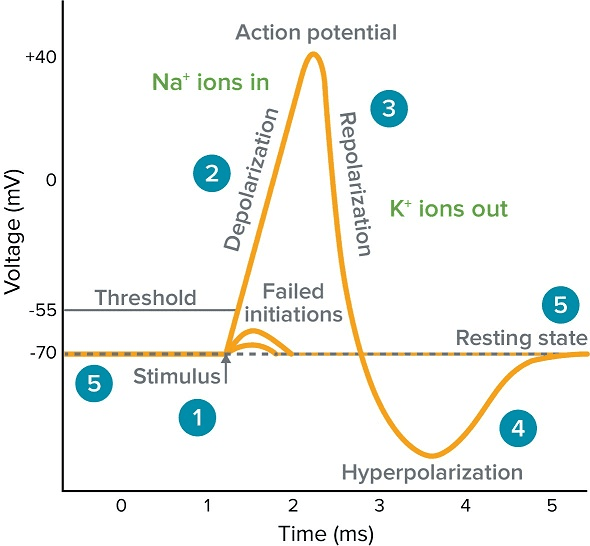
depolarization
gain of positive charges makes the inside of the cell less negative
the membrane potential difference decreases, which is equal to saying “the membrane potential is less negative or more positive”
increases cell excitability
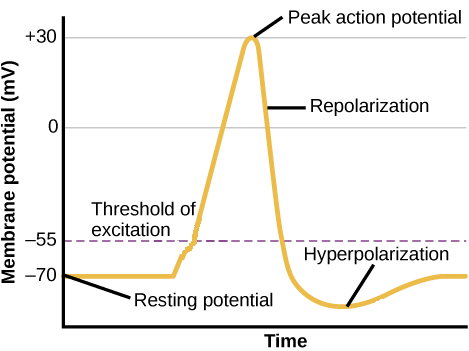
hyperpolarization
loss of positive charges (or gain of negative charges) makes the side of the cell more negative
the membrane potential difference increases, which is qual to saying “the membrane potential is more negative or less positive”
silences cells (makes them less excitable)
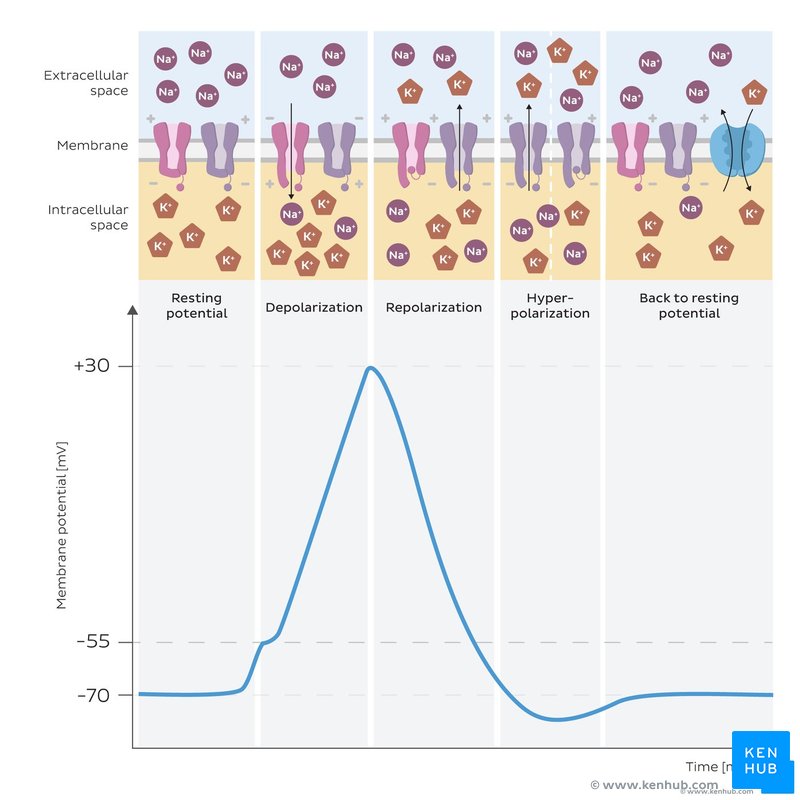
Action potential steps
Resting membrane potential (-70mV)
Depolarizing stimulus. Membrane depolarizes to the threshold. Voltage- gated Na+ and K + channels begin to open
Rapid Na+ entry depolarizes the cell
Rapid Na+ channels close (auto inactivation), and slower K+ channels open
K+ moves from cell to extracellular fluid
K+ channels remain open and additional K+ leaves cell, hyperpolarizing it (making it more negative)
Voltage-gated K+ channels close, less K+ leaks out of the cell
voltage changes
voltage changes across the membrane can be classified into two basic electrical signal types: graded potential and action potential
graded potential
variable strength signals that travel over short distances and lose strength as they travel through the cell
used for short-distance communication
if a depolarizing graded potential is strong enough when it reaches an integrating region within a neuron (trigger zone or axon hillock), the graded potential initiates an action potential
action potential
very brief, large depolarizations that travel long distances through a neuron without losing strength
their function is rapid signaling over long distances, from the toe to the brain

generation of the action potential: depolarization
the influx of Na+ depolarizes the cell membrane from -70mV toward 0. Driving force = at the beginning, the electrochemical gradient promotes the influx of Na+, but at the end, during the overshoot, the driving force is just the chemical gradient
extracellular calcium modulates the function of the soodum-gated channels and others: for instance, hypocalcemia leads to hyperexcitibility due to enhancing sodium conductance

generation of the action potential: Repolarization
the inactivation gate also responds to depolarization but with some delay. Then, this gate closes (positive mV values) and the potential is reversed for a short time (= overshoot)
depolarization: the flux of K+ depolarizes the cell membrane toward -70mV
driving force: at a positive membrane potential, the concentration and electrical gradients for K+ favor the movement of K+ out of the cell (efflux). However, the electrical gradient opposes the diffusion as the membrane potential becomes negative
the K+ channel gate closes too late, and the depolarization goes beyond -70mV (=hyperpolarization)

Refractory periods
absolute refractory period: the period of an ongoing action potential during which no stimulus, not even an extremely strong one, can initiate another action potential
relative refractory period: follows the absolute refractory period during which a strong (=suprathreshold) stimulus can initiate another action potential
all or none principle
any depolarization of the cell membrane of an excitable cell either has no effect or results in a full action potential
action potentials are uniform in one kind of cell
once the threshold potentials is reached, the sequence of depolarization and depolarization starts and continues automatically
as both the Na+ and K+ channels are activated and deactivated by certain membrane potential levels, this sequence always generates a full action potential this means “all”
stimuli, not reaching the threshold potential, has no effect. This means “None”
changes in the extracellular potassium concentration from the physiological range impact cell excitability
clinical signs: muscle weakness and ventroflexion (downward bending) of the neck in cats
channelopathy: hyperkalcemic periodic paralysis in horses (HYPP)

Potassium K+ chemical gradient
The Na+/K+ ATPase (IPump) creates and maintains the K+ gradient via transporting K+ against its concentration gradient to the intracellular fluid (ICF).
The IPump transports Na+ against its concentration gradient to the extracellular fluid (ECF).
The difference between the number of positive charges transported out and into the cells explains the electrogenic properties of the IPump that makes the cell membrane potential (Vm) slightly negative.
potassium chemical gradient: magnitude and direction

strength of the K+ concentration gradient
