BMS2062 - W3: Genomic Variation and Disease
 Call Kai
 Learn
Learn Practice Test
 Spaced Repetition
 Match
Match Flashcards
 Knowt Play
1/11

There's no tags or description
Looks like no tags are added yet.
Name | Mastery | Learn | Test | Matching | Spaced | Call with Kai | Chat |
|---|
No analytics yet
Send a link to your students to track their progress
12 Terms
What are some approaches to determining the function of a gene product/ protein?
location of gene
comparative analysis
structure function analysis
biomolecule interaction analysis
consequences of over/ under expression
consequences of mutation
Location of gene expression - analysis
Genome contains the same genetic material in all cells but are expressed differently in different cells.
gene being expressed in a particular cell = protein’s function is required in some way by that cell
transcriptomics can tell us where genes are being expressed (which RNA are present)
proteomics can also tell us what collection of protein are present within a cell/ group of cells at any one time
The expression atlas: a database that contains the transcriptomics and proteomic data regarding genes expression in specific tissues for specific disease states
Comparative analysis
Have paralogues or orthologues previously been characterised for the gene of interest
can infer that genes which haven’t been researched yet function similar to homologues
could use web BLAST to find homologues (as they are likely to have a high number of sequence similarity)
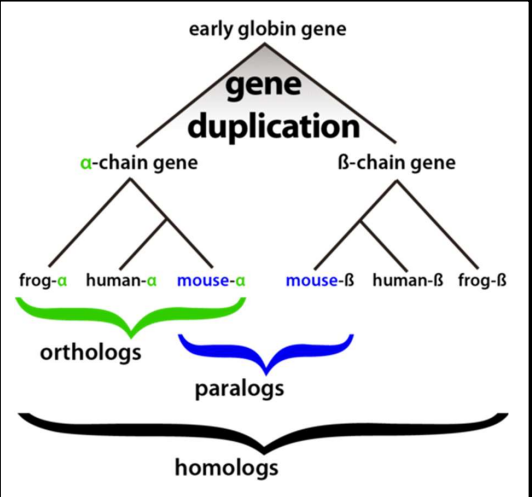
Homologues:
Orthologues: genes which have been evolved from a common ancestor gene that have retained similar functions in different species
Paralogues: Genes which have evolved from the same ancestral gene in different regions of an organism’s genome
Structure function analsyis
Through the structure of a protein, we can determine the functionally important regions
sequence of a protein can help understand how a protein might function - particular domains/ regions which can be used to infer function (can compare with already known proteins)
X-ray crystallography, NRM or cryo-electron microscopy can be used to help understand the structure of a protein
can look for binding pockets
amino acid patterns (charged residues which bind to things)
Biomolecule interactions analysis
Based on the structure of the protein, what is it likely to interact with
Can be detected by:
NMR - to collect structural data
fluorescence experiment (two proteins coming close together produces a fluorophore)
interactions proteomics
Bioinformatic Tools:
STRING (protein-protein interaction database)
Consequences of under/ overexpression
Common approach of determining function
can use model organisms to see this
consequences of mutation
Individuals with mutations can be used to study how mutation in that region of the gene causes dysfunction in the protein and cellular level
can create mutations in model organisms to see changes → understand function
Applications of genomics for humans
diagnostic testing
linking genetic variations to disease
prenatal genetic testing
cellular function
cancer therapy
pharmacogenomics
gene editing/ therapy
How can genomics be used to differentiate between healthy and cancerous tissue?
tumour suppressor genes and Proto-oncogenes
type of mutation, location of mutation, percentage chance people develop cancer with the mutation
some mutations have higher penetrance than others (more likely to cause cancer)
ClinVar
A bioinformatics tool that can assess an individual’s mutations against known mutations in the ClinVar database to assess pathogenicity
How can genomics enable gene editing?
genomics provides a map of where genes of interest are located (tells us where genes are and their sequence)
can identify desirable traits and find location of genomic variants associated with those traits
allows us to possibly add desirable traits into an embryo → desirable traits can get passed on
What is gene editing?
What techniques allow us to edit genes?
Making changes to the genetic material of an organism
techniques:
CRISPR-Cas9
ZFNs
TALENs
These techniques involve creating a double stranded break in the DNA and adding genes of interest