Infectious Diseases Week 3
 Call Kai
 Learn
Learn Practice Test
 Spaced Repetition
 Match
Match Flashcards
 Knowt Play
1/194

There's no tags or description
Looks like no tags are added yet.
Name | Mastery | Learn | Test | Matching | Spaced | Call with Kai | Chat |
|---|
No analytics yet
Send a link to your students to track their progress
195 Terms
What are the three components of the epidemiologic triad
Environment, Host, and Agent
what is the environment
External factors that affecting agent and the opportunity for exposure
These are physical, social, economic, and biological factors that facilitate of act as a barrier for transmission of infectious diseases to a host
what are examples of the environment
Climate, sanitation, living conditions, and healthcare infrastructure
what is the host
The organism susceptible to an infectious disease
what are Factors influencing infection
genetic susceptibility, immune status, age, and behavior of the host
what is the agent
Causative factor of an infectious disease
eg. Bacterium, virus, parasite
what is Symbiosis
Together-life" with a host
What are ectosymbionts
Symbionts found on the surface of a larger organism
What are endosymbionts
Symbionts found within an organism
what are the types of symbiotic relationships
intermittent, cyclic, or permanent
What are examples of transient associations in disease
Listeriosis, malaria, leptospirosis, legionellosis, vaginosis
What happens in permanent associations between host and symbiont
They co-evolve
What is a consortium
A host with more than one symbiont
Do symbiotic interactions only affect the host and symbiont
No. Interactions impact the larger biotic community and wider ecosystem
what are the types of beneficial relationships
mutualism
cooperation or synergism
commensalism
What is mutualism
Reciprocal benefit between obligatory, dependent organisms
They may not survive as individual organisms
what are examples of mutualism
microbe-insect, methane-based, rumen-microbe
What is cooperation or synergism
A syntrophic relationship where growth relies on or is improved by nutrients from another in proximity
They can be separate but may hamper their functions
what is an example of cooperation
beneficial metabolites produced by gut bacteria
What is commensalism
A unidirectional relationship where the commensal feeds on host nutrients
May modify surroundings to make them favourable for other microorganisms
what is an example of commensalism
microorganisms on skin
what are the types of harmful symbiotic relationships
predation
parasitism
amensalism
what is predation
Predator species attacking, often killing its prey
what is parasitism
One obtains nutrients/benefits from host who is harmed
when is parasitism succesful and unsuccesful
Successful if co-existence is maintained
Failure if host dies or immune response elicited
what is an example of parasitism
Rickettsia typhi in human from rats (murine typhus)
the tropical disease schistosomiasis
what is amensalism
Harmful effects of one organism on another, unidirectional
what are examples of amensalism
antibiotic, bacteriocin production
What is competition in symbiotic relationships
A limiting nutrient resource utilised by different organisms – intra- and inter-specific competition
What is the competitive exclusion principle (Gause, 1934)
The dominant organism occupies physical space, acquires nutrients, and outgrows and outnumbers competing populations, often leading to extinction or specialisation
why does the ability of microbes to cause disease vary between species
Different virulence factors, modes of entry, etc
What are the three components of the innate immune system
Physical barriers, Chemical barriers, Cellular responses
How does normal microbiota help the host resist pathogens
Particularly on the skin and in the gut, via competitive exclusion
What were the characteristics of co-diversified species
They had smaller genomes and greater sensitivity to temperature and oxygen
How were co-diversified species transmitted
Between people in proximity or down generations
What happened to species that did not co-diversify
They were more likely to survive outside the body and were transmitted through water and soil compared to non-human primates
What were the differences in the gut microbiota of humans compared to non-human primates
Lower diversity in gut, increased Bacteroides abundance, decreased Methanobrevibacter and Fibrobacter
What factors changed the human microbiome
Dietary changes (e.g., cooking), agriculture, population size/density
Are internal tissues free of microorganisms
yes
Are surface tissues readily colonised by microbial species
yes
Is microflora acquisition a random or selective process
selective
Is the microbial niche stable
It is dynamic but generally stable
What can alter the microbiota
Medication, ageing, disease
What does host survival depend on
A complex defence network to keep pathogens and foreign material out and prevent parasitism or pathogenicity
What is 16S ribosomal RNA sequencing
A method to identify and compare bacteria and archaea
Why do all bacteria and archaea have 16S rRNA
It is a conserved gene present in all bacteria and archaea
How much phylogenetic information does 16S rRNA contain
Enough phylogenetic information (1500 bp)
What are highly conserved regions used fo
Primer design
What are highly variable regions used for
They have adequate variation to infer phylogenetic relationships and compare species
When does the development of a lifelong symbiotic relationship with microbes begin
at birth
What is the microbial community of the birth canal rich in
Lactobacill
What does breast milk do
It reinforces development and selects for symbiotic species
What are the effects of microbiota on human health
Influence metabolic function
protect against opportunistic infection
modify gene expression
immune system communication
produce neurotransmitters for neurological function and behaviour
What is the skin's role as a barrier
It is a mechanically strong barrier to microbial invasion with thick, tightly packed keratinocytes and continuous outer epithelial cell shedding
Is the skin microbiota shaped by physiological characteristics
yes
Do resident organisms normally grow on/in the skin
Yes. Their presence is fixed in well-defined distribution patterns
What are transient microorganisms
Temporarily present microorganisms on the skin
Does the mode of delivery affect initial colonisation
Yes. Initial colonisation is dependent on delivery mode
What are the long-term effects of delivery mode on health
unknown
What are the microbial differences associated with different delivery modes
Greater abundances of Firmicutes (Streptococcaceae spp.), Bacteroidetes and Proteobacteria (betaproteobacteria and gammaproteobacteria )
What happens to the skin microbiota during puberty
It is restructured. Increased hormones stimulate sebum production, favouring lipophilic organisms such as Propionibacterium spp., Corynebacterium spp., and fungal Malassezia spp
What does P. acnes produce and what effect does it have
P. acnes produces coproporphyrin III, which promotes S. aureus aggregation and biofilm formation
What is common acne, and what is it caused by
A chronic skin inflammatory condition. P. acnes is the most abundant organism, with distinct gene expression profiles between people with and without acne
what contributes to common acne
Genetics, immune/barrier defects, and microbiome-environment interactions
What is atopic dermatitis (eczema)
A chronic relapsing inflammatory disease involving epidermal barrier impairment, immune cell activation, and altered microbial community
Is it known whether changes in atopic dermatitis are cause or consequence
no
What is the role of S. aureus in eczema
is a poorly understood driver of eczema
Strain-dependent ability to trigger cutaneous immune response
δ-toxin induces mast cell degranulation
α-toxin induces monocytic IL-1β production (++ IL-17 from T-cells)
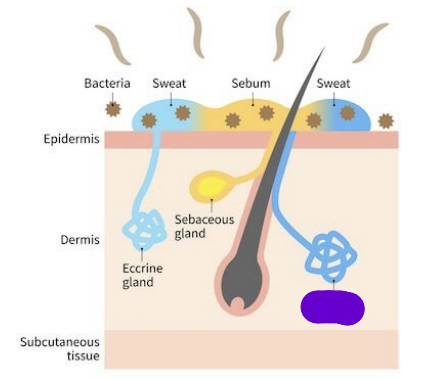
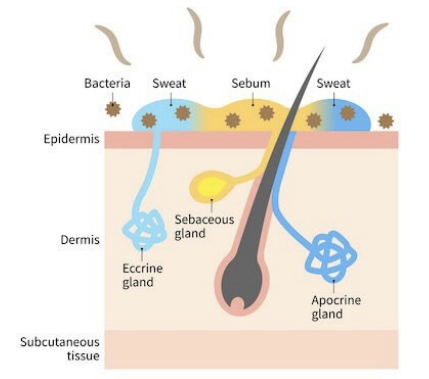
what is body odour produced by
Apocrine sweat glands – odourless secretion
Malodourous microbial metabolites
what do Corynebacterium spp. produce
volatile fatty acids › Intense cheese-like odour
What are the microbiota of the nasal cavity and nasopharynx (upper respiratory tract)
S. aureus, S. epidermidis (may be pathogenic when translocated)
S. pneumoniae (also an otopathogen with H. influenzae, M. catarrhalis)
How do these bacteria influence lower respiratory tract infections
hey influence the severity of LRTI caused by viruses by modulating the host immune response
What are the microbiota of the oropharynx
α-haemolytic streptococci – S. oralis, S. milleri, S. gordonii, S. salivarius
What are the microbiota of the external ear
they resemble that of the skin – coagulase-negative staphylococci, Corynebacteria, fungi
What is the microbiota of the middle ear
There is no scientific consensus on the "healthy" microbiota of the middle ear; it has low biomass
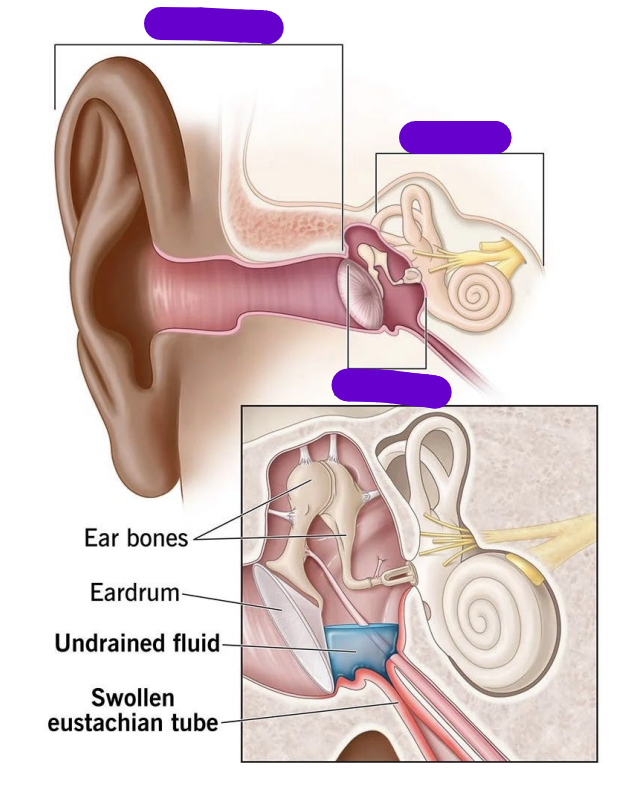
What is otitis media
Middle ear disease – an ear infection common in children
how are bacteria thought to reach the middle ear
They translocate via the pharyngotympanic (Eustachian) tube
Do acute cases of otitis media often resolve on their own
yes
What is chronic suppurative otitis media
A condition where the eardrum bursts; perforations heal on their own in most cases

Is there a resident microbiota in the lower respiratory tract
It is unknown if they exist as resident or transient populations
What genera are found in the lower respiratory tract
Pseudomonas, Streptococcus, Prevotella, Fusobacterium, Veillonella
How are sparse bacterial populations normally removed
By mucus from goblet cells, alveolar macrophages, and bactericidal lysozyme
What pathogens cause pneumonia
S. pneumoniae, H. influenzae, Mycoplasma pneumoniae
What happens in pneumonia
Inflammation and accumulation of fluids and leukocytes in the alveoli; can lead to pleurisy, making breathing painful
What viruses cause pneumonia
Influenza, viral pneumonia, SARS, MERS
What viral causes of pneumonia also cause skin rashes
Measles, rubella, chickenpox/shingles
Are fungal infections of the respiratory tract common
Symptomatic infections are rare in healthy individuals
What structures of the eye interface with the environment
Cornea, conjunctiva, tear film, eyelids
What is the dominant genus in the eye microbiota
Staphylococci (coagulase-negative commensals)
Is the "healthy" genera composition of the eye well-established
No. It is debated
Is the eye an immunologically privileged organ
yes
Why is the eye considered immunologically privileged
It is highly vascularised but requires sophisticated, tight regulation to avoid intraocular inflammation
What inflammatory diseases are associated with non-ocular microorganisms
Infectious uveitis caused by Herpes simplex virus, Toxoplasma gondii, Varicella-zoster virus
How do organisms resist mechanical removal in the oral cavity
By adherence (flush into stomach and epithelial cell shedding)
What genera initially colonise the oral cavity
Streptococcus, Neisseria, Actinomyces, Veillonella, Lactobacillus
What happens when teeth first erupt
Anaerobes dominate due to anoxic conditions between teeth and gums – Porphyromonas, Prevotella, Fusobacterium
What do S. parasanguis and S. mutans do
They adhere to enamel
What does S. salivarius do
It adheres to buccal and gingival epithelia and colonises saliva
What is the eventual outcome of oral biofilm formation
Dental plaque, caries, gingivitis, periodontal disease