Fundamentals of Lab medicine-part 1 W2:L2
0.0(0)
Studied by 0 people Call Kai
 Learn
Learn Practice Test
 Spaced Repetition
 Match
Match Flashcards
 Knowt Play
Card Sorting
1/38

Earn XP
Description and Tags
Last updated 9:28 PM on 10/29/22
Name | Mastery | Learn | Test | Matching | Spaced | Call with Kai | Chat |
|---|
No analytics yet
Send a link to your students to track their progress
39 Terms
1
New cards
MLT Job Settings:
-Hospitals
-Private laboratories
-Community health clinics
-Public health facilities
-IT, other areas w/in the hospital
-University research labs
-Biotechnology companies
-Specialty labs, e.g. in vitro fertilization labs
-Armed Forces
-Teaching
-Private laboratories
-Community health clinics
-Public health facilities
-IT, other areas w/in the hospital
-University research labs
-Biotechnology companies
-Specialty labs, e.g. in vitro fertilization labs
-Armed Forces
-Teaching
2
New cards
Laboratory Director/Pathologist
All licensed laboratories must operate under the direction of a Pathologist
3
New cards
Anatomic Pathologist:
Physician with 4-5 years of training in the examination of surgically removed specimens
4
New cards
Clinical Pathologist:
Physician with training in clinical pathology or laboratory medicine
5
New cards
Laboratory Manager/Supervisor:
Responsible for the technical aspects in
the laboratory and day-to-day
operations
the laboratory and day-to-day
operations
6
New cards
Medical Laboratory Technologist (MLT):
Performs general duty laboratory testing
7
New cards
Why order a lab test?
-Diagnosis of disease
-Management of illness of health
-Predict patient prognosis
-Establish a baseline
-Screen for “hidden” disease (no symptoms)
~85% of physician decisions and diagnosis are based
on laboratory test results
-Management of illness of health
-Predict patient prognosis
-Establish a baseline
-Screen for “hidden” disease (no symptoms)
~85% of physician decisions and diagnosis are based
on laboratory test results
8
New cards
OBJECTIVES:
To define as objectively as possible health and disease*
To help predict the course of a disease
To monitor the effectiveness of treatment
To seek for underlying causes of disease
To help predict the course of a disease
To monitor the effectiveness of treatment
To seek for underlying causes of disease
9
New cards
Morbidity:
Decreased life expectancy
10
New cards
How are Lab Tests ordered?
Electronic entry:
-hospital Information System (HIS)
-Laboratory Information System (LIS)
“Manual” Ordering:
-Requisitions: paper lab order forms
-Provincial order forms (OHIP form)
-hospital Information System (HIS)
-Laboratory Information System (LIS)
“Manual” Ordering:
-Requisitions: paper lab order forms
-Provincial order forms (OHIP form)
11
New cards
Laboratory Requisition Requirements:
Full name of patient
Patient unique number:
-“Admission” numbers: Every time a patient is registered into the
HIS/LIS a unique admission number is generated which identifies
that patient (for that admission)
Patient demographics: sex, DOB, address, etc
Order info: date, time, patient location, primary care provider
Tests ordered and priority: stat, urgent, routine
Relevant patient information: height/weight, drugs in use, race, disorder/disease
Collection info: date, time, collected by, fasting, patient
temp
Patient unique number:
-“Admission” numbers: Every time a patient is registered into the
HIS/LIS a unique admission number is generated which identifies
that patient (for that admission)
Patient demographics: sex, DOB, address, etc
Order info: date, time, patient location, primary care provider
Tests ordered and priority: stat, urgent, routine
Relevant patient information: height/weight, drugs in use, race, disorder/disease
Collection info: date, time, collected by, fasting, patient
temp
12
New cards
Accessioning:
The act of logging in/documenting the receipt of a specimen in the lab
-INFO documented: date/time specimens received in the lab, received by
-Generates an accession number:
Every UNIQUE specimen has a unique specimen/sample ID number
-INFO documented: date/time specimens received in the lab, received by
-Generates an accession number:
Every UNIQUE specimen has a unique specimen/sample ID number
13
New cards
How do we report results?
Interface: Electronic automatic transfer of results from the analyzer to LIS
14
New cards
What’s on the Lab Report?
Test info:
(date/time /person verifying results)
Test results :
-Test units, reference intervals, critical values
-Sample comments, interpretative comments
-Phoned results (what, to whom, by whom)
(date/time /person verifying results)
Test results :
-Test units, reference intervals, critical values
-Sample comments, interpretative comments
-Phoned results (what, to whom, by whom)
15
New cards
Are all lab orders the same?
No! The Lab can receive tests orders
in different ways:
in different ways:
16
New cards
Reference Intervals :
“Normal Values”: a range of values obtained by measurement of a particular type of quantity on a reference individual = usual values for a healthy population.
-Positive Diagnosis (“Rule-in”): condition (lab results) that resembles that typical of a particular disease.
-Diagnosis by Exclusion (“Rule-Out”): observations (lab results) that do not fit patterns characteristic of alternative diseases.
-Positive Diagnosis (“Rule-in”): condition (lab results) that resembles that typical of a particular disease.
-Diagnosis by Exclusion (“Rule-Out”): observations (lab results) that do not fit patterns characteristic of alternative diseases.
17
New cards
IFCC (International Federation of Clinical Chemistry)
Each lab must establish their own Reference Intervals!!!
recommends “reference interval” and 5 factors specified when establishing a RI
recommends “reference interval” and 5 factors specified when establishing a RI
18
New cards
5 factors specified when establishing a RI:
1.Define demographics: age, sex, race, pregnancy
2. Criteria for inclusion and exclusion of data
3. Physiological & environment conditions under which samples are collected (date/time/food intake/smoking...)
4. Specimen collection procedure
5. Analytical method used including accuracy and precision details.
2. Criteria for inclusion and exclusion of data
3. Physiological & environment conditions under which samples are collected (date/time/food intake/smoking...)
4. Specimen collection procedure
5. Analytical method used including accuracy and precision details.
19
New cards
Critical Values:
A clinically significant value of an analyte that requires immediate medical intervention.
-Previously referred to as “Panic Levels”
-Often requires repeat for confirmation
-MUST be immediately telephoned to the physician and documented.
-Communicable diseases: must notify department of health
-Previously referred to as “Panic Levels”
-Often requires repeat for confirmation
-MUST be immediately telephoned to the physician and documented.
-Communicable diseases: must notify department of health
20
New cards
Systems of Measurement:
The UNIT defines the dimensions (volume, mass,
concentration, time) of a measured analyte (test).
Three systems in use:
Metric System
Conventional Units: the amount of dissolved mass
International System (SI System): the number of dissolved molecules (measured in moles)
concentration, time) of a measured analyte (test).
Three systems in use:
Metric System
Conventional Units: the amount of dissolved mass
International System (SI System): the number of dissolved molecules (measured in moles)
21
New cards
International System of Units (SI System)
Accepted internationally in 1960
Based upon Metric System (but NOT the same!)
Consists of 7 basic units
Meter
Kilogram
Second
Mole
Ampere
Kelvin
Candela
And....... derived units
Based upon Metric System (but NOT the same!)
Consists of 7 basic units
Meter
Kilogram
Second
Mole
Ampere
Kelvin
Candela
And....... derived units
22
New cards
Derived units:
obtained by combining basic units
through multiplication/division
through multiplication/division
23
New cards
SI Units:
Basic and Derived units can be too large or too small
-NOT used in Canada for many tests
Prefixes are used to express multiples of submultiples of the units
-NOT used in Canada for many tests
Prefixes are used to express multiples of submultiples of the units
24
New cards
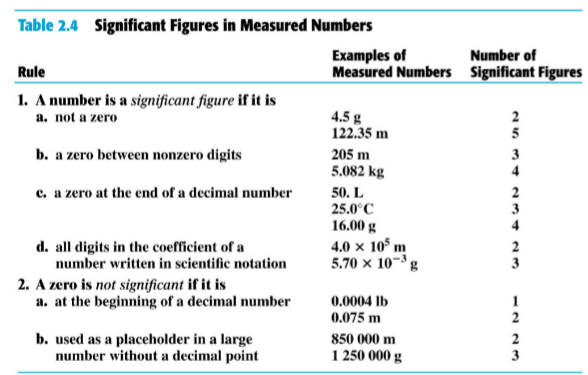
Significant Figures (decimal precision):
The minimum number of digits needed to express
a particular value in scientific notation without
loss of accuracy.
a particular value in scientific notation without
loss of accuracy.
25
New cards
Biological Variation:
the natural variability in a lab test due to
physiologic differences among subjects and within the same subject over time
physiologic differences among subjects and within the same subject over time
26
New cards
Sig figs lab:
1. Patient results should be expressed to the same decimal precision as used to express the Reference Interval for a test
2. Good quality control practice reports control results to one additional significant figure when possible.
Example:
Glucose: Normal Range: 4.0 – 6.0 mmol/L
PATIENT: reported to 1 decimal point (ex. 4.1 mmol/L)
CONTROL: reported to 2 decimal points (ex. 4.11 mmol/L)
2. Good quality control practice reports control results to one additional significant figure when possible.
Example:
Glucose: Normal Range: 4.0 – 6.0 mmol/L
PATIENT: reported to 1 decimal point (ex. 4.1 mmol/L)
CONTROL: reported to 2 decimal points (ex. 4.11 mmol/L)
27
New cards
Rounding Off:
1. If the number to be removed is less than 5 round down
Ex: 6.423 becomes 6.42
2. If the number to be removed is greater than or equal to 5 round up
Ex: 6.427 becomes 6.43
6.425 becomes 6.43
Ex: 6.423 becomes 6.42
2. If the number to be removed is greater than or equal to 5 round up
Ex: 6.427 becomes 6.43
6.425 becomes 6.43
28
New cards
Post-Analytical Processes:
-Call critical values
- Report results
-Interpret results
-Verify results
-Phone/send results to health care provider
-Store Specimens (prepare samples accordingly)
-Specimen retention
-Retention of results
- Report results
-Interpret results
-Verify results
-Phone/send results to health care provider
-Store Specimens (prepare samples accordingly)
-Specimen retention
-Retention of results
29
New cards
Information Systems:
HIS (Hospital Information System): Computerized system linking all areas/processes of patient care in the hospital
-Assigns unique identification number for patient upon admission
-Captures Patient Demographics
-Facilitates Order Entry (by physicians, nurses, etc)
-Captures other patient info
-Medications, diagnoses, diagnostic tests
-Keeps electronic record of all activities associated with a patient admission
-Assigns unique identification number for patient upon admission
-Captures Patient Demographics
-Facilitates Order Entry (by physicians, nurses, etc)
-Captures other patient info
-Medications, diagnoses, diagnostic tests
-Keeps electronic record of all activities associated with a patient admission
30
New cards
The Laboratory Information System (LIS):
-Integration w/HIS allows transfer of information (w/o
manual transcription)
-Facilitates capture of demographics, order entry,
date/time of collection/testing, specimen
requirements, physician information, test specifics,
quality control results, and just about anything you
can think of!!!!
-Analyzer Interface: communication software
linking analyzer output directly to LIS
manual transcription)
-Facilitates capture of demographics, order entry,
date/time of collection/testing, specimen
requirements, physician information, test specifics,
quality control results, and just about anything you
can think of!!!!
-Analyzer Interface: communication software
linking analyzer output directly to LIS
31
New cards
Advantages of the LIS:
-Documentation of sample handling, analysis,
reporting
-Captures date/time/operator for each step
-Provides a means to relay interpretative
messages and reference interval information to
the health care provider
-Documents handling of critical values
-Tracks volumes/workload/patient billing
-Provides a database for investigations and quality
assurance measures
reporting
-Captures date/time/operator for each step
-Provides a means to relay interpretative
messages and reference interval information to
the health care provider
-Documents handling of critical values
-Tracks volumes/workload/patient billing
-Provides a database for investigations and quality
assurance measures
32
New cards
MLTS:
-Venipuncture
-Run Lab tests
-Develop and evaluate the tests
-Interpret data
-Assess results
-Communicate with physicians regarding test results
-Perform, assess quality control/QA/QM
-Equipment maintenance/troubleshooting
-Inventory
-Run Lab tests
-Develop and evaluate the tests
-Interpret data
-Assess results
-Communicate with physicians regarding test results
-Perform, assess quality control/QA/QM
-Equipment maintenance/troubleshooting
-Inventory
33
New cards
Millimoles(mmol/L) to micromoles (umol/L)?
x 1000
34
New cards
Why is the reporting unit used extremely important in the clinical laboratory?
to interpret result with the reference intervals
35
New cards
Single test order:
GLU
36
New cards
Multiple selected test orders:
GLU, UREA, CREA
37
New cards
Profile (Panel) orders:
LYTES, LIPIDS
A set of tests ordered together using one profile name
A set of tests ordered together using one profile name
38
New cards
Standing Orders (aka Recurring Orders):
A set of tests (automatically) repeated at a designated interval
39
New cards
Add-Ons:
after blood collected, add on additional tests (usually requires a phone call to the lab)