B.2. TYPES OF TITRATIONS Part 2
 Call Kai
 Learn
Learn Practice Test
 Spaced Repetition
 Match
Match Flashcards
 Knowt Play
1/100

There's no tags or description
Looks like no tags are added yet.
Name | Mastery | Learn | Test | Matching | Spaced | Call with Kai | Chat |
|---|
No analytics yet
Send a link to your students to track their progress
101 Terms
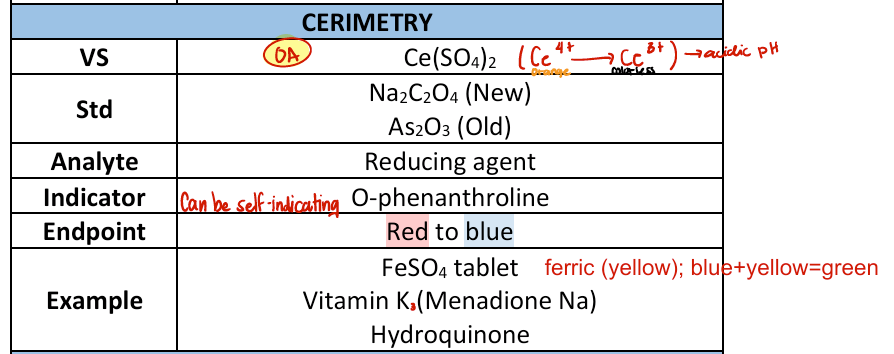
d. Ce(SO₄)₂
Oxidizing agent
[BASED ON TYPE OF RXN INVOLVED]
The titrant used in Cerimetry
a. KMnO₄
b. I₂
c. Na₂S₂O₃
d. Ce(SO₄)₂
b. Ce⁴⁺ → Ce³⁺ in acidic pH
orange to colorless
[BASED ON TYPE OF RXN INVOLVED]
The redox reaction of Ce(SO₄)₂ in Cerimetry
a. Ce³⁺ → Ce⁴⁺ in basic pH
b. Ce⁴⁺ → Ce³⁺ in acidic pH
c. Ce²⁺ → Ce³⁺ in acidic pH
d. Ce⁰ → Ce⁴⁺ in basic pH
d. As₂O₃ (arsenic trioxide)
[BASED ON TYPE OF RXN INVOLVED]
The old standard used in Cerimetry
a. Na₂C₂O₄
b. KHP
c. Tromethamine
d. As₂O₃
a. Na₂C₂O₄ (sodium oxalate)
[BASED ON TYPE OF RXN INVOLVED]
The new standard used in Cerimetry
a. Na₂C₂O₄
b. KHP
c. Tromethamine
d. As₂O₃
d. Reducing agent
because Ce(SO4)2 is OA
[BASED ON TYPE OF RXN INVOLVED]
The analyte in Cerimetry
a. Oxidizing agent
b. Acid
c. Base
d. Reducing agent
d. O-phenanthroline -
but can be self-indicating
[BASED ON TYPE OF RXN INVOLVED]
The indicator used in Cerimetry
a. Starch
b. Phenolphthalein
c. Crystal violet
d. O-phenanthroline
d. Red to blue
[BASED ON TYPE OF RXN INVOLVED]
The endpoint color change in Cerimetry
a. Colorless to pale pink
b. Yellow to green
c. Colorless to blue
d. Red to blue
d. Yellow
Blue (endpoint of ceric) + Yellow (Ferric)= Green
Blue + Yellow = Green
[BASED ON TYPE OF RXN INVOLVED]
The color of FeSO₄ tablet in Cerimetry titration
a. Blue
b. Violet
c. Colorless
d. Yellow
b. Vitamin K3 (Menadione Na)
c. FeSO₄ tablet
d. Hydroquinone
[BASED ON TYPE OF RXN INVOLVED]
The examples analyzed by Cerimetry
(multiple answers)
a. H₂O₂ and NaNO₂
b. Vitamin K3 (Menadione Na)
c. FeSO₄ tablet
d. Hydroquinone
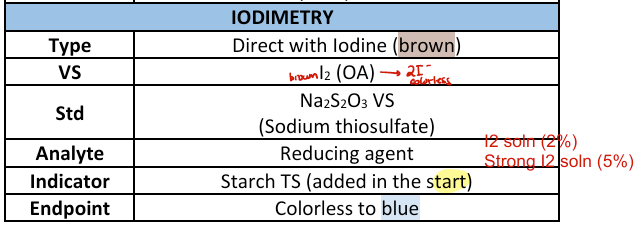
d. I₂ (brown)
[BASED ON TYPE OF RXN INVOLVED]
The titrant used in Iodometry
a. KMnO₄
b. Ce(SO₄)₂
c. Na₂S₂O₃
d. I₂
c. I₂ (brown) → 2I⁻ (colorless)
[BASED ON TYPE OF RXN INVOLVED]
The reaction of I₂ as oxidizing agent in Iodometry
a. I⁻ → I₂
b. I₂ → I⁻
c. I₂ → 2I⁻
d. 2I⁻ → I₂
d. Na₂S₂O₃ (Sodium thiosulfate)
[BASED ON TYPE OF RXN INVOLVED]
The standard used in Iodometry
a. KHP
b. As₂O₃
c. Na₂C₂O₄
d. Na₂S₂O₃ (Sodium thiosulfate)
d. Reducing agent
because iodine is OA
[BASED ON TYPE OF RXN INVOLVED]
The analyte in Iodometry
a. Oxidizing agent
b. Acid
c. Base
d. Reducing agent
b. Starch TS (added at the start)
[BASED ON TYPE OF RXN INVOLVED]
The indicator used in Iodometry
a. Crystal violet
b. Starch TS (added at the start)
c. Phenolphthalein
d. Starch TS (added at the end)
d. Colorless to blue
[BASED ON TYPE OF RXN INVOLVED]
The endpoint color change in Iodometry
a. Red to blue
b. Blue to colorless
c. Colorless to pale pink
d. Colorless to blue
b. I₂ solution: 2%; Strong I₂ solution: 5%
[BASED ON TYPE OF RXN INVOLVED]
The concentration of Iodine solution used as analyte in Iodometry
a. Strong I₂ solution: 5%; I₂ solution: 2%
b. I₂ solution: 2%; Strong I₂ solution: 5%
c. Both are 2%
d. Both are 5%
d. Iodometry
[BASED ON TYPE OF RXN INVOLVED]
The old test for Vitamin C
a. Dichlorophenol-Indophenol Titration
b. Diazotization Titration
c. Iodimetry
d. Iodometry
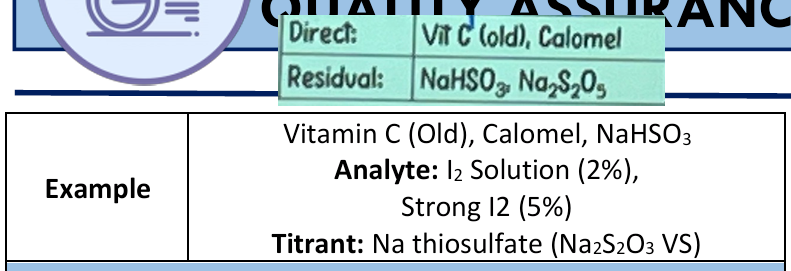
a. Calomel
c. Vitamin C (old)
[BASED ON TYPE OF RXN INVOLVED]
The examples of Direct Iodimetry analytes
(multiple answers)
a. Calomel
b. Phenol and Resorcinol
c. Vitamin C (old)
d. K₂CrO₇ and Na₂S₂O₃
d. NaHSO₃ and Na₂S₂O₅
[BASED ON TYPE OF RXN INVOLVED]
The examples of Residual Iodimetry analytes
a. Vitamin C and Calomel
b. CuSO₄ and NaOCl
c. K₂CrO₇ and KHP
d. NaHSO₃ and Na₂S₂O₅
a. Na₂S₂O₃ (Sodium thiosulfate)
[BASED ON TYPE OF RXN INVOLVED]
The titrant used in Iodimetry
a. Na₂S₂O₃
b. K₂CrO₇
c. As₂O₃
d. KHP
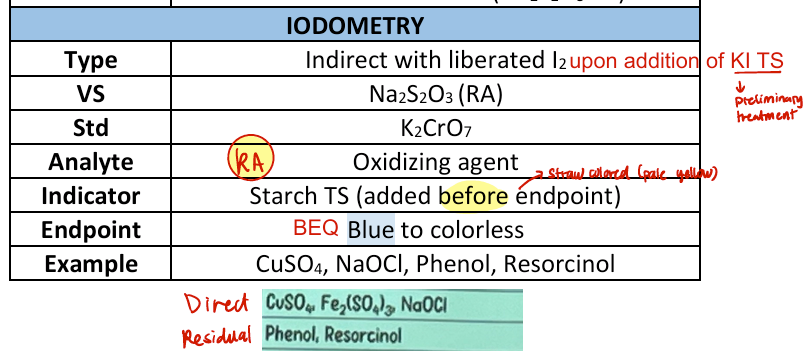
b. Iodometry
[BASED ON TYPE OF RXN INVOLVED]
The type of titrimetry that involves indirect reaction with liberated I2 upon addition of KI TS
a. Iodimetry
b. Iodometry
c. Diazotization Titration
d. Complexation Titration
c. Na2S2O3 VS
reducing agent
[BASED ON TYPE OF RXN INVOLVED]
The VS used in Iodometry
a. KMnO4 VS
b. KIO3 VS
c. Na2S2O3 VS
d. NaNO2 VS
d. K2CrO7
[BASED ON TYPE OF RXN INVOLVED]
The standard used in Iodometry
a. KHP
b. Na2S2O3
c. Sulfanilamide RS
d. K2CrO7
c. Starch TS added before endpoint
while the soln is straw colored (pale yellow)
[BASED ON TYPE OF RXN INVOLVED]
The indicator used in Iodometry and when it is added
a. Amaranth TS added at endpoint
b. Starch TS added after endpoint
c. Starch TS added before endpoint
d. Phenolphthalein added before endpoint
a. Oxidizing agent
because Na2S2O3 is RA
ito lang ang analyte na OA
[BASED ON TYPE OF RXN INVOLVED]
The analyte in Iodimetry
a. Oxidizing agent
b. Acid
c. Base
d. Reducing agent
c. Blue to colorless
Iodometry: colorless to blue
[BASED ON TYPE OF RXN INVOLVED]
BEQ: The endpoint of Iodometry
a. Colorless to pale pink
b. Red to yellow
c. Blue to colorless
d. Colorless to blue
b. CuSO4 and Fe(SO4)3
c. NaOCl
[BASED ON TYPE OF RXN INVOLVED]
Examples of analytes tested by Direct Iodometry
(multiple answers)
a. Phenol and Resorcinol
b. CuSO4 and Fe(SO4)3
c. NaOCl
d. Sulfa drugs and Dapsone
d. Phenol and Resorcinol
[BASED ON TYPE OF RXN INVOLVED]
Examples of analytes tested by Residual Iodometry
a. CuSO4 and NaOCl
b. Vitamin C and NaHSO3
c. Sulfa drugs and Dapsone
d. Phenol and Resorcinol
b. Iodimetry
[BASED ON TYPE OF RXN INVOLVED]
The old test for Vitamin C
a. Dichlorophenol-Indophenol Titration
b. Iodimetry
c. Complexation Titration
d. Iodometry
c. Dichlorophenol-Indophenol Titration
[BASED ON TYPE OF RXN INVOLVED]
The new test for Vitamin C
a. Iodometry
b. Complexation Titration
c. Dichlorophenol-Indophenol Titration
d. Diazotization Titration
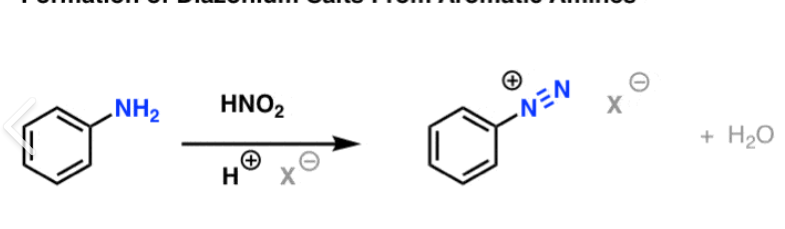
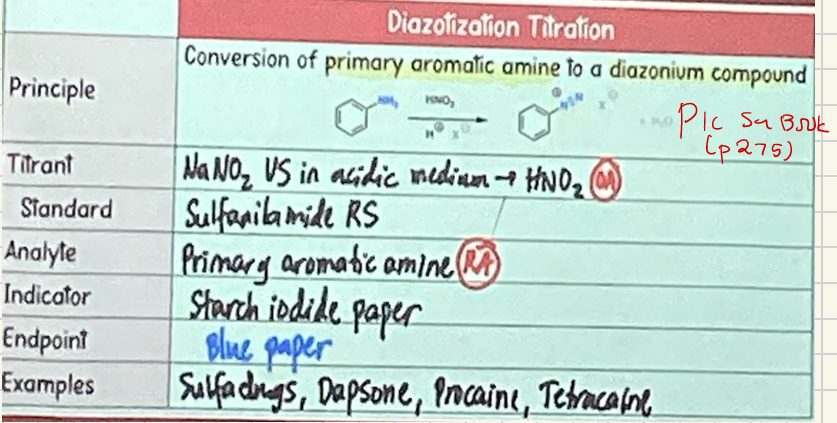
c. Conversion of primary aromatic amine to a diazonium compound
[BASED ON TYPE OF RXN INVOLVED]
The principle of Diazotization Titration
a. Indirect reaction with liberated I2
b. Dichlorophenol-Indophenol has a specific ability to oxidize ascorbic acid
c. Conversion of primary aromatic amine to a diazonium compound
d. Oxidation of ascorbic acid
d. NaNO2 VS in acidic medium
oxidizing agent
acidic medium: HNO2
[BASED ON TYPE OF RXN INVOLVED]
The titrant used in Diazotization Titration
a. KIO3 VS in basic medium
b. Dichlorophenol-Indophenol VS in basic medium
c. Na2S2O3 VS in acidic medium
d. NaNO2 VS in acidic medium
c. Sulfanilamide RS
[BASED ON TYPE OF RXN INVOLVED]
The standard used in Diazotization Titration
a. Ascorbic acid RS
b. K2CrO7
c. Sulfanilamide RS
d. KHP
d. Starch iodide paper
[BASED ON TYPE OF RXN INVOLVED]
The indicator used in Diazotization Titration
a. Starch TS
b. Amaranth TS
c. Phenolphthalein
d. Starch iodide paper
b. Blue paper
[BASED ON TYPE OF RXN INVOLVED]
The endpoint of Diazotization Titration
a. Colorless to pale pink
b. Blue paper
c. Blue to colorless
d. Red to yellow
b. Procaine and Tetracaine
c. Sulfa drugs and Dapsone
[BASED ON TYPE OF RXN INVOLVED]
Examples of analytes tested by Diazotization Titration
(multiple answers)
a. CuSO4, NaOCl, and Phenol
b. Procaine and Tetracaine
c. Sulfa drugs and Dapsone
d. NaI and KI
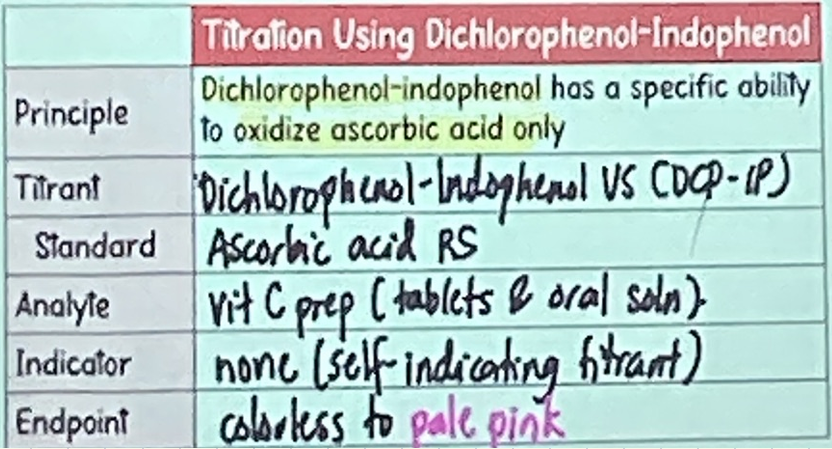
c. Dichlorophenol-Indophenol has a specific ability to oxidize ascorbic acid
[BASED ON TYPE OF RXN INVOLVED]
The principle of Titration Using Dichlorophenol-Indophenol
a. Conversion of primary aromatic amine to a diazonium compound
b. Formation of ion pair in acidic pH
c. Dichlorophenol-Indophenol has a specific ability to oxidize ascorbic acid
d. Conversion of primary aromatic amine to a diazonium compound
d. Dichlorophenol-Indophenol VS (DCDP-IP)
[BASED ON TYPE OF RXN INVOLVED]
The titrant used in Dichlorophenol-Indophenol Titration
a. NaNO2 VS
b. Na2S2O3 VS
c. KIO3 VS
d. Dichlorophenol-Indophenol VS (DCDP-IP)
c. Ascorbic acid RS
[BASED ON TYPE OF RXN INVOLVED]
The standard used in Dichlorophenol-Indophenol Titration
a. Sulfanilamide RS
b. K2CrO7
c. Ascorbic acid RS
d. KHP
c. Vitamin C preparations (tablets and oral solutions)
[BASED ON TYPE OF RXN INVOLVED]
The analyte tested in Dichlorophenol-Indophenol Titration
a. Primary aromatic amines
b. Iodide salts
c. Vitamin C preparations
d. Polyvalent metal ions
d. Colorless to pale pink
[BASED ON TYPE OF RXN INVOLVED]
The endpoint of Dichlorophenol-Indophenol Titration
a. Blue to colorless
b. Red to yellow
c. Blue paper
d. Colorless to pale pink
d. None
self-inducing
[BASED ON TYPE OF RXN INVOLVED]
The indicator of Dichlorophenol-Indophenol Titration
a. Sulfanilamide RS
b. K2CrO7
c. Ascorbic acid RS
d. None
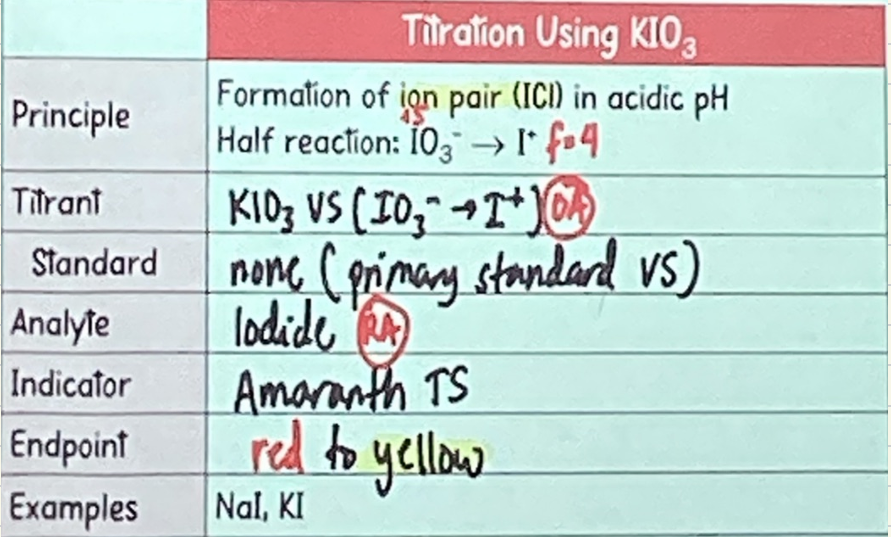
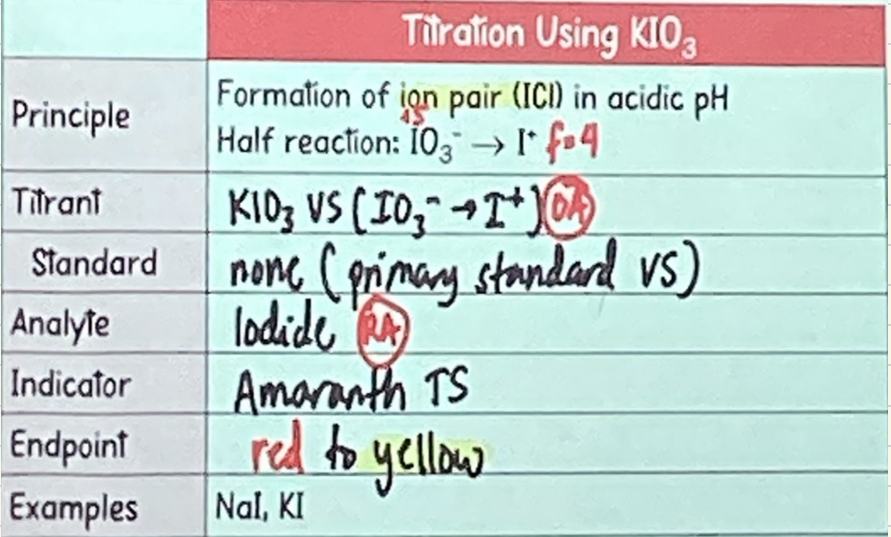
c. Formation of ion pair (ICl) in acidic pH
[BASED ON TYPE OF RXN INVOLVED]
a. Oxidation of ascorbic acid only
b. Conversion of primary aromatic amine to diazonium compound
c. Formation of ion pair (ICl) in acidic pH
d. Indirect reaction with liberated I2
d. IO3⁻ → I⁺ (f = 4)
[BASED ON TYPE OF RXN INVOLVED]
The half reaction in Titration Using KIO3
a. IO3⁻ → I2 (f = 5)
b. IO3⁻ → ICl (f = 4)
c. IO3⁻ → I⁻ (f = 6)
d. IO3⁻ → I⁺ (f = 4)
c. KIO3 VS
oxidizing agent
[BASED ON TYPE OF RXN INVOLVED]
The titrant used in Titration Using KIO3
a. NaNO2 VS
b. Na2S2O3 VS
c. KIO3 VS
d. Dichlorophenol-Indophenol VS
b. Iodide (RA)
because the titrant KlO3 is OA
[BASED ON TYPE OF RXN INVOLVED]
The analyte tested in Titration Using KIO3
a. Primary aromatic amines
b. Iodide
c. Vitamin C preparations
d. Polyvalent metal ions
d. Amaranth TS
[BASED ON TYPE OF RXN INVOLVED]
The indicator used in Titration Using KIO3
a. Starch iodide paper
b. Starch TS
c. Phenolphthalein
d. Amaranth TS
d. Nonep
primary standard VS
[BASED ON TYPE OF RXN INVOLVED]
[BASED ON TYPE OF RXN INVOLVED]
The indicator of Titration using KIO3
a. Sulfanilamide RS
b. K2CrO7
c. Ascorbic acid RS
d. None
c. Red to yellow
[BASED ON TYPE OF RXN INVOLVED]
The endpoint of Titration Using KIO3
a. Blue to colorless
b. Colorless to pale pink
c. Red to yellow
d. Blue paper
d. NaI and KI
[BASED ON TYPE OF RXN INVOLVED]
Examples of analytes tested by Titration Using KIO3
a. CuSO4 and NaOCl
b. Sulfa drugs and Dapsone
c. Vitamin C tablets and oral solutions
d. NaI and KI
c. Complexation Titration
polyvalent = +2, +3 metal ions
[BASED ON TYPE OF RXN INVOLVED]
The current method of choice for determination of polyvalent metal ions using disodium EDTA as titrant
a. Iodometry
b. Diazotization Titration
c. Complexation Titration
d. Precipitation Titration
d. Hexadentate ligand
[BASED ON TYPE OF RXN INVOLVED]
The classification of disodium EDTA as a ligand in Complexation Titration
a. Monodentate ligand
b. Tridentate ligand
c. Bidentate ligand
d. Hexadentate ligand
b. Mn and Zn
c. Ca and Mg
[BASED ON TYPE OF RXN INVOLVED]
The divalent metal ions determined by Direct Complexation Titration
(multiple answers)
a. Al and Bi
b. Mn and Zn
c. Ca and Mg
d. Cu and Pb
a. Al and Bi (Residual)
[BASED ON TYPE OF RXN INVOLVED]
[BASED ON TYPE OF RXN INVOLVED]
The trivalent metal ions determined by Direct Complexation Titration
a. Al and Bi
b. Mn and Zn
c. Ca and Mg
d. Cu and Pb
a. 1:1
[BASED ON TYPE OF RXN INVOLVED]
Complexometry using disodium EDTA always occur in ___ ratio
a. 1:1
b. 1:10
c. 10:1
d. 1:2
b. Masking
[BASED ON TYPE OF RXN INVOLVED]
The special technique in Complexation Titration used for determination of a metal in the presence of another metal
a. Standardization
b. Masking
c. Precipitation
d. pH Adjustment
pH adjustment
Precipitation
Use of masking agents
[BASED ON TYPE OF RXN INVOLVED]
Complexation titration methods (3)
a. acidic
[BASED ON TYPE OF RXN INVOLVED]
The pH condition used in Complexation Titration for trivalent metal ions
a. acidic
b. basic
b. basic
[BASED ON TYPE OF RXN INVOLVED]
The pH condition used in Complexation Titration for divalent metal ions
a. acidic
b. basic
d. Triethanolamine
“Tri FAM”
[BASED ON TYPE OF RXN INVOLVED]
The masking agent used for Fe, Al, and Mn in Complexation Titration
a. Thioglycols
b. CN⁻
c. F⁻ (NH4F)
d. Triethanolamine
a. Thioglycols
[BASED ON TYPE OF RXN INVOLVED]
The masking agent used for Hg, Cu, Pb, and Bi in Complexation Titration
a. Thioglycols
b. CN⁻
c. F⁻ (NH4F)
d. Triethanolamine
b. CN⁻
“CuCo Ni Zinc”
[BASED ON TYPE OF RXN INVOLVED]
The masking agent used for Cu, Co, Ni, and Zn in Complexation Titration
a. Thioglycols
b. CN⁻
c. F⁻ (NH4F)
d. Triethanolamine
c. F⁻ (NH4F)
[BASED ON TYPE OF RXN INVOLVED]
The masking agent used for Mg, Al, and Ca in Complexation Titration
a. Thioglycols
b. CN⁻
c. F⁻ (NH4F)
d. Triethanolamine
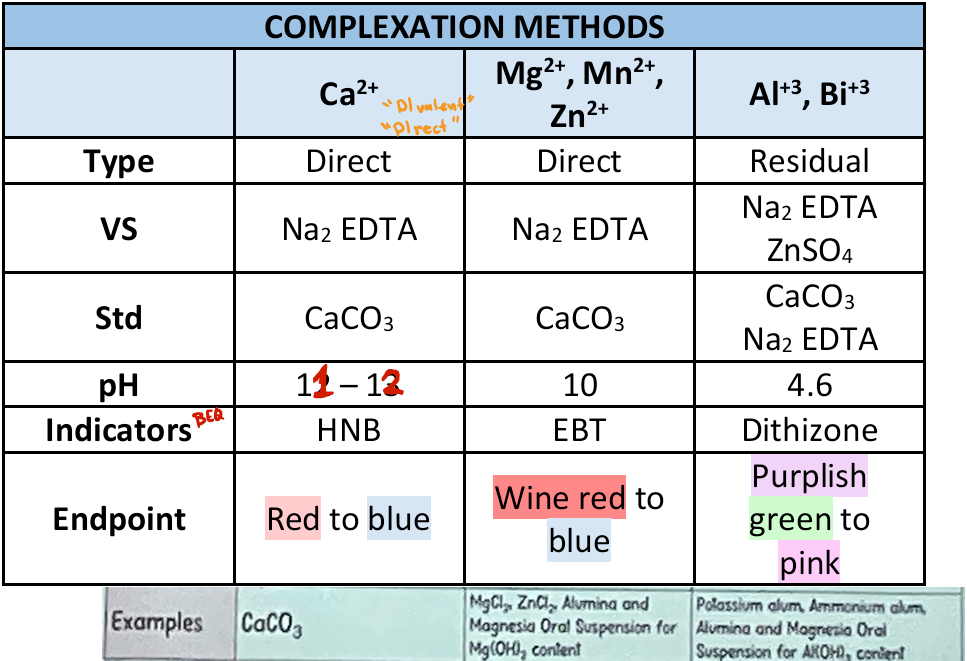
a. Direct
“DIvalent, DIrect”
[BASED ON TYPE OF RXN INVOLVED]
The type of titration used in Complexation Titration for Ca2+
a. Direct
b. Indirect
c. Residual
d. Blank
a. Direct
“DIvalent, DIrect”
[BASED ON TYPE OF RXN INVOLVED]
The type of titration used in Complexation Titration for Mg2+, Mn2+, Zn2+
a. Direct
b. Indirect
c. Residual
d. Blank
c. Residual
[BASED ON TYPE OF RXN INVOLVED]
The type of titration used in Complexation Titration for Al+3, Bi+3
a. Direct
b. Indirect
c. Residual
d. Blank
a. Na2 EDTA
b. ZnSO4
[BASED ON TYPE OF RXN INVOLVED]
The VS used in Complexation Titration for Al+3, Bi+3
(multiple answers)
a. Na2 EDTA
b. ZnSO4
c. CaCO3
d. HNB
a. Na2 EDTA
[BASED ON TYPE OF RXN INVOLVED]
The VS used in Complexation Titration for Mg2+, Mn2+, Zn2+
a. Na2 EDTA
b. ZnSO4
c. CaCO3
d. HNB
a. Na2 EDTA
[BASED ON TYPE OF RXN INVOLVED]
The VS used in Complexation Titration for Ca2+
a. Na2 EDTA
b. ZnSO4
c. CaCO3
d. HNB
c. CaCO3
[BASED ON TYPE OF RXN INVOLVED]
The indicator used in Complexation Titration for Ca2+
a. Na2 EDTA
b. ZnSO4
c. CaCO3
d. HNB
c. CaCO3
[BASED ON TYPE OF RXN INVOLVED]
The indicator used in Complexation Titration for Mg2+, Mn2+, Zn2+
a. Na2 EDTA
b. ZnSO4
c. CaCO3
d. HNB
a. Na2 EDTA
c. CaCO3
[BASED ON TYPE OF RXN INVOLVED]
The indicator used in Complexation Titration for Al+3, Bi+3
(multiple answers)
a. Na2 EDTA
b. ZnSO4
c. CaCO3
d. HNB
c. HNB
Hydroxynaphthol blue
[BASED ON TYPE OF RXN INVOLVED]
The indicator used in Complexation Titration for Ca2+
a. EBT
b. Dithizone
c. HNB
d. Murexide
d. Red to blue
[BASED ON TYPE OF RXN INVOLVED]
The endpoint of Complexation Titration for Ca2+
a. Wine red to blue
b. Purplish green to pink
c. Colorless to pale pink
d. Red to blue
c. 11–12
[BASED ON TYPE OF RXN INVOLVED]
The pH used in Complexation Titration for Ca2+
a. 4.6
b. 10
c. 11–12
d. 7
d. EBT
Eriochrome black T
[BASED ON TYPE OF RXN INVOLVED]
The indicator used in Complexation Titration for Mg2+, Mn2+, and Zn2+
a. HNB
b. Dithizone
c. Murexide
d. EBT
c. Wine red to blue
[BASED ON TYPE OF RXN INVOLVED]
The endpoint of Complexation Titration for Mg2+, Mn2+, and Zn2+
a. Red to blue
b. Purplish green to pink
c. Wine red to blue
d. Colorless to pale pink
a. 10
[BASED ON TYPE OF RXN INVOLVED]
The pH used in Complexation Titration for Mg2+, Mn2+, and Zn2+
a. 10
b. 11–13
c. 7
d. 4.6
a. Dithizone
[BASED ON TYPE OF RXN INVOLVED]
The indicator used in Complexation Titration for Al3+ and Bi3+
a. Dithizone
b. HNB
c. Murexide
d. EBT
c. Purplish green to pink
[BASED ON TYPE OF RXN INVOLVED]
The endpoint of Complexation Titration for Al3+ and Bi3+
a. Wine red to blue
b. Red to blue
c. Purplish green to pink
d. Colorless to pale pink
d. 4.6
[BASED ON TYPE OF RXN INVOLVED]
The pH used in Complexation Titration for Al3+ and Bi3+
a. 10
b. 11–13
c. 7
d. 4.6
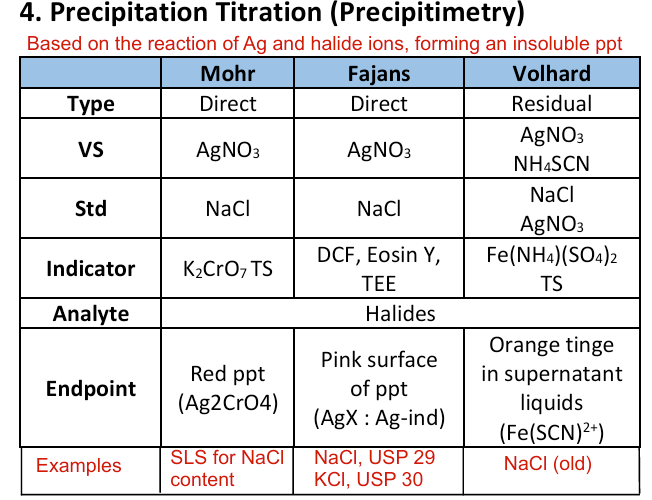
c. Reaction of Ag and halide ions forming an insoluble precipitate
[BASED ON TYPE OF RXN INVOLVED]
The principle behind Precipitation Titration
a. Conversion of primary aromatic amine to diazonium compound
b. Formation of ion pair in acidic pH
c. Reaction of Ag and halide ions forming an insoluble precipitate
d. Oxidation of ascorbic acid
d. Mohr
[BASED ON TYPE OF RXN INVOLVED]
The Precipitation Titration method that uses K2CrO7 TS as indicator
a. Volhard
b. Fajans
c. Argentometry
d. Mohr
a. Volhard
b. Fajans
&
d. Mohr
[BASED ON TYPE OF RXN INVOLVED]
The Precipitation Titration method that uses AgNO3 as VS
a. Volhard
b. Fajans
c. Argentometry
d. Mohr
a. Volhard
b. Fajans
&
d. Mohr
[BASED ON TYPE OF RXN INVOLVED]
The Precipitation Titration method that uses NaCl as Std
a. Volhard
b. Fajans
c. Argentometry
d. Mohr
a. Volhard
[BASED ON TYPE OF RXN INVOLVED]
The Precipitation Titration method that uses AgNO3 as Std
a. Volhard
b. Fajans
c. Argentometry
d. Mohr
a. Volhard
[BASED ON TYPE OF RXN INVOLVED]
The Precipitation Titration method that uses NH4SCN as VS
a. Volhard
b. Fajans
c. Argentometry
d. Mohr
a. Volhard
b. Fajans
&
d. Mohr
[BASED ON TYPE OF RXN INVOLVED]
The Precipitation Titration method that uses Halide as analyte
a. Volhard
b. Fajans
c. Argentometry
d. Mohr
b. Fajans
&
d. Mohr
[BASED ON TYPE OF RXN INVOLVED]
The Precipitation Titration method that uses Direct titration
a. Volhard
b. Fajans
c. Argentometry
d. Mohr
a. Volhard
[BASED ON TYPE OF RXN INVOLVED]
The Precipitation Titration method that uses residual titration
a. Volhard
b. Fajans
c. Argentometry
d. Mohr
c. Red precipitate (Ag2CrO4)
[BASED ON TYPE OF RXN INVOLVED]
The endpoint of the Mohr method in Precipitation Titration
a. White curdy PPT
b. Orange tinge in supernatant liquids
c. Red precipitate (Ag2CrO4)
d. Wine red to blue
c. SLS for NaCl content
[BASED ON TYPE OF RXN INVOLVED]
The example analyte tested by the Mohr method
a. NaCl (old)
b. KCl USP 30
c. SLS for NaCl content
d. NaCl USP 29
c. DCF, Eosin Y, and TEE
DCF - dichlorofluorescein
TEE - tetrabromophenolphthalein
[BASED ON TYPE OF RXN INVOLVED]
The indicators used in the Fajans method of Precipitation Titration
a. K2CrO7 TS and Fe(NH4)(SO4)2 TS
b. K2CrO7 TS only
c. DCF, Eosin Y, and TEE
d. Fe(NH4)(SO4)2 TS only
a. Pink surface of precipitate (AgX:Ag-ind)
[BASED ON TYPE OF RXN INVOLVED]
The endpoint of the Fajans method in Precipitation Titration
a. Pink surface of precipitate (AgX:Ag-ind)
b. Orange tinge in supernatant liquids
c. Wine red to blue
d. Red precipitate
a. KCl USP 30
&
c. NaCl USP 29
[BASED ON TYPE OF RXN INVOLVED]
Examples of analytes tested by the Fajans method
a. KCl USP 30
b. NaCl (old)
c. NaCl USP 29
d. Potassium alum and Ammonium alum
b. NaCl (old)
[BASED ON TYPE OF RXN INVOLVED]
Examples of analytes tested by the Volhard method
a. KCl USP 30
b. NaCl (old)
c. NaCl USP 29
d. Potassium alum and Ammonium alum
d. Fe(NH4)(SO4)2 TS
[BASED ON TYPE OF RXN INVOLVED]
The indicator used in the Volhard method of Precipitation Titration
a. K2CrO7 TS
b. DCF and Eosin Y
c. EBT
d. Fe(NH4)(SO4)2 TS
d. Orange tinge in supernatant liquids (Fe(SCN)2+)
[BASED ON TYPE OF RXN INVOLVED]
The endpoint of the Volhard method in Precipitation Titration
a. Red precipitate (Ag2CrO4)
b. Pink surface of precipitate
c. Wine red to blue
d. Orange tinge in supernatant liquids
d. White
[BASED ON TYPE OF RXN INVOLVED]
The color of AgCl precipitate formed in Precipitation Titration
a. Yellow
b. Pale yellow
c. Red
d. White
d. Pale yellow
[BASED ON TYPE OF RXN INVOLVED]
The color of AgBr precipitate formed in Precipitation Titration
a. White
b. Yellow
c. Red
d. Pale yellow