Atomic Structures
 Call Kai
 Learn
Learn Practice Test
 Spaced Repetition
 Match
Match Flashcards
 Knowt Play
1/12

There's no tags or description
Looks like no tags are added yet.
Name | Mastery | Learn | Test | Matching | Spaced | Call with Kai | Chat |
|---|
No analytics yet
Send a link to your students to track their progress
13 Terms
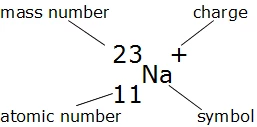
Atomic Number
The amount of protons an element has, typically located on at the very top of the box. Used to identify an element, as the periodic table is arranged by the number.

What two components of an atom are equal to each other in a electrically neutral element?
Protons and electrons. (ex. If a neutral Fe, or Iron, has 26 protons, it also has 26 electrons)

Symbol (of an element)
The abbreviation of the name of an element. Some symbols don’t match the names as they are based off the Latin word. Usually the centermost and biggest part of the box.

Mass Number
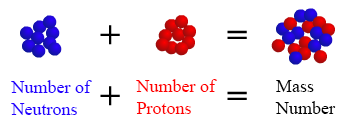
The number of protons and neutrons added together, basically the nucleus of the atom.
Note: Exact mass number isn’t on periodic table, but it becomes the mass number once the atomic mass is rounded up.
Atom’s Charge/Net Charge
Protons subtracted by electrons. Determines if the atom is neutral (0), positive (-1/or more), or negative (+1/or more)

Ion
An atom with a net electrical charge due to the loss or gain of an electron,

Cation
A positively charged ion.
Anion
A negatively charged ion.
What happens when you lose an electron?
The charge of the atom will be positive, because electrons are negatively charged, and losing them makes the atom more positive.
Think: Less is best.
What happens when you gain an electron?
The charge of the atom will be negative, because electrons are negatively charged, and the gain of them makes the atom more negative.
Think: More is worse.
Hyphen Form
Format: Name of Element/Symbol - mass number
(ex. Potassium - 40)
Nuclear Form
mass numberK
(ex. 40K)
Symbol Form