II. Life Science
 Note
Note Call Kai
 Learn
Learn Practice Test
 Spaced Repetition
 Match
Match Flashcards
 Knowt Play
1/85

There's no tags or description
Looks like no tags are added yet.
Name | Mastery | Learn | Test | Matching | Spaced | Call with Kai | Chat |
|---|
No analytics yet
Send a link to your students to track their progress
86 Terms
Prokaryotes
Single-celled organisms with no nucleus (e.g., bacteria).
Eukaryotes
Organisms with cells that have a nucleus and membrane-bound organelles (e.g., animals, plants, fungi).
Nucleus
The control center of eukaryotic cells (i.e animal, plant, fungi etc.) containing DNA.
Mitochondria
Powerhouse of the cell; site of cellular respiration.
Cell Membrane
Protects the cell and regulates what enters/exits.
Cytoplasm
Jelly-like substance where cell processes occur.
Chloroplasts
Site of photosynthesis in plants; contain chlorophyll.
Cellular Respiration
Process by which cells convert glucose and oxygen into energy (ATP), carbon dioxide, and water.
Photosynthesis
Process by which plants use sunlight to synthesize foods from carbon dioxide and water.
Circulatory System
Transports blood, nutrients, and oxygen throughout the body.
Respiratory System
Facilitates gas exchange (O2 in, CO2 out) through lungs.
Digestive System
Breaks down food into nutrients that can be absorbed by the body.
Excretory System
Removes waste from the body, including kidneys, bladder, and urinary tract.
Nervous System
body’s control system that coordinates actions and transmits signals between different parts of the body.
Endocrine System
Regulates hormones and controls processes like growth, metabolism, and reproduction.
Immune System
Defends the body against pathogens (viruses, bacteria).
Sexual Reproduction
Involves two parents; produces genetically diverse offspring.
Asexual Reproduction
Involves one parent; offspring are genetically identical.
Mitosis
Cell division resulting in two identical daughter cells.
Meiosis
Cell division that produces four non-identical sex cells (gametes).
Double Helix
The shape of DNA, consisting of two strands coiled together.
Nitrogen Bases (A. T. C. G)
Adenine (A), Thymine (T), Cytosine (C), Guanine (G).
Sugar-Phosphate Backbone
The structural framework of DNA.
Dominant Traits
Traits expressed in the presence of one dominant allele.
Recessive Traits
Traits expressed only when both alleles are recessive.
Punnett Square
Tool to predict offspring genotypes and phenotypes.
Natural Selection
Concept proposed by Charles Darwin that organisms with favorable traits are more likely to reproduce.
Adaptation
A characteristic that improves an organism's ability to survive in its environment.
Mutation
A change in DNA that may lead to new traits.
Fossils
Preserved remains of ancient organisms; provide evidence of past life and evolutionary changes.
Kingdoms (B. P. F. P. A)
biological classification groups:
Bacteria (prokaryotes), Protists (eukaryotes), Fungi (decomposers), Plants (photosynthetic), Animals (heterotrophic),
Taxonomy (D. K. P. C. O. F. G. S)
Classification hierarchy:
Domain → Kingdom → Phylum → Class → Order → Family → Genus → Species.
Producers
Organisms that produce their own food (e.g., plants).
Consumers
Organisms that eat other organisms (primary, secondary, tertiary).
Decomposers
Organisms that break down dead matter (e.g., fungi, bacteria).
Mutualism
A symbiotic relationship where both organisms benefit.
Commensalism
A symbiotic relationship where one organism benefits and the other is unaffected.
Parasitism
A symbiotic relationship where one organism benefits at the expense of the other.
Carrying Capacity
The maximum number of individuals an environment can support.
Limiting Factors
Resources or conditions that limit the growth of a population (e.g., food, water, space).
Plant Life Cycle (S. G. G. R)
Stages: Seed → Germination → Growth → Reproduction.
Animal Life Cycle (E. L. P. A)
Stages of metamorphosis: Egg → Larva → Pupa → Adult.
Homeostasis
organisms maintain a stable internal environment despite external changes.
Amino Acid
Organic compounds that combine to form proteins; building blocks of proteins.
Cell Division
When a parent cell divides to form two or more daughter cells.
Genes
Segments of DNA that determine traits.
Gregor Mendel
Father of genetics; known for experiments with pea plants that established basic principles of heredity.
Law of Segregation
Mendel's law stating that each organism has two alleles for each trait, which segregate during gamete formation.
Law of Independent Assortment
Mendel's law stating that genes for different traits are inherited independently.
Regulation
The process of controlling or managing biological functions, such as homeostasis and gene expression.
Ectothermic
Cold-blooded Organisms that regulate their body temperature based on external environmental conditions.
Open Circulatory System
where blood flows freely within the body cavity, directly bathing organs.
Closed Circulatory System
where blood circulates within vessels, separated from the surrounding tissue.
Interdependence of Organisms
The reliance of different organisms on each other for survival, often seen in ecosystems.
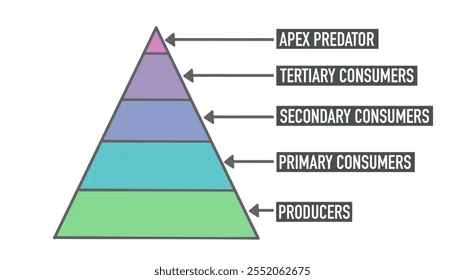
Food/Energy Pyramid (P. PC. SC. TC)
A graphical representation of the flow of energy through an ecosystem.
Producers, Primary Consumers, Secondary Consumers, Tertiary Consumers
Symbiosis
A close relationship between two different species that live together, benefiting at least one organism.
Bacteria
Single-celled microorganisms that can be beneficial or harmful.
Virus
Microscopic infectious agents that can only reproduce within living host cells.
Animal Cells
Eukaryotic cells that make up animals, lacking a cell wall but containing organelles.
Plant Cells
Eukaryotic cells that make up plants; contain cell walls and chloroplasts.
Cell Reproduction
The process by which cells divide to create new cells.
Benefits of Sexual Reproduction over Asexual Reproduction
Sexual reproduction introduces genetic diversity; asexual reproduction creates identical offspring.
Trisomy
A genetic condition where an individual has three copies of a chromosome.
DNA
Deoxyribonucleic acid, the molecule that carries genetic information.
Change Over Time in Living Things
The process of evolution, where species gradually change over generations.
Evolution
The process through which species change over time through mechanisms like natural selection.
Behavior
The actions or reactions of an organism in response to its environment.
Endothermic
Organisms that regulate their body temperature internally.
Vertebrate
Animals with a backbone or spinal column.
Invertebrate
Animals without a backbone.
Unity of Life
The concept that all living organisms share certain characteristics.
Diversity of Life
The variety of living organisms resulting from evolutionary processes.
Classification
The scientific system of categorizing living organisms into groups.
Competition
When two or more organisms vie for the same resources.
Predation
An interaction where one organism hunts and consumes another.
Covalent Bond
A type of chemical bond where two atoms share electrons to form a stable molecule.
Genes & Heredity
Units of heredity passed from parent to offspring. Alleles are different forms of a gene, either dominant or recessive.
DNA replication
process of copying a DNA molecule to create two identical copies.
Interaction of Organisms
Ways in which organisms interact with each other and their environment.
Examples: Feeding relationships, symbiosis, competition
Metamorphosis
biological process in which an organism undergoes a significant transformation in its body structure during its life cycle
Gamets
Reproductive cells (sperm in males, egg/ovum in females) carry half the genetic material (haploid) of an organism.
Genotype
genetic makeup of an organism; the combination of alleles inherited from parents.
Phenotype
observable physical traits or characteristics of an organism, determined by its genotype and environmental factors.
Primary Consumers
Herbivores that eat producers (plants or algae).
Example: Grasshoppers, deer
Secondary Consumers
Carnivores that eat primary consumers.
Example: Frogs, small birds
Tertiary Consumers
Carnivores that eat secondary consumers.
Example: Hawks, lions.