Language Development Concepts
 Call Kai
 Learn
Learn Practice Test
 Spaced Repetition
 Match
Match Flashcards
 Knowt Play
1/12

There's no tags or description
Looks like no tags are added yet.
Name | Mastery | Learn | Test | Matching | Spaced | Call with Kai | Chat |
|---|
No analytics yet
Send a link to your students to track their progress
13 Terms
Five Defining Features of Language
As System of Symbols
A Socially Shared Code
Language is Conventional
Language is Dynamic
A tool for human communication
Language as a System of Symbols
Defining feature of Language
Represents concepts (meaning isn’t inherently obvious)
The symbols of language are Morphemes (smallest units that carry meaning in a language)
Language is a Socially shared code
Defining feature of Language
Shared among speakers of the same language & Dialects. Rule based and agreed upon definitions (AKA code)
Language is Conventional
Defining feature of Language
Speakers abide by accepted rules (Legal sentence structure, word order, number agreement, etc)
Language is Dynamic
Defining Feature of Language
Is active and changing, both within individuals and language communities
Ex: Open & Closed Classes
Language as a tool for communication & thought
Defining feature of Language
Almost exclusively a human capacity
Language can be used in communication (sharing info among 2 or more people) and in thought processes (Language is not only external but also an internal cognitive tool)
Speech Defintion
A neuromuscular process by which language is transformed into acoustic signals and transmitted through a medium
Communication/ Speech Chain

Preintentional Communication
Type of Communication
Meaning of a communicative behavior must be inferred by observer. Always nonsymbolic and/or pre-symbolic
Ex: Crying, looking, etc
Intentional Non symbolic communication
Type of Communication
Sender sends a message in a non-arbitrary contextualized manner. Behavior has meaning & sender is trying to interpret the clear meaning
Ex: Pointing, gestures, etc
Symbolic Communication
Type of Communication
Communicating something specific using an arbitrary, agreed upon code
All linguistic communication is symbolic
Ways to Communicate
Linguistically: With your words
Non-Linguistically: With no language involved
Extra-Linguistic: Communication outside of language/relates to communication. Ex: gestures, postures, etc
Para-linguistic: Use of pitch, tone, stress, etc. to convey emotion
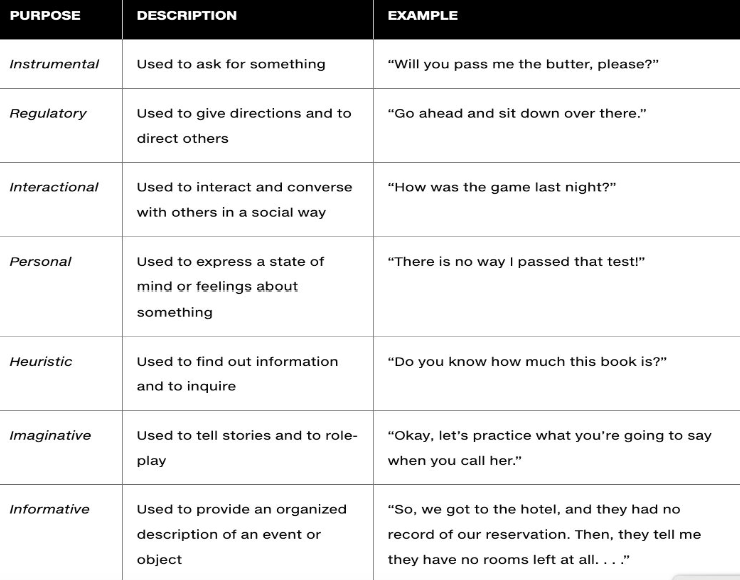
Purposes of Communication (7 different ones)