Phisio Exam 1
 Call Kai
 Learn
Learn Practice Test
 Spaced Repetition
 Match
Match Flashcards
 Knowt Play
1/261

There's no tags or description
Looks like no tags are added yet.
Name | Mastery | Learn | Test | Matching | Spaced | Call with Kai | Chat |
|---|
No analytics yet
Send a link to your students to track their progress
262 Terms
In addition to functioning as structural support for the cell and a mechanical barrier, list several other roles of the plasma membrane (6)
1. Mechanical barrier – traps needed molecules inside cell
2. Selectively permits passage of specific substances
3. Controls import of nutrients & export of secretory products, wastes
4. Maintains different ion concentrations inside vs. outside (essential for electrical activity)
5. Cell junctions (tissue formation)
6. Respond to signals from chemical messengers
phospholipid
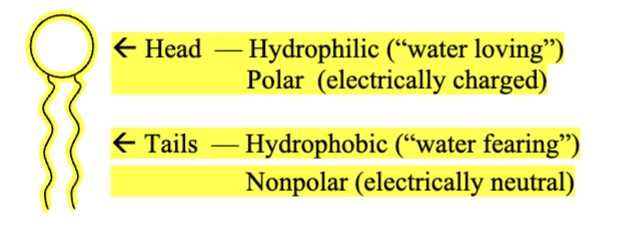
How are phospholipids in the membrane arranged?
Lipid bilayer with heads contacting the ECF and ICF
Are phospholipids linked into an interconnected network or floating loose?
Floating loose and in constant movement (like ping pong balls floating on a pool)
two seemingly opposing properties of the membrane are regulated by cholesterol?
Cholesterol regulates fluidity and stability. It prevents the phospholipid fatty acid tails from interacting and packing to the point of crystallization (like bacon fat solidifying) and thereby maintains the membrane’s fluidity. By intercalating between the phospholipids, cholesterol also contributes to the membrane stability.
Integral proteins
embedded in the phospholipid bilayer
Transmembrane proteins
an integral protein that crosses the entire thickness of the membrane
Peripheral proteins
proteins weakly anchored to a membrane surface (sometimes on the extracellular surface; very commonly on the intracellular surface)
List 7 different roles of membrane proteins
(1) Channels (e.g., leak channels, gated channels)
(2) Carriers (transporters)
(3) Docking-marker acceptors (essential for exocytosis)
(4) Membrane-bound enzymes
(5) Receptors
(6) Cell adhesion molecules (CAMs)
(7) Cell recognition (self-recognition)
Carbohydrate modifications are attached to which leaf of the membrane?
extracellular surface
To what molecules are carbohydrates attached, and what are the respective names of these carbohydrate-linked structures
To proteins= glycoproteins
To lipids= glycolipids
What major role do membrane carbohydrates serve?
“self-recognition” and cell-to-cell interactions
Fluid Mosaic Model
Membrane proteins floating freely amidst a constantly moving sea of phospholipids. Resembles buoys floating in a swimming pool covered with floating ping pong balls.
What does it mean for the membrane to be selectively permeable?
It permits certain particles to pass through it while others are excluded.
Two Route Determinants
1. Lipid solubility (aka polarity)
2. Size
Passive Transport
Passive transport does not require energy (ATP) expenditure
Active Transport
Active transport requires energy (directly or indirectly) to transport the molecule
Net Diffusion
Random movement down the concentration gradient
Where are steriod receptors
The steriod receptor is inside a cell because teh steriod nonpolar can diffuse through the lipid bylayer
In unassisted Transport What two forces drive this passive movement?
Concentration gradient and/or electrical gradient
[Simple] Diffusion
random movement of molecules as they “spread out” toward uniform distribution
Distinguish between net diffusion and dynamic equilibrium.
Net diffusion is the difference between random movement (diffusion) of molecules from area A-to-B vs. area B-to-A. When net diffusion is zero, the system is in dynamic equilibrium.
In diffusion, molecules move in what net direction?
Net diffusion of a solute occurs from its area of greater concentration to its area of lesser concentration
If there is no net diffusion, are molecules crossing the membrane?
Yes. When net diffusion is zero (dynamic equilibrium), molecules are still randomly crossing the membrane in both directions, but doing so in equal numbers each direction.
List the 5 factors the influence the rate of net diffusion. (Fick)
(1) Concentration gradient- directly
(2) Surface area of membrane- directly
(3) Lipid solubility- directly
(4) Molecular weight- inversely
(5) Distance (membrane thickness)- inversely
In terms of size and solubility, describe the type of molecules that directly permeate the membrane
Whether large or tiny, the molecules are uncharged, nonpolar, highly lipid soluble and can pass directly through the membrane
Examples: O2, CO2, fatty acids, steroids
In terms of size and solubility, describe the type of molecules that could be allowed through the membrane using a protein channel.
These must be tiny (few atoms or less); They are polar or charged molecules (otherwise they’d pass directly)
Examples: Water, Na+, K+, Ca2+
By what two routes does water enter/leave the cell?
(1) Aquaporins — very fast! (billion molecules/second per channel!)
(2) directly through momentary spaces between phospholipids — relatively slow
Hydrostatic pressure
pressure exerted by a standing fluid
Osmotic pressure
the pull of a water into a solution by osmosis; that is, the pull of water into a solution with higher solute concentration (“solutes suck”)
Isotonic
Solute Concentration (relative to the cell solute)- Equal
Osmosis- no net diffusion
Effect on Cell Volume- no change
Hypotonic
Solute Concentration (relative to the cell solute)- Less
Osmosis- into the Cell
Effect on Cell Volume- Cell swells
Hypertonic
Solute Concentration (relative to the cell solute)- More
Osmosis- Out of the Cell
Effect on Cell Volume- cell shrinks (crenates)
Osmosis
net flow of water across a membrane
Carrier mediated Transport
Binding site kenetics
Specificity: What will fit
Saturation: 1 thing at a time
Competion: who will win
Cystinuria
A disease where you are missing one carrier protien, many kidney stones.
Passive Carrier-Mediated (properties)
always DOWN concentration gradient (the Boyscout lending a arm to the old women)
Large lipid-insoluble molecules (polar)
“a” or “the” Facilitated Diffusion
Active Carrier Method
Requires Energy! (“Pump”)
Is independent of concentration
Primary Active Transport
Directly use ATP
Seconday Active Transport
Exploites gradient created by primary active transport to pump
The story of Glucoes
Glucose is to big and polar: No Channels, No passive transport
Fist we have good gradient→ but gets worse
SGLT→ Soduim Clucose cotransport: Active
GLUT→ glucose transport: passive carreir
Not all cells take in glucose all the time regulated by insulin
SGLT
Sodium Glucose co-transported
Active transport
Could be primary or seconday
Need a sodium and potaisum pump
GLUT
Clucose Transport
To get Glucose out of the cell the gradadient is always in our favore so we can use the PASSIVE CARREIR GLUT
Glocuse in the Cell
Stored as Glycogin
1st step of Glycolis phospholoratoin
Counter-transport (Antiport)
One goes in the other goes out
VESICULAR Transport
Endocytosis
i. Phagocytosis
ii. Pinocytosis
iii. Receptor-mediated endocytosis
Endocytosis
movement into cel
Phagocytosis: large chunks
Pinocytosis: Water
Receptor-mediated endocytosis: uses Recptors (more picky)
Exocytosis
movement out of cell
internal environment
Extracellular fluid ECF
ECF fluid can be further divided into two major components:
1. Plasma (Blood)
2. Interstitial fluid (ISF)
Define homeostasis
Maintenance of a relatively stable internal environment.
According to Sherwood, what 7 families of factors must be homeostatically maintained?
1. Concentration of nutrients
2. Concentration of O2 and CO2
3. Concentration of waste products
4. Concentration of hydrogen ions (pH)
5. Concentration of water, salts, and other electrolytes
6. ECF volume and pressure
7. Temperature
Which body system in not essential for homeostasis
Reproductive system
Intrinsic control system
a mechanism built into or inherent in an organ
Systemic control
Extrinsic control system
mechanisms initiated outside an organ to alter its activity
What two body systems are responsible of extrinsic control
1. Nervous
2. Endocrine
Negative Feedback
restores homeostasis by generating a response that opposes or reverses the original stimulus (negates the deviation)
What is term for the desired value of a controlled variable?
Set point
Integumentary
Sweating
Positive Feedback
he response strengthens or reinforces the stimulus (increases the deviation).
What is uniquely defines a feedforward system
mechanisms designed to anticipate a deviation and respond in advance
Insulin is the example of this
What are the Three Major players in Membrane potential
Na+ / K+ ATPase pump
Leak Current
Trapped anions
What percent of all Calories power ATPase Pump
40% of all Caloric intake
What are the negatively charged anions inside of the Cell
Protiens
Nicleic acids
Phosphates
The Unstimulated cell Resting Memrane Potential
-70mV
ATPase Pump Maintains Steady state
Leak channels
Open at all times
Potassium leaks out of the cell leading us to the -90mV difference
Sodium leaks in making the -70mV
When Na+ leakage is High
we are producing more heat
so endotherms birds + Maamals have more Na+ leak channes
Seconday Active transport
use the gradient to pump something else
Graded Potentials
Small local changes in membrane potential
Example of local potental triggers exocytosis
Action Potentials
Large Rapid changes and reset of membrane potential
Chemmically-Gated (Receptor- Channels)
A type of Ion Gated Channel
taste, small
neurotransmitter
Mechanically-Gated
A type of Gated Ion Change
Distortion of the plasma memnrane
Touch
Hearing
Stretch (pressure)
Thermally-Gated Channels
Temp gated
Voltage-Gated channel
a type of Gated Ion Channel
However action potential not graded potential
Example of a Gated Na+ Channel Triggering a Graded Potential
Stimulus Opens channel (like a nuerotransmitter)
Na+ rapidly flows IN down both the chemical and electrical gradiant
Membrane potential shift Causigng dexrease in potential membrane becomes less negative= DEPOLARZATION
Depolarrization spreads locally causing LOCAL CURRENT
Example of a Gated K+ Channel
k+ channel open
k+ radidly out of cell
Shifts membrane potantial increase becoming extra negative= HYPERPOLARZING
Gated Cl- Channels
Cl- rapidly flows into the cell
Shifts the membraine potantial to become even more negative also HYPERPOLIZING
Graded or Local
Local because only affects whats around it Rember lanas chair
Grade because can vary depending on what
Propoerties of Graded Potential
Graded- Vary in magnitude
Local- Decline in strength over short distance
Short-lived- membrane quickly returns to resting potential
Either Excitiory or inhibitory
Why are Graded potentals short lived
Pumps do help but the LEAK channels help restore quicly
Fuctions of Graded Potentials
Stimulate specific cell functions like exocytosis
Trigger an Action potential in cells with Excitable Membranes
EPSPs
Excitatory Post-synaptic potentials
IPSPs
Inhibitory Post-synaptic Potentials
EPPs
End-Plate Potentials
What is important to rember about Diffusion
IT IS SLOW!!!!
so we need something better
Excitable Membrane
Can Generate electrical signals (or action potentials)
Neurons
Muscle Cells
ONLY
What things define Excitable Membrane
Voltage-gated Na+ channel
Voltage gated K+ Channel
basic anatomy of Neuron

Action Potential
Radin, large, depolarization PROPEGATED across/down the entire membrane
8 Steps in the action potential
Threshold is reached -50 to -55 mV
two events at threshold ( gates open +close)
Depolarixation phase Na+ comes in reaches +30mV
Repolarization Phase (K+ out gets to -7mV)
returened to Resting Membrane Potental k+ slowly starts closing)
Afterhyperpolarization Phase Membrane potental now less that -70mV
Resetting the gradent pump resets chemical gradient
Refactory Period
When are Action Potentail triggered
ONLY IF THRESHOLD IS REACHED -50 or 055 mV
Axon Hillick
Is where the dendrites turn into axons
3 things that happen when threshold is reached
Voltage gated Na+ channels, open rapidly,
inactivation gates begin to close slowly (NOT STOPABLE)
Voltage gated K+ channels Befin to open slowly
Dpolarization phase of teh Action potential
a. Na+ rushes in → triggering more Na+ channels to open
In 0.5 msec delay before the inactivation gate shuts ( in this time poteital has reached (+30 mV)
Repolariarization Phase
a. K+ rushes out
membranse potantial resturns to -70mV
Events at Return to Resting Membrane Potental
Voltagegated Na+ chanes
Activation gates now close
Inactivation gates reopen
Volage gated K+ channels becgin closing
Afterhyperpolariztion Phase (ONE WORD)
Voltage-gated Na+ channels ready to go again
Membrane Potential dips below Resting Membrane Poteintal
Resetting the Gradient (step 7)
Electical gradient - is reset already YAY
Chemail gradient needs to be corrected
Refractory Periods
the local membrane cannot be stimulated to fire another action potential
Absolute Refactory Period
due to inactive Na+ channels
Duration entire action potental to reactivation: so threshold to closing of K+ channels