1.10-1.13 Separating Mixtures
0.0(0)
Studied by 3 people Call Kai
 Learn
Learn Practice Test
 Spaced Repetition
 Match
Match Flashcards
 Knowt Play
Card Sorting
1/38

Earn XP
Description and Tags
Last updated 2:06 AM on 12/31/22
Name | Mastery | Learn | Test | Matching | Spaced | Call with Kai | Chat |
|---|
No analytics yet
Send a link to your students to track their progress
39 Terms
1
New cards
What are the physical means for separating mixtures?
Chromatography
Crystallization
Filtration
Fractional distillation
Simple distillation
Crystallization
Filtration
Fractional distillation
Simple distillation
2
New cards
Filtration
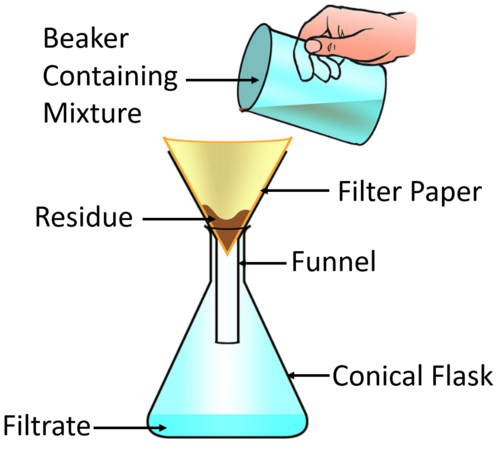
Physical separation process that removes solids (e.g. unreacted, insoluble solutes) from a fluid (e.g. solution).
Can also separate 2 solids if only 1 is soluble in water (water-soluble solid can dissolve in water to form an aqueous solution that passes through the filter as filtrate; other solid remains as residue on filter paper).
1. Pour solution through filter paper in filter funnel supported by beaker or conical flask.
2. Residue cannot pass through small gaps in the fibrous filter paper → they remain trapped while the filtrate passes through.
Can also separate 2 solids if only 1 is soluble in water (water-soluble solid can dissolve in water to form an aqueous solution that passes through the filter as filtrate; other solid remains as residue on filter paper).
1. Pour solution through filter paper in filter funnel supported by beaker or conical flask.
2. Residue cannot pass through small gaps in the fibrous filter paper → they remain trapped while the filtrate passes through.
3
New cards
Residue
Solid that remains on the filter paper because it cannot pass through it.
4
New cards
Filtrate
Liquid/solution that passed through the filter paper and filter funnel.
5
New cards
Filter (a.k.a. filter paper)
Fibrous device with many pores and holes too small for solids to pass through (retains solute as residue), but large enough for liquid/fluid particles to pass through (allows solvent to go through filter).
6
New cards
Filter funnel
Device with a wide top, narrow bottom, and tubular pathway connected to the bottom. It can help filter substances when connected with filter paper.
7
New cards
Crystallization
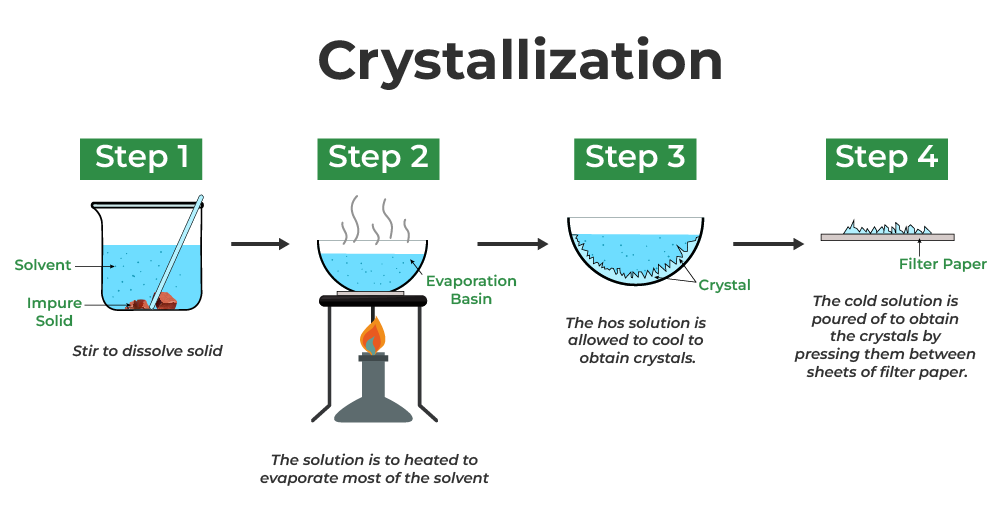
Physical separation process that utilizes different evaporation points of substances to remove a dissolved solute (solid) from a solution and purify constituents.
8
New cards
Crystallization process
1. Heat solution in evaporating basin.
2. Solvent molecules gain energy and vaporize.
3. Saturated solution formed (crystals form on glass rod and solution surface when glass rod dipped into solution then removed → saturated).
4. Removing any more solvent causes solute to crystallize.
5. Turn off bunsen burner, allow solute to crystallize as solvent evaporates and solution cools.
6. Crystallized solute and remaining solids can be removed from the solution/mixture via filtration.
9
New cards
How can you obtain pure salt from rock salt?
1. Filtration and crystallization can be used
2. Crush rock salt and mix with hot water → salt dissolves in water but impurities do not.
3. Impurities filtered out as residue on filter paper.
4. Filtrate is salt solution.
5. Pure solid salt can be obtained from the salt solution filtrate by crystallization.
10
New cards
Rock salt
Salt contaminated by earthy/rocky impurities (e.g. minerals) that are water-insoluble.
11
New cards
Simple distillation
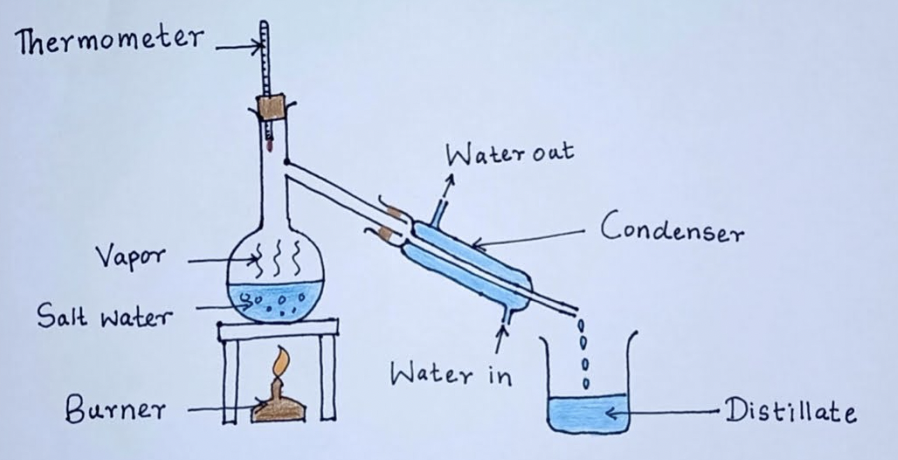
Physical separation process that separates various liquid/solvent components from a solution or mixture of liquids/solvents, based on their different boiling points.
Used to separate 2 liquids, or a solute from a solution’s solvent, when they have significantly different boiling points.
Used to separate 2 liquids, or a solute from a solution’s solvent, when they have significantly different boiling points.
12
New cards
Simple distillation process
1. Solid solutes in solution → Solutes left behind as solvents evaporate when solution is heated → Solvents can be purified later by condensation.
2. Mixture of solvents in solution → Liquid/solvent with lowest boiling point evaporates first + other liquids/solvents remain in flask → vapor travels to Liebig condenser → cools to form collected distillate (can be removed from collecting flask afterwards so it’s separated from other solvents that will later form the distillate as well).
13
New cards
Conical flask
Container for mixing substances or collecting filtered substances. It has a flat bottom, conical body, and cylindrical neck.
14
New cards
Liebig condenser
Straight glass tube with a water jacket surrounding it to cool/condense the vapor passing through it.
Water is always fed into the bottom of the Liebig condenser and exits from the top → better fills condenser jacket and ensures it remains full even when water flow/supply stops.
Water is always fed into the bottom of the Liebig condenser and exits from the top → better fills condenser jacket and ensures it remains full even when water flow/supply stops.
15
New cards
Distillate
Purer or purified liquid/solvent collected during distillation when the evaporated liquid/solvent condenses.
16
New cards
Fractional distillation
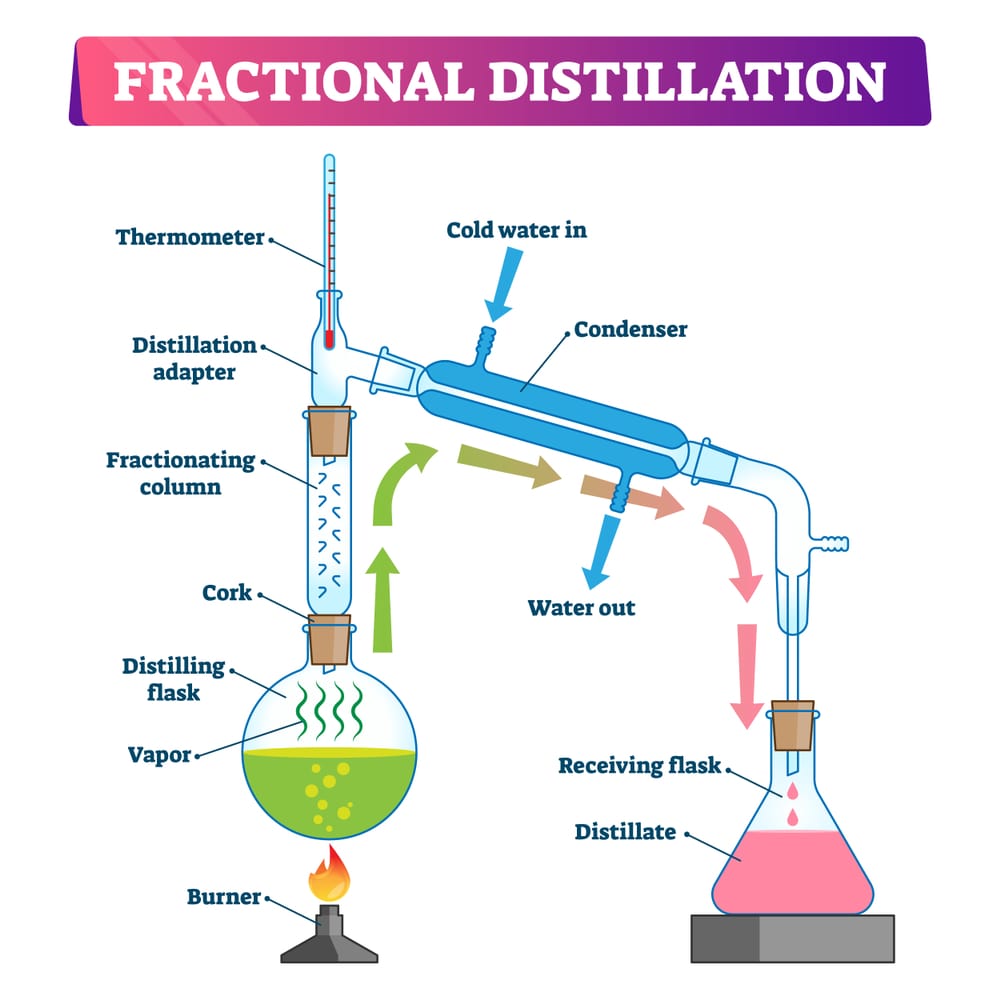
Physical separation process that separates liquid/solvent components (fractions) of a solution with similar boiling points.
E.g: fractional distillation can separate water and ethanol from their solution, or can separate crude oil components.
E.g: fractional distillation can separate water and ethanol from their solution, or can separate crude oil components.
17
New cards
Fractional distillation process
1. Solution heated in round-bottom flask.
2. Evaporated solvents reach fractionating column.
3. Fractionating column’s temperature decreases as you go up.
4. A series of distillations (rectification) are used to separate components in the fractionating column.
5. Liquids reach their respective boiling points → their vapor moves into the condenser where it cools to be condensed.
6. The heat of rising vapor causes this liquid to vaporize again, moving it along the fractionating column and eventually yielding a higher purity for this liquid/solvent component of the mixture.
18
New cards
Rectification
Purification of a substance by repeated or continued distillation.
19
New cards
Distillation
Process whereby a liquid is heated to create vapor, which is collected when cooled/condensed separately from the original liquid/solution.
Used to separate a mixture’s components or purify a liquid/solvent.
Used to separate a mixture’s components or purify a liquid/solvent.
20
New cards
Fractionating column
Long vertical cylinder used in fractional distillation.
Tall and horizontally subdivided.
Vapor passes upwards whilst condensing liquid flows downwards.
Vapor becomes enriched in more volatile components as it ascends.
Less volatile components concentrate in descending liquid, which can be drawn off.
Tall and horizontally subdivided.
Vapor passes upwards whilst condensing liquid flows downwards.
Vapor becomes enriched in more volatile components as it ascends.
Less volatile components concentrate in descending liquid, which can be drawn off.
21
New cards
Volatility
Tendency of a substance to vaporize; high volatility → high tendency to vaporize
22
New cards
Chromatography
Separation of molecular mixture by passing it through a medium (solution, suspension, or vapor) where components move at different rates or are drawn across other material surfaces.
Different additives have different solubility levels in the solvent/surface they travel on → constituents separate.
Different additives have different solubility levels in the solvent/surface they travel on → constituents separate.
23
New cards
Paper chromatography process
1. Draw pencil line across chromatography paper 1cm above sheet’s bottom.
2. Don’t use pen (ink colors move up chromatography paper with solvent).
3. Put a spot of the mixture of dyes on the pencil line (next to spots of known pure substances/reference substances) and allow it to dry.
4. Bottom of the chromatogram’s edge is dipped in a solvent (usually water), which travels up the chromatogram.
5. Dip below baseline to prevent substances from dissolving downwards off the paper and into the solvent rather than travel upwards.
6. Put lid on beaker so the atmosphere becomes saturated with solvent. This stops the solvent’s evaporation from the paper’s surface.
7. When the solvent front has moved to about 1cm away from the top, remove the paper from the beaker and draw a pencil line to show where it got up to.
8. Leave the paper to dry so all the solvent evaporates.
9. The solvent can be water or a non-aqueous solvent, the solvent used can depend on what substances are present in the mixture.
10. A suitable solvent can be found by experimenting with different ones.
24
New cards
Uses of chromatography
1. Identifying food additives
2. Comparing fibers, fingerprints, drugs, and alcohol in a crime scene
3. Testing water samples for pollution
4. Detecting airport bombs
5. Detecting pesticides/insecticides in food
6. Paper chromatography separates different solvents in a mixture of liquids (e.g. ink pigments or food coloring additives)
7. Separating inks and dyes according to the size of their particles.
25
New cards
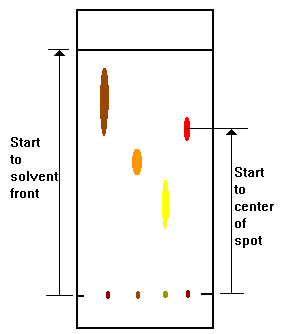
Chromatogram (a.k.a. chromatograph)
Adsorbent paper used in paper chromatography which shows the separation of different colored substances.
It’s a visible record showing the result of the separation of a mixture’s components. Components in chromatography have different solubilities → they travel at different rates and therefore spread apart.
It’s a visible record showing the result of the separation of a mixture’s components. Components in chromatography have different solubilities → they travel at different rates and therefore spread apart.
26
New cards
In a chromatogram, the more soluble the additive is in the .... or ..... it travels on, the ... and .... it moves up the chromatogram. If an additive is ... in the solvent or surface it's placed in, it does … move up across the chromatogram at all.
solvent, surface, faster, farther, insoluble, not
27
New cards
Adsorbent
A substance that adsorbs another.
28
New cards
Adsorb
When a solid holds a molecule of gas/liquid/solute as a thin film on the outside surface or on internal surfaces within the material.
29
New cards
How does the size of particles affect distance travelled on the chromatogram/chromatograph?
Smaller particles travel further than larger particles on the chromatogram for paper chromatography due to differences in solubility and their attractions with the paper.
30
New cards
Solvent front
Furthest height solvent travels to on the chromatogram.
31
New cards
Substances tested in a … that have … may have … A … is found when 1 of the spots from the unknown sample is the same … and same … (i.e. same …) as 1 of the reference spots. A … can be analysed using … by comparing its … results with results of …
chromatography, similar solubility, overlapping spots, match, color, height, retention factor, mixture, chromatography, chromatogram, known dyes
32
New cards
Affinity
Strength of attraction between 2 substances (i.e. how well inks/dyes “stick” to the chromatography paper).
33
New cards
Effect of affinity on how far a spot of dye moves on the chromatogram.
Higher affinity → Spot of dye will not move much because there is high resistance as it “sticks” to the chromatogram more due to attractions with the adsorbent paper.
Lower affinity → Spot of dye will move more due to less resistance as it does not “stick” to the chromatogram as much since it has less attractions with the adsorbent paper.
Lower affinity → Spot of dye will move more due to less resistance as it does not “stick” to the chromatogram as much since it has less attractions with the adsorbent paper.
34
New cards
Rf value (a.k.a. retardation factor or retention factor)
Ratio that represents how far a compound travels in a particular solvent, used to compare components of liquid mixtures in chromatography.
Rf value = (Distance spot moved form the base pencil line measured from the center of the spot)/(Distance solvent moved from the base pencil line)
Rf value = (Distance spot moved form the base pencil line measured from the center of the spot)/(Distance solvent moved from the base pencil line)
35
New cards
How many spots do pure substances have on a chromatogram?
1
36
New cards
How many spots do impure substances have on a chromatogram?
2 or more
37
New cards
Range of Rf values and what they represent. How do you compare Rf values of different substances?
Rf value = 0 → insoluble additive
Rf value = 1 → completely soluble additive
If multiple/separate chromatograms used, ensure the solvent and paper type is kept constant for controlled, fair tests.
2 solvents/mixtures have same Rf values → likely (not necessarily) same substance.
2 solvents/mixtures have different Rf values → definitely different substances.
Rf value = 1 → completely soluble additive
If multiple/separate chromatograms used, ensure the solvent and paper type is kept constant for controlled, fair tests.
2 solvents/mixtures have same Rf values → likely (not necessarily) same substance.
2 solvents/mixtures have different Rf values → definitely different substances.
38
New cards
Stationary phase
Phase in chromatography that does not move, e.g. the adsorbent paper in basic paper chromatography.
39
New cards
Mobile phase
Phase in chromatography where the molecules can move. The mobile phase of chromatography is always a fluid, e.g. the solvent moving through the paper which carries different substances with it.