Bio230 1st half
 Call Kai
 Learn
Learn Practice Test
 Spaced Repetition
 Match
Match Flashcards
 Knowt Play
1/266

There's no tags or description
Looks like no tags are added yet.
267 Terms
The tree of life has three primary branches...
Bacteria, Archaea, Eukaryotes
archaea closer related to eukaryotes, but still prokaryote
Prokaryote and Eukaryote
1) Prokaryotic organisms
eubacteria and archaea
single-celled
no nucleus and organelles
.
2) Eukaryotic organisms
plants, fungi, animals
single or multi celled
nuclei and organelles
Prokaryotic cell
nucleoid
SMALLLER

Eukaryotic cell
LARGER

Prokaryotic and Eukaryotic Cells Live Together in the Human Body
Microbiota: microorganisms of a site (bacteria, archaea, fungi, protists, and viruses)
reside on skin, lungs, gut, etc
microbial:human cell is at least 1:1
important role in health
.
Microbiome: combined genomes of microbiota
200X more microbial genes than human in human body
Lecture 2: Genomes — All known life forms possess a genome
Encodes the info to construct and maintain organism
Most genomes are made of DNA
except some viruses have RNA genomes (not living, no cells, some have DNA)
Release of information requires genome expression
Genome Expression: The Transcriptome
First product of genome expression is transcriptome
repertoire of RNA molecules in a cell at a particular time
maintained by the process of transcription
DNA microarray: snapshot of transcriptome
How to read
rows = genes
columns = samples
red = lots of RNA
black = in between
green = minimal RNA
RNA sequencing more popular now

Genome Expression: The Proteome
The second product of genome expression is the proteome
Collection of proteins in a cell
Defines the biochemical functions of the cell
Maintained by the process of translation
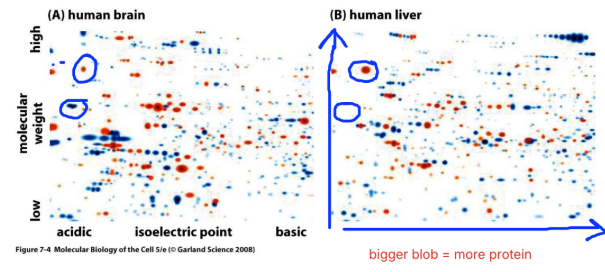
2D gel electrophoresis: snapshot of the proteome
How to read
y-axis = molecular weight
x-axis = isoelectric point (pH)
splotches = proteins
bigger blob = more protein
not normally colour coded
red = common proteins (both has)
blue = unique proteins
diff cells can have same protein at different amounts
or diff proteins
‘Central dogma’ of molecular biology
Genome (DNA) ➔Transcriptome (RNA) ➔Proteome (Protein)
How to have various cells from a single genome?
A cells have same genome.
Differences in genome expression!

Genome size, how many genes expressed, what type, regulation
Human genome ~25 000 genes
At any time only 30-60% of genes expressed
Expression varies from one cell type to another
Genome expression is regulated at many steps from DNA to protein
Regulation of Genome Expression — red lightning = ways of regulating

Interactome
All protein-protein interactions
Metabolome
All small molecule metabolites
nutrients
waste
etc
Regulation of gene expression is crucial for:
Defining Cell Types (multicellular organisms)
Responses to extracellular stimuli (both multicellular and unicellular organisms)
A Review of Prokaryotic Transcription...
Sigma factor — binds to promotor
small space in RNA core enzyme before active site for sigma factor
Holoenzyme = sigma factor + RNA core enzyme

Transcriptional Regulation: Overview of gene regulatory proteins (bind to where? pos/neg)
Gene expression regulated by gene regulatory proteins (transcription factors)
Bind to regulatory regions of DNA (cis elements — on the same DNA double helix as gene, trans is different double helix)
.
Gene regulatory proteins can turn genes:
ON = Positive regulators = activators
OFF = Negative regulators = repressors
E. coli:
unicellular prokaryote
one chromosome of circular DNA encodes about 4300 proteins
many genes are transcriptionally regulated by food availability
Prokaryotic operons
Multiple genes can be transcribed into a single RNA molecule
under control of one promotor
Example 1: The Tryptophan (Trp) Operon (how many promotors?)
Five genes
Encode enzymes for tryptophan biosynthesis
Transcription regulated by a single promoter
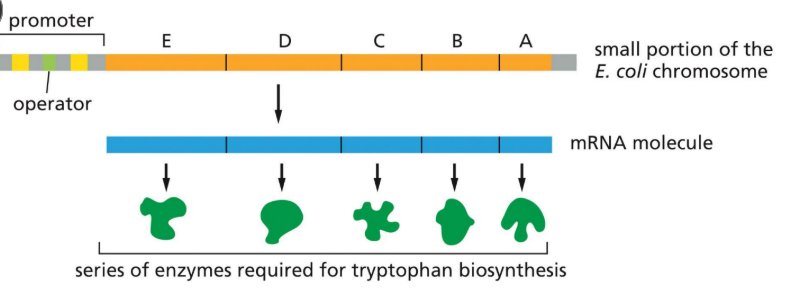
The Tryptophan (Trp) Operon Promoter... (repressor binds to what?)
...has two potential protein-bound states:
Bound by RNA polymerase — Trp gene expression ON
Bound by tryptophan repressor protein — Trp gene expression OFF
repressor binds to specific DNA sequence of promoter = operator

The Tryptophan (Trp) Operon Promoter binding (does what and needs what?)
Tryptophan repressor binding blocks promoter access
RNAP cannot bind
negative regulation
.
Repressor DNA-binding is regulated
must bind TWO molecules of tryptophan
repressor and operator — control tryptophan biosynthesis according to availability of free tryptophan
The Tryptophan Operon: Summary

Helix-turn-helix (binds to what, trp repressor)
Tryptophan repressor contains a helix-turn-helix DNA binding motif (most common DNA-binding motif)
structural category in many DNA-binding proteins
bind to major groove in double helix
.
Tryptophan binding to repressor induces
➢ Conformational change
➢ Protein fits into the major groove

Example 2: The Lac Operon (has what and does what?)
E. coli Lac operon:
3 genes required for transport of lactose into cell for catabolism (breaking down for energy)
enables use of lactose in absence of glucose
positive and negative control
Lac Operon activator/repressor is what?
1) Activator: Catabolite Activator Protein (CAP)
Low glucose/High lactose
.
2) Repressor: Lac Repressor Protein
Low lactose
3 steps for turning ON Lac operon
E.coli first choise is glucose
Low glucose, high lactose = use lactose (BOTH conditions must be true)
lac operon turned on to use lactose
.
glucose lactose high = no
glucose high lactose low = no
glucose low lactose low = no
glucose low lactose high = YES
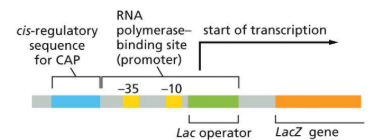
The Lac Operon Schematic (first operon encodes what)
1st gene of Lac operon encodes β-galactosidase; breaks down lactose to glucose and galactose
cis-regulatory sequence for CAP
lac operator for lac repressor

How is the Lac Operon Regulated? Lactose low
Lactose low, the lac repressor is bound to the operator
Lac operon gene expression is OFF
Increased lactose removes the repressor from the operator...

How is the Lac Operon Regulated? Lactose high (allolactose)
Increases in lactose increase levels of allolactose, related to lactose; requires β-galactosidase
allolactose binds to lac repressor
conformational change, decrease DNA-binding activity, release from operator

How is the Lac Operon Regulated? activator
Why is an activator needed?
• RNA polymerase binding is inefficient to the Lac promoter
• Efficient RNA polymerase binding to Lac promoter requires CAP to be bound
• CAP contains a helix-turn-helix DNA binding domain

How is the Lac Operon Regulated? Glucose low
Low glucose —→ high signaling molecule cyclic AMP (cAMP)
cAMP bind to CAP protein
conformation change, increases DNA-binding activity
binds to CAP binding site
CAP recruits RNA polymerase to the Lac promoter

Prokaryotic Gene Regulation — negative and positive regulation, bound repressor/activator
Negative regulation: bound repressor prevents transcription
ligand binds to remove protein
ligand binds to allow protein binding
.
Positive regulation: bound activator promotes transcription
ligand vinds to remove protein
ligand binds to allow protein binding
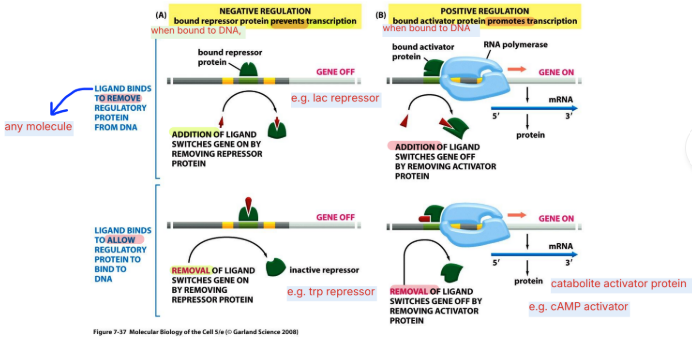
To summarize negative/positive regulation, competition vs recruiting (ProK) (recruits to where?)
• Negative regulation: Competition between RNA polymerase and repressor protein for promoter binding
.
• Positive regulation: Activator protein recruits RNA polymerase to the promoter to activate transcription
Prokaryotic Gene Regulation: location of gene regulatory elements
Gene regulatory elements are typically close to the transcriptional start site of prokaryotic genes
But CAN be:
far upstream
downstream
within gene (introns, eukaryotes only)
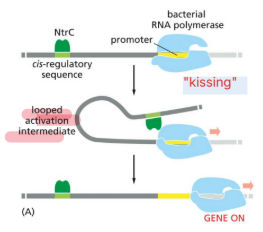
Some regulatory elements are distant (kissing) (NtrC)
Some regulatory elements distant from start site
DNA looping to allow interaction between protein and RNAP
“kissing”
.
NtrC protein is a transcriptional activator
DNA looping allows NtrC to directly interact with RNA polymerase — activate transcription from distance
A Genetic Switch Example from Bacteriophage Lambda
Virus that infects bacterial cells
Positive and negative regulatory mechanisms work together to regulate the lifestyles of bacteriophage lambda

Bacteriophage lambda can exist as one of two states in bacteria
Prophage pathway: integration of DNA into host chromosome, dont do much (favourable conditions)
Lytic pathway: synthesis of many copies and lyses (host cell is damaged)
Two gene regulatory proteins — repress each other’s synthesis
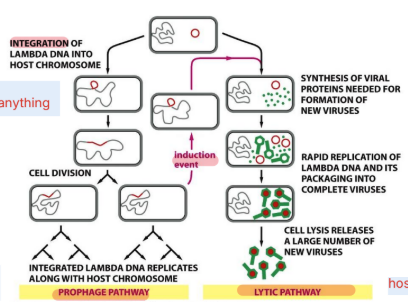
Two gene regulatory proteins are responsible for initiating the switch between prophage and lytic pathways
Lambda repressor protein (cI) and Cro protein
repress each other’s synthesis, giving rise to the two states
State 1: prophage state
Lambda repressor protein made
occupies operator
blocks synthesis of Cro
activates own synthesis (both repressor and activator)
most viral DNA not transcribed

State 2: Lytic state
Lambda Cro protein is made
occupies operator
blocks synthesis of lambda repressor
allows own synthesis (NOT an activator)
most Viral DNA is extensively transcribed
DNA replicated, packaged, new bacteriophage released by lysis

What triggers the switch between prophage and lytic states?
Host response to DNA damage!
induction event — switch to lytic state inactivates repressor
bac activates DNA repair proteins
virus detects, something wrong, LYSE TIME
.
Under good growth conditions, lambda repressor protein turns off Cro and activates itself in a positive feedback loop (prophage state)
.
The prophage-lytic control is an example of a transcriptional circuit
Transcriptional Circuits (4 types)

Positive feedback loops can be used to create cell memory
Parent cell: gene OFF
Transient temporary signal: gene ON
Positive feedback loop
Progeny continues to have feedback loop in abscence of initial signal
how specialized cells keep its memory

Feed-forward loops can measure the duration of a signal
BOTH A and B required for transcription of Z
needs duration of A and B to make Z
need enough of A to make B and to bind to Z operator

Complex transcriptional circuits
Combinations of regulatory circuits in eukaryotic cells to create exceedingly complex regulatory networks
can construct artificial circuits and examine behavior in cells
“synthetic biology”
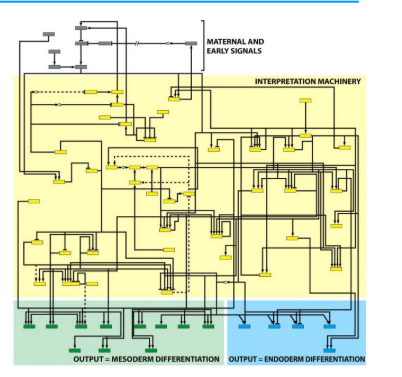
An Example of Synthetic Biology: The Repressilator
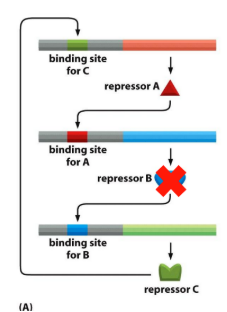
The Repressilator: simple gene oscillator using a delayed negative feedback circuit
A: Lac repressor
B: Tet repressor (response to antibiotic)
C: Lambda repressor
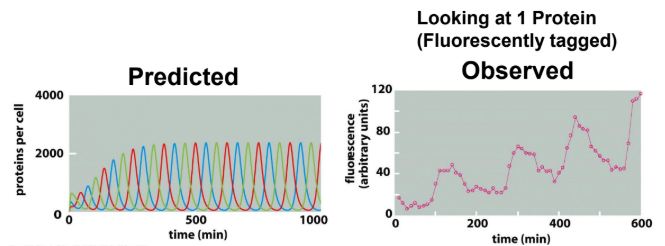
Predicted: delayed negative feedback give rise to oscillations in gene expression
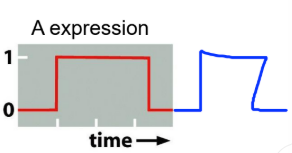
The Repressilator — how does it work?
A expressed
B repressed
C expressed
C represses A expression
A repressed
B expressed
C repressed
REPEAT
The Repressilator — real results
increasing amplitude due to bacterial growth
Transcriptional Attenuation
Premature termination (both prok and euk)
RNA adopts a structure that interferes with RNA polymerase
Regulatory proteins can bind to RNA and interfere with attenuation
Riboswitches
Prokaryotes, plants and some fungi also use riboswitches to regulate gene expression
Riboswitches: short RNA sequences that change conformation when bound by small molecule (some do transcription attenuation)
eg. prokaryotic riboswitch that regulates purine biosynthesis
Prokaryotic riboswitch that regulates purine biosynthesis (attenuates before?) (ribo where?)
Riboswitch: 5’ untranslated region (UTR)
start site of transcription not start site of translation
.
Low guanine levels: Transcription of purine biosynthetic genes is ON
High guanine levels:
guanine binds to riboswitch
riboswitch conformational change
forms transcription terminator
causes RNAP to terminate (transcription attenuation) before coding sequence
Transcription of purine biosynthetic genes is OFF

Eukaryotic transcription review — Types of RNA and RNA polymerases
Cells produce several types of RNA
mRNA, rRNA, tRNA (both euk and prok, euk has more)
.
Different RNA transcribed by diff RNAP in EUKARYOTES
Pol I = rRNA
Pol II = mRNA
Pol III = tRNA
Prok only have 1 type
Eukaryotic transcription review — General transcription factors (TATA box?)
Help position RNAP at eukaryotic promoters
TF = general transcription factor
II = RNA pol II
subunit = D, B, A, etc
.
Many euk promoters have TATA box
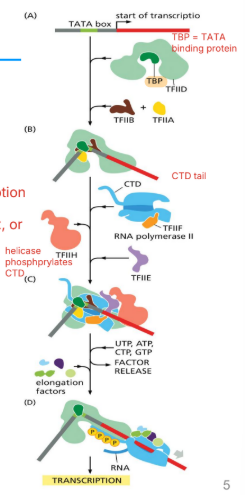
Details on eukaryotic transcription
RNA polymerase II
Requires five general transcription factors: TFIID, TFIIB, TFIIF, TFIIE, and TFIIH (prokaryotes only need one; σ factor)
NO operons
DNA packaged into chromatin
Transcriptional activation requires many gene regulatory proteins

Regulatory vs general EUK transcription factors
General transcription factors — needed for any type of transcription
Gene regulatory proteins — activators or repressors
Eukaryotic transcription review — mediators
Intermediate between regulatory proteins and RNA polymerase


EUK gene regulatory proteins (how many, distance)
Eukaryotic gene expression — many regulatory proteins (~2000 encoded by the human genome): activators & repressors
Gene regulatory proteins can act over very large distances, sometimes >10 000 base pairs away
One mechanism is DNA looping

Eul Gene regulatory proteins often function as protein complexes (coactivators/corepressors)
Coactivators and corepressors: assemble on DNA-bound gene regulatory proteins
do NOT directly bind DNA
helps with activation/repression
some proteins can have multiple functions depending on neighboring proteins

Modular design of eukaryotic activator proteins
Modular design:
DNA binding domain (DBD) — recognizes specific sequence
Activation domain (AD) — accelerates frequency/rate of transcription
.
As long as DBD is bound to DNA, AD can do its job
Can mix-and-match DBD and AD (evolution, biotech, synthetic biology)

How do activator proteins activate transcription? (3 what?)
Attract, position, and modify:
General transcription factors
Mediator
RNA polymerase II
.
Either:
1) Directly by acting on these components
2) Indirectly modifying chromatin structure
EUK Activator Proteins — binding directly
1) Activator proteins can bind directly to transcriptional machinery or the mediator and attract them to promoters (like prokaryotic activators)
EUK Activator Proteins — altering chromatin structure
2) Activator proteins can alter chromatin structure
Nucleosomes and histones
Nucleosomes are the basic structure of eukaryotic chromatin
~200 DNA base pairs wound around a histone octamer
(H2A, H2B, H3, and H4) x 2
one nucleosomes includes linker DNA = 10-80 base pairs
DNA wraps around histone 1.7 times = approx 147 base pairs
separate from core histone, H1 protein
Nucleosomes pack as compact chromatin fibers (transcription machinery? Activators do what?)
Zigzag model vs Solenoid model
transcription machinery cannot assemble on promoters tightly packed in chromatin
activator proteins can alter chromatin structure — increase promoter accessibility

4 major ways activator proteins can alter chromatin PICTURE
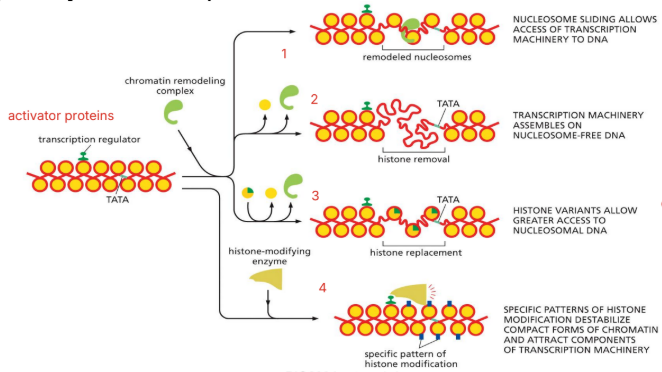
1) Activator Proteins and Nucleosome Sliding
Nucleosome structure altered by chromatin remodeling complexes
ATP-dependent
increase promoter accessibility
allows access of transcription machinery to DNA
“rolls around to make space”

2) Activator Proteins and Histone Chaperones — removing nucleosomes
Nucleosome removal requires cooperation with histone chaperones and chromatin remodelling complex (ATP)
remove histone core
transcription machinery assembles on nucleosome free DNA
OPTIONAL: variant proteins combine to general transcription factors to help with transcription

3) Activator Proteins and Histone Chaperones — histone exchange
Histone chaperones and chromatin remodelling complex (ATP)
Change histone octamer
histone variants allow greater access to nucleosomal DNA
looser binding

4) Activator Proteins and Histone Modifying Enzymes — Histone code (what enzymes?)
Histone modifying enzymes produce specific patterns of histone modifications — “histone code”
phosphorylation (enzyme: kinase)
acetylation (acetyltransferase)
methylation (methyltransferase)
Histone modifications occur on specific amino acids of histone tails
The Histone Code: Writer
Specific modifications to histone tails by histone modifying enzymes (writers)
N-term of histone subunits gets modified

The Histone Code: Reader
Code “reader” proteins can recognize specific modifications and provide meaning to the code
gene silencing
gene expression
chromosome inactivation
Human Interferon Gene Regulation As A Histone Code Example — steps 1 & 2 (started by?)
Step 1: Activator protein binds to chromatin DNA and attracts a histone acetyltransferase (HAT)
Step 2: HAT acetylates lysine 9 of histone H3 and lysine 8 of histone H4

Human Interferon Gene Regulation As A Histone Code Example — steps 3 & 4
Step 3: Activator protein attracts a histone kinase (HK)
Step 4: HK phosphorylates serine 10 of histone H3. Can only occur after acetylation of lysine 9

Human Interferon Gene Regulation As A Histone Code Example — step 5
Step 5: Serine modification signals the acetyltransferase (HAT) to acetylate lysine 14 of histone H3
The histone code for transcription initiation is written

Human Interferon Gene Regulation As A Histone Code Example — step 6 (TFII…and c?)
Step 6: TFIID and a chromatin remodeling complex bind to modified histone tails (and TATA box) and initiate transcription

Eukaryotic Gene Regulation: Repressor Proteins (has what domains?)
Transcriptional Repression:
Unlike prokaryotes, eukaryotic repressor proteins rarely compete with RNA polymerase for access to DNA
variety of mechanisms to inhibit transcription
Repressor has DNA binding domain and repression domain
Eukaryotic Gene Regulation: Repressor Proteins — 1
Competitive DNA binding
DNA sequence for activator overlaps with sequence for repressor

Eukaryotic Gene Regulation: Repressor Proteins — 2
Masking activation domain of activator

Eukaryotic Gene Regulation: Repressor Proteins — 3
Direct interaction with general transcription factors (TFII)
stops general transcription factors

Eukaryotic Gene Regulation: Repressor Proteins — 4
Recruitment of chromatin remodelling complexes
rewrapping DNA

Eukaryotic Gene Regulation: Repressor Proteins — 5
Recruitment of histone deacetylases
writing on tails of histones

Eukaryotic Gene Regulation: Repressor Proteins — 6
Recruitment of histone methyltransferase
writing on tails of histone

A More Complex Example of Transcriptional Repression (guided by what)
Guided by gene regulatory proteins, histone “reader” and “writer” proteins can establish a repressive form of chromatin
writer recruits reader
reader recruits writer
repeat
can also write directly on DNA
Histone code can spread!!!

A More Complex Example of Transcriptional Repression — barrier sequences (DNA more?)
Spreading the histone code along chromatin carried out by reader-writer complexes
barrier sequences (border sequencess) to stop reader-writer
DNA more compact/condensed, transcription factors and RNAP cant access

A More Complex Example of Transcriptional Repression — DNA methylase (methylates what)
DNA methylase enzyme is attracted by Reader and methylates nearby cytosines in DNA (AGCT and methylated C)
DNA methyl-binding proteins bind methyl groups and stabilize structure
methylation and therefore gene expression patterns can be inherited (epigenetic inheritance)

Various Techniques Allow for Transcriptome Analyses
Analysis of a large set of cellular transcripts
Provides a “signature” of cell type
DNA microarray

Transcriptome Analyses is Powerful! (for seeing what states?)
Provides a “signature” of cell state
➢ response to extracellular stimuli
➢ disease states e.g., cancer
Transcriptome Analyses provides a “signature” of cell state
Compare transcriptomes of:
Model cell for cancer
Cancer cells from patient
Normal cells from patient
Chemically treated — potential cancer drugs

Transcriptome Analyses is Powerful! Previous example drugs
IC50: Concentration of compound required to inhibit cell proliferation by 50%
lower better, stronger

A Review of RNA Processing (euk coupling vs prok coupling?)
Eukaryotic RNA processing is tightly coupled to transcription:
1. covalent modifications of RNA ends (5’ cap, poly A tail)
2. removal of intron sequences
(prokaryotes translation is coupled to translation, start translation before transcription ends)

A Review of RNA Processing: RNA Capping
Addition of a modified guanine nucleotide to the 5’ end of pre-mRNA (3 enzymes involved)
Cap bound by cap-binding complex (CBC)

What does 5’ cap do after exporting?
helps RNA processing and export from nucleus
important role in translation of mRNA in cytosol
protects mRNA from degradation
5’ exonuclease (5’ to 3’ exonuclease)
cuts one nucleotide at a tide
cuts 5’ to 3’ phosphodiester bonds
so weird that exonucleases cannot cut anymore

A Review of RNA Processing: RNA Splicing — introns and exons
Coding sequences (exons) and non-coding sequences (introns)
both are transcribed into RNA, but introns are removed by RNA splicing

RNA Splicing — alternative splicing does what? (percentageeeeeee)
~75% of human genes produce multiple proteins — increases coding potential of genomes

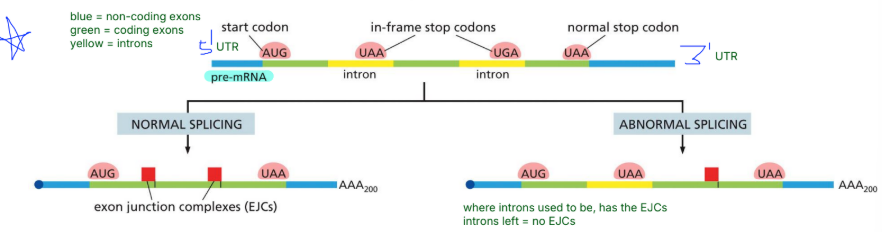
RNA Splicing — Spliceosomes and exon junction complexes (EJCs)
Spliceosomes — Enzyme complex made up of RNA and proteins
Sites of proper splicing bound by exon junction complexes (EJCs)
serve as a marker for properly spliced RNA
Alternative Splicing Can Be Regulated — negative control
Default: there is splicing
Repressor on: no splicing

Alternative Splicing Can Be Regulated — positive control
Default: no splicing
Activator on: splicing
