Environmental Physics PRELIM1
 Call Kai
 Learn
Learn Practice Test
 Spaced Repetition
 Match
Match Flashcards
 Knowt Play
1/32

There's no tags or description
Looks like no tags are added yet.
Name | Mastery | Learn | Test | Matching | Spaced | Call with Kai | Chat |
|---|
No analytics yet
Send a link to your students to track their progress
33 Terms
Why do we have seasons?
We have seasons because Earth’s 23.5° axial tilt causes the subsolar point to shift north and south between the Tropics throughout the year. This changes the solar elevation angle and length of daylight at each location, producing the seasons.
Equinoxes & Solstices
March 21 = march equinox
June 21 = summer solstice
Sep 21 = sep equinox
Dec 21 = dec solstice
What is an equinox?
Both hemispheres receive equal day and night (12 hours)
Declination angle
The latitude where the sun’s rays are directly overhead at noon
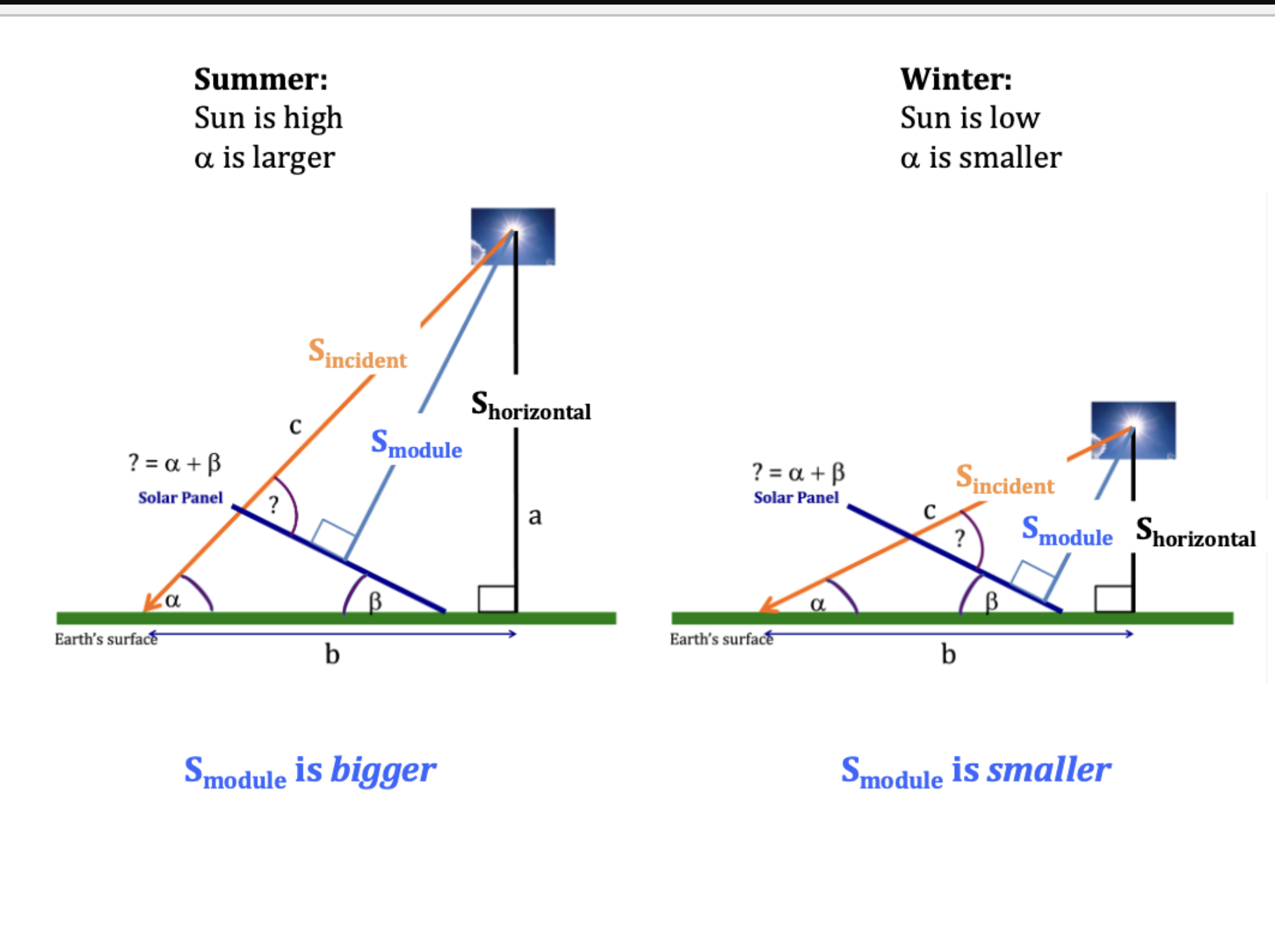
Why is Smod bigger in the summer than winter?
Sun is higher, α is larger
When α is larger, α + β is larger, so Smod is larger Smod = S0sin(α + β)
kwh definition
unit of energy; it kwh * hours.
kW = how fast energy is being used/produced
kWh = how much energy is used/produced
Why is module power similar to incident power in the summer but less in the winter?
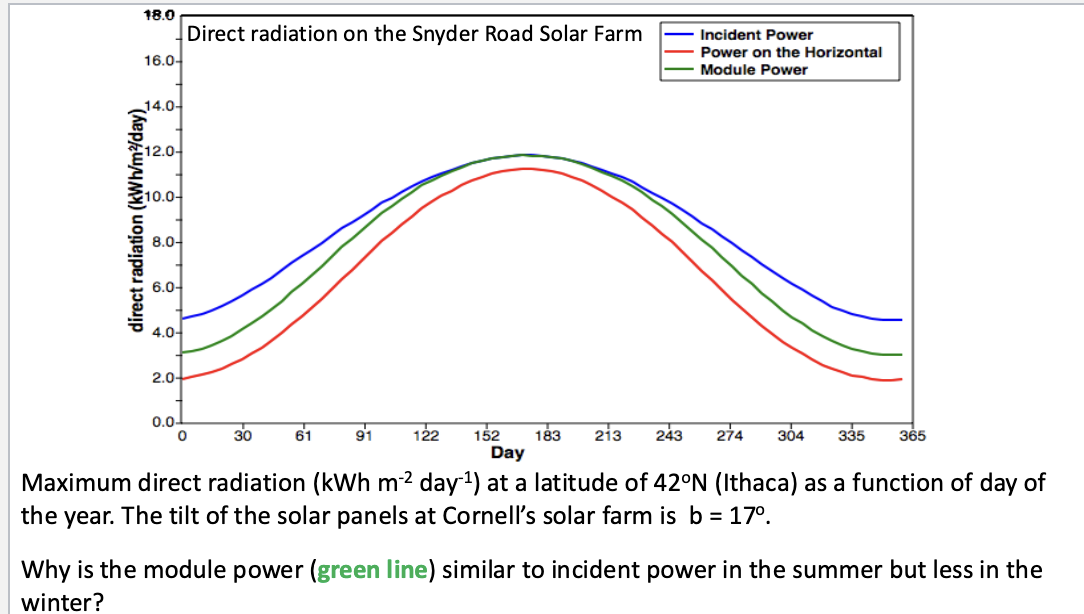
Because the tilt of the panel is closest to being normal to the solar beam (declination angle) at elevation angles occuring in the summer
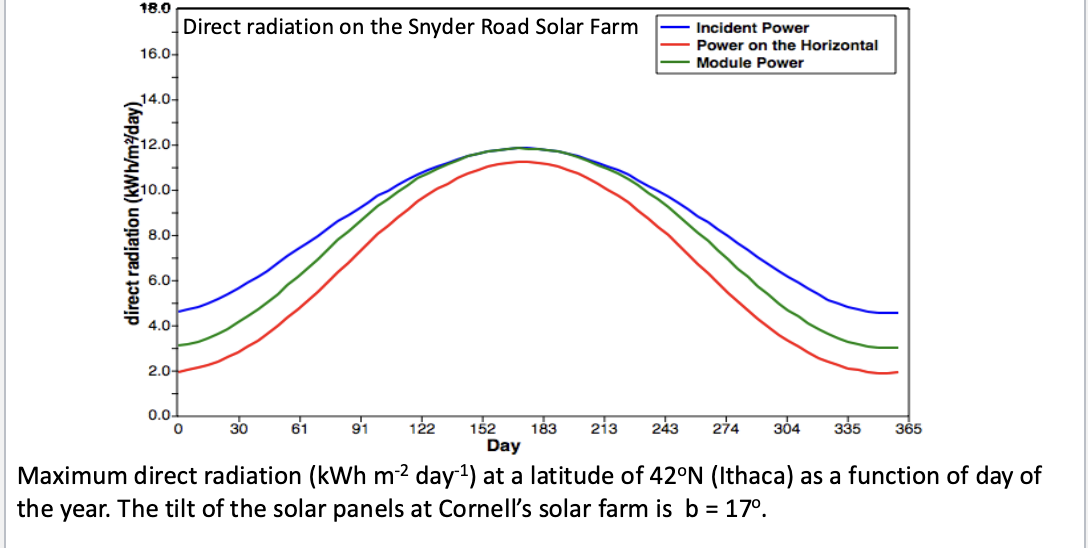
Why is incident power less in winter than in summer?
Because the days are longer in the summer. Sincident doesn’t change value btwn seasons; the days are longer so you get more energy per area per day
Units for total enery over the time period of a day
kWhr / m2 / day
Why does the total energy per day overestimate?
It assumes:
- it’s always daytime
- it’s always noon
What solar panel orientation receives the most solar radiation on a cloudy day?
Parallel to sky; facing flat up
bc the horizontal gets more energy on cloudy days
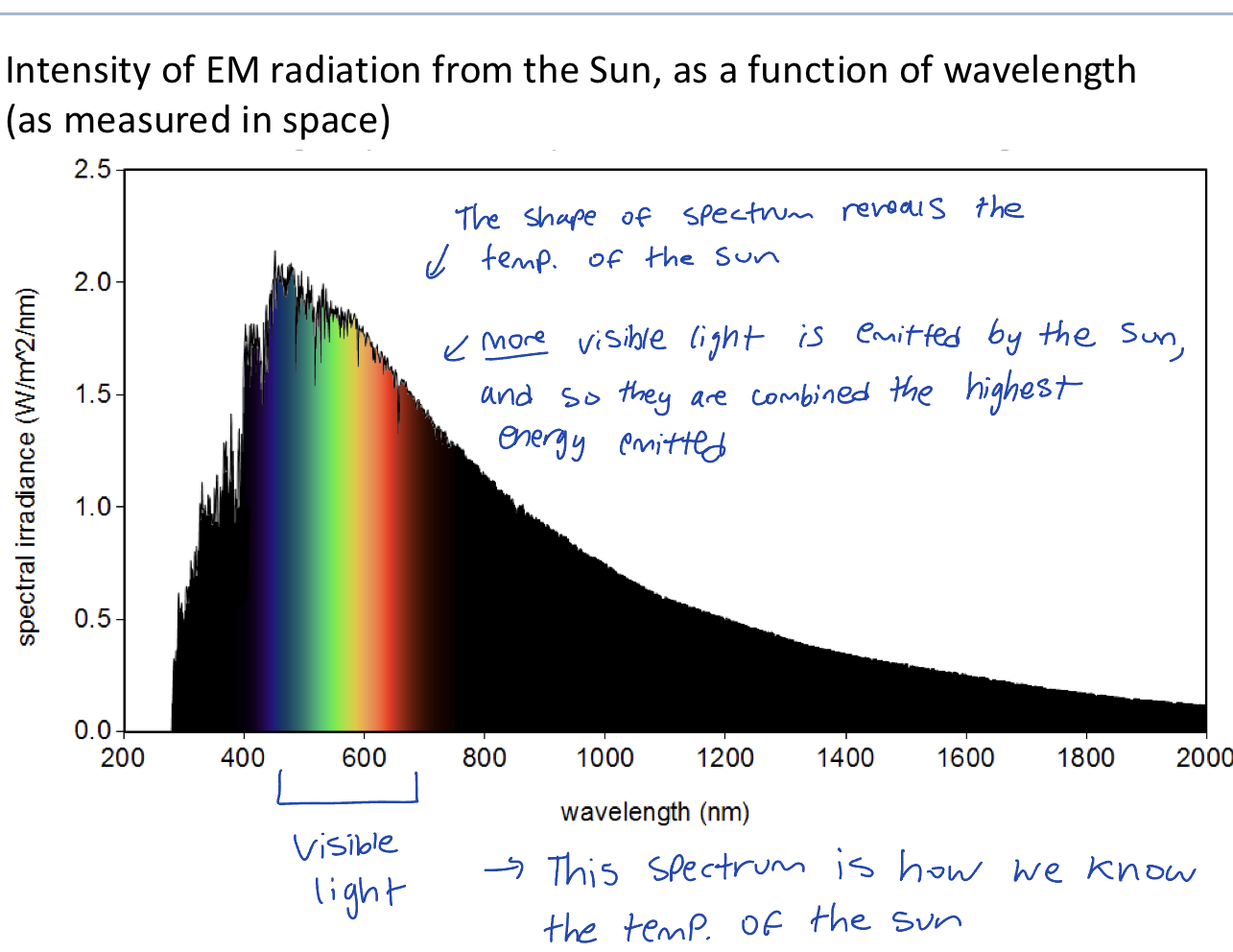
What EM radiation is emitted most by the sun?
Visible light
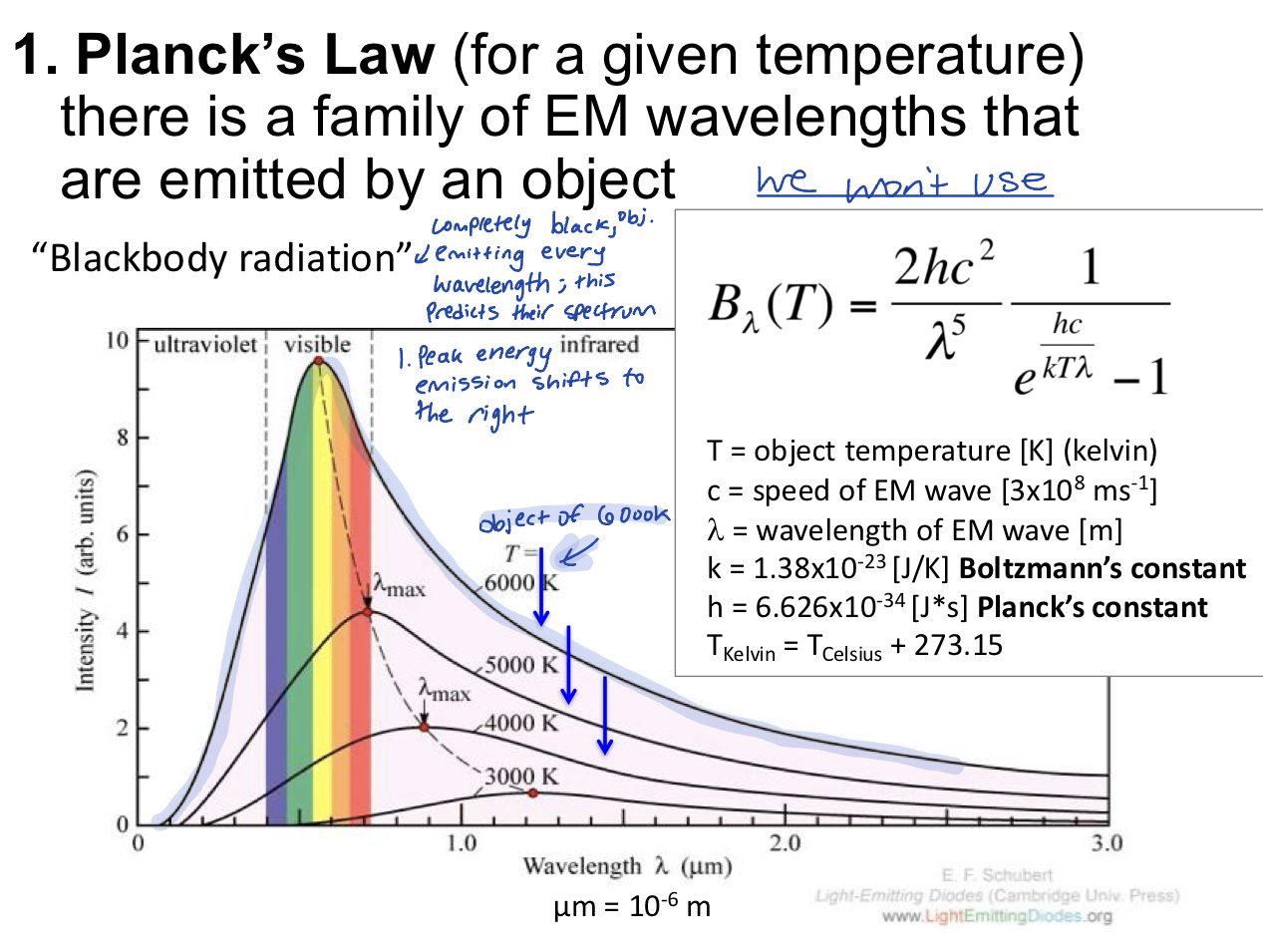
Planck’s Law
Wien’s Law
Wavelength of maximum emissions shifts to shorter wavelengths for higher temperatures

Stefan-Boltzmann Law
Total energy emitted by a m2 of an object is equal to a constant times temperature 4. Et = area under each curve

How do we know the temperature of the sun?
We analyze a spectral irradiance graph of the sun and compare it to the spectral insensity distribution of planck’s black-body radiation as a function of wavelength for different temperatures. see what the temperature is of the sun.
Kirchhoff’s Law
For a given temp, whichever wavelengths you emit, you must absorb the same wavelengths — applies to black bodies
Not the same intensity for all wavelengths
Molecular absorption spectra

What does LANDSAT do?
Records electromagnetic radiation reflected off of Earth so we can analyze the surface - can be used to show land use changes, etc
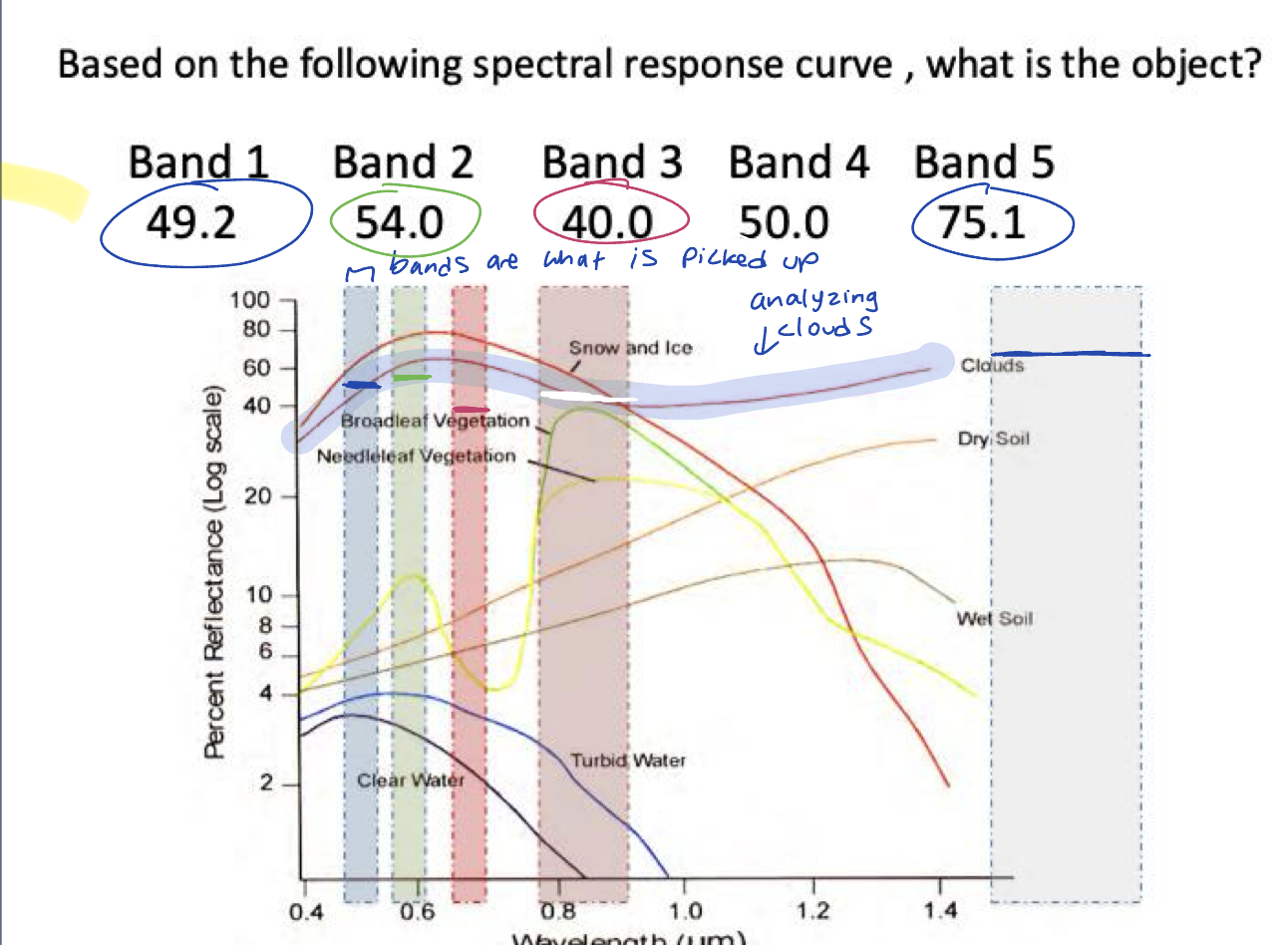
Healthy vs. stressed vegetation reflection landsat
Healthy vegetation: Absorbs most radiation in the visible (VIS) part of the spectrum and reflects radiation in the near infrared (NIR) part of the spectrum
Stressed vegetation: Absorbs less radiation in VIS and reflects more in NIR
(makes sense bc healthier plants do more photosynthesis and stuff, so absorb more visible light)
NDVI & what it means
NDVI = relationship to determine healthy or stressed vegetation
Higher NDVI = healthier vegetation
NDVI can be used to map the density of vegetative cover & track vegetative health throughout growing seasons bc low NDVI = stress

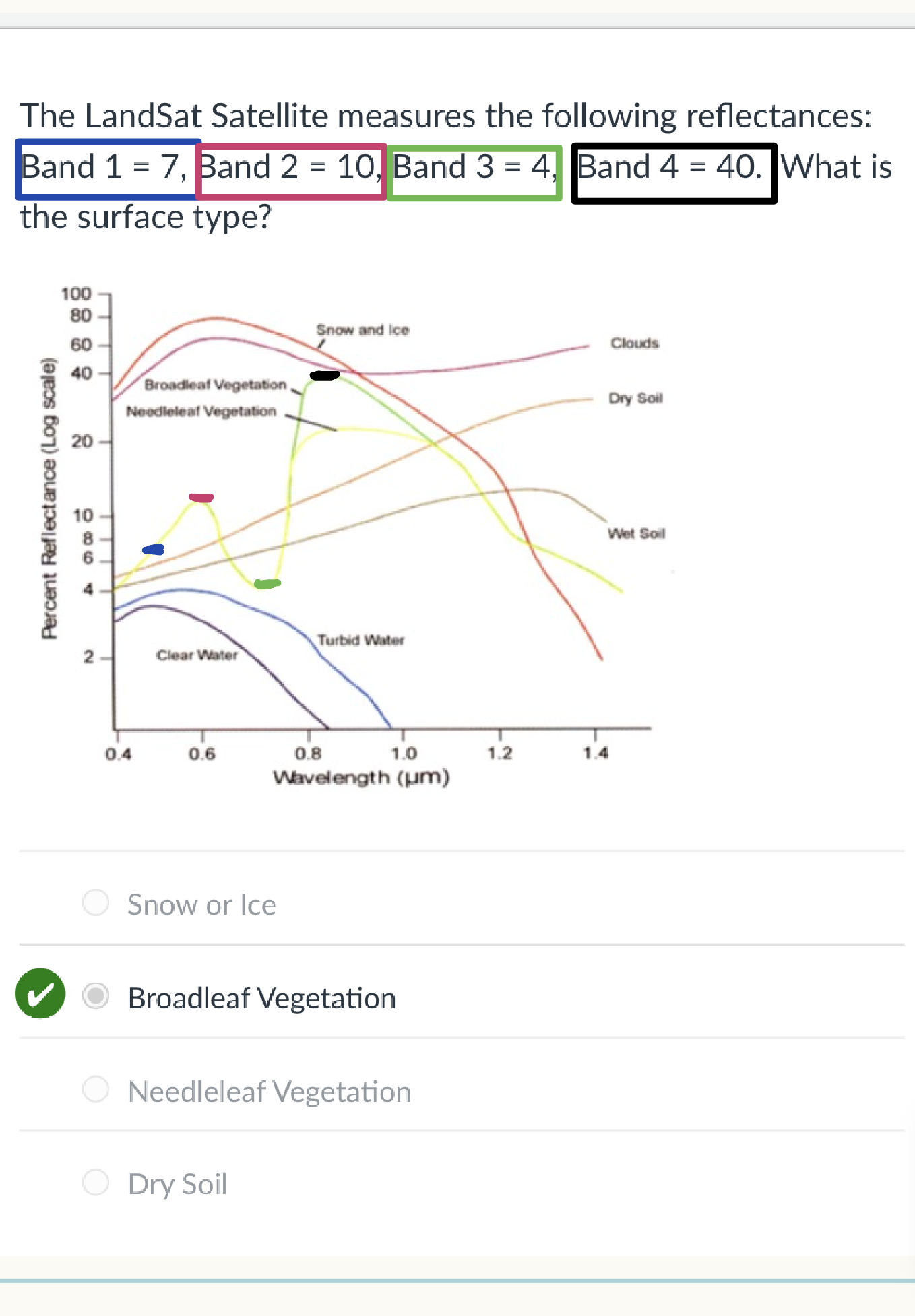
Blackbody model vs sun

Emissivity ε & its effect on Stefan-Boltzmann law

How to compute the TOTAL POWER of an object
Irradiance (ET) = Wm-2 = how many joules produced per second for each m2
Total power = ET * SAsun = power produced by entire surface of sun
How to calculate solar irradiance that Earth actually receives per 1m2 at the top of Earth’s atmosphere
The sun produces its Total Power by the entire surface of the sun in ALL directions, but only a proportion of that actually hits Earth
You get Ptotal by multiplying the ET by the surface area of the sun
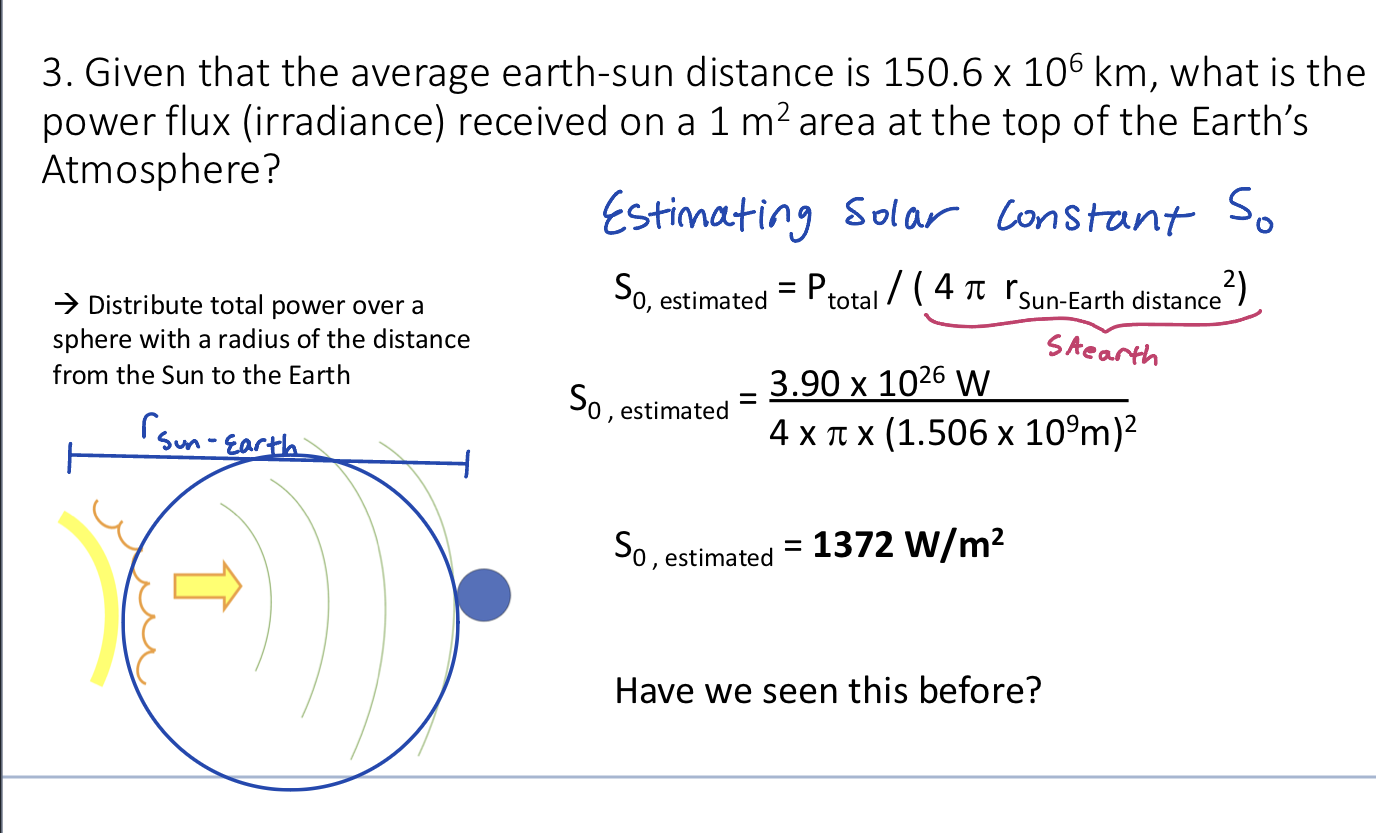
This is the average incoming radiation for the sun “solar constant”
How to calculate how much total power reaches the top of the Earth’s atmosphere?
Multiply the Solar constant (average irradiance (W/m2 )) by surface area of imaginary circle w/ radius of Earth
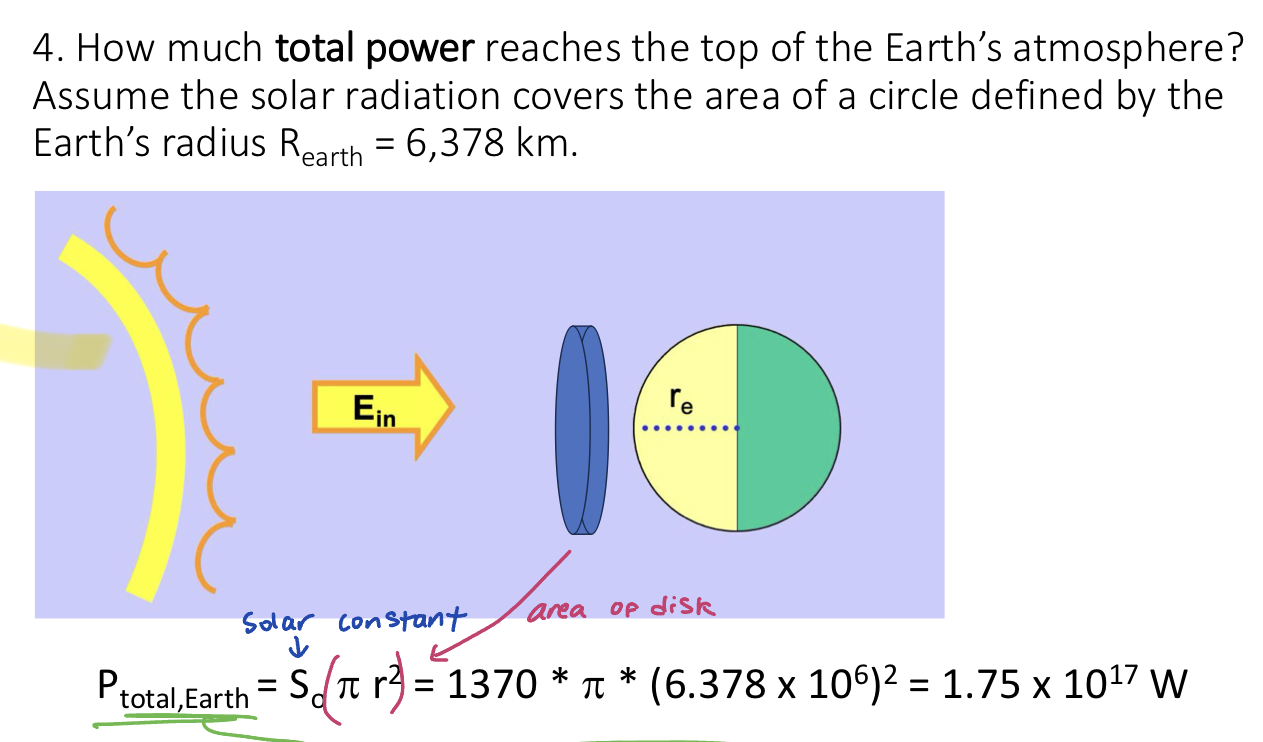
If the Earth’s albedo is 0.3, how much power actually enters the Earth’s atmosphere

Energy Balance

If Ein = Eout, what should a planet’s temperature be?

How to derive Energy Balance temperature equation
Total power out = power flux emitted by Earth * Earth’s SA
Eout = (ET) (SA)
Eout = (σTearth4) * (4πrearth2)
Ein = (1-A) * (S0 x πrearth2)
Ein = Eout
Ein = (1-A) * (S0 x 4πrearth2) = (σTearth4) * (4πrearth2)
Cancel stuff to get
(1-A) = σTearth4
Tearth4 = S0 (1-A) / 4σ
Why is Earth’s surface warmer than the expected temperature of -18?
The sun emits shortwave radiation and is let in through the atmosphere, which is this absorbed by the earth and reemitted as longwave radiation. Atmospheric molecules absorb longwave radiation and reemit it, keeping some energy in the system and causing heat

Solar geoengineering
