3.3 Organic Chemistry - Halogenalkanes
 Call Kai
 Learn
Learn Practice Test
 Spaced Repetition
 Match
Match Flashcards
 Knowt Play
1/45

There's no tags or description
Looks like no tags are added yet.
Name | Mastery | Learn | Test | Matching | Spaced | Call with Kai | Chat |
|---|
No analytics yet
Send a link to your students to track their progress
46 Terms
Why are halogenoalkanes reactive?
What type of bond is the carbon–halogen bond?
Why is the C–X bond polar?
What charge does the carbon have in halogenoalkanes?
What charge does the halogen have?
Why are halogenoalkanes attacked by nucleophiles?
Polar C–X bond makes carbon δ⁺
Polar covalent bond
Halogen more electronegative than carbon
δ⁺
δ⁻
Carbon is electron-deficient
What is nucleophilic substitution?
What is a nucleophile?
Does a nucleophile need a negative charge?
Why is the carbon attacked?
Why is halogen a good leaving group?
What is a leaving group?
What is the general equation for nucleophilic substitution?
Nucleophile replaces leaving group
Electron pair donor
No
Carbon is δ⁺
Forms stable halide ion
Group that leaves with bonding electrons
R–X + Nu⁻ → R–Nu + X⁻
What happens in aqueous OH⁻ conditions?
What happens in ethanolic OH⁻ conditions?
Why does aqueous OH⁻ favour substitution?
Why does ethanolic OH⁻ favour elimination?
What does it mean that OH⁻ is more stable in water?
How does solvation affect OH⁻?
Why is OH⁻ less reactive in water?
What does OH⁻ act as in substitution?
What does OH⁻ act as in elimination?
Why does solvent change reaction pathway?
What happens in a water + ethanol mixture?
Alcohol forms
Alkene forms
OH⁻ stabilised by hydration
OH⁻ acts as base
Surrounded by water → stabilised
Reduces reactivity
Hydrogen bonding stabilises OH⁻
Nucleophile
Base
Changes OH⁻ stability
Both products form
What are the conditions for ammonia reacting with halogenoalkanes?
Why is ethanol used with ammonia?
Why is pressure used?
What is formed when ammonia reacts with halogenoalkanes?
What intermediate is formed?
Why is the intermediate positively charged?
Why is a second ammonia molecule needed?
What does the second ammonia molecule do?
Why are primary amines favoured in excess ammonia?
Why can secondary and tertiary amines form?
What is the side product?
Heat, pressure, ethanolic NH₃
Prevents hydrolysis
Keeps NH₃ in solution
Primary amine
Alkylammonium ion
Nitrogen has 4 bonds
Second NH₃ removes H⁺
Acts as base
Prevents further substitution
Product amines are nucleophiles
NH₄Br
Why can amines act as nucleophiles?
Why are amines stronger nucleophiles than ammonia?
What is a primary amine?
What is a secondary amine?
What is a tertiary amine?
What is a quaternary ammonium salt?
Lone pair on nitrogen
Alkyl groups increase electron density
R–NH₂
R₂NH
R₃N
R₄N⁺
What are the conditions for reaction with CN⁻?
Why is ethanol used with CN⁻?
What type of reaction is this?
What does CN⁻ do?
Which atom in CN⁻ attacks?
Why does CN⁻ extend the carbon chain?
What can nitriles be converted into?
Ethanolic KCN + reflux
Prevents hydrolysis
Nucleophilic substitution
Attacks carbon
Carbon atom
Adds one carbon
Carboxylic acids / amines
What is elimination?
What product is formed?
What conditions favour elimination?
Why is ethanol used?
Why is heat used?
What does OH⁻ remove?
What is the β-carbon?
Where does OH⁻ attack?
Why is that hydrogen removed?
What happens to electrons after H removal?
What happens to halogen?
Why is elimination a one-step mechanism?
What is formed from OH⁻ + H⁺?
Why is water a side product?
Removal of atoms to form double bond
Alkene
Ethanolic KOH + heat
Favour elimination
Provides activation energy
H⁺
Carbon next to C–X
β-carbon
Needed for C=C formation
Forms π bond - the electrons from the C-H bond form a bond between the 2 carbons
Leaves as halide ion
One-step mechanism
Water
OH⁻ is protonated
What is bond enthalpy?
How does bond enthalpy affect rate?
Why is C–I weaker than C–F?
How does atomic radius affect bond strength?
How does bond length affect strength?
Which halogenoalkanes react fastest?
Which react slowest?
Energy to break bonds
Lower enthalpy → faster rate
Larger atoms → weaker overlap
Bigger atoms = weaker bonds
Longer bond = weaker bond
Iodoalkanes
Fluoroalkanes
Why is O₂ more stable than O₃?
What type of bond is in O₂?
Why is O₃ less stable?
How is ozone formed?
What breaks O₂?
Where is ozone found?
Why is ozone low in concentration?
What is photodissociation?
What happens when UV hits CFCs?
What radicals are formed?
Why are chlorine radicals dangerous?
O₂ has strong double bond
O=O double bond
Weaker delocalised bonding
UV splits O₂ → O atoms → O₃
UV radiation
Stratosphere
Constant breakdown
Light breaks bonds
C–Cl bonds break
Chlorine radicals (Cl•)
Catalytically destroy ozone
What is ozone?
Where is ozone found?
How is ozone formed naturally?
Why is ozone beneficial?
What type of radiation does ozone absorb?
A molecule made of three oxygen atoms (O₃)
Stratosphere (upper atmosphere)
UV radiation splits O₂ → O atoms → O₃ forms
Absorbs harmful UV radiation
Ultraviolet radiation
What causes C–Cl bonds in CFCs to break?
What is the process called when UV breaks bonds in CFCs?
What is formed when C–Cl bonds break?
Why are chlorine atoms formed in the upper atmosphere?
UV radiation
Photodissociation / photolysis
Chlorine radicals (Cl•)
UV breaks C–Cl bonds in CFCs
What do chlorine atoms do to ozone?
What is meant by chlorine acting as a catalyst?
What is the overall effect of chlorine on ozone levels?
What is the first step in the ozone depletion mechanism?
What is formed in the first step?
What is the second step in the mechanism?
What is regenerated in the second step?
Why is chlorine called a catalytic radical?
They catalyse ozone decomposition
It is not used up and is regenerated
Reduction in ozone concentration (ozone hole)
Cl• + O₃ → ClO• + O₂
ClO• (chlorine monoxide radical)
ClO• + O₃ → 2O₂ + Cl•
Cl• (chlorine radical regenerated)
It speeds up reaction without being used up and has an unpaired electron
What is the equation for Cl reacting with ozone?
What is the equation for ClO reacting with ozone?
What is the overall effect of these two steps?
What is the ozone layer hole?
Why is ozone depletion dangerous?
What is the role of scientific research in CFC bans?
What did scientists discover about CFCs?
What has replaced CFCs?
Cl• + O₃ → ClO• + O₂
ClO• + O₃ → 2O₂ + Cl•
Ozone is converted into oxygen overall
Region of significantly reduced ozone concentration
More UV reaches Earth → skin cancer, DNA damage
Provided evidence leading to CFC bans
That CFCs release chlorine radicals in the atmosphere
Chlorine-free alternatives (modern refrigerants)
Why is ozone constantly formed and destroyed naturally?
Why does ozone depletion become a problem when chlorine is present?
Why is chlorine described as a radical?
Natural balance between formation and breakdown
Chlorine radicals catalyse rapid breakdown
Because it has an unpaired electron
Explain how to name halogenoalkanes
Naming halogenoalkanes
A halogenoalkane is a type of chemical compound where one or more hydrogen atoms in an alkane have been replaced by halogen atoms (like fluorine, chlorine, bromine, or iodine).
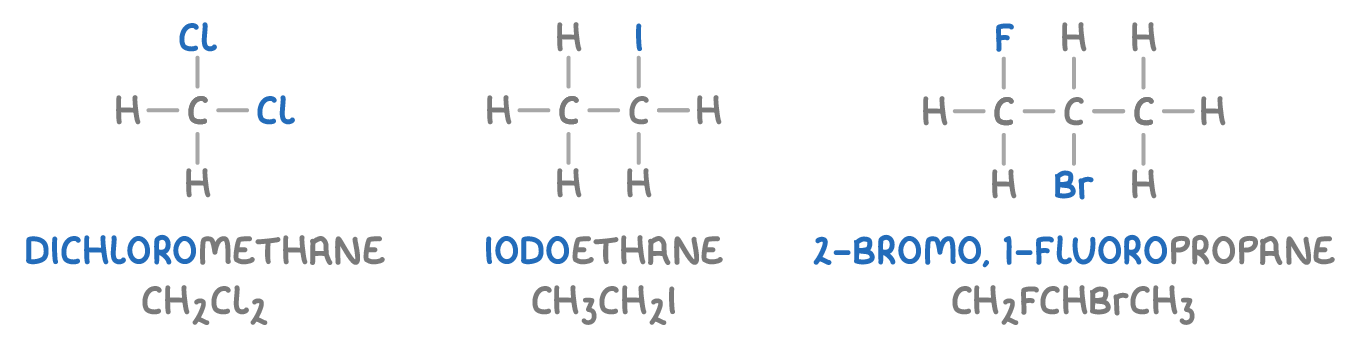
To name a halogenoalkane, we use prefixes (like fluoro-, chloro-, bromo-, iodo-) to indicate the type and number of halogen atoms.
Here are some examples of halogenoalkanes:
Explain the polarity of a carbon-halogen bond
Polarity of the carbon-halogen bond
In halogenoalkanes, the carbon-halogen bond is polar because halogen atoms have a higher electronegativity than carbon. This causes an uneven distribution of electrons, making the carbon atom partially positively charged (δ+) and the halogen atom partially negatively charged (δ-).
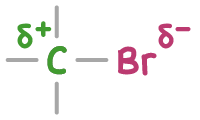
This bond polarity makes the carbon atom a target for nucleophiles (electron-pair donors). Common nucleophiles include OH-, CN-, NH3, and H2O
Polarity of the carbon–halogen bond (AQA A-level):
In halogenoalkanes, the carbon–halogen (C–X) bond is polar because the halogen atom is more electronegative than the carbon atom. This means the bonding pair of electrons is drawn towards the halogen.
As a result:
The carbon atom becomes δ⁺ (partially positive)
The halogen atom becomes δ⁻ (partially negative)
Why this matters:
The δ⁺ carbon is electron-deficient, so it is attacked by nucleophiles (species that donate a lone pair of electrons), such as:
OH-, CN⁻, NH₃, H₂O
This is why halogenoalkanes undergo nucleophilic substitution reactions.
One extra detail for top marks:
The polarity also helps explain bond strength trends (e.g. C–I is weaker than C–Cl), which affects how easily the halogen is replaced.
Explain the influence of carbon-halogen bond enthalpy on reaction rates
Influence of carbon–halogen bond enthalpy on reaction rates
Bond enthalpy is the energy required to break one mole of a bond in the gaseous state. It is a measure of bond strength.
In halogenoalkanes, the carbon–halogen bond enthalpy affects the rate of nucleophilic substitution:
Lower bond enthalpy → weaker bond → easier to break → faster reaction
Higher bond enthalpy → stronger bond → harder to break → slower reaction
Trend down Group 7
The carbon–halogen bond enthalpy decreases down Group 7:
Atomic radius of the halogen increases
C–X bond length increases
Attraction between the nuclei and bonding electrons decreases
This results in weaker bonds that require less energy to break.
Effect on reactivity
Therefore, the rate of reaction increases down the group:
fluoroalkanes < chloroalkanes < bromoalkanes < iodoalkanes
Iodoalkanes react fastest (weakest C–I bond)
Fluoroalkanes react slowest (strongest C–F bond)
Exam tip (for full marks)
Make sure you explicitly link:
“lower bond enthalpy means less energy needed to break the bond in the rate-determining step”
Bond | Bond enthalpy (kJ mol-1) |
|---|---|
C–F | 467 |
C–Cl | 346 |
C–Br | 290 |
C–I | 228 |
Explain the nucleophilic substitution mechanism and the key steps and the nucleophiles that can react
Nucleophilic substitution mechanism
A nucleophile is a species that donates an electron pair to form a new covalent bond.
A nucleophile can react with a polar molecule like a halogenoalkane by 'kicking out' the halogen functional group and taking its place.
This is called a nucleophilic substitution reaction and follows the mechanism below:

The key steps are:
A nucleophile (Nuc) approaches the halogenoalkane (RCH2X), which has a partially positive carbon atom (δ+).
The nucleophile donates its lone pair of electrons to the δ+ carbon, forming a new covalent bond.
The original bond between the δ+ carbon and the halogen breaks heterolytically as the halogen atom takes both the shared electrons.
The halogen departs as a halide ion (X-), being replaced by the nucleophile.
Halogenoalkanes readily undergo nucleophilic substitution reactions via this mechanism. The nucleophiles that can react via this mechanism include hydroxide ions (OH-), water (H2O), cyanide ions (CN-) and ammonia (NH3). The nature of the product formed depends on which nucleophile is used.
Explain what haloalkanes react with to form alcohols and the nucleophiles from what bases, what type of reaction is this, what about water molecules involved …
Reaction with hydroxides to form alcohols
Halogenoalkanes readily undergo nucleophilic substitution with aqueous hydroxide ions (OH-) from bases like sodium hydroxide or potassium hydroxide when the reaction mixture is warmed.
For example, bromoethane reacts with hydroxide to form ethanol:
CH3CH2Br + OH- ➔ CH3CH2OH + Br-
The reaction mechanism is:
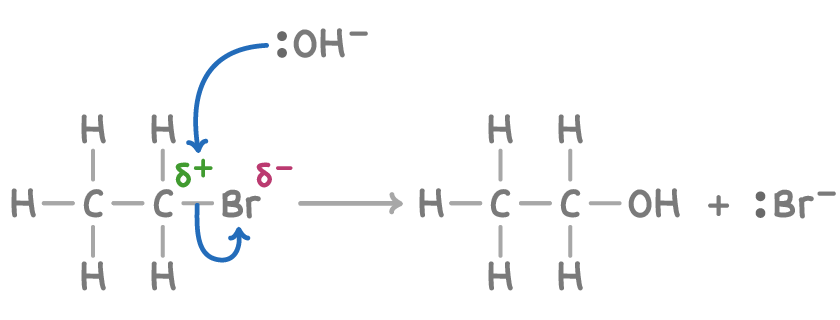
This reaction, which replaces the halogenoalkane with an alcohol product, is a type of hydrolysis reaction. Water molecules can also act as the nucleophile in similar hydrolysis reactions with halogenoalkanes to generate alcohols. However, the reaction rate is much slower with neutral water molecules than with hydroxide ions, which are more nucleophilic.
Explain the hydrolysis of haloalkanes with water vs OH-, which is slower and why
Hydrolysis of halogenoalkanes (with water vs OH⁻)
Hydrolysis is a reaction where a molecule is broken using water, producing an alcohol from a halogenoalkane.
With hydroxide ions (OH⁻):
OH⁻ is a negatively charged ion
It has a lone pair of electrons and a high electron density
This makes it a strong nucleophile
So it can readily attack the δ⁺ carbon in the polar C–X bond, leading to a fast nucleophilic substitution reaction:
R–X + OH⁻ → R–OH + X⁻
With water (H₂O):
Water is neutral (no charge)
It still has lone pairs, but lower electron density
So it is a weaker nucleophile
This means:
It is less attracted to the δ⁺ carbon
It attacks more slowly
The reaction has a lower rate
Why is water slower? (key AQA explanation)
OH⁻ has a negative charge → stronger electrostatic attraction to the δ⁺ carbon
H₂O has no charge → weaker attraction
Therefore, fewer successful collisions per second
Extra detail (to push for top marks)
When water reacts:
It forms an intermediate oxonium ion (R–OH₂⁺)
This then loses a proton (H⁺) to form the alcohol
This extra step also contributes to the slower overall rate.
Nice summary sentence (exam-ready):
Water is a weaker nucleophile than hydroxide ions because it is neutral and has a lower electron density, so it reacts more slowly with halogenoalkanes.
Explain how the reaction with cyanide goes and what it forms
Reaction with cyanide to form nitriles
Halogenoalkanes also undergo nucleophilic substitution when refluxed with ethanolic potassium cyanide. The cyanide ion (CN-) acts as the nucleophile, displacing the halogen to form a nitrile product.
For example, bromoethane reacts with cyanide to form ethanenitrile:
CH3CH2Br + CN- ➔ CH3CH2CN + Br-
The reaction mechanism is:

Importantly, this reaction extends the carbon chain length of the original halogenoalkane by one carbon atom.
For reactions with cyanides explain the reaction conditions, type of mechanism, nature of the cyanide ion, why CN- is a good nucleophile and the importance of chain extension
1. Reaction conditions (very important)
Reflux with ethanolic potassium cyanide (KCN in ethanol)
Ethanol is used instead of water to prevent hydrolysis (formation of alcohol)
2. Type of mechanism
Proceeds via nucleophilic substitution
Usually SN2 mechanism for primary halogenoalkanes:
One-step reaction
Backside attack
Forms a transition state
3. Nature of the cyanide ion (key detail)
CN⁻ is an ambident nucleophile (can attack through C or N)
In this reaction, it attacks through the carbon atom, forming a nitrile (–C≡N)
4. Why CN⁻ is a good nucleophile
Has a negative charge
High electron density
Strong attraction to δ⁺ carbon
5. Importance of chain extension (exam gold)
Adds one extra carbon atom
Useful for building longer organic molecules
Nitriles can be further converted into:
Carboxylic acids (by hydrolysis)
Amines (by reduction)
Upgraded summary sentence (for your flashcard):
This reaction is useful in organic synthesis because it increases the carbon chain length by one and forms a nitrile, which can be further converted into other functional groups such as carboxylic acids or amines.
Explain the reaction with ammonia to form amines
Reaction with ammonia to form amines
When heated under pressure with excess concentrated ethanolic ammonia, halogenoalkanes undergo nucleophilic substitution to form primary amines.
For example, bromoethane reacts with ammonia to form ethylamine:
CH3CH2Br + 2NH3 ➔ CH3CH2NH2 + NH4Br
This reaction proceeds through a two-step mechanism:

Initially, ammonia replaces the bromine atom. Subsequently, it abstracts a hydrogen from the intermediate amine, yielding the final amine product alongside the salt ammonium bromide.
🧠 Big picture first (what’s happening?)
You start with: a halogenoalkane (e.g. CH₃CH₂Br), ammonia (NH₃)
👉 You end up with: a primary amine (CH₃CH₂NH₂)
So basically: the halogen (Br) gets replaced by NH₂
⚡ Why does this happen? (link to what you already know)
The C–Br bond is polar
Carbon is δ⁺ (slightly positive)
NH₃ has a lone pair of electrons
👉 So ammonia is attracted to the carbon and attacks it
🔍 Now the mechanism — step by step ✅ Step 1: Ammonia attacks (most important step)
Think of ammonia like this:
Nitrogen has a lone pair
It wants to donate electrons (so it's a nucleophile)
👉 What happens:
The lone pair on N attacks the δ⁺ carbon
At the same time, Br leaves
So:
A new bond forms: C–N
The C–Br bond breaks → Br⁻
⚠ BUT here’s the key thing:
Nitrogen now has 4 bonds, so it becomes positively charged
👉 You get this intermediate:
CH₃CH₂NH₃⁺ (called an alkylammonium ion)
✅ Step 2: Another ammonia fixes the charge
That positive charge isn’t stable, so:
Another NH₃ molecule acts as a base
It removes a hydrogen (H⁺) from CH₃CH₂NH₃⁺
👉 This gives:
CH₃CH₂NH₂ (your amine ✅)
NH₄⁺
Then: NH₄⁺ + Br⁻ → NH₄Br
💡 Why do you need 2 NH₃? (this confuses a lot of people)
Because:
One NH₃ = attacks (nucleophile)
One NH₃ = removes H⁺ (base)
👉 That’s why the equation has 2NH₃
🚀 Why use EXCESS ammonia? (very exam important)
Here’s the tricky bit: The product CH₃CH₂NH₂ (amine) also has a lone pair…
👉 So it can ALSO attack more halogenoalkane!
This would make: secondary amines, tertiary amines
❌ Not what we want
👉 So we use excess NH₃ to:
make sure NH₃ reacts instead of the amine
get mostly primary amine
🔥 Final simple way to remember it
NH₃ attacks carbon
Br leaves
Intermediate forms (positive)
Another NH₃ removes H⁺
→ Amine formed
📝 Exam-ready sentence (learn this)
Ammonia acts as a nucleophile, donating a lone pair of electrons to the δ⁺ carbon atom. The carbon–halogen bond breaks, forming an alkylammonium ion, which is then deprotonated by another ammonia molecule to form a primary amine.
Why do we need a second ammonia molecule, why this is better
🧠 Why do we need a SECOND ammonia molecule?
After the first step, you form this: CH₃CH₂NH₃⁺ (alkylammonium ion)
⚠ What’s wrong with this?
Nitrogen normally forms 3 bonds + 1 lone pair
Here it has 4 bonds and no lone pair
So it has a positive charge (NH₃⁺)
👉 This is: unstable, not the final product
🔍 So what needs to happen?
We need to:
remove one hydrogen (H⁺)
so nitrogen goes back to: 3 bonds, 1 lone pair, neutral charge ✅
💡 Why does NH₃ remove the H⁺? Ammonia can act as a base because:
it has a lone pair, it can accept a proton (H⁺)
👉 So a SECOND NH₃ molecule: takes H⁺ from CH₃CH₂NH₃⁺, forms NH₄⁺
🔥 Key idea (very exam-worthy): You need the second NH₃ because:
the first step produces a positively charged intermediate that must be deprotonated to form a stable neutral amine.
⚠ Why are 2° and 3° amines a problem?
Once you form your product: CH₃CH₂NH₂ (a primary amine)
👉 It still has: a lone pair on nitrogen
So it is ALSO a: nucleophile
😬 What goes wrong? The amine can react again with another halogenoalkane:
Step-by-step:
Primary amine reacts → secondary amine (R₂NH)
Secondary amine reacts → tertiary amine (R₃N)
Can even go further → quaternary ammonium salt
❌ Why is this “bad”? (exam meaning)
It’s not “bad” chemically — but:
👉 In exams/synthesis:
You usually want ONE specific product
Here, you get a mixture of products
This means:
Lower yield of your desired primary amine
Harder to separate products
🚀 So why use EXCESS ammonia?
To reduce this problem:
More NH₃ molecules = more chance NH₃ reacts
Less chance the amine reacts again
👉 So: Primary amine is favoured, Further substitution is minimised
🧩 Nice way to remember it
NH₃ has 2 roles:
nucleophile (attacks carbon)
base (removes H⁺)
Amines are “greedy”: they keep reacting unless you stop them
📝 Top-level exam sentence
A second ammonia molecule is required to act as a base and remove a proton from the alkylammonium ion, forming a neutral amine. Excess ammonia is used to minimise further nucleophilic substitution, as the amine product can also act as a nucleophile and form secondary and tertiary amines, leading to a mixture of products
Explain how halogenoalkanes eliminate in alkaline conditions. Why does ethanol and heat matter. How does OH- act what is the difference with how an OH- reacts in a substitution and elimination reaction.
🧠 Big idea (what is elimination?)
Instead of replacing the halogen (like in substitution), you:
👉 REMOVE things from the molecule
Specifically: a hydrogen (H), the halogen (X)
👉 This creates a double bond (C=C) → an alkene
⚡ What are the conditions?
KOH in ethanol, heat under reflux
👉 These conditions make OH⁻ act as a base (not a nucleophile)
🔥 What does OH⁻ actually DO?
Think of OH⁻ like this: 👉 It grabs a hydrogen (H⁺) from the molecule
🔍 Step-by-step (simple version)
Let’s use your example: CH₃CHICH₃ (2-iodopropane)
✅ Step 1: OH⁻ removes a hydrogen
OH⁻ takes a H⁺ from a carbon next to the iodine
This forms water (H₂O)
✅ Step 2: double bond forms
When the H is removed, the electrons from the C–H bond stay behind
These electrons go on to form a C=C double bond
✅ Step 3: halogen leaves
At the same time, the C–I bond breaks
Iodine leaves as I⁻
👉 All of this happens at the same time (one step)
💡 So overall:
You remove: H (as H₂O), I (as I⁻) 👉 and form: propene (alkene)
⚠ KEY thing students miss OH⁻ is doing a different job here:
Reaction type | What OH⁻ does |
|---|---|
Substitution | attacks carbon |
Elimination | removes H⁺ |
👉 Same chemical, different role
🔥 Why ethanol matters (SUPER important)
Ethanol → elimination Water → substitution
👉 Ethanol makes OH⁻ more likely to:
act as a base, not attack carbon
🌡 Why heat?
Elimination needs more energy. Heat makes it more likely to happen
🧩 Easy way to remember Elimination = “pull off H and X → make double bond”
📝 Simple exam sentence
A hydroxide ion acts as a base and removes a hydrogen from a carbon adjacent to the halogen, forming a double bond as the halogen is eliminated.
Go through the reaction mechanism for an elimination reaction.
The mechanism of the elimination reaction occurs in three steps:
OH⁻ removes a hydrogen ion (H⁺) from the halogenoalkane, forming water.
👉 OH⁻ is acting as a base here (not a nucleophile).
It picks up a hydrogen (H⁺) from a carbon next to the carbon–halogen bond (this is called a β-hydrogen in A-level terms).
When OH⁻ takes H⁺, it becomes H₂O (water).
💡 Important idea: This step is about removing a proton, not attacking carbon.
This leaves the adjacent carbon with a spare electron to form a π bond.
👉 When the hydrogen is removed:
The C–H bond breaks
The electrons from that bond are left behind on the carbon
Now that carbon has extra electrons, so:
These electrons move to form a C=C double bond (π bond) between the two carbons
💡 Key idea:
A double bond forms because electrons are rearranging, not because something is added.
The movement of electrons breaks the carbon-halogen bond heterolytically, eliminating the halide ion.
👉 At the same time:
The electrons in the C–X bond move onto the halogen
This causes the bond to break unevenly (heterolytically)
So:
Halogen leaves as a negative ion (X⁻)
💡 Key idea:
The halogen doesn’t “fall off” randomly — it leaves because the electrons go with it.
So OH⁻ acts as a base in elimination reactions by removing a proton.
👉 This is the most important concept:
In elimination, OH⁻ is a base
It removes H⁺ (proton abstraction)
💡 Contrast (helps understanding):
In substitution → OH⁻ attacks carbon
In elimination → OH⁻ removes hydrogen
🧠 One-line overall picture
OH⁻ removes a hydrogen, electrons rearrange to form a C=C bond, and the halogen leaves as a halide ion — all in one step.
Reaction mechanism
The mechanism of the elimination reaction occurs in three steps:
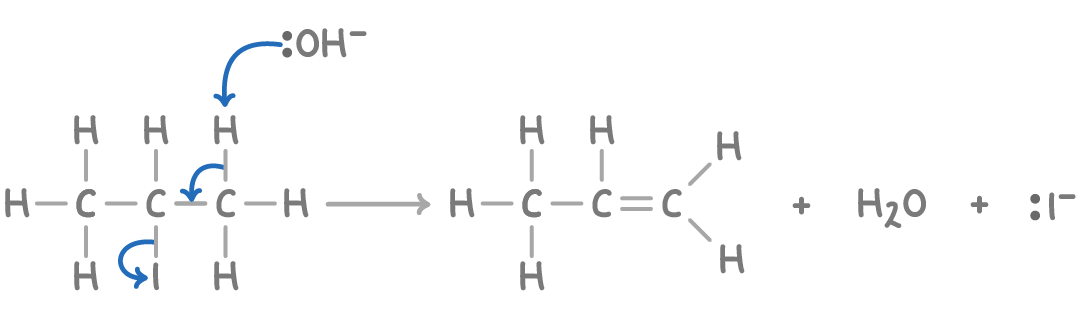
OH- removes a hydrogen ion (H+) from the halogenoalkane, forming water.
This leaves the adjacent carbon with a spare electron to form a π bond.
The movement of electrons breaks the carbon-halogen bond heterolytically, eliminating the halide ion.
So OH- acts as a base in elimination reactions by removing a proton.
The mechanism for the elimination of 2-iodopropane with OH- is:
When OH⁻ reacts with halogenoalkanes, it has two possible roles: explain them all in depth, the stability of the molecule
Anhydrous conditions favour elimination
Halogenoalkanes treated with hydroxide can undergo either substitution or elimination, depending on the choice of solvent.
Substitution is favoured in aqueous solution. OH- acts as a nucleophile.
Elimination is favoured in an ethanolic solution. OH- acts as a base.
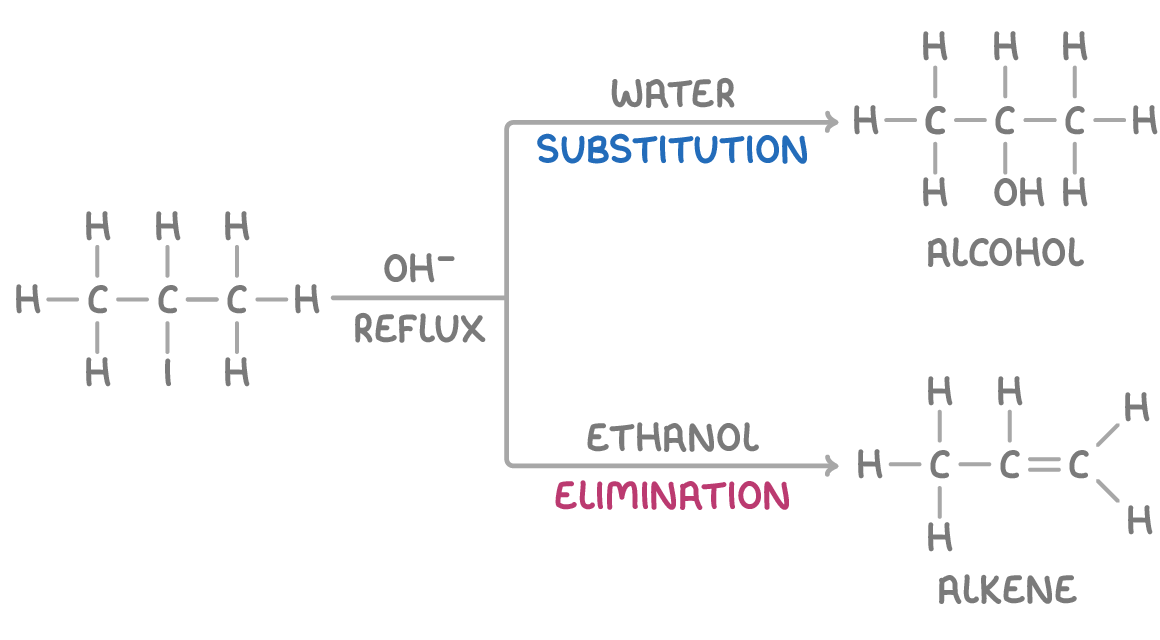
Using a solvent mixture of water and alcohol allows both reactions to occur, giving a mixture of products.
🧠 Big idea first (what is this question really about?)
When OH⁻ reacts with halogenoalkanes, it has two possible roles
Nucleophile → substitution → alcohol
Base → elimination → alkene
👉 Which one happens depends on the solvent (water or ethanol)
💧 AQUEOUS CONDITIONS (water) → substitution🔬 What “aqueous” really means
OH⁻ is dissolved in water molecules, It is surrounded by water constantly
This is called hydration (solvation)
🧲 Why OH⁻ is “more stable” in water OH⁻ is a charged ion (negative), so it strongly attracts water.
Water molecules are:
polar, slightly positive on hydrogen (=δ⁺)
👉 So water molecules surround OH⁻ like this:
H (δ⁺) of water points towards OH⁻
strong ion–dipole attractions form
💡 What this does: This “coat” of water molecules:
stabilises OH⁻ (lowers its energy)
holds it in a hydration shell
makes it less reactive
⚡ What does “less reactive” mean here?
Because OH⁻ is stabilised: it is less eager to react as a base, instead it behaves more like a nucleophile
👉 So it prefers: attacking the δ⁺ carbon forming a C–O bond replacing the halogen → substitution🔥 Key idea:
In water, OH⁻ is “calmed down” by hydration, so it is more likely to attack carbon rather than remove hydrogen.
🔍 SUBSTITUTION MECHANISM IN WATER
OH⁻ attacks δ⁺ carbon C–X bond breaks alcohol forms 👉 Product: R–OH
🍺 ETHANOLIC CONDITIONS → elimination🔬 What changes in ethanol?
Ethanol is: less polar than water, poorer at stabilising ions
So OH⁻ is: 👉 less surrounded by solvent molecules
⚡ What does that mean for OH⁻?
Because OH⁻ is NOT strongly stabilised:
it is higher energy more reactive more “aggressive” 👉 It behaves more like a strong base
💥 So what does it do instead?
Instead of attacking carbon:
it grabs a proton (H⁺) from a nearby carbon, forms H₂O, electrons shift → C=C forms, halogen leaves 👉 Product: alkene
⚖ WHY SOLVENT CHANGES THE ROLE OF OH⁻
This is the key A-level idea:
💧 In water: OH⁻ is stabilised (hydrated), lower reactivity, acts as nucleophile
🍺 In ethanol: OH⁻ is less stabilised, higher energy, acts as base
🧠 VERY IMPORTANT CONCEPT (EXAM GOLD)
👉 Stability affects behaviour:
Stable ion → less reactive → nucleophilic attack
Less stabilised ion → more reactive → base behaviour (elimination)
🔥 WHY THIS CHANGES REACTION PATHWAY
Because:
Substitution needs:
attack on carbon
Elimination needs:
removal of H⁺ (base behaviour)
👉 So solvent decides what OH⁻ “feels like doing”
🧪 WHY MIXED WATER + ETHANOL GIVES BOTH
If both solvents are present:
some OH⁻ is surrounded by water → substitution
some OH⁻ is surrounded by ethanol → elimination
👉 So both reaction pathways compete
➡ result = mixture of products
🌡 EXTRA DEPTH (often linked in exams)
Even if solvent is same:
higher temperature → more elimination
lower temperature → more substitution
Because elimination has:
higher activation energy
needs more energy to break bonds simultaneously
🧠 SIMPLE WAY TO LOCK IT IN
Water “calms OH⁻ down” → substitution
Ethanol “frees OH⁻ up” → elimination
📝 PERFECT EXAM SENTENCE
In aqueous solution, OH⁻ is stabilised by hydrogen bonding with water molecules, which reduces its reactivity and causes it to act as a nucleophile in substitution reactions. In ethanolic solution, OH⁻ is less stabilised and therefore acts as a stronger base, favouring elimination to form alkenes. Mixed solvents produce both reactions.
What are chlorofluorocarbons and how are they stable, what do they contain give examples? Why were they used… due to what properties??
Chlorofluorocarbons are stable halogenoalkanes
Chlorofluorocarbons (CFCs) are a type of halogenoalkane containing only carbon, chlorine and fluorine.
Key features include:
They contain no C-H bonds as all hydrogen atoms are substituted by chlorine and fluorine.
Common examples are CCl3F (trichlorofluoromethane) and CClF3 (chlorotrifluoromethane).
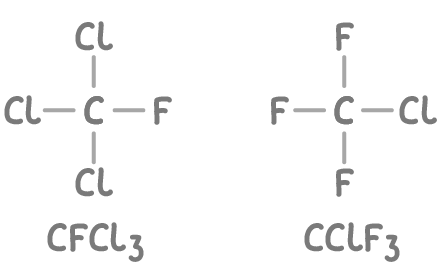
CFCs were widely used industrially and domestically as refrigerants, propellants and solvents until the late 1980s.
They were widely used due to properties such as:
High stability
Low toxicity
Non-flammability
Volatility
Their high stability is a result of the strong carbon-halogen bonds.
What do chlorine radicals do to the ozone? Give equations
What does it result in and lead to
Chlorine radicals destroy ozone
Chlorine radicals initiate a chain reaction that rapidly depletes ozone through a series of propagation reactions:
UV radiation forms chlorine radicals (Cl•) which react with ozone molecules:
Cl• + O3 ➔ ClO• + O2
The chlorine radical is regenerated:
ClO• + O3 ➔ Cl• + 2O2
The overall effect of these reactions is:
2O3 ➔ 3O2
This cycle allows a single chlorine radical to destroy more than 10,000 ozone molecules. The resulting depletion forms "holes" in the ozone layer, increasing UV radiation penetration.
What are the alternatives to CFCs and what are the positives and negatives of them.
Alternatives to CFCs
In response to the environmental damage caused by CFCs, the 1989 Montreal Protocol imposed a global ban on CFC production by 2000. Currently, their use is limited to specific applications like medical inhalers and submarine systems.
Scientists and environmentalists support the reduction of CFCs and are working on developing safer alternatives:
Hydrofluorocarbons (HFCs) - These do not contain chlorine, so they do not harm the ozone layer, but they are powerful greenhouse gases.
Hydrocarbons - These substances decompose rapidly but are flammable and contribute to greenhouse gas emissions.
Though these alternatives are not perfect, they are less harmful to the environment than CFCs. Continuous efforts are being made to improve these substances while monitoring the gradual recovery of the ozone layer.
How does the reactivity of halogenalkanes decrease in order of what. WHat needs to happen for the halogenalkane to react
What controls their reactivity?
The reactivity of halogenalkanes decreases in the order i>Br>Cl>F. This is as C-I bond is the weakest and C-F is strongest, for the halogenoalkane to react the C-X bond msit be break X being any halogen, thai means teh activation energy is highest for a halogenalkane wiith a carbon-flourine bond and the reaction is therefore the slowest
What controls halogenalkanes reactivity? Polar carbon-halogen bonds
What type of reactions do halogenalkanes tend to be involved in? and in each reaction what products can be formed?
What type of reactions do halogenalkanes tend to be involved in? Substitution
Halogenoalkanes mainly take part in two key types of reactions at AQA A-level — everything you’ve been learning links back to these:
🧠 1. Nucleophilic Substitution
👉 Halogen is replaced by another group
Why it happens:
The C–X bond is polar
Carbon is δ⁺
So it is attacked by nucleophiles (electron pair donors)
Examples:
With OH⁻ → alcohols
With CN⁻ → nitriles
With NH₃ → amines
General idea: R–X + Nu⁻ → R–Nu + X⁻Key point: Halogenoalkanes are very reactive because the δ⁺ carbon is susceptible to nucleophilic attack.
⚡ 2. Elimination 👉 A hydrogen and halogen are removed to form an alkene
Why it happens:
A base (like OH⁻) removes a hydrogen
The halogen leaves
A C=C double bond forms
Example: With ethanolic KOH → alkene General idea: R–CH₂–CHX–R → alkene + HX⚖ Summary (very important)
Reaction type | What happens | Conditions | Product |
Substitution | Halogen replaced | Aqueous | Alcohol / amine / nitrile |
Elimination | H + X removed | Ethanolic + heat | Alkene |
🧠 One-line answer (exam-ready) Halogenoalkanes mainly undergo nucleophilic substitution reactions due to the polar carbon–halogen bond, and elimination reactions in the presence of a base to form alkenes.
If you want, I can also explain SN1 vs SN2 (which is the next level they test this at).
What is the main reason the C-X bond is polar? What do nucleophiles do and why does substitution happen specifically and why can the halogen leave?
🧠 Main reason: the C–X bond is polar
In halogenoalkanes: Halogen is more electronegative than carbon So it pulls electron density towards itself
👉 This creates: δ⁺ carbon δ⁻ halogen
🔥 Why this matters
That δ⁺ carbon is electron-deficient 👉 So it is naturally attracted to:
nucleophiles (electron pair donors)
⚡ What nucleophiles do
Nucleophiles: have a lone pair, are often negative (e.g. OH⁻, CN⁻)
👉 They are attracted to the δ⁺ carbon and: donate electrons, form a new bond with carbon
💥 Why substitution happens specifically
When the nucleophile attacks:
A new bond forms (C–Nu) At the same time, the C–X bond breaks
👉 The halogen leaves as X⁻
🔍 Why can the halogen leave? Because:
Halogens form stable negative ions (X⁻)
They can take the bonding electrons with them
👉 This makes them good leaving groups
🧠 So the FULL reason (put together)
Halogenoalkanes undergo nucleophilic substitution because:
The C–X bond is polar, making carbon δ⁺
The δ⁺ carbon is attracted to nucleophiles
The halogen can leave easily as X⁻
What is a good leaving group, and give examples.
What is a leaving group?
In some reactions (like substitution or elimination), part of the molecule breaks off.
The atom/group that breaks off and takes the bonding electrons with it is called the leaving group
Example with a haloalkane:
CH3CH2Br→CH2=CH2+HBr Here Br⁻ is the leaving group.
What makes it a good leaving group?
A good leaving group leaves easily because it can exist stably on its own after leaving.
When it leaves:
It takes the pair of electrons from the bond.
It becomes a stable ion.
Why halogens work well
Halogens form stable negative ions.
Trend: I⁻ > Br⁻ > Cl⁻
Reason:
Bigger atoms spread the negative charge better
The bond to carbon is weaker
So the atom leaves more easily
Simple way to think about it 💡
A good leaving group = happy on its own after leaving.
If the ion formed is stable, the group leaves easily.
Short exam definition (AQA style)
A good leaving group is an atom or group that can leave the molecule easily, taking the bonding pair of electrons and forming a stable ion.
Why is substitution more common than elimination?
⚖ Why substitution is more common than elimination
Substitution is the “default” because:
The molecule is already set up for attack at carbon
Nucleophiles are strongly attracted to δ⁺ carbon
Elimination needs:
a strong base
specific conditions (ethanol, heat)
👉 So elimination only happens when you force it
🧩 Simple way to think of it
Carbon is slightly positive → gets attacked
Halogen is good at leaving
👉 So substitution happens naturally
📝 Perfect exam answer
Halogenoalkanes undergo nucleophilic substitution because the carbon–halogen bond is polar, making the carbon atom partially positive and susceptible to attack by nucleophiles, while the halogen can leave as a stable halide ion.
Ammonia does not have a ___ charge but still can act as a nucleophile as it contains a pair of lone electrons. What is a nucleophile? Why is it so that ammonia still works?
⚡ What is a nucleophile?
A nucleophile is: a species that donates a pair of electrons
👉 Key point: It’s about having electrons to donate, not necessarily having a charge.
💡 Why ammonia (NH₃) works
Nitrogen has 5 outer electrons
It forms 3 bonds with hydrogen
This leaves 1 lone pair of electrons
👉 That lone pair:
is available
can be donated to a δ⁺ carbon
⚠ Important clarification
Many nucleophiles are negative (like OH⁻, CN⁻) → stronger
But some are neutral (like NH₃, H₂O) → weaker
👉 So:
Charge is not required
It just makes the nucleophile stronger
🔥 Why NH₃ is a weaker nucleophile
Because:
It has no negative charge
Lower electron density
Weaker attraction to δ⁺ carbon
👉 So reactions with NH₃ are usually:
slower
need harsher conditions (heat, pressure)
🧠 Simple way to remember
Nucleophile = lone pair donor
Charge = makes it stronger, not essential
📝 Exam-ready sentence
Ammonia can act as a nucleophile because it has a lone pair of electrons that it can donate, even though it does not carry a negative charge.
If you want, I can give you a quick ranking of nucleophile strength (that helps a lot with exam questions).
Where does the hydroxide ion attack the halogenalkane in the elimination mechanism? Why is it that hydrogen specifically
Where does the hydroxide ion attack the halogenalkane in the elimination mechanism? Hydrogen on the carbon adjacent to the C-Cl bond
Yes — that answer is exactly right, and it’s just using slightly different wording. Let me make it click:
🧠 What they mean
“the hydrogen on the carbon adjacent to the C–Cl bond”
👉 This is the same as saying:
The carbon bonded to Cl = α-carbon
The carbon next to it = β-carbon
So: “carbon adjacent to the C–Cl bond” = β-carbon ✅
🔍 So where does OH⁻ act?
👉 It removes: a hydrogen attached to the carbon NEXT to the C–Cl bond
💡 Why THAT hydrogen specifically? (this is the key bit)1. It allows a double bond to form
When OH⁻ removes that hydrogen:
the C–H bond breaks
the electrons stay behind
These electrons form a C=C bond between the two carbons
2. It lines up perfectly with the C–Cl bond
At the same time: The C–Cl bond breaks, Cl leaves as Cl⁻
👉 So you remove: H from one carbon, Cl from the next carbon
➡ This creates a double bond between them
⚠ Why not remove hydrogen from the same carbon as Cl?
If OH⁻ removed H from the same carbon:
You wouldn’t form the correct C=C double bond
The elimination wouldn’t work properly
👉 You NEED:
H on one carbon, X on the adjacent carbon
🧠 Simple way to remember
👉 Elimination always removes:
H from one carbon
X from the next carbon
→ forming C=C
📝 Clean exam answer
The hydroxide ion removes a hydrogen from a carbon adjacent to the carbon–chlorine bond. This allows the electrons from the C–H bond to form a double bond while the C–Cl bond breaks, resulting in elimination.
If you want, I can show you how exam questions try to trick you with different carbon chains — that’s where this idea really matters.
How do hydroxide ions act as a base
Here’s the filled sentence first:
Because the hydroxide ion acts as a base and removes a proton (H⁺), a side product of the reaction is water (H₂O).
🧠 Explanation (in depth but clear)
OH⁻ is a base, which means it accepts a proton (H⁺)
During elimination, it removes a hydrogen ion (H⁺) from the halogenoalkane
🔍 What happens to OH⁻?
When OH⁻ removes H⁺:
👉 OH⁻ + H⁺ → H₂O
So: OH⁻ gains a proton It becomes water
💡 Why this matters in the reaction
In elimination:
OH⁻ removes H⁺ → forms H₂O
Halogen leaves → forms X⁻
Double bond forms → alkene
👉 So water is a side product because it’s formed from the base reacting with the hydrogen
📝 Exam-ready explanation
Hydroxide ions act as a base by accepting a proton from the halogenoalkane, forming water as a side product.
If you want, I can show you how to spot side products quickly in any mechanism — that’s a common exam skill.
How can OH- act as both a base and a nucleophile and what type of reaction would each be
🧠 Key idea
In elimination, OH⁻ acts as a base, not a nucleophile — even though it can be both.
⚡ What does “can be both” mean?
OH⁻ has:
a negative charge, a lone pair of electrons
👉 So it can: donate electrons to carbon → nucleophile (substitution)
accept H⁺ (proton) → base (elimination)
So what’s the difference in behaviour?✅
As a nucleophile (substitution):
OH⁻ attacks the δ⁺ carbon, forms a new bond (C–O), replaces the halogen
👉 Product: alcohol
✅ As a base (elimination):
OH⁻ does NOT attack carbon, it removes a proton (H⁺) from a nearby carbon
electrons form a C=C double bond, halogen leaves
👉 Product: alkene
💡 Why does it act as a base in elimination?
Because of the conditions:
Ethanol solvent, Heat
👉 These conditions:
make OH⁻ more likely to remove H⁺, rather than attack carbon
🔥 What “more like a base” really means
It means:, OH⁻ is using its lone pair to accept H⁺
instead of using it to form a bond with carbon
👉 Same electrons, different job
🧠 Simple way to remember
Nucleophile = attacks carbon
Base = removes hydrogen (H⁺)
📝 Exam-ready sentence
In elimination reactions, hydroxide ions act as a base by removing a proton from the halogenoalkane, rather than acting as a nucleophile that attacks the carbon atom.
If you want, I can give you a quick trick to instantly tell in an exam whether OH⁻ is acting as a base or nucleophile — that’s super useful under time pressure.
What does more like a base mean?
🧠 Start with the actual definitions Base: accepts a proton (H⁺)
Nucleophile:👉 donates a pair of electrons to carbon
⚡ OH⁻ can do BOTH
Because OH⁻ has:
a lone pair
a negative charge
👉 So it has two options every time it reacts:
🔵 Option 1: act like a nucleophile
Uses its lone pair to attack carbon
Forms a new bond (C–O)
👉 Think:
“I’m going for the carbon”
🔴 Option 2: act like a base
Uses its lone pair to grab H⁺
Forms H₂O
👉 Think:
“I’m stealing a hydrogen”
🔥 So what does “more like a base” ACTUALLY mean?
It means:
👉 OH⁻ is choosing to remove H⁺ instead of attacking carbon
That’s it.
🔍 Why does it choose that? (this is the real understanding)
Under ethanolic + hot conditions:
It’s easier / more favourable for OH⁻ to grab a proton
Instead of squeezing in and attacking carbon
👉 So the reaction pathway switches to:
proton removal → elimination
💡 What happens after it acts as a base
OH⁻ removes H⁺ → forms H₂O
Electrons form C=C bond
Halogen leaves
👉 That’s elimination
🧠 Better way to picture it
Instead of thinking:
❌ “OH⁻ is different”
Think:
✅ “OH⁻ is the same, but it chooses a different target
Behaviour | What OH⁻ targets | Result |
Nucleophile | carbon | substitution |
Base | hydrogen (H⁺) | elimination |
🎯 Key sentence (understand this and you’re sorted)
“More like a base” means hydroxide ions use their lone pair to remove a proton rather than forming a bond with the carbon atom.
🧩 Super simple analogy
Nucleophile → attacks the main molecule
Base → pulls off a hydrogen
What is the formula of ozone, why is it less stable than O2, how is it formed why is it in low concentrations, where is it found
Between 1928 and 1978 halogenalkanes called chloroflurocarbons were widely used in industry, these CFCs often escaped into the atmosphere where they depleted the ozone layer. A CFC is a chloroflurocarbon molecule CFCs only contain carbon, chlorine and fluorine atoms. Ozone has the formula O3
O3 is much less stable than O2
O3 is formed from O2 and UV light. O3 is present in low concentrations - its highest concentrations are in the ozone layer of the earths atmosphere
Alright — let’s make this clearer and a bit deeper without overcomplicating it.
🧠 Why is O₃ less stable than O₂?🔵 Structure of O₂
O₂ has a strong double bond (O=O)
This bond is:
short
strong
So O₂ is very stable
🔴 Structure of O₃ (ozone)
O₃ has three oxygen atoms
It doesn’t have simple double bonds — instead it has:
delocalised bonding (the double bond is spread out)
👉 This means:
Bonds are longer and weaker than in O₂
The molecule is less stable
⚡ Key idea
Stronger bonds = more stable
Weaker bonds = less stable
So:
O₂ = strong bond → stable
O₃ = weaker bonding → less stable
☀ How is O₃ formed?
Ozone is made using UV radiation:
UV light breaks O₂:
O₂ → 2O (oxygen atoms)
These oxygen atoms are very reactive:
O + O₂ → O₃
🌍 Why is O₃ in low concentrations?
Because it is unstable:
It can easily break back down:
O₃ → O₂ + O
👉 So it is:
constantly being made
and broken down
☁ Where is it found?
Highest concentrations are in the ozone layer (in the upper atmosphere)
👉 This is where:
there is lots of UV radiation
so ozone can form
🧠 Simple way to remember
O₂ = strong, stable
O₃ = weaker, reactive, constantly changing
📝 Exam-style sentence
Ozone is less stable than oxygen because it contains weaker, delocalised bonds compared to the strong double bond in O₂, so it is more easily broken down and exists in low concentrations in the atmosphere.
What is the name of the process that breaks down chlorofluorocarbons in the atmosphere under the influence of light?
What is the name of the process that breaks down chlorofluorocarbons in the atmosphere under the influence of light?
The process is called photodissociation (also known as photolysis).
🧠 Answer: 👉 Photodissociation
🔍 What it means
Photodissociation is when:
UV light breaks chemical bonds
in molecules like CFCs (chlorofluorocarbons)
⚡ In the atmosphere (important context)
When UV radiation hits a CFC: a C–Cl bond breaks, forming chlorine radicals (Cl•)
These radicals are what then go on to destroy ozone (O₃).
📝 Exam tip
If the question says:
“breaking down by light” → photodissociation / photolysis
The positively charged species formed when ammonia reacts with a halogenoalkane is best described as:
🧠 Correct answer: “intermediate”
The positively charged species formed when ammonia reacts with a halogenoalkane is best described as: 👉 an intermediate
🔍 Why the mark scheme uses “intermediate”
Because in mechanisms:
An intermediate = a species formed in one step and used up in the next
It is not the final product
It exists temporarily during the reaction pathway
⚡ In this reaction:Step 1:
NH₃ attacks the δ⁺ carbon → forms:
👉 R–NH₃⁺ (positively charged species)
This is NOT the final product.
Step 2:
Another NH₃ removes H⁺ → forms:
R–NH₂ (amine)
NH₄⁺
👉 So R–NH₃⁺ is:
formed in step 1
used up in step 2
➡ That makes it an intermediate
🧠 Key idea
The mark scheme focuses on the role in the mechanism, not the structure name.
So even though it is an alkylammonium ion structurally, examiners want:
👉 intermediate
📝 Exam-ready sentence
The positively charged species is an intermediate because it is formed during the mechanism and then immediately reacts further to form the final product.
If you want, I can show you a quick trick to tell intermediate vs final product instantly in mechanism questions — that comes up a lot.
When ammonia reacts with halogenalkanes, it forms a positively charged species - an intermediate
What modification would promote an elimination reaction with a halogenoalkane? Heat under reflux conditions
Explain all about the ozone layer
🌍 Ozone Layer
The ozone layer is a region of the stratosphere.
It contains the highest concentration of ozone (O₃) in the atmosphere.
Its main function is to absorb harmful ultraviolet (UV) radiation from the Sun, protecting life on Earth.
☀ Ozone Depletion What causes ozone depletion?
Certain chemicals, especially chlorofluorocarbons (CFCs), destroy ozone molecules.
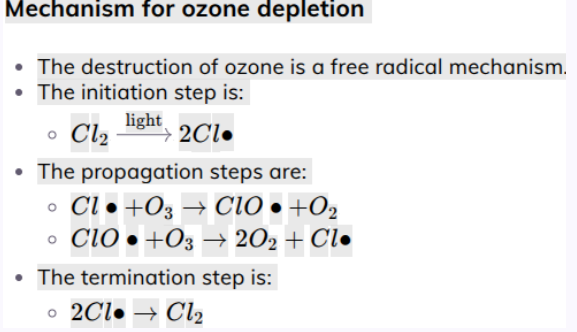
Photolysis
Photolysis means a molecule is broken down by light (UV radiation).
In the atmosphere:
CFC→UV lightCl∙+other products
UV light breaks the C–Cl bond in a CFC, producing a chlorine radical (Cl•).
Radicals contain an unpaired electron, making them very reactive.
Ozone destruction mechanism
1⃣ Chlorine radical attacks ozone
Cl∙+O3→ClO∙+O2
Ozone is converted to oxygen (O₂).
A chlorine monoxide radical (ClO•) forms.
2⃣ Chlorine radical regenerated
ClO∙+O→Cl∙+O2
The chlorine radical is regenerated.
Why this is dangerous
Because the chlorine radical is regenerated, it acts as a catalyst and can destroy thousands of ozone molecules.
Overall reaction:
O3+O→2O2 +O_3
This reduces the amount of protective ozone in the atmosphere.
🚫 CFC Bans What were CFCs used for?
CFCs were widely used because they were stable, non-toxic and non-flammable.
Common uses included:
Aerosol propellants
Coolants in refrigerators and air conditioners
Industrial solvents
Scientific discovery
In the 1970s, scientists discovered evidence that CFCs were damaging the ozone layer.
This research led to international concern about ozone depletion.
Government action
The first bans began with Sweden in 1978.
This led to global restrictions on CFC production.
Replacement chemicals
Safer alternatives were developed:
Hydrofluorocarbons (HFCs)
Do not contain chlorine, so they do not destroy ozone.
Hydrocarbons
Used as alternative refrigerants and propellants.
⚛ Halogenoalkanes – Bond Polarity Polar C–X bond
In halogenoalkanes, the carbon–halogen bond is polar.
Reason:
Halogens are more electronegative than carbon.
They withdraw electron density from carbon.
Result:
Cδ+—Xδ−
Carbon becomes partially positive (δ⁺).
Why polarity is important
This polarity makes the carbon atom susceptible to nucleophilic attack in reactions.
🧲 Nucleophiles Definition
A nucleophile is a species that donates a pair of electrons to form a covalent bond.
Key features:
Usually negatively charged OR
Contains a lone pair of electrons
Examples
OH⁻
CN⁻
NH₃
Why nucleophiles attack halogenoalkanes
Because the carbon atom is δ⁺, nucleophiles are attracted to it.
This leads to nucleophilic substitution reactions.
🧪 Reaction with Cyanide Ions
When a halogenoalkane reacts with cyanide ions (CN⁻):
R–X+CN−→R–CN+X−
The cyanide ion replaces the halogen. Organic product formed
The product is called a nitrile.
Example:
CH3CH2Br+CN−→CH3CH2CN+Br−
Why nitriles are useful
Nitriles are important in organic chemistry because they:
Increase the carbon chain length by one carbon
Can be further converted into carboxylic acids or amines.
⭐ Key Exam Points to Remember
✔ The ozone layer contains the highest concentration of ozone in the atmosphere
✔ CFCs undergo photolysis, producing chlorine radicals
✔ Chlorine radicals catalytically destroy ozone
✔ CFC bans began in the late 1970s after scientific evidence
✔ Halogenoalkane C–X bonds are polar because halogens are more electronegative
✔ Nucleophiles donate electron pairs and attack the δ⁺ carbon
✔ Reaction with CN⁻ produces nitriles
In base elimination reactions what are the products and what happens
🧪 In base elimination (AQA context) Using ethanolic NaOH
The products are: 👉 Alkene + water + halide ion (X⁻)
NOT a halogen molecule like Cl₂ or Br₂.
🔍 What actually happens
OH⁻ acts as a base
It removes H⁺ → forms H₂O
The halogen leaves as X⁻ (e.g. Br⁻)
So yes:
✔ Water (H₂O) is formed
✔ Halogen leaves, but as a halide ion (Br⁻ / Cl⁻), NOT as Br₂ or Cl₂
🧪 Example
2-bromoalkane + OH⁻ → alkene + H₂O + Br⁻
❗ Common mistake
❌ Saying “bromine is formed (Br₂)” → WRONG
✅ It forms Br⁻ ions, not bromine molecules
⭐ One-line exam answer
Water is formed, and the halogen leaves as a halide ion (X⁻), not as a halogen molecule.
What type of reaction is ammonia used in and how does it work
🧪 What is Ammonia in Chemistry?
Ammonia (NH₃) has a lone pair of electrons on nitrogen
This allows it to act as a:
✅ Nucleophile (electron pair donor)
⚠ Weak base (but not strong enough for elimination in AQA)
⚛ Reaction Type: Nucleophilic Substitution 📌 When ammonia reacts with halogenoalkanes General reaction: R–X+NH3→R–NH2+HX
R–X = halogenoalkane
R–NH₂ = primary amine
🧲 Why ammonia acts as a nucleophile
Nitrogen has a lone pair of electrons
It is attracted to the δ⁺ carbon in the polar C–X bond
Cδ+—Xδ−
🔁 Mechanism (AQA detail) Step 1: Nucleophilic attack
NH₃ donates its lone pair
Forms a bond with the carbon
Halogen leaves as X⁻
Intermediate formed: R–NH3+
Step 2: Deprotonation
Another NH₃ molecule removes a H⁺
Forms the amine (R–NH₂)
📌 Final products:
Amine (R–NH₂)
Ammonium halide (NH₄⁺X⁻)
⚠ Important AQA detail
Ammonia is usually used in:
Excess
Ethanolic conditions
Sealed tube (heated under pressure)
👉 This helps prevent further substitution
🚨 Multiple Substitution Problem
The amine formed (R–NH₂) also has a lone pair, so it can react further:
Secondary amine (R₂NH)
Tertiary amine (R₃N)
Quaternary ammonium salt (R₄N⁺)
✔ How to prevent this:
Use excess ammonia
❌ Why ammonia does NOT cause elimination Elimination requires:
A strong base
Removal of H⁺ from a β-carbon
Formation of a C=C bond
🚫 Why NH₃ doesn’t work
NH₃ is a weak base
Cannot effectively remove H⁺
So it cannot drive elimination
✔ Instead, elimination uses:
OH⁻ (ethanolic NaOH)
Heat
🧠 Key Comparison
Feature | Ammonia (NH₃) | Hydroxide (OH⁻) |
|---|---|---|
Type | Weak base | Strong base |
Role | Nucleophile | Base |
Reaction | Substitution | Elimination |
Product | Amine | Alkene |
⭐ Key Exam Points
✔ NH₃ has a lone pair → nucleophile
✔ Attacks δ⁺ carbon in C–X bond
✔ Forms amines via substitution
✔ Needs excess NH₃ to avoid multiple substitution
✔ Does NOT cause elimination (too weak as a base)
🧠 One-line exam answer
Ammonia acts as a nucleophile due to its lone pair and undergoes nucleophilic substitution with halogenoalkanes to form amines, but it is too weak a base to cause elimination.