Vascular Exam 1 - Hemodynamics and Cerebrovascular (Daigle & Q)
 Call Kai
 Learn
Learn Practice Test
 Spaced Repetition
 Match
Match Flashcards
 Knowt Play
1/79

There's no tags or description
Looks like no tags are added yet.
Name | Mastery | Learn | Test | Matching | Spaced | Call with Kai | Chat |
|---|
No analytics yet
Send a link to your students to track their progress
80 Terms
Which normal cerebrovascular vessel demonstrates the highest flow resistance?
Options: CCA, ICA, ECA, Vert A
External carotid artery (ECA)
The left CCA originates from the brachiocephalic artery. True or False?
False
A stroke symptom when a patient cannot speak or express themselves is called:
Aphasia
What is the first branch of the ECA?
Superior thyroid artery

Identify the following five structures or vessels in this right carotid artery. The transducer was positioned laterally on the neck.
A: Thyroid gland, B: CCA, C: IJV, D: ECA, E: ICA
A high-resistance flow pattern in the distal portion of the ICA suggests which of the following conditions?
Options: Proximal CCA disease, Proximal ICA disease, Intracranial AV (arteriovenous) fistula, Severe distal ICA stenosis
Severe distal ICA stenosis
The internal carotid artery (ICA) normally supplies the _____-resistance vascular bed of the brain, demonstrating a continuous, _____-resistance Doppler waveform with high _____ flow. However, when there is a severe obstruction downstream (_____ to the sample volume)—such as a severe _____ ICA stenosis or occlusion—the downstream resistance _____ drastically. This forces the upstream Doppler pattern to become _____ _____, showing a sharp _____ peak and significantly decreased or absent _____ flow.
low, low, diastolic, distal, distal, increases, highly resistant, systolic, diastolic
Significant disease at the proximal portion of the ICA would cause elevated _____ _____ velocities at the _____ site and a dampened, _____-resistance _____ _____ flow pattern further downstream in the _____ ICA.
peak systolic, stenosis, low, tardus parvus, distal
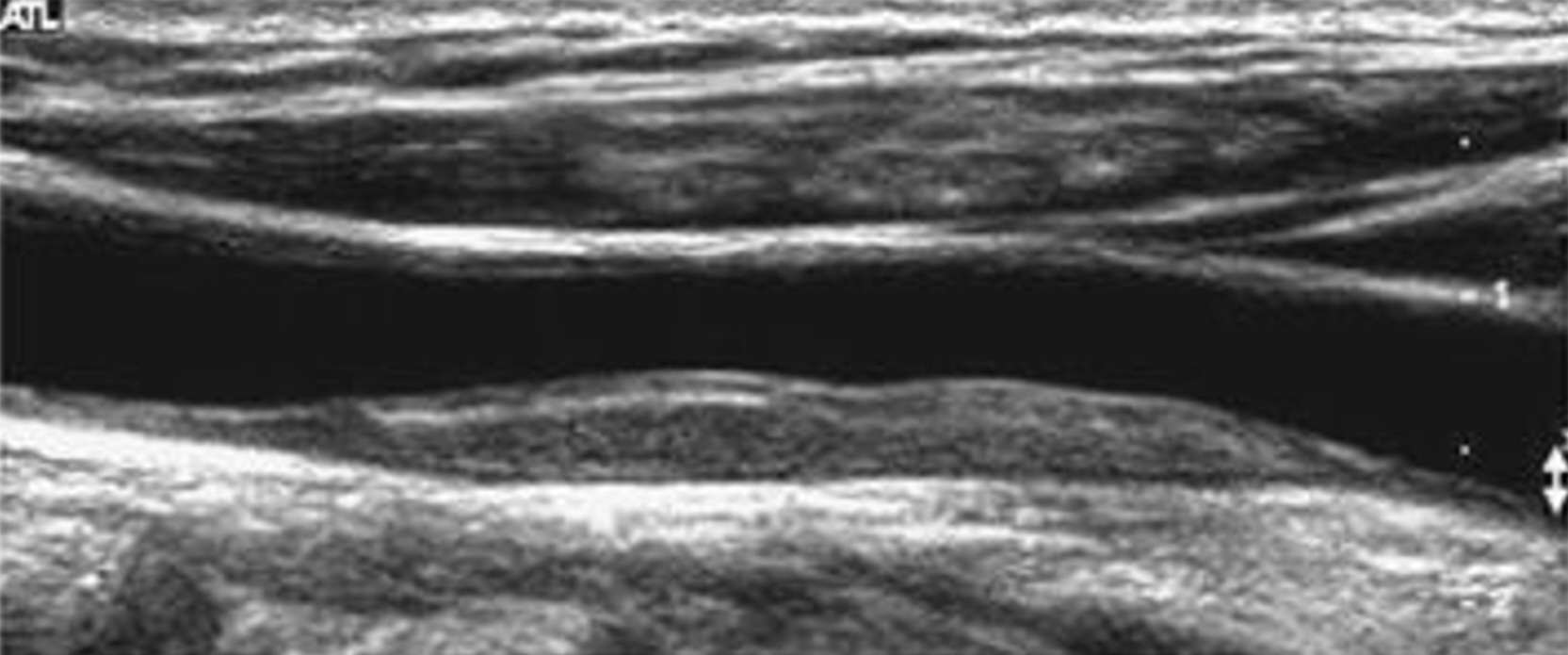
In the following sonographic image, how would you describe the plaque?
Homogeneous plaque with smooth surface characteristics
What is the first branch of the ICA?
Ophthalmic artery
A patient presents with the classic cerebrovascular symptom of left amaurosis fugax. Of the choices below, what is the most likely cause?
Options: Atheroemboli from the left ICA, Atheroemboli from the right ICA, Occlusion of the left vertebral artery, Occlusion of the left ICA
Atheroemboli from the left ICA
Which of the following is the most common cause of re-stenosis following carotid endarterectomy?
Neointimal (intimal) hyperplasia

In this example, the recorded ICA velocities may underestimate the stenosis category. Why?
Options: Doppler gain was too low, Doppler sample was not obtained at maximum stenosis, Doppler was steered in the wrong direction, PRF scale was set incorrectly
Doppler sample was not obtained at maximum stenosis
A proximal right CCA waveform that unilaterally demonstrates low peak velocity and delayed rise time is most likely due to which of the following:
Options: Innominate artery stenosis or occlusion, Severe ICA stenosis, Right subclavian artery stenosis, Aortic stenosis
Delayed rise time and a “rounding” of the waveform is usually caused by _____ disease. If the condition were caused by aortic stenosis, it would affect waveforms _____.
Innominate artery stenosis or occlusion; proximal, bilaterally
What is the name for a cerebrovascular event that resolves within 24 hours?
TIA (Transient Ischemic Attack)
What is an abnormal sound, caused by turbulent blood flow, and heard with a stethoscope?
Bruit
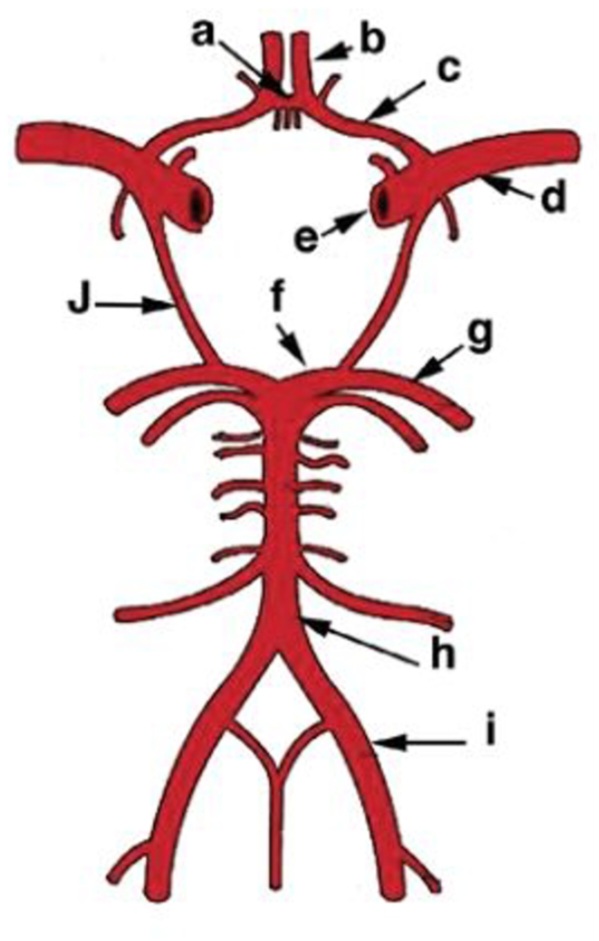
Label these significant cerebral arteries (lettered) with either abbreviations or full names.
a. Anterior communicating artery (ACoA); b. Anterior cerebral artery, A2 (ACA); c. Anterior cerebral artery, A1 (ACA); d. Middle cerebral artery (MCA); e. Distal ICA, ICA terminus (TICA); f. Posterior cerebral artery (P1 segment, (PCA); g. Posterior cerebral artery (P2) segment, (PCA); h. Basilar artery (BA); i. Vertebral artery (VA); j. Posterior communicating artery (PCoA)

Is the flow in this left vertebral artery normal or retrograde?
Explain your previous answer; why do you think it is normal or why do you think it is retrograde? (Remember, the color coding can be inverted with a push of a button).
In the Figure, why is there a gap in the vertebral artery color fill?
Retrograde
Looking at the color map, the top (red) is towards the transducer and the bottom (blue) is away from the transducer. Since the vessel is blue, the flow is AWAY (retrograde) from the transducer.
There is a gap due to shadowing from the vertebral bones.
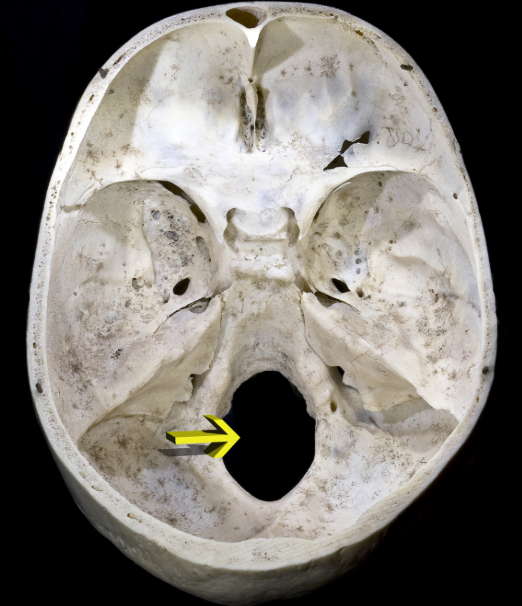
The vertebral arteries enter the cranium at what location?
Foramen Magnum
In transcranial Doppler, the MCA is accessed through the _____ “window” and typically demonstrates flow direction _____ the transducer.
Transtemporal, towards
The optimal window for evaluation of the vertebral and basilar arteries with transcranial Doppler is the:
Suboccipital window
The blood flow velocity parameter commonly reported in transcranial Doppler is:
Time-averaged mean velocity
According to Bernoulli, pressure and velocity have what type of relationship?
Inverse
Which of the following characteristics does not describe a vein?
Options: Contains valves, Decrease in size, Confluence or merge, Travel towards the heart
Decrease in size
Energy in motion is…?
Kinetic energy
How will an increase in blood viscosity affect resistance?
Increase
According to Poiseuille’s Law, which of the following will have the greatest effect on flow?
Options: Pressure change, Vessel length, Blood viscosity, Vessel radius
Vessel radius (*4th power)
How will an increase in vessel length effect resistance?
Increase
Vasoconstriction occurs as a result of cold exposure. This will have what effect on resistance?
Increase
What ultimately creates movement of blood?
A pressure or energy gradient
A vessel dilates as a result of exercise. This will cause…?
Occurs: Change in blood viscosity, Increase in flow, Increase in resistance, Decrease in flow
Increase in flow
Which vessel wall layer contains the vasa vasorum?
Tunica adventitia
According to Poiseuille’s Law, an increase in blood viscosity will have what effect on flow?
Decrease
According to Poiseuille’s Law, an increase in vessel length will have what effect on flow?
Decrease
Blood tends to flow…?
From areas of high pressure to areas of low pressure
True or false: Resistance and flow are inversely related
True
In arteries, this vessel wall layer is thickest
Tunica media
True or False: Veins confluence and become larger until they terminate at the right atrium of the heart.
True
The highest pressure in the vascular system is found where?
Left ventricle
Turbulent flow describes…?
Chaotic, non-laminar flow
Energy “loss” in the vascular system is primarily due to these two factors:
Blood viscosity and inertia
Reynold’s number predicts turbulent flow. What is Reynold’s number?
2,000
What is the function of capillaries?
Nutrient exchange
According to Poiseuille’s Law, a decrease in the pressure gradient will have what effect on flow?
Decrease
The resistance equation and Poiseuille’s Law share all of the following components except:
Options: Pressure change, Blood viscosity, Vessel radius, Vessel length
Pressure change
In veins, this vessel wall layer forms valves
Tunica intima
Which of the following characteristics does not describe an artery?
Options: Travel away from the heart, Branch or bifurcate, Carry oxygen rich blood, Confluence or merge
Confluence or merge
Parabolic and plug (or steady) flow are both types of what flow?
Laminar
The three vessels/branches of the aortic arch (in order) are?
Brachiocephalic, left CCA, left subclavian
Stored or resting energy is…?
Potential energy
How will an increase in vessel radius affect resistance?
Decrease
The Bernoulli Principle defines a balance between which two components?
Velocity and pressure

The anterior cerebral artery (ACA) is represented by which letter?
B
Which of the following is NOT a branch of the external carotid artery (ECA)?
Options: Occipital artery, Ascending pharyngeal artery, Basilar artery, Superficial thyroid artery
Basilar artery
Which common carotid artery branches directly from the aortic arch?
Left CCA

The pulsed wave tracing seen below would be described as…?
Options: High resistant, Phasic, Low resistant, No answer
High resistant
True or false: During a TCD exam, a 0 angle of insonation is assumed.
True
Which vessel receives majority of the blood flowing through the CCA?
ICA
True or false: The ECA has 8 extracranial branches.
True

Which vessel corresponds to letter O?
ICA (distal)
True or false: The MCA is not technically part of the Circle of Willis.
True
True or false: A higher resistive index (RI) indicates a lower resistant waveform.
False

Based off the waveform alone, this tracing most likely came from which vessel?
Options: ICA, ECA, No answer
ICA
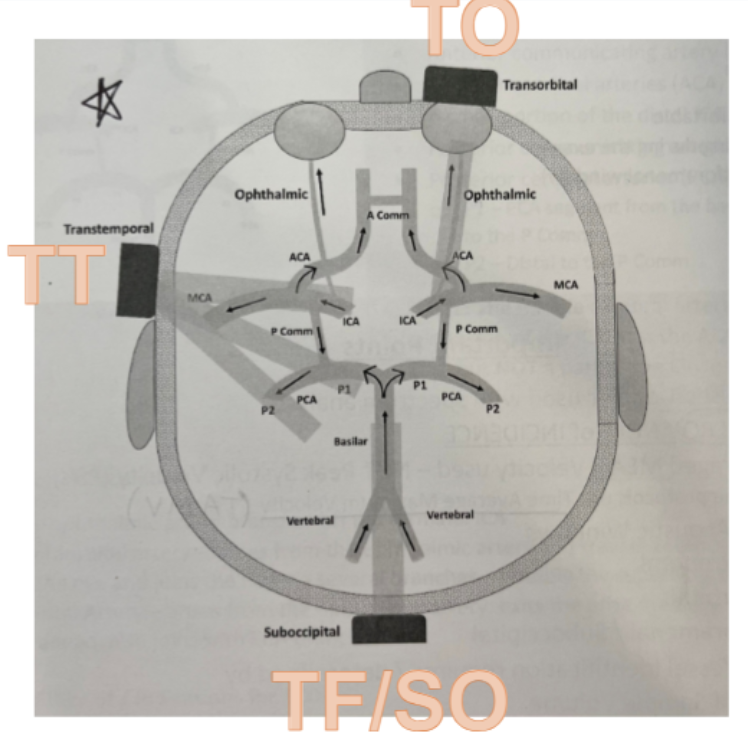
Which of the following is not a window used during a TCD exam?
Options: Transtemporal, Subocciptal (Transforaminal), Transorbital, Subcaudal
Subcaudal
Flow in the ICA differs from flow in the ECA in the following way:
Options:
The ICA has a higher resistive index than the ECA
The ICA has less diastolic flow than the ECA
The ICA has less peripheral resistance than the ECA
The ICA has more peripheral resistance than the ECA
The ICA has less peripheral resistance than the ECA
The ophthalmic artery has three branches. Which of the following listed below is not one of these branches?
Options: Facial artery, Supraorbital artery, Frontal artery, Nasal artery
Facial artery
During a carotid duplex exam, you obtain the following measurements in the mid ICA:
PSV = 313 cm/s
EDV = 101 cm/s
ICA/CCA ratio = 4.2
Given this criteria, how would you categorize the % stenosis?
> or equal to 70%, but < near occlusion
A cerebral infarct affecting the right hemisphere will likely cause symptoms to appear where?
Left side of the body
A non-atherosclerotic disease involving the mid to distal segments of the ICA that predominately affects females describes which pathology?
Fibromuscular dysplasia (FMD)
True or false: Patients with prior history of MI, PAD, or CAD are at risk of developing cerebrovascular disease
True
A patient presents to the vascular lab with paresis of the legs. Which vessel might we expect to exhibit disease?
ACA
During a TCD exam, the normal direction of blood flow in the MCA using the transtemproal window is?
Antegrade (Towards)
During a carotid duplex exam, you obtain the following measurements in the mid ICA:
PSV = 155 cm/s
EDV = 30 cm/s
ICA/CCA ratio = 1.2
Given this criteria, how would you categorize the % stenosis?
Normal
A highly vascular, likely benign lesion located at the carotid bifurcation best describes:
Carotid body tumor (CBT)
Observation of low resistant flow with decreased velocities may indicate disease _____ to the current sampling site.
proximal
True or false: stenting requires balloon inflation while angioplasty does not.
False
Diplopia, poor coordination, dysphasia, vertigo, and ataxia are symptoms typically associated with…?
Vertebrobasilar disease
Which type of atherosclerosis is most likely to cause embolization?
Ulcerative lesion
Which of the following will cause the longest duration of symptoms?
Options: CVA, TIA, RIND, HIJK
CVA (Cerebrovascular Accident)
A patient complains of temporary shading of the vision in one eye. This symptom is called?
Amaurosis fugax