Genetic diversity 3.4.3/4
 Call Kai
 Learn
Learn Practice Test
 Spaced Repetition
 Match
Match Flashcards
 Knowt Play
1/7

Earn XP
Description and Tags
Name | Mastery | Learn | Test | Matching | Spaced | Call with Kai | Chat |
|---|
No analytics yet
Send a link to your students to track their progress
8 Terms
Gene mutations
A gene mutation is a change in the DNA base sequence. Mutations occur spontaneously during DNA replication. There are 3 types of gene mutation:
Substitution - One base is replaced by another.
Deletion - One base is removed.
Insertion - One base is added to the sequence.'
These mutations change the order of DNA bases which changes which amino acids are coded for (during protein synthesis), altering the protein produced.
Due to the degenerate nature of the genetic code, not all substitutions result in a change of amino acid. However deletion and insertion will always lead to changes in the amino acid sequence because a frame shift will occur.
Mutagenic agents
Mutagenic agents are things that increase the likelihood of mutations occurring. For example, UV and ionising radiation, some chemicals and viruses.
Chromosome mutations
When meiosis goes wrong, the cells produced can contain changes in the structure/number of chromosomes. Chromosome mutations lead to inherited conditions because the errors are present in the gametes. Types of chromosome mutation:
Polyploidy - When an organism has more than 2 sets of chromosomes.
Non-disjunction - When homologous chromosomes fail to separate in meiosis, resulting in gametes with extra/missing chromosomes.
Meiosis
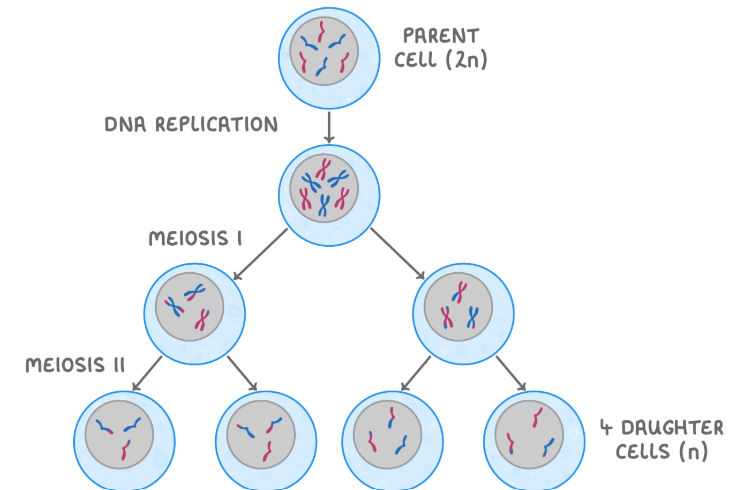
A type of cell division (asexual reproduction) where parent cells divide to form 4 haploid cells (gametes) with genetic variation in the reproductive organs.
Interphase - DNA is replicated so each chromosome contains 2 identical sister chromatids.
Meiosis I - Contains PMAT the same as in mitosis except during anaphase, homologous chromosomes are separated (rather than chromatids like in mitosis).
Meiosis II - Contains PMAT and during anaphase, sister chromatids are separated. This produces 4 daughter cell.
Genetic variation
Crossing over - During meiosis I, the homologous chromosomes pair up and chromatids twist around each other, forming a chiasmata. Bits of the chromatids swap over, so the chromatids still contain the same genes but now contain a different combination of alleles.
Independent segregation/assortment - During metaphase I, pairs of homologous chromosomes line up along the equator. However the way round the paternal and maternal chromosomes are is completely random. Therefore which chromosomes end up in each daughter cell is also random.
Natural selection
Genetic diversity is the total number of different alleles in a population. High genetic diversity leads to many different observable traits and characteristics due to the proteins being produced. Genetic diversity influences natural selection:
Organisms with a random gene mutation leading to an allele that causes advantageous traits to survival are more likely to reproduce, passing on their alleles to the next generation, increasing the allele frequency. Over time, these beneficial alleles become more frequent, and populations become more adapted to their environments over generations.
This is also the process that causes antibiotic resistance.
Types of selection
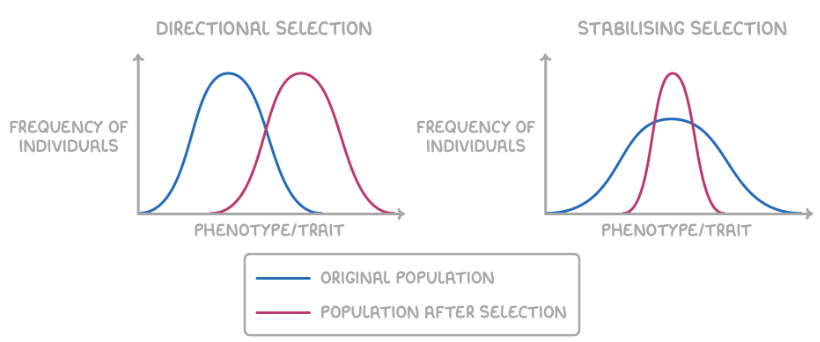
Directional selection - favours extreme phenotype and shifts the normal distribution in the direction of the favoured extreme. E.g. bird beak size.
Stabilising selection - favours average phenotypes and narrows the normal distribution curve. E.g. human birth weight.
Adaptations
Adaptations are inherited characteristics that enhance an organism’s ability to survive and reproduce. There are 3 categories:
Anatomical - Physical structure, both internal and external. E.g. fur, camouflage, mimicry or teeth.
Behavioural - Activities and responses. E.g. courtship behaviour, defensive responses (playing dead) or migration/hibernation.
Physiological - Internal biological functions. E.g. venom, antibiotics or water storage.