NEURO2020 WEEK 9
 Call Kai
 Learn
Learn Practice Test
 Spaced Repetition
 Match
Match Flashcards
 Knowt Play
1/32

There's no tags or description
Looks like no tags are added yet.
Name | Mastery | Learn | Test | Matching | Spaced | Call with Kai | Chat |
|---|
No analytics yet
Send a link to your students to track their progress
33 Terms
SENSORIMOTOR SYSTEM NERVES
Sensory = afferent
Motor = efferent
FEEDBACK
Critical for coordination of motor movements
Movements that do not require feedback are called ballistic movements
LEARNING
Initially, moves are under conscious control, then they become automatic
APRAXIA
Disorder of voluntary movement
Not a motor deficit like paralysis/weakness or lack of motivation/comprehension
Typically, a person cannot perform a specific task out of context when requested but can perform the task spontaneously under natural conditions
Associated with damage to left parietal cortex
MIRROR NEURONS
provide a mechanism for social cognition
Understanding the perceptions, ideas and intentions of others
respond to the understanding of the purpose of the action, not just a superficial characteristic
respond fully to particular action regardless of how it is detected (auditory/visually)
ASSOCIATION CORTEX - Posterior Parietal Association Cortex – INPUT
Integrates information about environment and about your body
Directs movement and attention
Damage = deficits in deployment of attention = neglect, apraxia
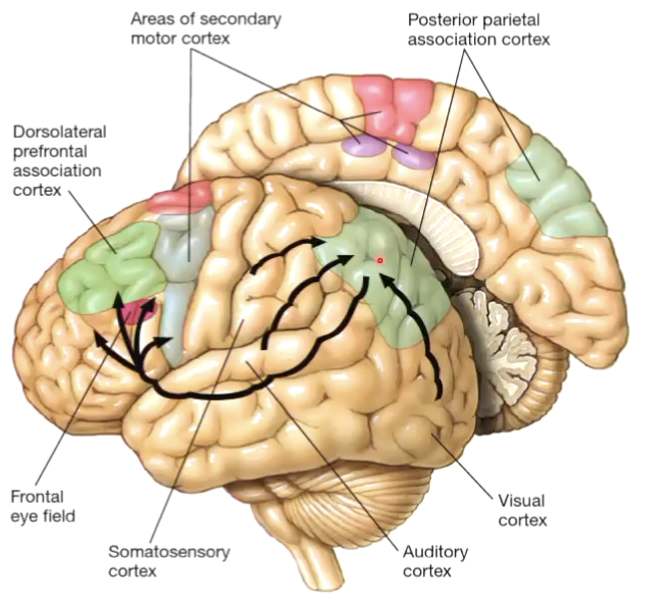
ASSOCIATION CORTEX - Dorsolateral Prefrontal Association Cortex – OUTPUT
Neurons respond to characteristics and locations of objects
Neurons begin to fire before action is executed and continue until it is completed
Outputs to secondary + primary motor cortex and frontal eye field
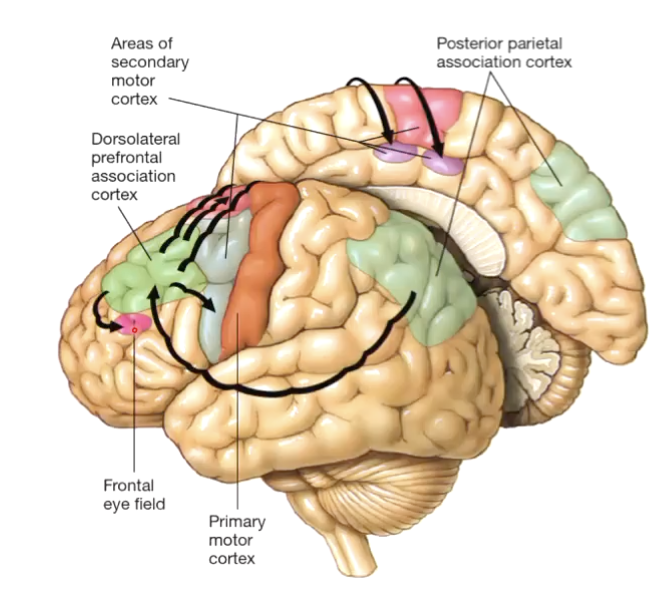
SECONDARY MOTOR CORTEX
Three parts:
Supplementary Motor Area
Premotor Cortex
Cingulate Motor Areas
Stimulation of these areas elicit complex movements of both sides of the body
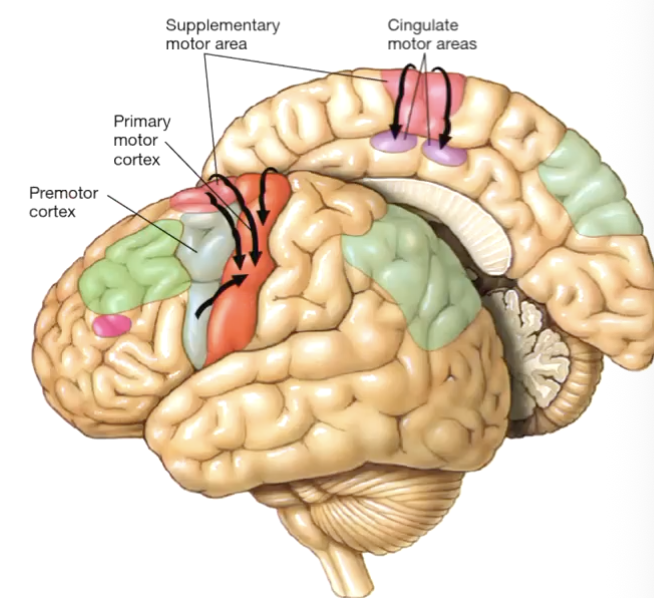
PRIMARY MOTOR CORTEX
Major point of convergence/depature of sensorimotor signals
neurons initiate movements towards specific goals rather than coding for just one direction of movement
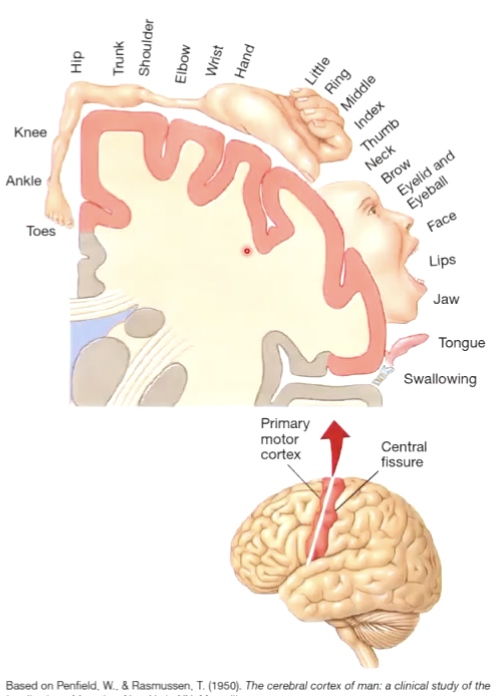
LESIONS IN PRIMARY MOTOR CORTEX
Typical deficits are loss of ability
Lose stereognosis (the ability to identify objects from touch)
Reduction in speed/force of movements
Voluntary movement not usually lost completely
CEREBELLUM AND BASAL GANGLIA
Interconnected within sensorimotor system
Not part of the descending pathway to muscles, but interacts with different levels of the hierarchy to coordinate and modulate actions.
CEREBELLUM
10% of brain mass but over 50% of neurons
Compares inputs from these systems to correct movements that deviate from intended course
Plays a major role in motor learning, particularly those that involve timing
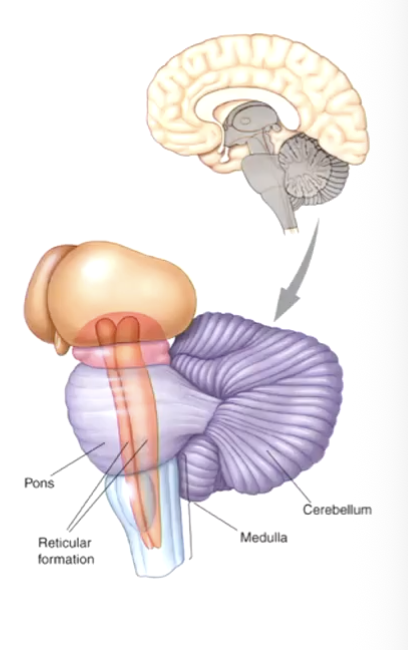
CEREBELLUM DAMAGE =
Posture difficult to maintain
Can't adapt movement to changing conditions
loss of ability to control:
Direction/force/amplitude/velocity of movement
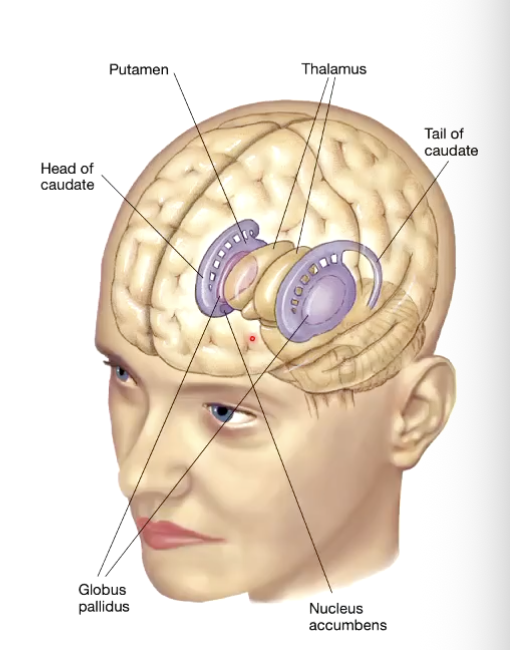
BASAL GANGLIA
Cluster of interconnected nuclei
Involved with motivation and movement
May be responsible for movement vigour
Responsible for suppressing motor activity
SPINAL CORD CIRCUITS
Both pathways have major tracts, one that descends directly to the spinal cord, another that descends indirectly to the spinal cord
Ventromedial neurons project to proximal muscles close to spinal cord
Dorsolateral neurons project to distal muscles
MOTOR UNITS
Comprises of a single motor neuron and all the skeletal muscles that it innervates.
Fingers/face motor units have few fibres for each motor neuron vs legs
MOTOR END PLATE
The junction between motor neuron and the muscle fibre
The motor neuron releases Acetylcholine at the neuromuscular junction which causes the muscle to contract
RECEPTOR ORGANS OF TENDONS AND MUSCLES
Golgi Tendon Organs
Embedded in the tendons and respond to increase in tension
Can inhibit contraction if tension too high
Muscle spindles
Embedded in muscle tissue
Signals change in muscle length
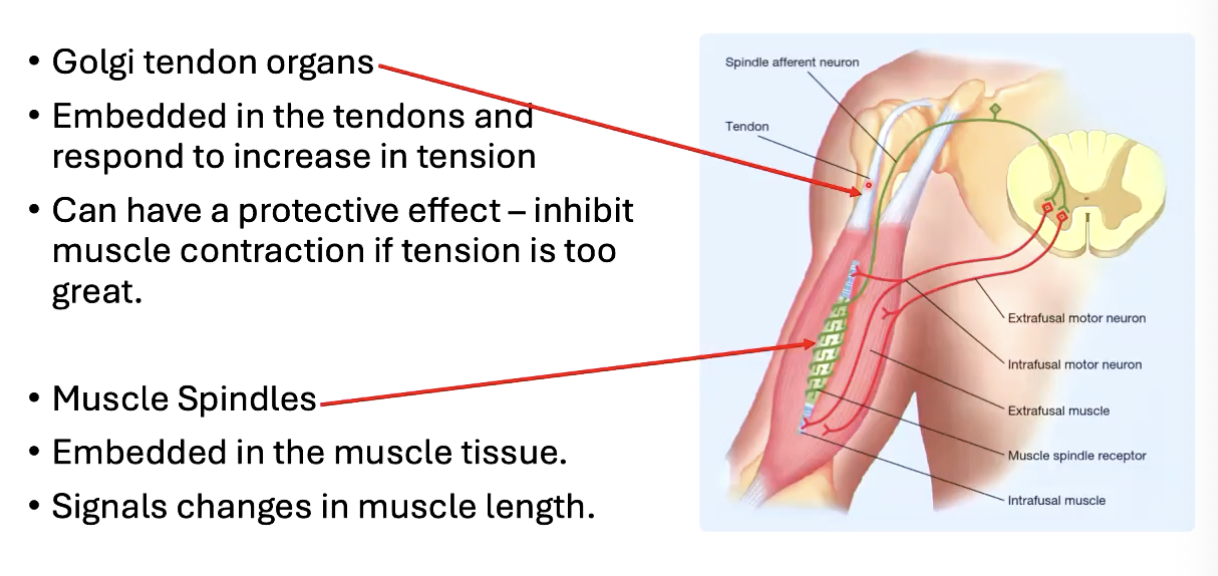
INTRAFUSAL MOTOR NEURONS
Without intrafusal motor neurons, spindles would become slack and unresponsive to stretch during an extrafusal muscle contraction
They function by adjusting the length of intrafusal muscles, maintaining an appropriate degree of tension on muscle spindles
STRETCH REFLEX
Stretch reflex elicited by sudden external stretching force on a muscle
Spindle receptors are stretched and send signal to the spinal cord
Automatically stimulates motor neurons in the ventral horn to send APs back to the muscle containing the spinal -> contracts
RECURRENT COLLATERAL INHIBITION
Each motor neuron branches just before exiting spinal cord
One branch synapses onto a small inhibitory interneuron (Renshaw cell)
Renshaw cell inhibits the motor neuron each time it fires, diverting the action to another member of the motor pool
Prevents fatigue by giving regular break to motor circuit
PRACTICE CREATES CENTRAL SENSORIMOTOR PROGRAMS
Response chunking;
Practice combines sensorimotor programs that control individual responses into programs that control sequences of behaviour
Shifting control to lower levels:
Practice shifts control of motor programs to lower levels, freeing up resources at higher levels for other things
BODY REPRESENTATION/SCHEMA
Our brain needs to keep track of where our limbs are through time and space
Navigate safely
Interact with objects/people
Communicate and portray emotion non-verbally
A vital requirement for maintaining body representation is multisensory integration.
PROPRIOCEPTION
Sense of the position of body parts relative to one another and their motion
What we see and feel the position of our body parts, are integrated
unified representation of events, both of the outside world and of our body
MULTISENSORY INTEGRATION & BODY REPRESENTATIONS
MSI enables us to update representations of our bodies continuously
Automatic - doesn’t require effortful processing
MSI more likely to be integrated into a single event if they correspond in time and space
Information of each sense is not equally/reliably weighted = greatest weight given to most spatially precise source of information
We can exploit these perceptual weightings however
TEMPORAL PARIETAL JUNCTION
important for limb representation/updating
TPJ damage/disfunction is associated with out of body experiences
MIRROR HAND ILLUSION PREDICTIONS
Without mirror there should be no systematic pattern of reach errors related to mirror hand position
It should not matter where left hand is sitting as there is no mismatch between felt and seen hand locations
Control condition
Reach errors will be systematic, the more the real and mirror locations differ, the greater the reach error
The pattern of errors will be consistent with the brain representing the hand somewhere between the real and mirror signalled locations
MIRROR HAND ILLUSION OUTCOMES
Real hand and mirror signal at same location
Reach is accurate
Mirror hand signals a location on the opposite side to real hand
Participants reaches relatively straight
Mirror signals a location further left than the real hand
Participants stops further right
Mirror signals a location further right than the real hand
Participants stops further left
MIRROR HAND ILLUSION RESULTS
Participants reaches showed systematic errors towards the seen location of the hand rather than what they felt
Further the hand in mirror differed from the real hand, the less accurate they were
This is consistent with their brain representing their hand as somewhere between its real location and the location signalled in the mirror
PROPRIOCEPTIVE DRIFT
The reliability of proprioceptive information is known to degrade over time, with proprioceptive drift occurring over very short timescales
Change in perceived position of obscured hand
Without fake hand, drift tends to occur towards the middle of the body due to it being the default position
With the fake hand, drift tends to occur towards the fake hand because the brain relies on visual input, now that proprioceptive input is degraded
MIRROR BOX THEORY
For patients with phantom limb syndrome the mirror box illusion can be used to reset the missing limb and alleviate pain
RUBBER HAND ILLUSION - SYNCHRONOUS STROKING
Temporal correspondence
Sensations occur at same time
Spatial correspondence
Stroking occurs in same direction and same location on both hands
Results in integration of inputs into single event
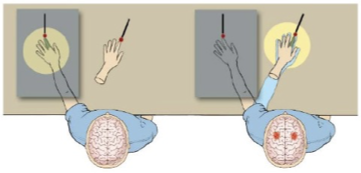
RUBBER HAND ILLUSION - OUTCOMES
Referral of touch – stroking sensation is coming from the rubber hand
Proprioceptive drift towards rubber hand
Temperature drop in hidden hand
These effects weaker in asynchronous than synchronous