Intro and Basic Terminology
 Call Kai
 Learn
Learn Practice Test
 Spaced Repetition
 Match
Match Flashcards
 Knowt Play
1/80

There's no tags or description
Looks like no tags are added yet.
Name | Mastery | Learn | Test | Matching | Spaced | Call with Kai | Chat |
|---|
No analytics yet
Send a link to your students to track their progress
81 Terms
What is anatomical kinesiology?
The study of human movement through the perspective of physical sciences. Specifically, biomechanics, musculoskeletal anatomy, and neuromuscular physiology.
Every structure that participates in movements of the body does so according to…
physical and physiological principles
What is the reason to study KIN480?
To improve performance (in clients and self) by learning how to analyze movements of the human body.
It also enables professionals to help their students or clients perform with optimum safety, effectiveness, and efficiency (SEE)
What is Safety, Effectiveness, and Efficiency?
Safety: Body structures participating in movements are doing so to avoid doing harm to the body
Effectiveness: Determining as a professional if movement goal was successful or failed to meet goals of an effective performance
Efficiency: Striving to achieve movement goal with the least amount of effort (most efficient manner)
SEE are…
underlying aims of kinesiology for analysis and modification of human movement
What is the Basic Biomechanical terminology we are going to use?
Qualitative variable and Quantitative variable
What is a qualitative variable
the focus is on
examples
It is a non-numerical, with data based on observation where equipment is not necessary.
The focus is on time and space
Ex) Rotation of the femur during a golf swing
Adduction of humerus during freestyle swim
What is a quantitative variable
Focuses on
Examples
It is a numerical variable that is based on data collected where equipment was necessary.
Focuses on the forces
Ex) Stress (force) on shoulder during baseball pitch
Compression force on femur during landing
What is Kinesiology?
Scientific study of human movement. From an anatomical, physiological, psychological, and biomechanical.
What is biomechanics?
The application of mechanics to biological systems. It is a discipline more specific than the general definition of kinesiology.
The application of mechanics to biological systems
What is mechanics
what is biological systems
Mechanics: Motion and forces
Biological systems: cell to whole body
humans, animals, and plants
Anatomy
The structure of the body and focuses on the structure
ex) study of biceps brachii
Functional anatomy
The body components necessary to achieve a goal, focusing on the function
ex) analysis of bicep curl
What is linear motion?
When the object moves on a straight or curved pathway. Where ALL points of the object move at the SAME distance and time
translational motion
What is angular motion?
Motion around some point. All points DO NOT move the same distance and time.
Picture examples of linear motion
Picture examples of angular motion
Angu
Picture example of angular motion of specific joint (knee)
Reference Positions: Anatomical vs. Fundamental
Anatomical is the standard positions. The difference here is that the forearms and palms face forward with the radioulnar joints supinated
Fundamental is the practical position. The difference here is that the forearms and palms face inward, so all the joints are neutral
What joint is not at the assumed 0 of a neutral joint
The ankle joint is at a 90 degree angle, however, because it is how we typically stand, it is assumed neutral. Wh
What is a relative angle?
Observed segments in the body in relation to another segment.
Example in difference of relative angle
In AP the RUJ is supinated, in FP the RUJ is neutral (???)
Define: Axes
Imaginary lines that intersect at right angles D
Define: Origin
Point of intersection of axes
Medial
toward midline of the body
Lateral
Away from the midline of the body Pro
Proximal
Toward point of attachment Dist
Distal
Away from the point of attachment
Superior
Toward the top of the head
Inferior
toward the bottom of the feet
Anterior
front, ventral
Posterior
back, dorsal
Ipsilateral
on the same side
Contralateral
on opposite sides
Flexion
decreasing joint angle
Extension
increasing joint angle
Hyperflexion
flexion beyond normal range
Hyperextension
extension beyond normal range
Abduction
moving away from the midline
Adduction
moving toward midline
Hyperabduction
abduction past 180 degree point
Hyperadduction
adduction past 0 degree point
Rotation - exclusive for appendicular skeleton
medial (internal) or lateral (external) rotation
Rotation - exclusive for axial skeleton
Right and left rotation
Lateral flexion
exclusive to the axial skeleton (head and trunk)
Circumduction
movement in a conic fashion
Movement of scapulae - Elevation
raising the scapula (shrug)
Movement of scapulae - depression
lowering the scapula
Movement of scapulae - Protraction/adduction
move scapulae apart or towards the midline anteriorly
Movement of scapulae - retraction/abduction
move scapulae together or towards the midline posteriorly
Movement of scapulae - Upward rotation
bottom of scapula moves away from trunk, the top moves towards
moves laterally and upwards
Movement of scapulae - Downward rotation
return to normal
moves down and towards midline
Horizontal adduction
exclusive to the shoulder
combination of flexion and adduction
Horizontal abduction
exclusive to the shoulder
combination of extension and abduction
Supination
exclusive to RUJ
turns palms frontwards
Pronation
exclusive to RUJ
turns palm backwards
Radial flexion
exclusive to wrist
hand towards the thumb
Ulnar flexion
exclusive to wrist
hand towards little finger
Planterflexion
increasing the angle between foot and shank
Dorsiflexion
decreasing the angle between foot and shank
Inversion
Lifting medial edge of foot
Eversions
lift lateral edge of foot
Is pronation and supination of the foot at the ankle the same as inversion and eversion?
No
Pronation of the foot
Dorsiflexion at the ankle
Eversion in the tarsals (foot)
Abduction of the forefoot
Bringing toes away from midline to an abduction
Supination of the foot
Plantarflexion at the ankle
Inversion in the tarsals
Adduction of the forefoot
What are reference systems necessary for?
For accurate observation and description
What is a plane
Flat 2D surface
What is a Cardinal Plane
When the 2D surfaces (planes) are arranged at perfect right angles to each other and their center of mass intersect
What is an axis of rotation?
THE point where movement occurs (where the cardinal plane rotates), and THE point is ALWAYS perpendicular to the plane
C: Sagittal
D
AoR
Type of movement
Examples
Separates the body into right and left halves
AoR is mediolateral - goes medially and laterally through the body
Flexion and extension
Shoulder, elbow, wrist, hip, knee, ankle, and trunk (axial)
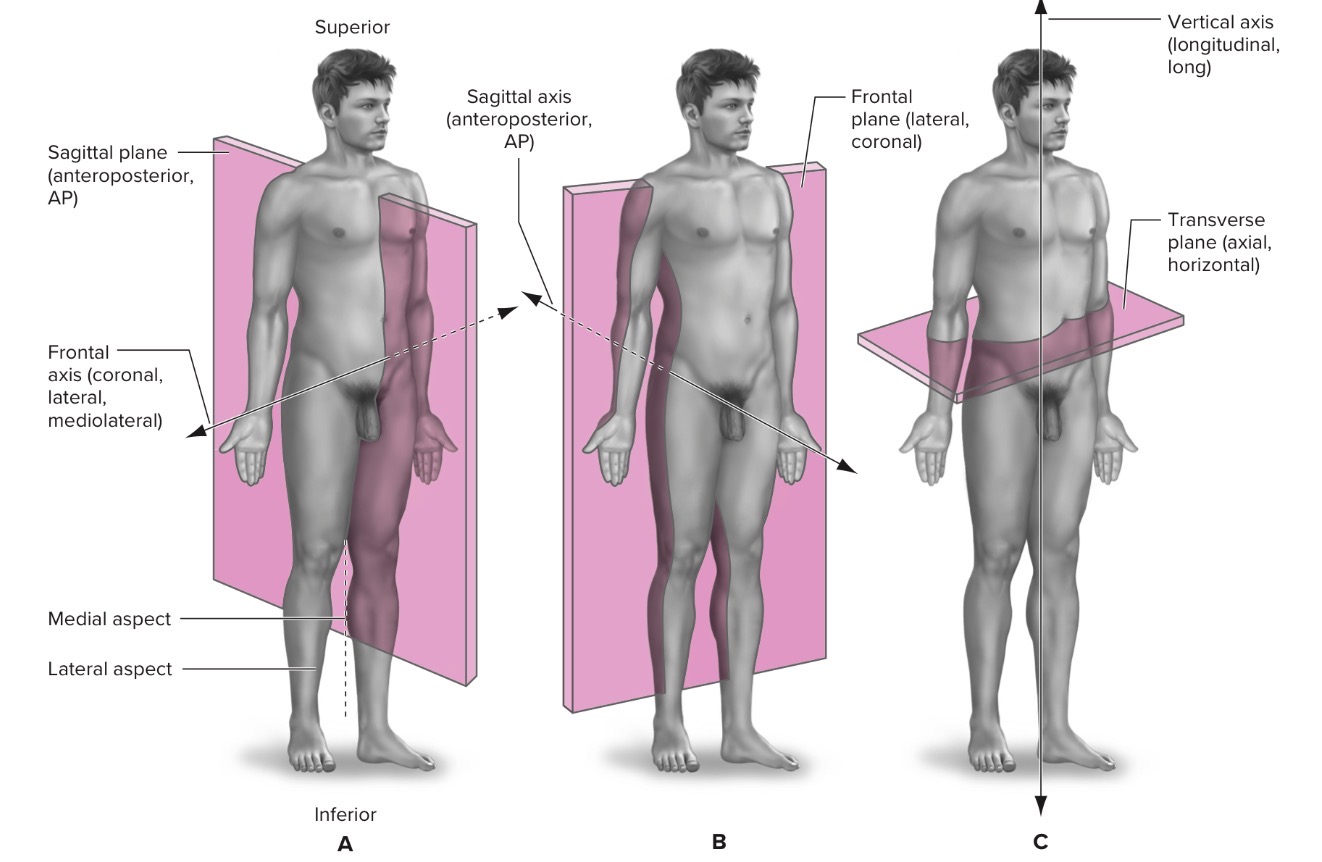
C: Frontal
D
AoR
Type of movement
Examples
Does NOT move
Separates into front and back segments
AoR: Anterior-posterior
Abduction, adduction, lateral flexion (axial)
Ex: Abd + Add of shoulder and hip, ulnar and radial flex at wrist, inversion + eversion at ankle, lateral flexion
NOT: elbow, knee, RUJ (?)

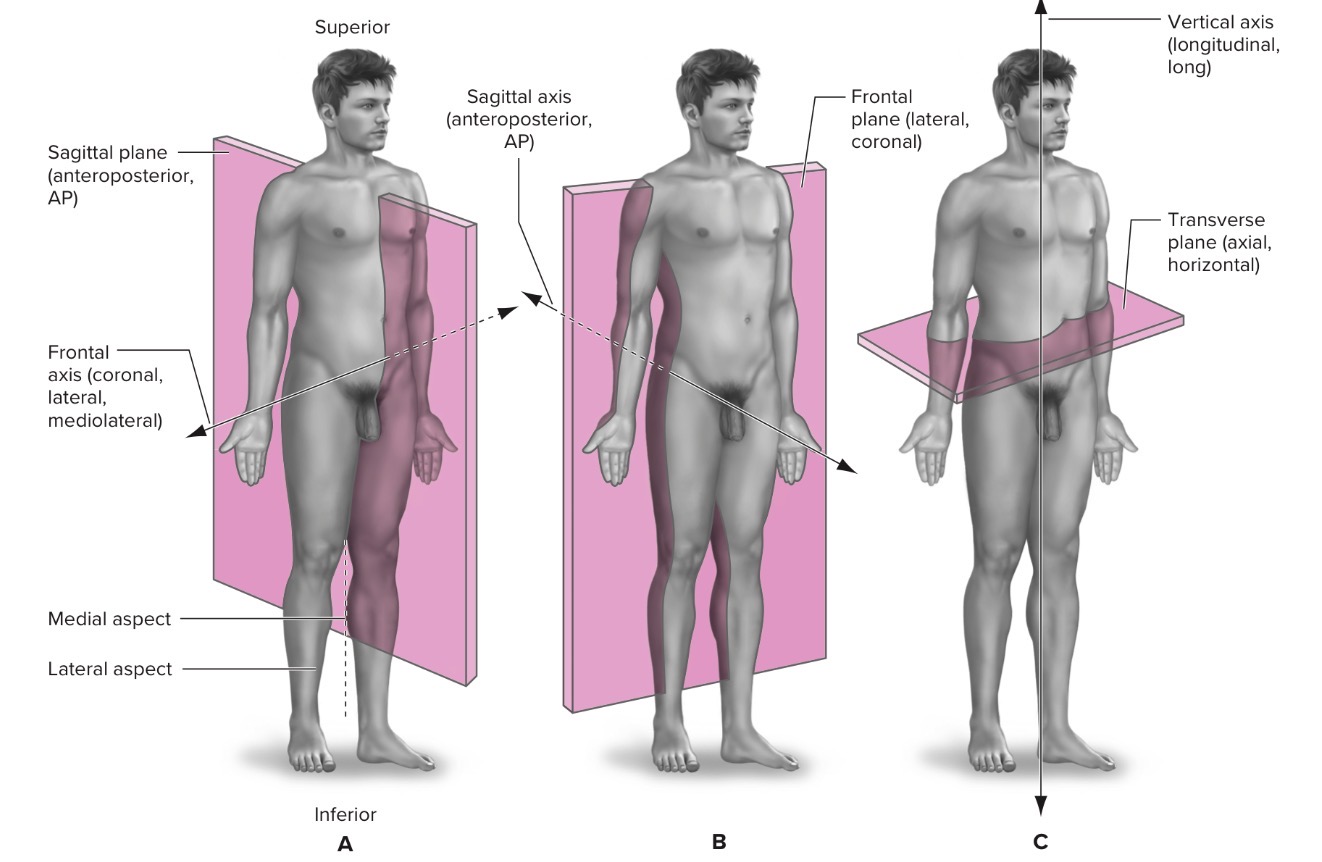
C: Transverse
D
AoR
Type of movement
Examples
Does NOT move
Separates body into superior and inferior portions
Transverse/longitudinal
Rotation
Ex: Medial and lateral rotation at shoulder + hip, Left and right rotation of axial skeleton, pronation and supination at RUJ, knee
NOT: elbow, wrist, and ankle
What is a degrees of freedom?
The number of planes in which a joint has the ability to move
1 degree of freedom
uniaxial
elbow (sagittal)
2 degrees of freedom
biaxial
wrist (sagittal and frontal)
3 degrees of freedom
Triaxial
Hip (sagittal, frontal, and transverse)
Events
Still shot picture within the movement. A logical place to stop the movement.
every movement has a start and an end
Phases:
The movement happening between events
“How did the joint move from one event to the next?”
Events: Position words
Flexed
extended
abducted
plantarflexed
Neutral
etcP
Phases: Motion Words
Flexion
Extension
Abduction
Plantarflexion
No motion
etc
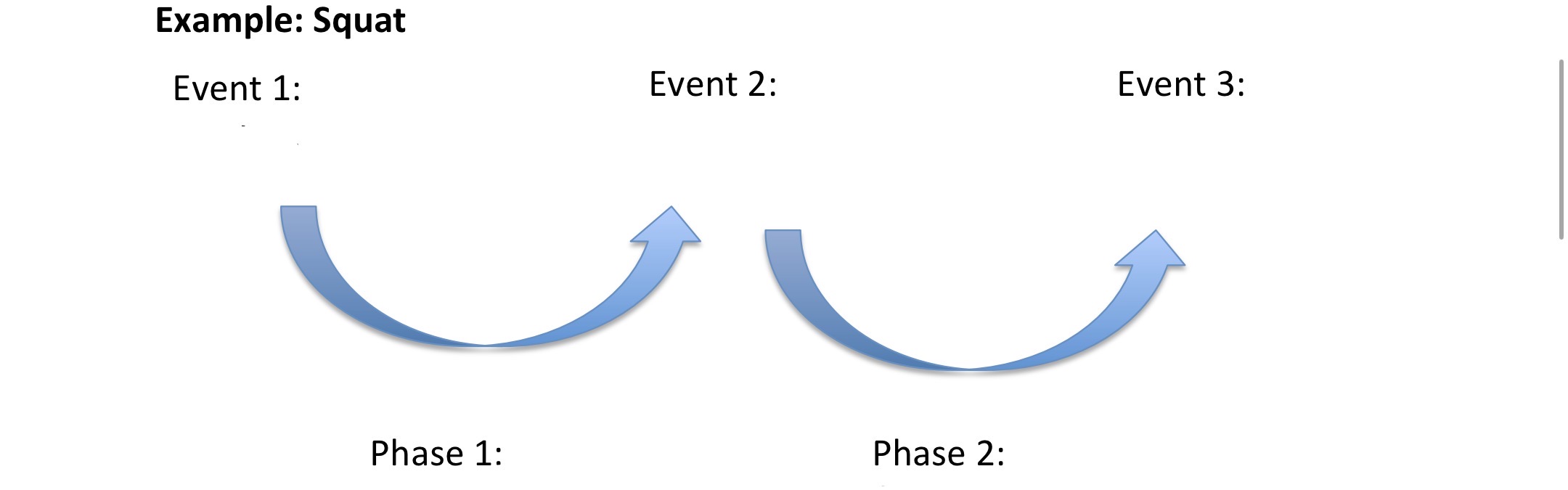
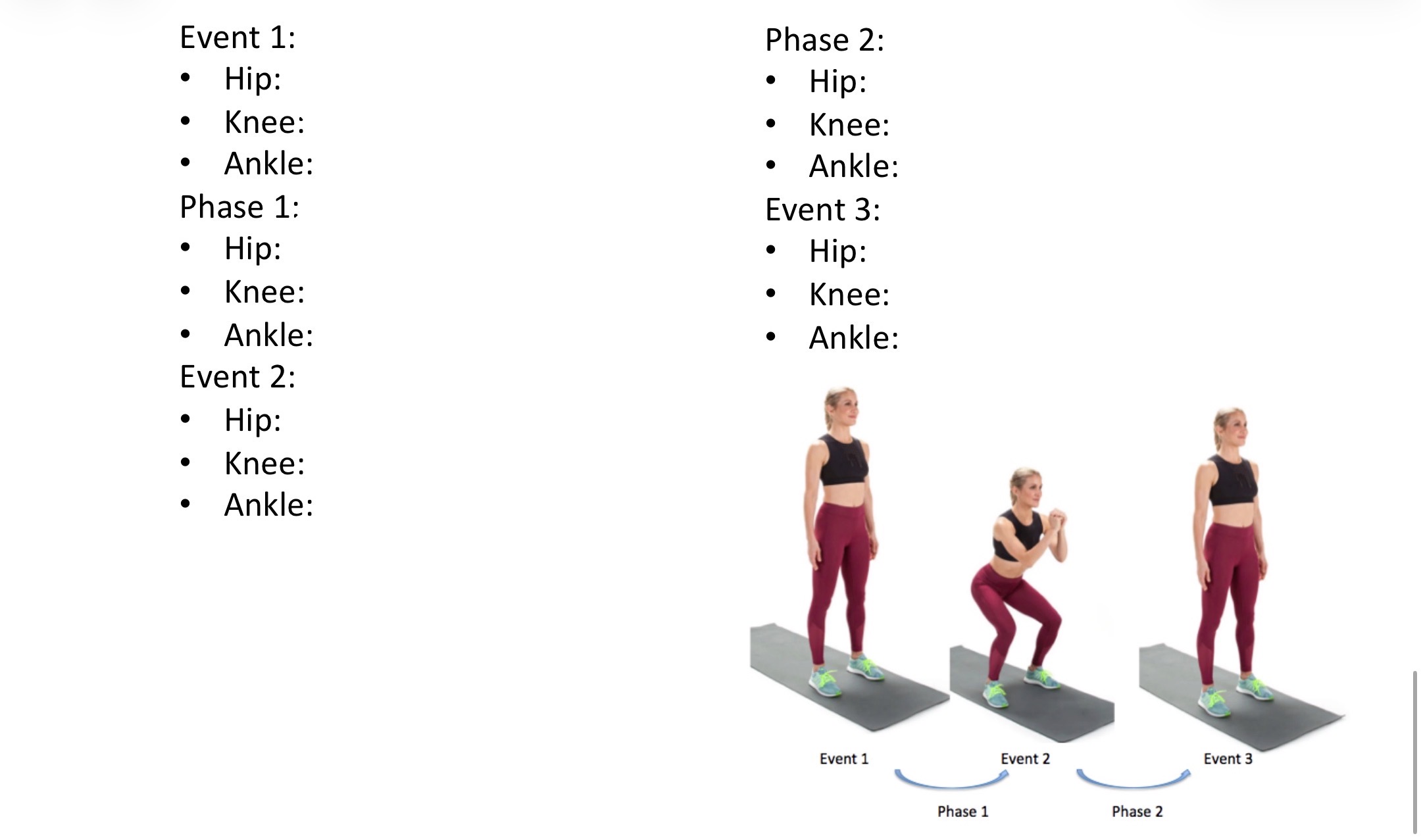
E1: Start position
P1: Descending
E2: Bottom of squat
P2: Ascending
E3: Return to start position
E1
H: Neutral
K: Neutral
A: neutral
P1
H: flexion
K: flexion
A: dorsiflexion
E2
H: flexed
K: flexed
A: dorsiflexed
P2
Hip: extension
K: extension
A: Plantarflexion
E3
H: neutral
K: neutral
A: neutral