Chapter 9 -- Muscle and Muscle Tissue
 Call Kai
 Learn
Learn Practice Test
 Spaced Repetition
 Match
Match Flashcards
 Knowt Play
1/45

There's no tags or description
Looks like no tags are added yet.
Name | Mastery | Learn | Test | Matching | Spaced | Call with Kai | Chat |
|---|
No analytics yet
Send a link to your students to track their progress
46 Terms
Type of tissue that is packaged in skeletal muscles, has obvious stripes called striations, and is controlled voluntarily
Skeletal Tissue
Type of tissue found in walls of hollow organs, and moves involuntarily
Smooth Tissue
Type of tissue only found in the heart, has striations, but moves involuntarily
Cardiac Tissue
Protective Sheath that surrounds entire muscle
Epimyseum
Protective sheath that surrounds each muscle fiber
Endomyseum
Protective sheath that surrounds each group of muscle fibers
Perimyseum
Level of organization that is a bundle of fascicle
Muscle
Level of organization that is a bundle of muscle fibers
Fascicle
Level of organization that is a bundle of myofibrils
Muscle Fiber
Level of organization that is a bundle of myrofilaments
Myrofibril
Horizontal unit of myrofilaments
Sacromere
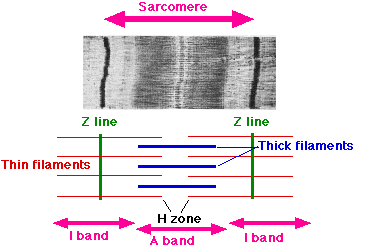
Part of sarcomere that is the length of myosin
A band
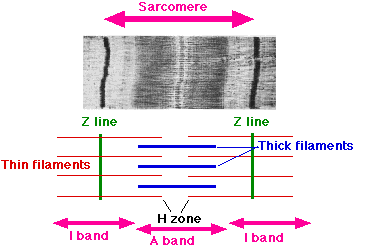
Part of sarcomere that separates successive sarcomeres
Z line
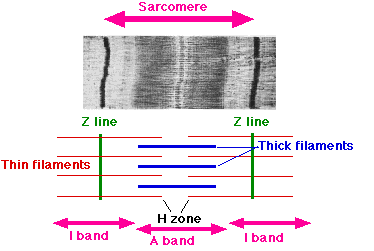
Part of sarcomere that is the space between the ends of myosin (thick protein)
I band
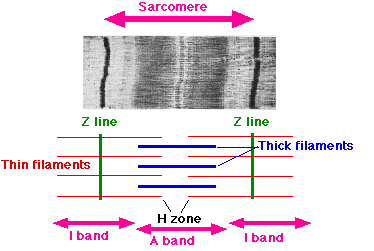
Part of sarcomere that is the space between the ends of actin (thin protein)
H zone
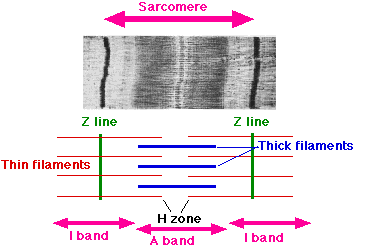
Part of sarcomere that is the middle part
M line
Sleeve of longitudinal/perpendicular tubules the regulates intracellular calcium levels
Sarcoplasmic Reticulum
Pathway fro nerve impulses to travel deep into muscle
Transverse Tubules
Thin protein made up of troponin and tropomyosin
Actin
Thick protein with a head and a tail
Myosin
Steps of Nerve Impulse Transmission into muscle: Nerve impulse reaches end of an axon
Step 1
Steps of Nerve Impulse Transmission into muscle: Channels open to allow Ca+ into axon
Step 2
Steps of Nerve Impulse Transmission into muscle: Ca+ triggers release of ACH from synaptic vessels
Step 3
Steps of Nerve Impulse Transmission into muscle: ACH diffuse quickly across synapse, binding to muscle fiber membrane
Step 4
Steps of Nerve Impulse Transmission into muscle: AP is regenerated at muscle fiber, then into transverse tubules
Step 5
Theory that explains how muscles contract, where thick myosin filaments use energy from ATP to repeatedly bind, pull, and release thin actin filaments, causing muscle fiber to shorten and force to be generated.
Sliding Filament Theory
Steps of SFT: Nerve impulse arrives at muscle and triggers electrical signal across muscle fiber
Step 1
Steps of SFT: Signal travels down transverse tubules and arrives at Sarcoplasmic Reticulum
Step 2
Steps of SFT: Sacroplasic Reticulum releases Ca+ ions into muscle
Step 3
Steps of SFT: Ca+ binds to troponin, shifting tropomyosin, and exposing active site of actin
Step 4
Steps of SFT: Myosin reaches out to exposed actin sites, allowing a “cross bridge” to form (BIND)
Step 5
Steps of SFT: Stored energy is released from myosin head, causing actin and myosin to slide together (SLIDE)
Step 6
Steps of SFT: New ATP binds to myosin, releasing cross-bridge (RELEASE)
Step 7
One of two ways muscles contract, this one being a quick one time contraction; 1 AP = 1 cycle of contraction
Twitch
One of two ways muscles contract, this one being for most muscle actions, where many AP’s are needed
Graded muscle response
Graded muscle response where multiple AP’s are sent back to back, causing successive contractions to occur more quickly
Summation
Graded muscle response where repeated quick summation leads to increased strength of twitch, due to Ca+ buildups in SR
Incomplete Tetanus
Graded muscle repose where AP’s occur so quickly, longer relaxation periods exist between contractions; resulting in smooth muscle contraction
Complete Tetanus
Factor where small motor units happen first, then larger motor units happen last
Recruitment
Factor where initial is weaker, but the repeated is stronger,
Strength over time
Factor where optimal force of contraction is generated when muscle is moderately stretched.
Length-Tension Relationship
Energy method where we regenerate ATP, giving energy for about 10-15 seconds
Creatine Phosphate System
Energy method where we breakdown glucose, yielding more ATP
Anaerobic Glycolysis
Energy method where a sequence of chemical reactions in mitochondria use 1 glucose to make 38 ATP.
Aerobic Respiration
Muscle fiber type that requires contraction time, and O2; yields a longer lasting, but weaker, contraction
Slow Twitch (Type 1)
Muscle fiber type that has a faster contraction time, and doesn’t require oxygen; shorter lasting, but stronger contractions
Fast Twitch (Type 2)