EXAM 1 - LIPID digestion & absorption
 Call Kai
 Learn
Learn Practice Test
 Spaced Repetition
 Match
Match Flashcards
 Knowt Play
1/52

There's no tags or description
Looks like no tags are added yet.
Name | Mastery | Learn | Test | Matching | Spaced | Call with Kai | Chat |
|---|
No analytics yet
Send a link to your students to track their progress
53 Terms
Simple lipids
Fatty acids (FA)
Triacylglycerols (TAG)
Diacylglycerols (DAG)
Monoacylglycerols (MAG)
Cholesterol esters
Compound Lipids
Phospholipids → cell membranes
Lipoproteins → HDL, LDL, VLDL
Fatty Acids
Straight hydrocarbon chain terminating with a carboxylic acid group
Fatty acid nomenclature
Delta (D) system - length, number/ position of double bonds
Double bonds counted from carboxyl end
Exist as fats or oils depending on nature of fatty acid components

Types of fatty acids
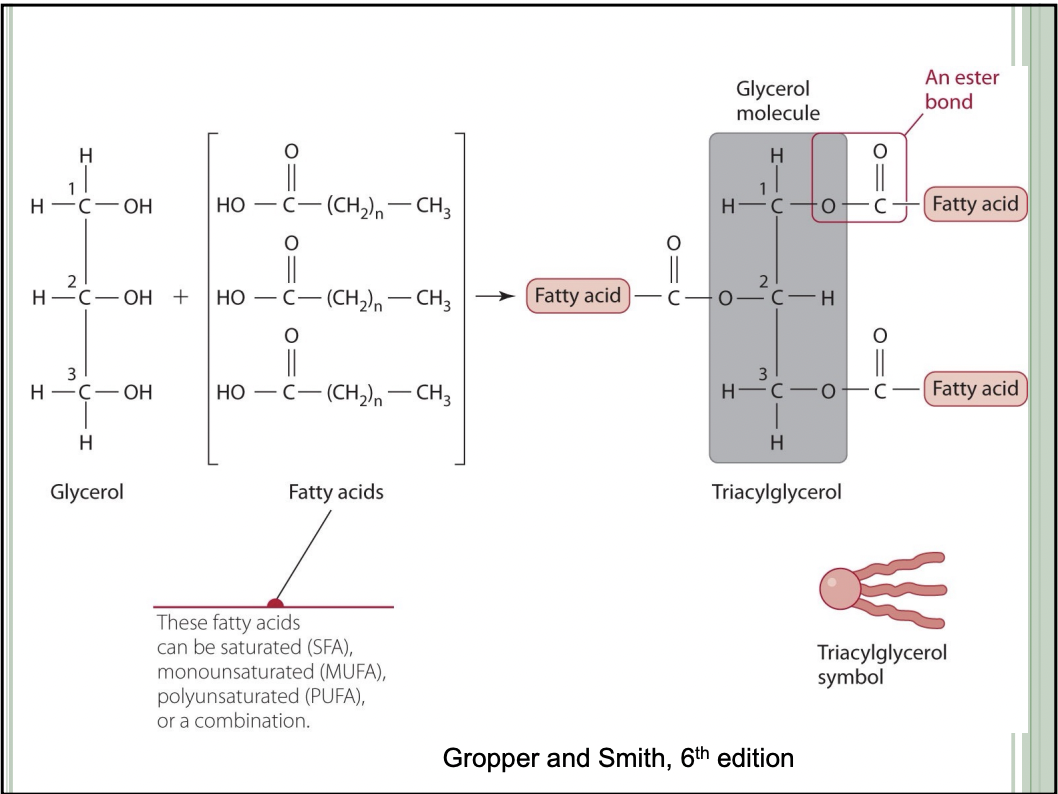
Lipid Digestion Fundamental Problem:
Fatty acids are not stored in feeds or animal tissues as fatty acids, they are stored as triglycerides (triacylglycerol esters), phospholipids, etc.
These lipids must be digested and the parts absorbed across the enterocyte
Lipid Digestion Fundamental Solution:
Must hydrolyze to component parts before molecules can be absorbed by the enterocyte
Must be able to accommodate hydrophobic molecules in an aqueous/hydrophilic environment
Critical steps in TAG digestion
Lingual & gastric lipases
Emulsification in the stomach
Emulsification in small intestine – bile salts
Pancreatic lipase
TAG digestion in small intestine highly efficient (about 95% digested)
Break down TAG into _____ + ____ to help emulsify additioinal fat
DAG + FA
Lipase activity + mixing/motility →
fine lipid droplets
However TAG digestion is not extensive in stomach
Most occurs in small intestine
Lingual lipase
from gland under tounge
Gastic lipase
from cheif cells in stomach
Highly stable at low pH (active up to pH 6.5)
Pancreatic lipase
from pancreas
digests TAGs and DAGs to MAGs and FA
______ is crutial for ABSORPTION of lipids
BILE
Produced by hepatocytes, and drains out through the many bile ducts that penetrate the liver
Common bile duct joins with the pancreatic duct to empty into the duodenum

_________ is released with the bile, dissolved in the acids and fats found in the concentrated bile solution
Cholesterol
When food is released by the stomach into the duodenum in the form of chyme, the gallbladder releases the concentrated bile to provide bile salts to aid in digestion

How do lipids get into the enterocyte?
Lipids have little solubility in water
“Unstirred water layer” at brush border presents a barrier even with vigorous intestinal motility and mixing of intestinal contents

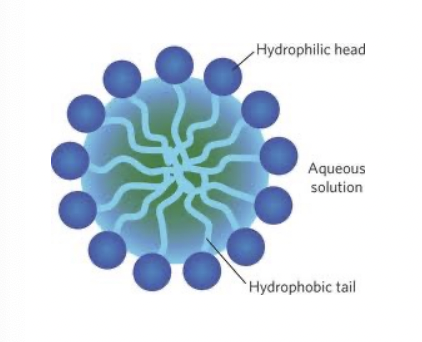
Mixed Micelles
Micelles form from bile salts (acids) + lipid moieties (cholesterol, etc.)
Engulf hydrophobic products of fat digestion
Provide polarity to penetrate the unstirred water barrier
Increases the concentration of lipid digestion products (100-1000X)
Cross unstirred water layer to deliver contents to apical enterocyte where contents enter via specific transporters or diffusion down concentration gradient
Micelle
Entering the enterocyte
Glycerol and short chain FA readily diffuse into enterocyte
Micelle products cross brush border passively (no energy required)
Following diffusion products quickly re-esterified at the endoplasmic reticulum
TAG, cholesterol esters reformed to sustain concentration gradient
Re-esterification
TAG digestion products (FA, MAG, DAG)…are moved to the endoplasmic reticulum (ER) to be repackaged as TAG
Re-formed lipids (TAG) leave the enterocyte (exocytosis) largely in the form of chylomicrons (monogastrics)
Chylomicrons
Chylomicrons resemble the fatty acid composition of diet
____________ delivers dietary lipids mostly to muscle and adipose (80%
Lymph system delivers dietary lipids mostly to muscle and adipose (80%)
Remaining lipid goes to liver as chylomicron remnants
Chylomicrons and lipoproteins

Overview of lipid digestion/ absorption

T or F: Lipases involved in cleaving fatty acids from glycerol backbone (many sites of digestion, mouth, stomach, SI)
true
Lipids have to be _______
emulsified
T or F: Lipids require special mechanisms to be absorbed, mixed micelle, exported via chylomicrons (monogastric)
true
Absorbed dietary fat is either:
stored as energy in the form of TAG in adipose tissue (adipocytes)
or fatty acids are oxidized for energy via betaoxidation
In order to store fats that originated as dietary fat and are presented to recipient tissues (like muscle or adipose!) as chylomicrons….
Lipoprotein lipase is critical
Role of lipoprotein lipase (LPL)
Problem: tissues can’t take up chylomicrons or lipoproteins directly! So how do they acquire fat products?
LPL targets the TAG in chylomicrons or lipoproteins in circulation to release glycerol and free fatty acids
Adipocytes and skeletal/cardiac myocytes need energy from lipids so they express LPL
LPL action
Results in sequential hydrolysis of TAG
TAG to DAG, MAG, Glycerol, FA (to allow into cell)
Free fatty acids, DAG and MAG
Taken up by tissues via diffusion and fatty acid transport proteins
Fatty acids, DAG, MAG then re-esterified and stored as TAG (what we likely started with in the diet!)
Glycerol is taken up by diffusion but eventually recycled to the liver
Chylomicron remnants (chylomicrons depleted of TAG) are then recycled to the liver

Mobilizing stored TAG when needed
TAG couldn’t get in the cell…so TAG can’t get out!
So how does the cell trigger release of stored lipids?
Hormone sensitive lipase (HSL) cleaves TAG to release
FA and glycerol ¢ FA and glycerol get exported
FA transported to recipient cells (muscle, etc. as NEFA)
Glycerol recycled to liver
T or F: HSL is activated by beta-agonists like Paylean and Optaflexx, causing animals to mobilize fat stores in support of lean muscle gain
TRUe
Lipid metabolism Recap

Before a target cell (like muscle) can use FA for energy, they have to get them delivered
Chylomicrons (dietary lipids) → Increase expression of lipoprotein lipase
Non esterified fatty acids in blood → From HSL cleavage of TAG in adipose stores
Which tissues prefer FA for energy?
Liver, muscle types, kidney
Activation of FA to FA Co-A
Fatty acids must be activated to form fatty acyl-coA derivatives because ONLY activated FA can enter metabolic pathways
Remember…beta-oxidation of FA occurs in mitochondria!
Acyl-coA synthetase in cytoplasm (Long chain FA activation)
Short and medium chain FA can pass into mito matrix and are “activated” in mito to form acyl-coA derivatives that feed into beta-oxidation cycle

Carnitine role in FA oxidation
BUT long chain FA need to be carried across inner membrane!
Carnitine (quasi vitamin!) plays critical role here
Carnitine acyltransferase I
Loads carnitine with activated fatty acid
Inhibited by malonyl coA (lipogenesis product)
Rate limiting step of beta oxidation
Carnitine acyltransferase II
Releases acyl carnitine to form acyl-coA and carnitine
Transporting Fatty Acyl-CoA across innter mito membrane

Beta Oxidation
Occurs in mitochondria
High in muscle and liver in fasted state (looking for energy!)
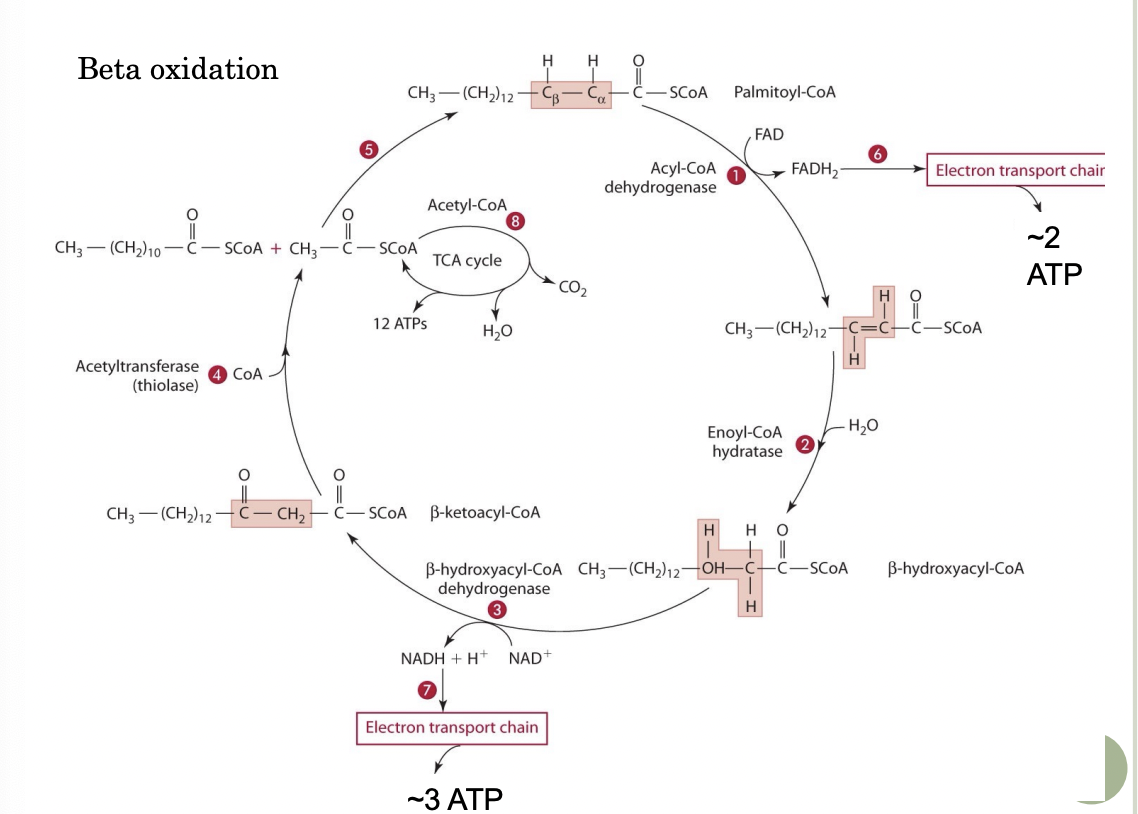
Beta-oxidation: sequential oxidation of the ß-carbon of FA that generates
1 FADH2 1 NADH and releases acetyl Co-A + activated fatty acid that is 2C shorter (cycle continues…)
Acetyl CoA enters the TCA cycle to generate additional energy
FADH2 and NADH enter ETC…to drive ATP production!
Beta Oxidation
Key to metabolism and energy homeostasis is the fate of ______________: whether they will be oxidized for energy or be stored
Key to metabolism and energy homeostasis is the fate of pyruvate and acetyl-CoA: whether they will be oxidized for energy or be stored
Acetyl Co-A can form citrate (TCA) to eventually support ATP synthesis or go on to form malonyl Co-A (first step of FA synthesis/lipogenesis)
Depends on the energy state of the animal!
De novo lipogenesis
dietary carbohydrate conversion (through series of enzymatic reactions) to fatty acids
Acetyl CoA is the key
Sources of Acetyl-CoA

Lipogenesis
Occurs in the cytosol
Acetyl CoA carboxylase converts acetyl-CoA to malonyl CoA
Requires biotin (B vitamin) for carboxylation reaction
This is the rate limiting step of lipogenesis

Lipogenesisi pt. 2
Sequential addition of 2 carbon units (acetyl CoA) results in the eventual formation of palmitate (C16:0)
Catalyzed by Fatty Acid Synthase
An enzyme complex with multiple catalytic activities
Catalyzes synthesis of new long chain FA in the body from
1) Acetyl CoA
2) Malonyl CoA and
3) NADPH (reducing equivalent coming from Pentose Phosphate Pathway)
Lipogenesis: Fatty acid to triacylglycerol
Palmitate is then esterified on a glycerol backbone to form triacylglycerol (TAG) for storage (3 palmitate in 1 TAG)
Glucose to Pyruvate
glycolysis
Acetyl-Co-A to fatty acid synthesis
lipogenesis
T or F: there is no pathway to convert fat to carbohydrate
TRUE
__________ of lipid necessary to generate energy
Beta oxidation
LOTS of energy in LCFA