BIOCH 200 Unit 9 - Glycolysis and the PDC (Questions)
 Call Kai
 Learn
Learn Practice Test
 Spaced Repetition
 Match
Match Flashcards
 Knowt Play
1/49

There's no tags or description
Looks like no tags are added yet.
Name | Mastery | Learn | Test | Matching | Spaced | Call with Kai | Chat |
|---|
No analytics yet
Send a link to your students to track their progress
50 Terms
How are glycolysis and gluconeogenesis regulated in relation to one another?
Reciprocally regulated such that both are not on at the same time
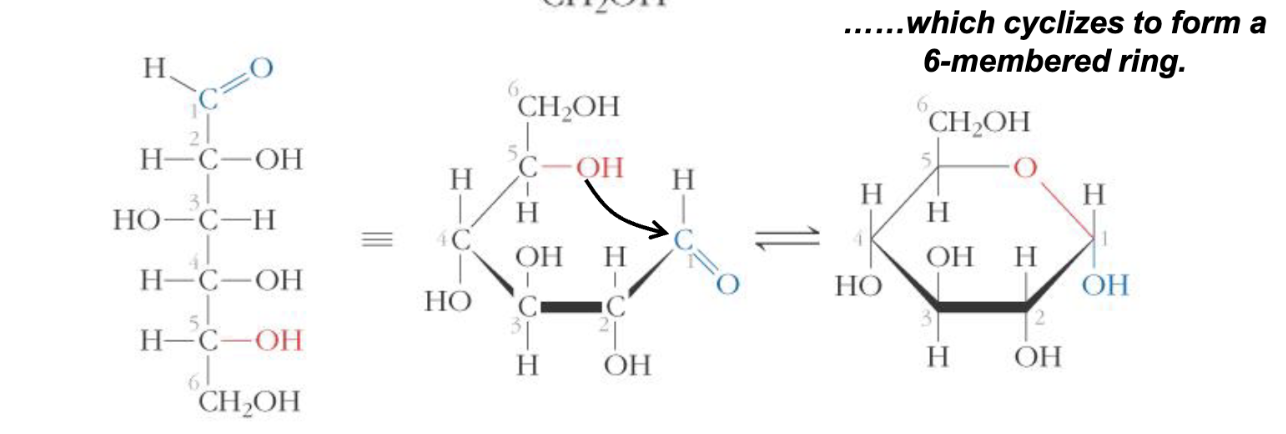
Describe the structure of glucose, including functional groups and cyclicality.
6 carbon compound with 1 aldehyde group and 5 hydroxyl groups. Cyclizes to form a 6 membered ring (loses 1 hydroxyl group) with C6 out of the ring to be able to interact with other groups (ex. phosphorylate)
What is the biological significance of glycolysis based on what it produces?
Produces a small amount of ATP (can occur under aerobic or anaerobic conditions)
Provides building blocks for the synthesis of cellular molecules in other processes
Is the first step of the complete oxidation of glucose
What do all intermediates of glycolysis have in common in terms of structure?
All phosphorylated
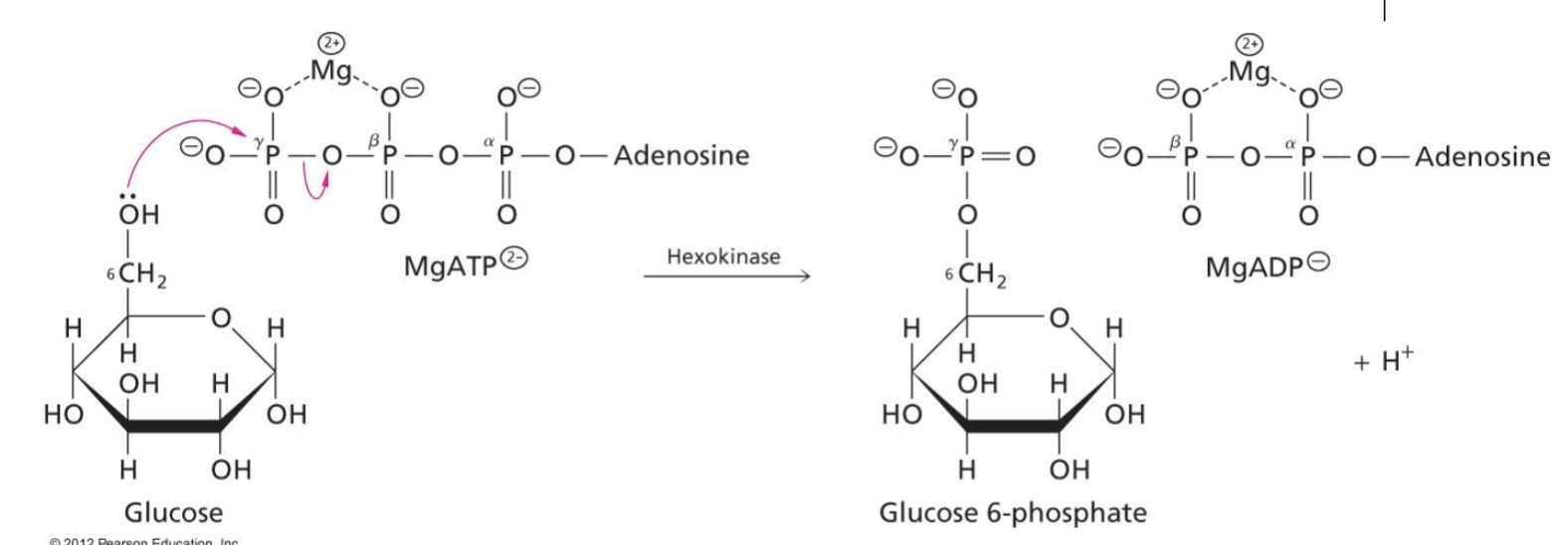
Describe what happens in reaction 1 of glycolysis, including reactants/products, reaction type, energy behaviour, and important enzymes.
Glucose + ATP → G6P + ADP + H+. Phosphoryl transfer reaction, ATP investment
Irreversible, exergonic (regulated).
Phosphoryl leaves ATP via breakage of phosphoanhydride bond, then becomes coupled to the glucose to make glucose-6-phosphate via a phosphoryl transfer that forms a phosphoester bond. This leaves ADP (from dephosphorylated ATP) and a proton (kicked off of the OH)
Breaking a phosphoanhydride bond will cause what amount of free energy change? Phosphoester?
Phosphoanhydride bond releases -30 kJ of energy, phosphoester releases -15 kJ of energy.
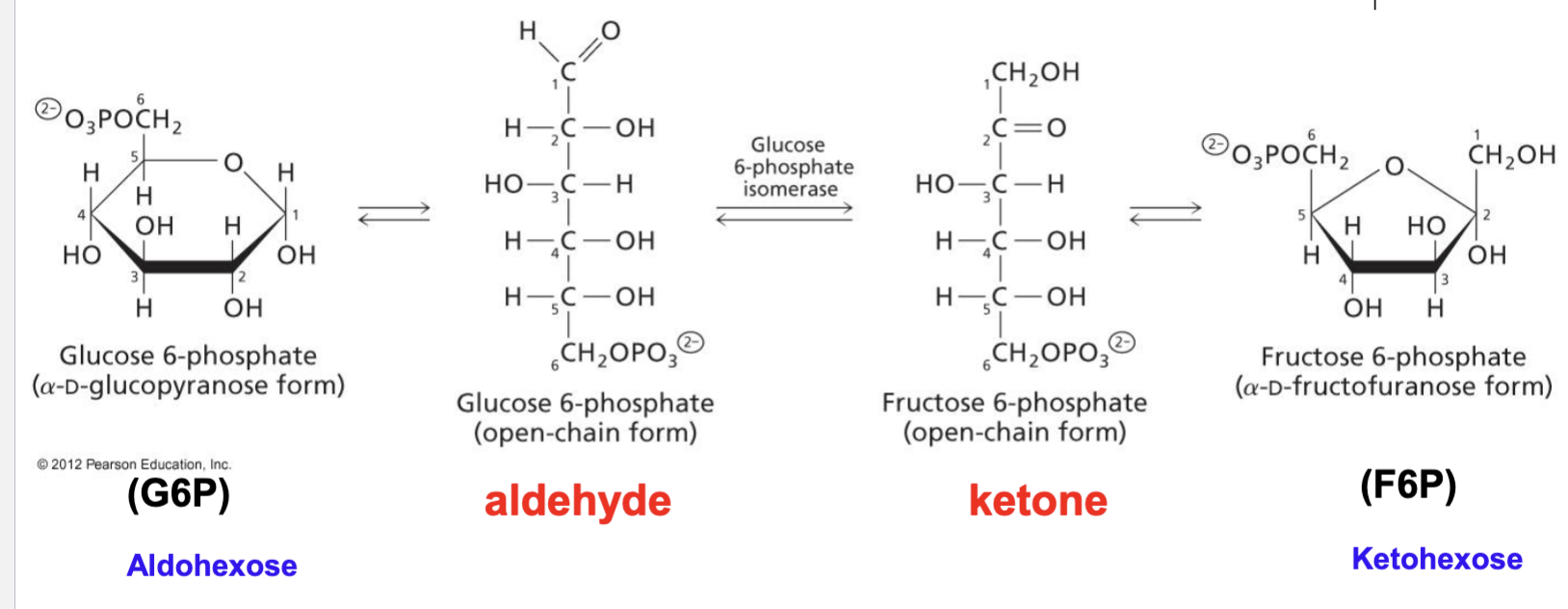
Describe what happens in reaction 2 of glycolysis, including reactants/products, reaction type, energy behaviour, and important enzymes.
G6P ↔ F6P. Isomerization
Reversible, free energy change close to 0 (not regulated).
To reduce steric hindrance, glucose-6-phosphate undergoes an isomerization to fructose-6-phosphate. The hexose molecule is isomerized from an aldehyde to a ketone
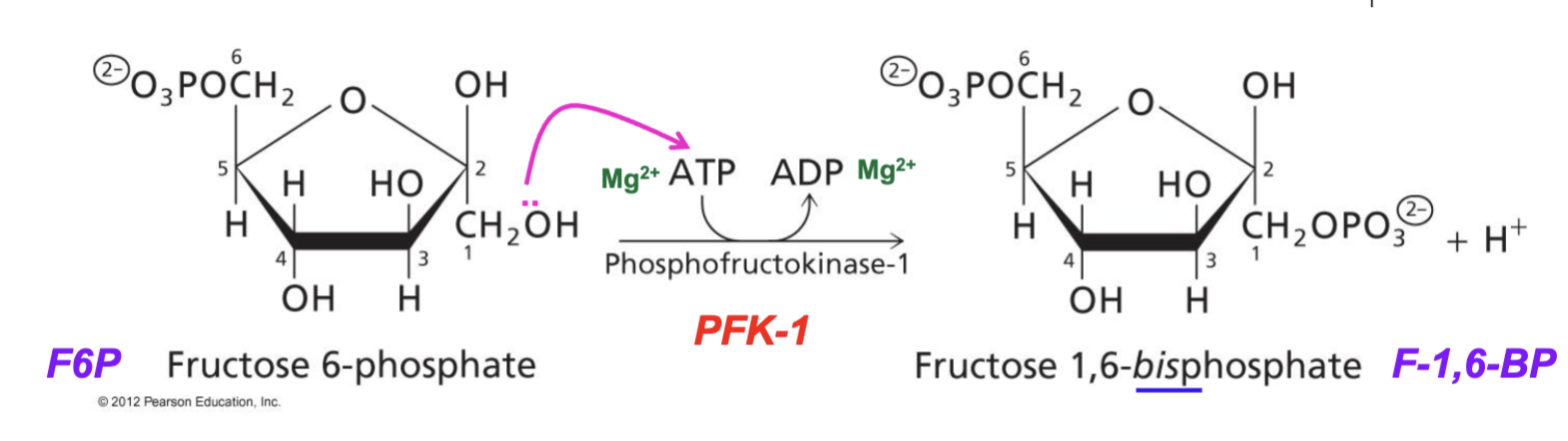
Describe what happens in reaction 3 of glycolysis, including reactants/products, reaction type, energy behaviour, and important enzymes.
F6P + ATP → F-1,6-BP + ADP + H+. Phosphoryl transfer reaction, ATP investment
Irreversible, exergonic (tightly regulated). Rate limiting reaction of glycolysis
Phosphoryl leaves ATP via breakage of phosphoanhydride bond, then becomes coupled to the fructose-6-phosphate to make fructose-1,6-bisphosphate via a phosphoryl transfer that forms 2 phosphoester bonds. This leaves ADP (from dephosphorylated ATP) and a proton (kicked off of the OH)
What do reactions 1 and 3 of glycolysis couple, and how (push/pull)?
Couples the breaking of a phosphoanhydride bond in ATP hydrolysis (releases high amount of energy) to the formation of a phosphoester bond in phosphoryl transfer (nonspontaneous on its own)
ATP hydrolysis creates a large excess amount of inorganic phosphate that acts as a substrate for phosphoryl transfer onto glucose/F6P, pushing the reaction forward
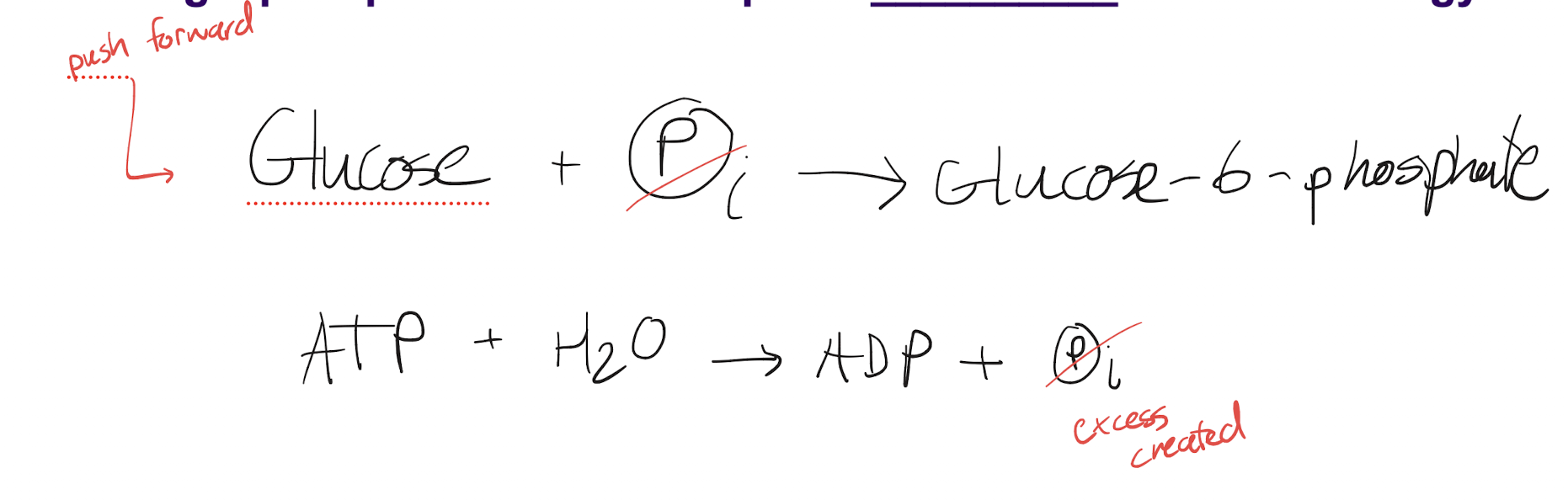
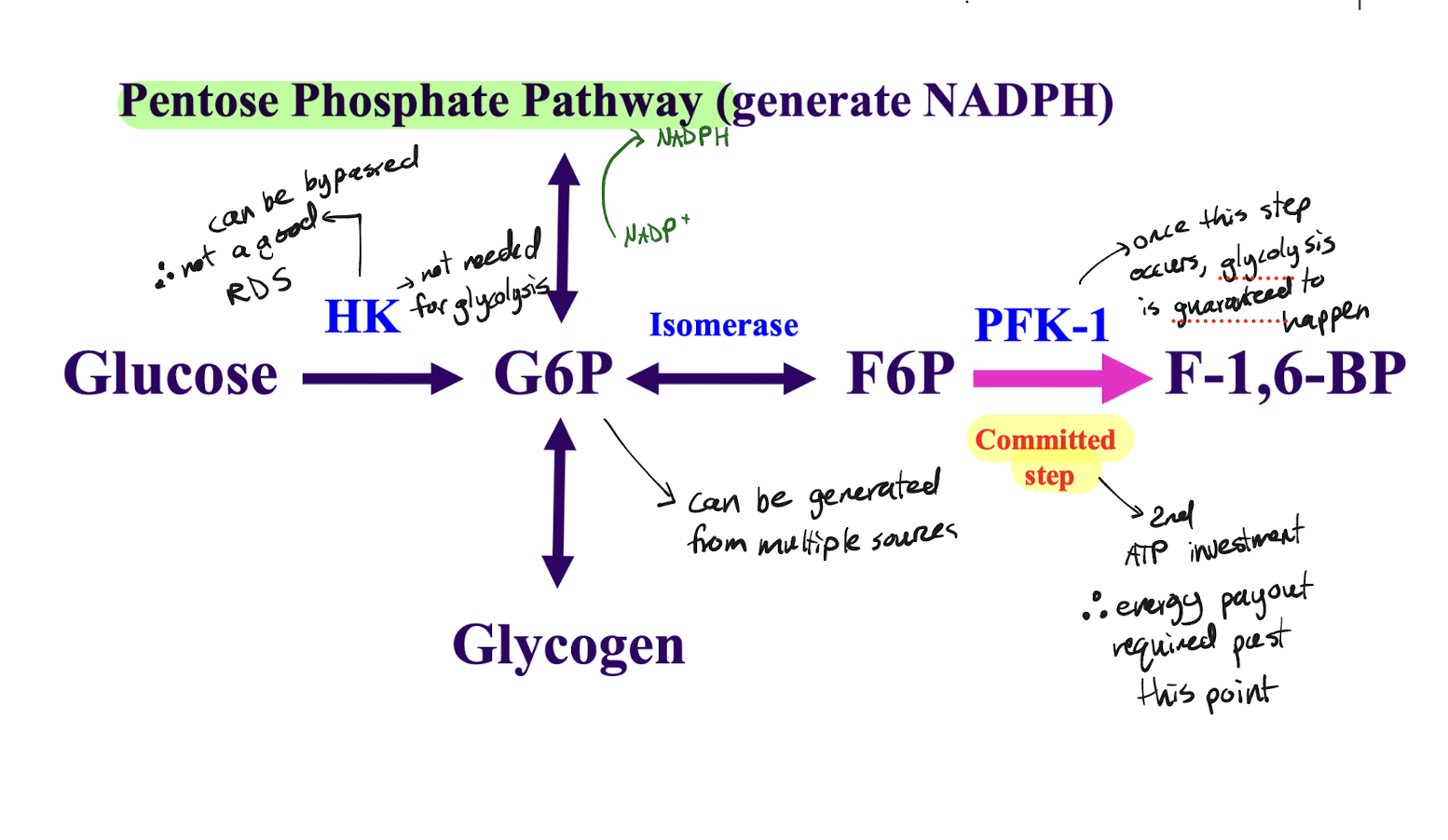
What is the committing step in glycolysis? Why this step and not others before it?
Reaction 3: phosphoryl transfer catalyzed by PFK-1 is the rate determining step
At this point 2 ATPs have been committed to the pathway, and thus ATP investment needs to occur. Reaction 1 (hexokinase phosphoryl transfer) occurs before this step in the pathway, but can be bypassed, as G6P created from this reaction can created in other reactions (from glycogen, pentosephosphate pathway). Reaction 2 is unregulated. Thus, reaction 3 is the best committed step for glycolysis
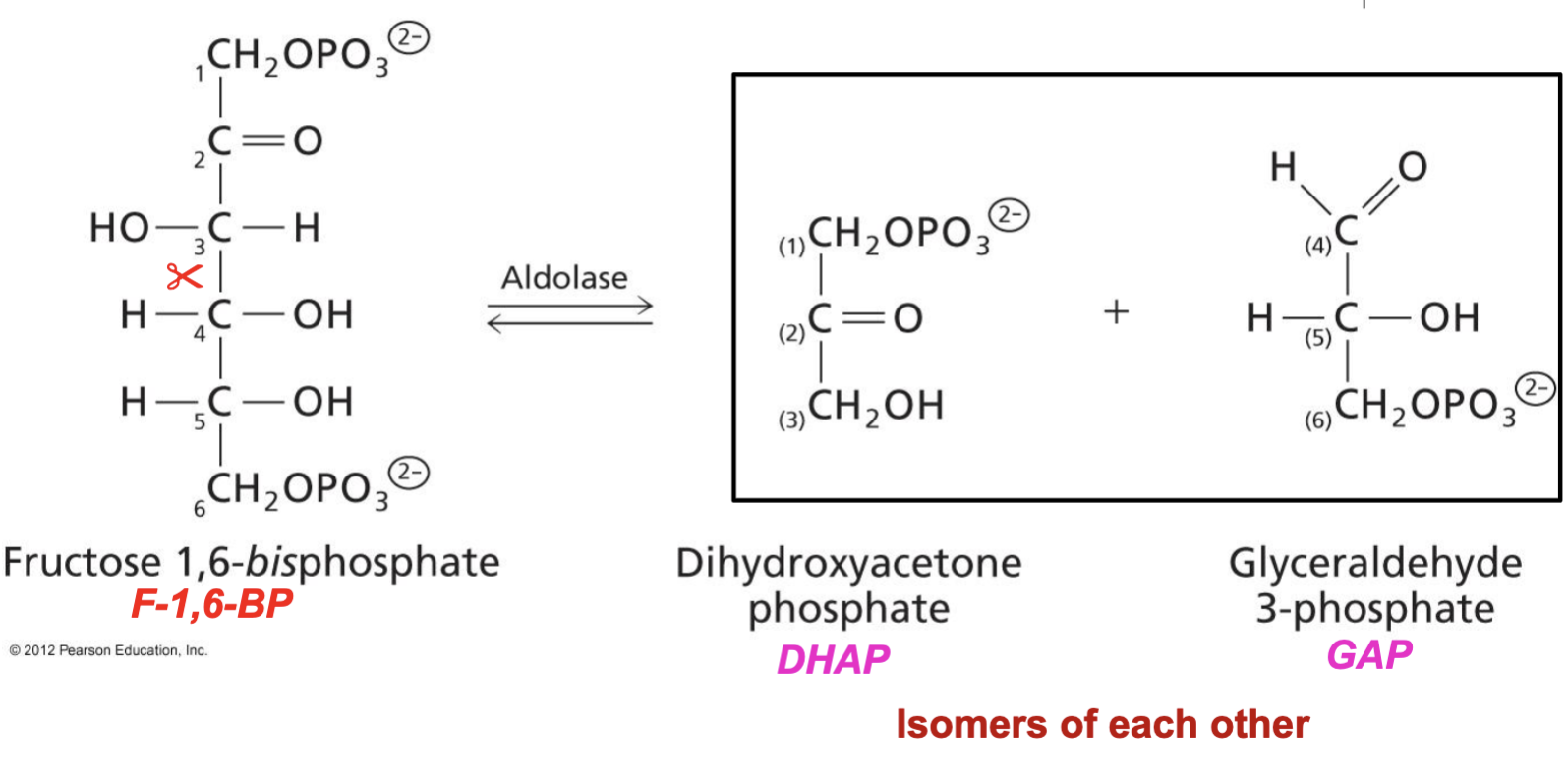
Describe what happens in reaction 4 of glycolysis, including reactants/products, reaction type, energy behaviour, and important enzymes.
F-1,6-BP ↔ GAP + DHAP. Lysis
Reversible, free energy change close to 0 (not regulated).
Fructose-1,6-bisphosphate is lysed in between its 3rd and 4th carbon to create 2 3-carbon intermediates: DHAP, a ketone, and glyceraldehyde-3-phosphate (G3P/GAP), an aldehyde. These molecules are isomers of one another.
Describe what happens in reaction 5 of glycolysis, including reactants/products, reaction type, energy behaviour, and important enzymes.
DHAP ↔ GAP. Isomerization
Reversible, free energy change close to 0 (not regulated).
Out of the two molecules created via lysis, DHAP undergoes isomerization to GAP, ultimately producing 2 separate molecules of GAP from one molecule of F-1,6-BP. The triose molecule is isomerized from a ketone to an aldehyde
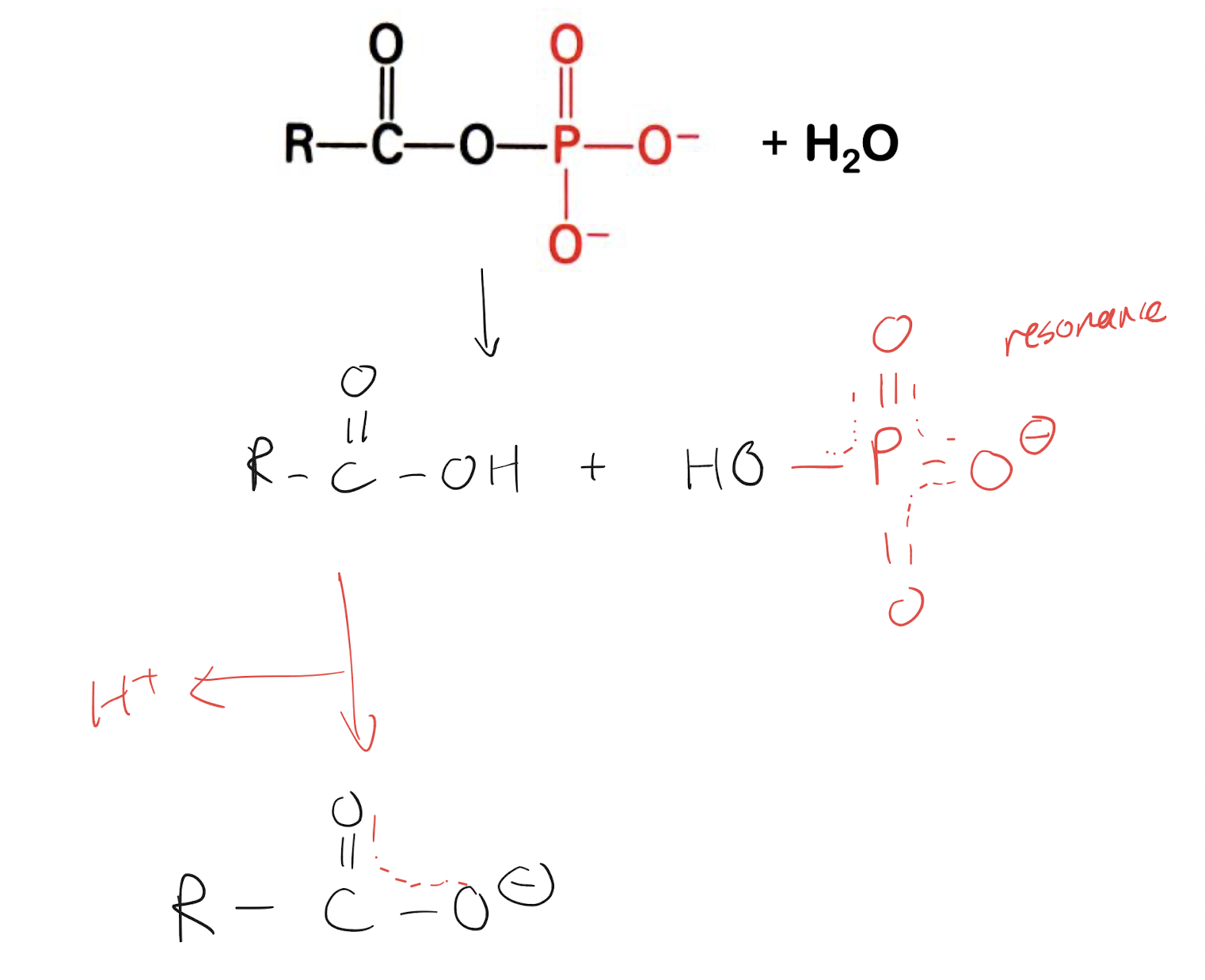
Does hydrolysis of an acyl phosphate release or require energy? Explain.
Releases. Product of hydrolysis (phosphate and carboxyl) both have resonance stabilization and thus prefer to be in the products state, thus the reaction is spontaneous and exergonic.
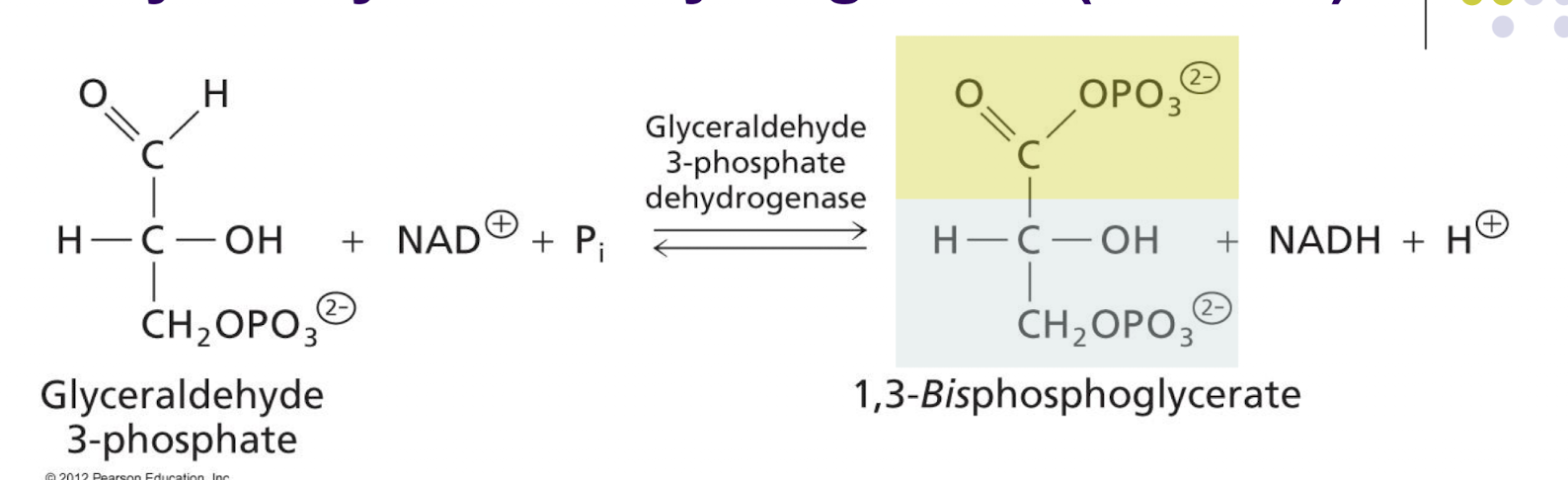
Describe what happens in reaction 6 of glycolysis, including reactants/products, reaction type, energy behaviour, and important enzymes.
GAP + NAD+ + Pi ↔ 1,3-BPG + NADH + H+. Oxidation, phosphorylation. Energy capture.
Reversible, free energy change close to 0 (not regulated).
Each GAP is oxidized by GAPDH, then phosphorylated from a free inorganic phosphate, generating 1,3-bisphosphoglycerate. NAD+ receives 2 electrons as a hydride ion (from GAP) and becomes reduced to NADH+. NADH and 1,3-BPG are both high energy molecules.
Which intermediates are involved in energy capture steps that create ATP? What allows them to do this?
1,3-BPG and phosphophenolpyruvate. Both have large phosphate transfer potentials and are able to undergo SLP to form ATP from ADP
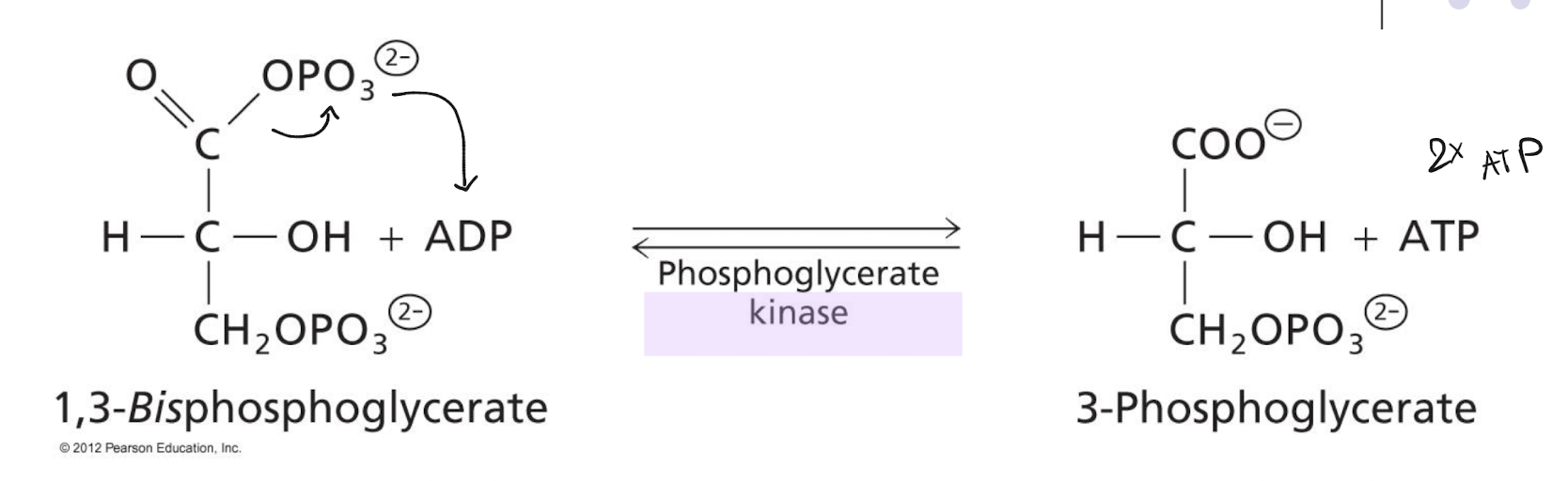
Describe what happens in reaction 7 of glycolysis, including reactants/products, reaction type, energy behaviour, and important enzymes.
1,3-BPG + ADP ↔ 3-phosphoglycerate + ATP. SLP. Energy capture.
Reversible, free energy change close to 0 (not regulated).
ATP synthesis is coupled with the hydrolysis of 1,3-BPG (an acyl phosphate): 1,3-BPG’s acyl phosphate bond is broken, and the phosphate is transferred to ADP via substrate level phosphorylation, making ATP and 3-phosphoglycerate.
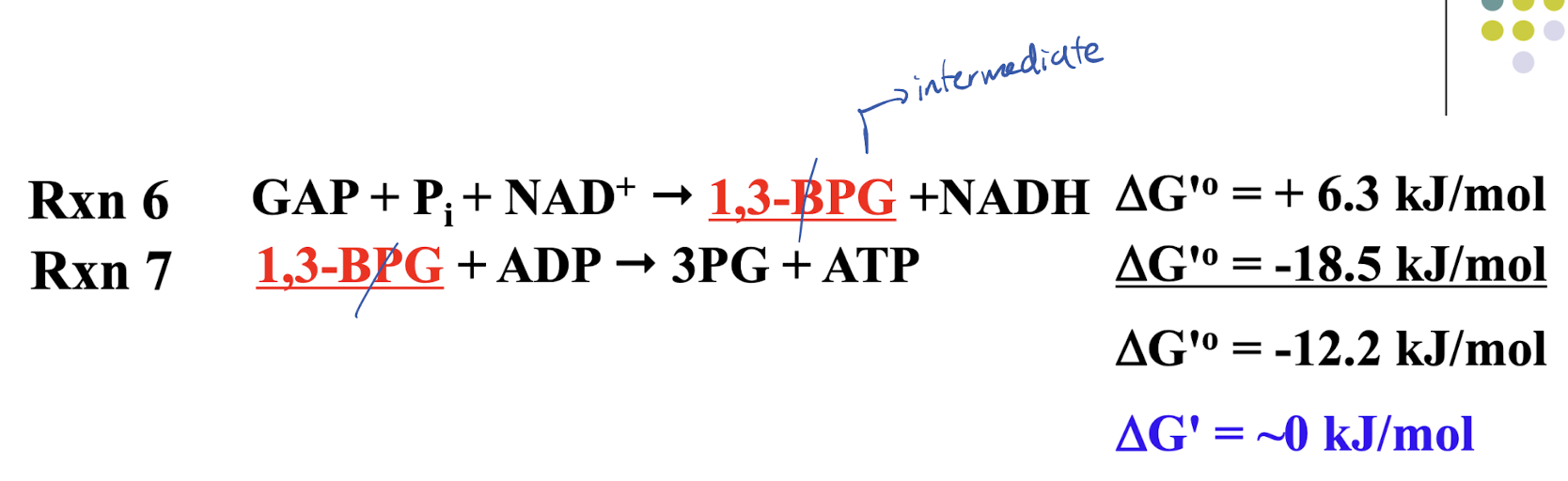
How are reaction 6 and 7 related in terms of coupled intermediates?
Consumption of 1,3-BPG in reaction 7 pulls reaction 6 forward, as the steady use of the reaction 6 product motivates equilibrium to keep creating it.
What does reaction 7 of glycolysis couple, and how?
Couples the breaking of an acyl phosphate with ATP synthesis through substrate level phosphorylation
Breaking the acyl phosphate linkage in 1,3-BPG creates a large excess amount of inorganic phosphate that acts as a substrate for phosphoryl transfer onto ADP, pushing the reaction forward
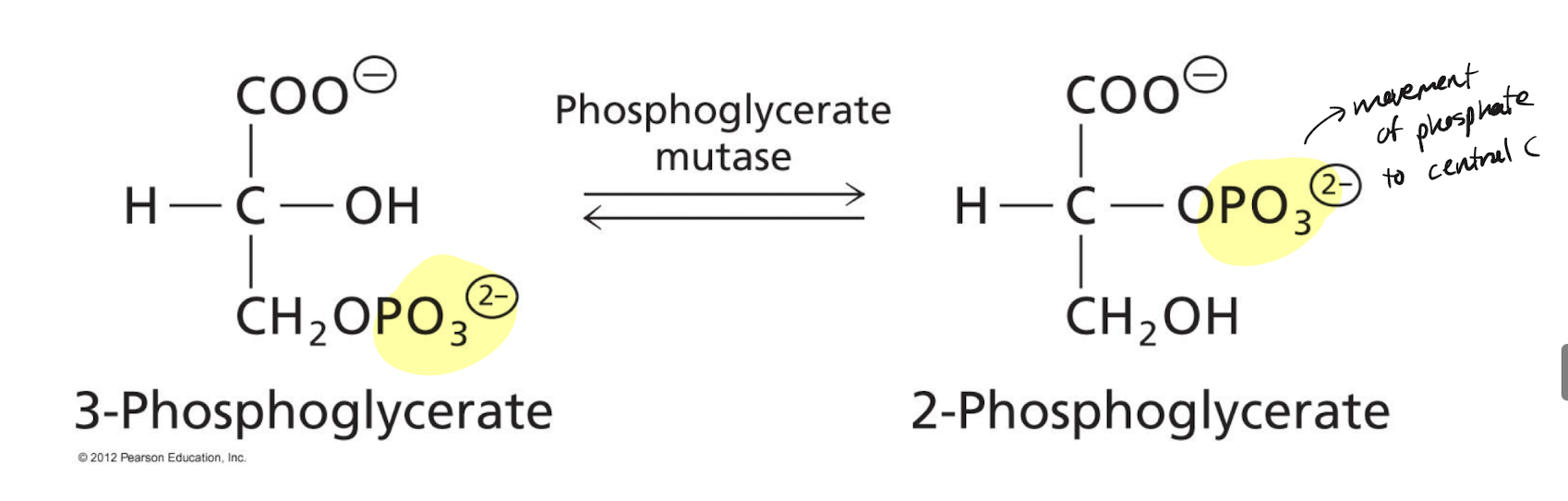
Describe what happens in reaction 8 of glycolysis, including reactants/products, reaction type, energy behaviour, and important enzymes.
3-phosphoglycerate ↔ 2-phosphoglycerate. Isomerization.
Reversible, free energy change close to 0 (not regulated).
The phosphate on 3-phosphoglycerate is moved from carbon 3 to the “central” carbon 2, isomerizing it to 2-phosphoglycerate
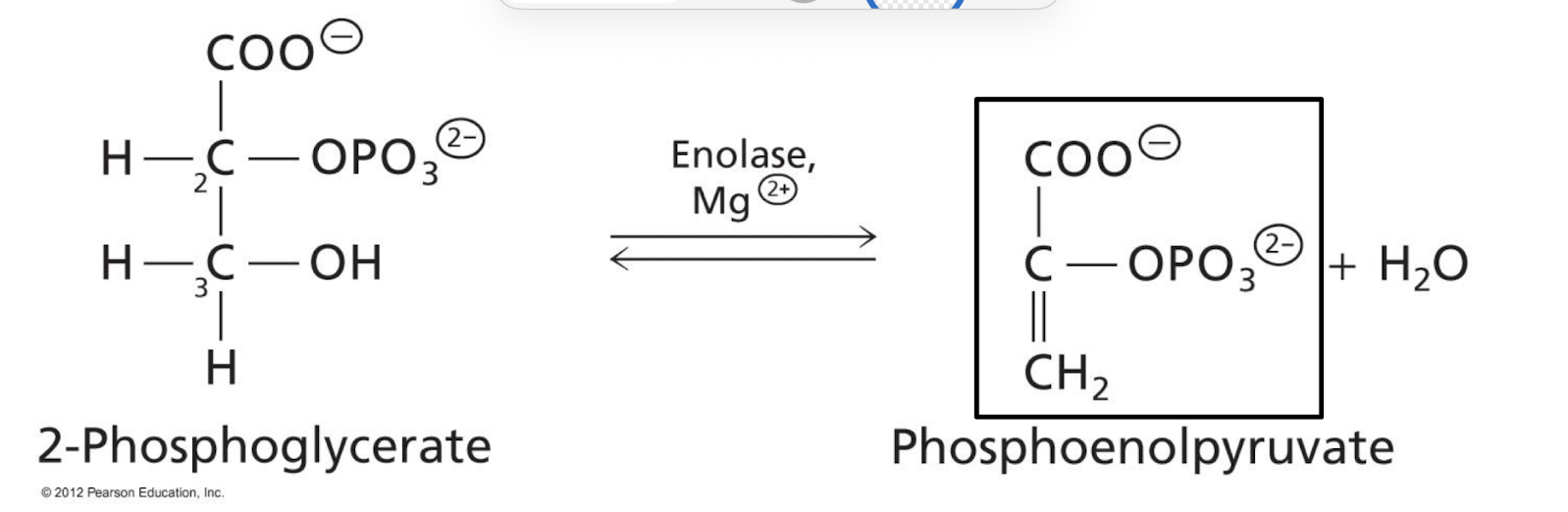
Describe what happens in reaction 9 of glycolysis, including reactants/products, reaction type, energy behaviour, and important enzymes.
2-phosphoglycerate ↔ PEP + H2O. Dehydration.
Reversible, free energy change close to 0 (not regulated).
A hydrogen on C2 and a hydroxyl on C3 are removed from 2-phosphoglycerate, forming phosphophenolpyruvate in a dehydration reaction. Phosphophenolpyruvate is a high energy intermediate.
Describe what happens in reaction 10 of glycolysis, including reactants/products, reaction type, energy behaviour, and important enzymes.
PEP + ADP → pyruvate + ATP. SLP, energy capture.
Irreversible, exergonic (regulated by pyruvate kinase).
ATP synthesis is coupled with the hydrolysis and tautomerization of phosphophenolpyruvate (high energy intermediate) catalyzed by pyruvate kinase: PEP’s phosoester bond is broken releasing a small amount of energy and freeing the phosphate, creating the unstable enol form of pyruvate. The enol form pyruvate undergoes tautomerization into its keto form, releasing a large amount of energy that allows the phosphate from PEP to be transferred to ADP via substrate level phosphorylation. The products are ATP and the stable keto pyruvate.
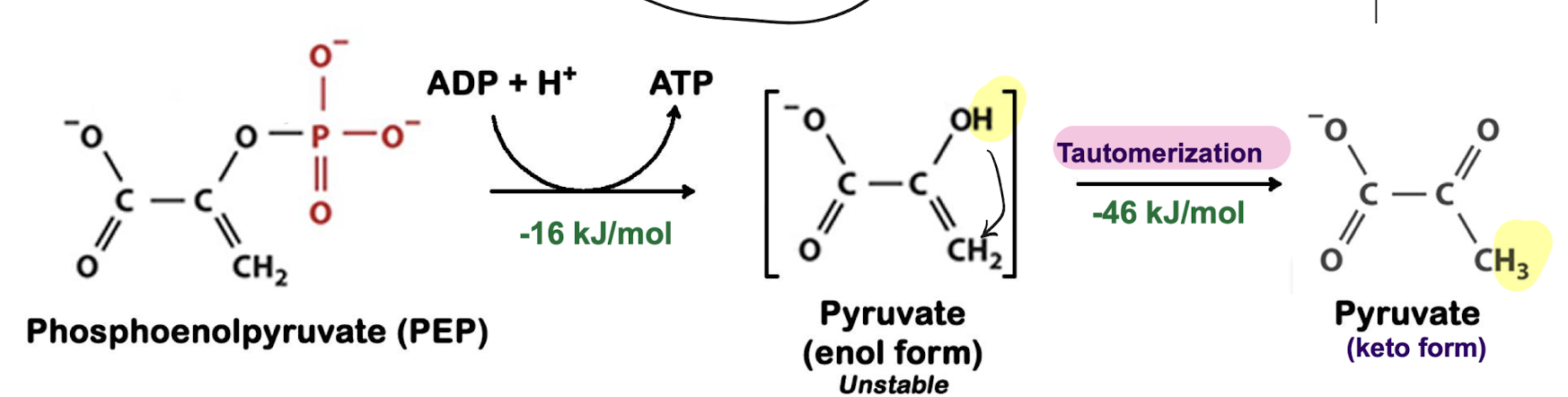
Tautomerization of enolpyruvate to pyruvate releases ___ of energy.
-46 kJ
What does reaction 10 of glycolysis couple, and how?
Couples the breaking of a phosphoester as well as tautomerization (provides energy) with ATP synthesis (requires energy) through substrate level phosphorylation
Breaking the phosphoester linkage in PEP creates a large excess amount of inorganic phosphate that acts as a substrate for phosphoryl transfer onto ADP, pushing the reaction forward. Energy is provided by the tautomerization of enolpyruvate into pyruvate
Which glycolysis steps occur once, and which twice?
1-4: 6 carbon phase. Only occurs once
5-10: 3 carbon phase due to lysis. 2 molecules so happens twice
What is the gross amount of ATP generated per glucose? What is the net amount? How much NADH is generated per glucose?
Gross: 4 ATP/glucose
Net: 2 used in pathway → 2 ATP/glucose
2 NADH per glucose
What are the ways through which metabolic processes are regulated?
Substrate availability: modifying the amount of substrate available → more substrate, more work (done by all enzymes)
Alteration of enzyme activity: allostery and covalent modifcation reversible depending on stimulues (short term regulation)
Alteration of amount of enzyme → more enzyme, more work (long term regulation due to investment of time needed)
Subcellular localization/compartmentalization (does not directly modify the enzyme’s activity)
How is glycolysis regulated, and by which molecules/proteins?
Substrate availability: glucose import is controlled by transporters with high affinity for glucose
Enzyme regulation: hexokinase, PFK-1, and pyruvate kinase are regulated
What regulates the hexokinase reaction? What type of regulation is this? Explain why this inhibits/activates the enzyme.
G6P: product inhibition
Buildup of G6P indicates that it is not being consumed in the following reactions, meaning there is too much being created.
What regulates the PFK-1 reaction? What type of regulation is this? Explain why this inhibits/activates the enzyme.
ADP/AMP: allosteric activation
High levels of ADP mean that the cell is active as ATP is being hydrolyzed for energy. PFK-1 will catalyze the reaction to be faster if there is more ATP being used and invested (ADP binding to PFK-1)
ATP: allosteric inhibition
High levels of ATP mean that the cell is less active as ATP is mainly not being hydrolyzed for energy. PFK-1 will catalyze the reaction to be slower and conserve energy if there is more ATP that is not being used (binding to PFK-1)
PEP: feedback inhibition
Elevated PEP levels signal that the products of glycolysis are not being made, meaning there is excess pyruvate concentration and it is not being used for other cell functions. Glycolysis is thus not needed → shut off committed step
(F6P: homoallosteric activator)
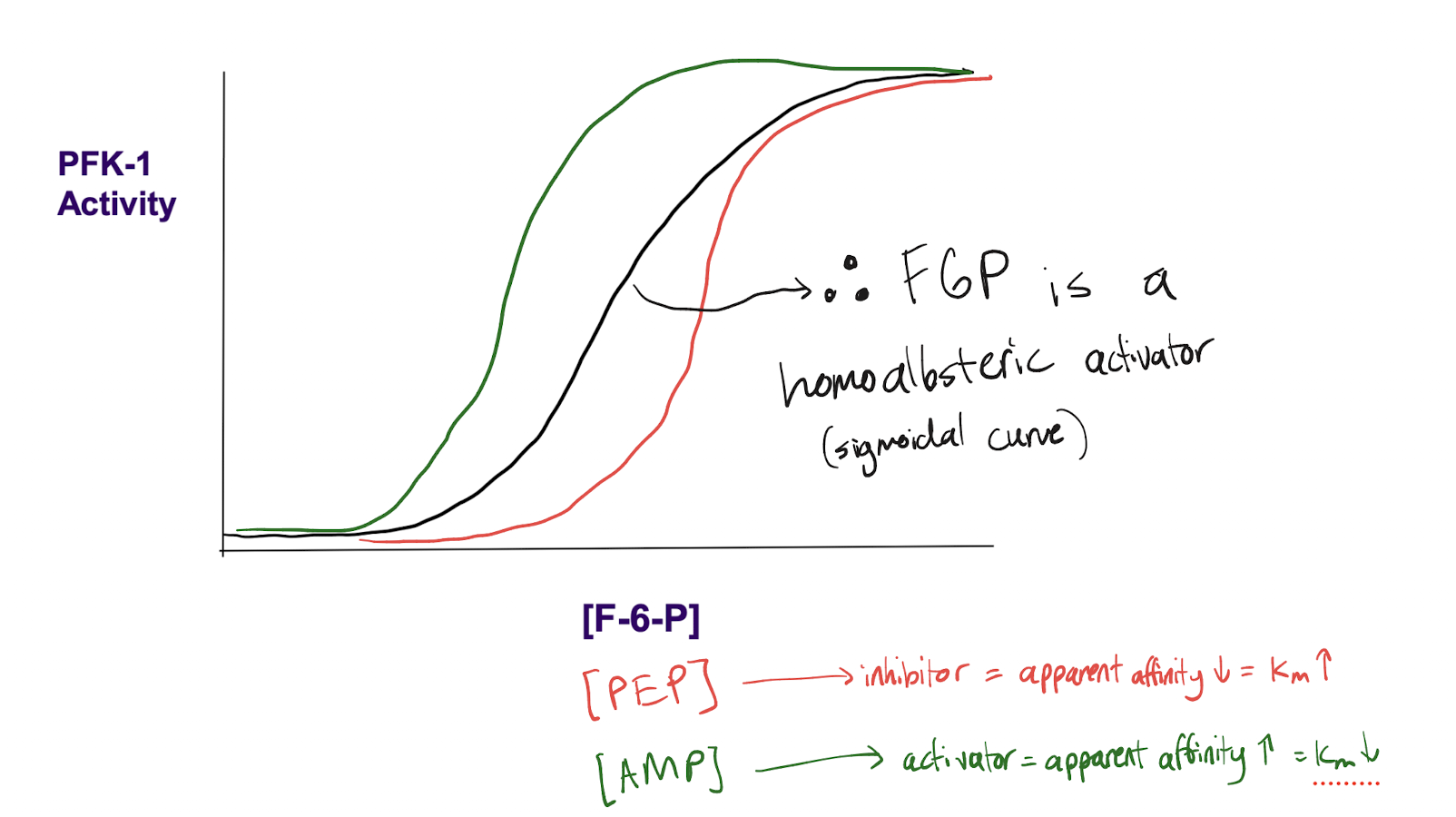
Describe a graph of F6P concentration vs PFK-1 activity. How does this change if PEP and AMP/ADP are added?
Graph: sigmoidal (F6P is a homoallosteric activator of PFK-1)
With PEP: allosteric inhibitor → decreases F6P affinity, graph shifts right
With AMP/ADP: allosteric activator → increases F6P affinity, graph shifts left
What regulates the pyruvate kinase reaction? What type of regulation is this? Explain why this inhibits/activates the enzyme.
ATP: allosteric inhibitor
High levels of ATP mean that the cell is less active as ATP is mainly not being hydrolyzed for energy
F-1,6-BP: allosteric (feed-forward) activator
High levels of F-1,6-BP mean that the PFK-1 reaction has occurred and thus glycolysis is committed (needed in the body). Pyruvate kinase must activate in order to create the product of glycolysis that is needed
(PEP: homoallosteric activator)
Is ATP a product inhibitor of pyruvate kinase since it is produced in the reaction? Why or why not?
No: pyruvate kinase reaction only creates 2 ATP, which is not enough to allosterically inhibit the enzyme.
ATP that inhibits pyruvate kinase is the majority ATP created by oxidative phosphorylation. Product that inhibits enzyme is not directly produced from the pathway itself → not product inhibition
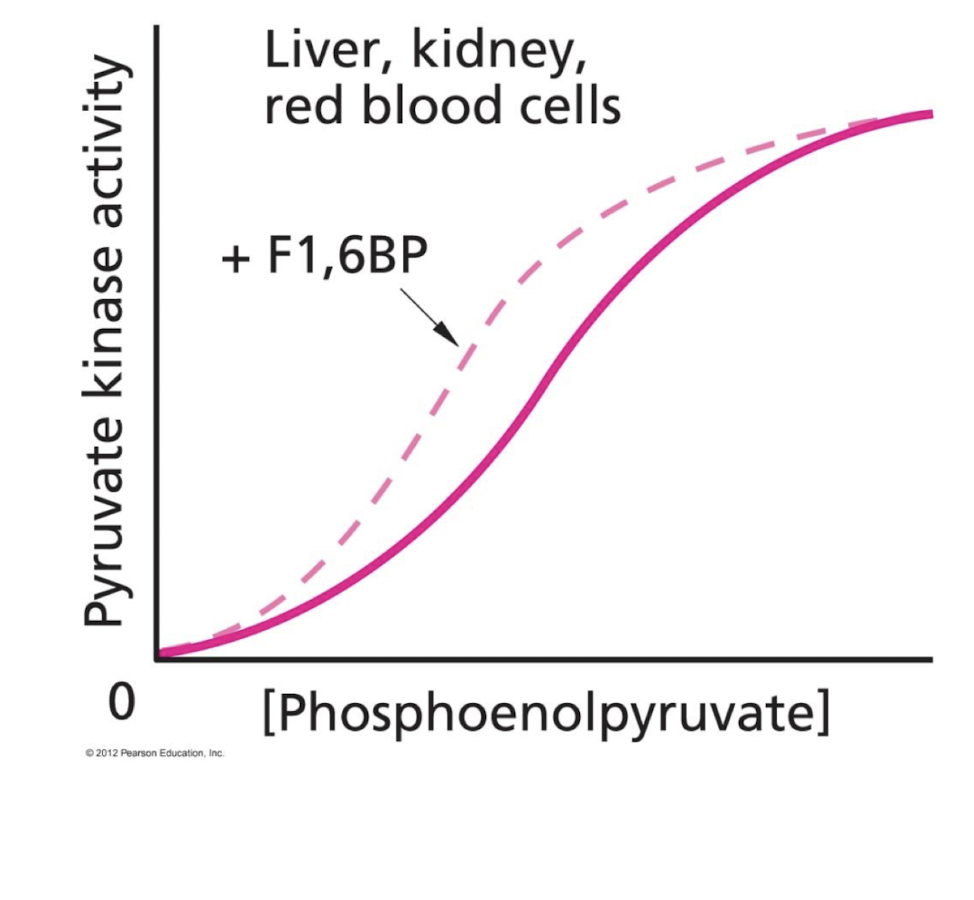
Describe a graph of PEP concentration vs pyruvate kinase activity. How does this change if F-1,6-BP is added?
Graph: sigmoidal (PEP is a homoallosteric activator of pyruvate kinase)
With F,-1,6-BP: allosteric activator → increases F6P affinity, graph shifts left
Which glycolysis enzymes will have quaternary structure? Why?
PFK-1, pyruvate kinase. Allosteric enzymes must have more than 1 binding site
How is glycolysis synchronously regulated? What reactions and which substrates are responsible?
Starting and ending reaction are both inhibited by the same product, allowing flow of intermediates to occur.
PFK-1 (committing step of glycolysis → regulated “starting” reaction even if not #1) and pyruvate kinase are both inhibited by high levels of ATP
How can ATP be an inhibitor of PFK-1 if it is also a substrate of the reaction?
There are two binding sites on PFK-1: a substrate binding site (carries out ATP investment step) that is high affinity and an allosteric inhibitor site that is low affinity. The substrate binding site will bind to ATP even at low concentrations of ATP due to its affinity, while the allosteric inhibitor site will only start binding upon high (excess) concentrations of ATP
What are the fates of pyruvate in cells within aerobic and anaerobic conditions? Where do they subsequently get used?
Anaerobic: produces lactate → used in rapidly contracting cells and erthrocytes as fuel + regenerates NAD+
Aerobic: produces acetyl CoA → used in CAC and oxidative phosphorylation to generate large amounts of ATP
What does glycolysis need as a coenzyme in order to keep occurring that must be regenerated? How is it regenerated? To which enzyme does it go to?
NAD+ needed to be reduced into NADH → needs to be reoxidized.
Oxidative phosphorylation regenerates NAD+ by oxidizing NADH for high energy electrons at the ETC
Pyruvate reduction in anaerobic conditions (ethanol and lactate formation) are anabolic reactions that oxidize NADH as a cofactor into NAD+
NAD+ goes to GAPDH which will catalyze the formation of 1,3-BPG
How does the role of lactate differ in aerobic and anaerobic cell conditions?
Anaerobic: lactate produced from pyruvate in order to regenerate NAD+ for glycolysis to continue (glycolysis is the main way to create ATP)
Aerobic: lactate converted back to pyruvate in order to be used as a fuel (used to create ATP)
Explain how lactate is produced including reactants products and cofactors, enzymes, and conditions necessary.
Under anaerobic conditions, pyruvate is reduced via the oxidation of NADH as a cofactor to yield lactate and NAD+, catalyzed by pyruvate dehdyrogenase. The reaction is anabolic.
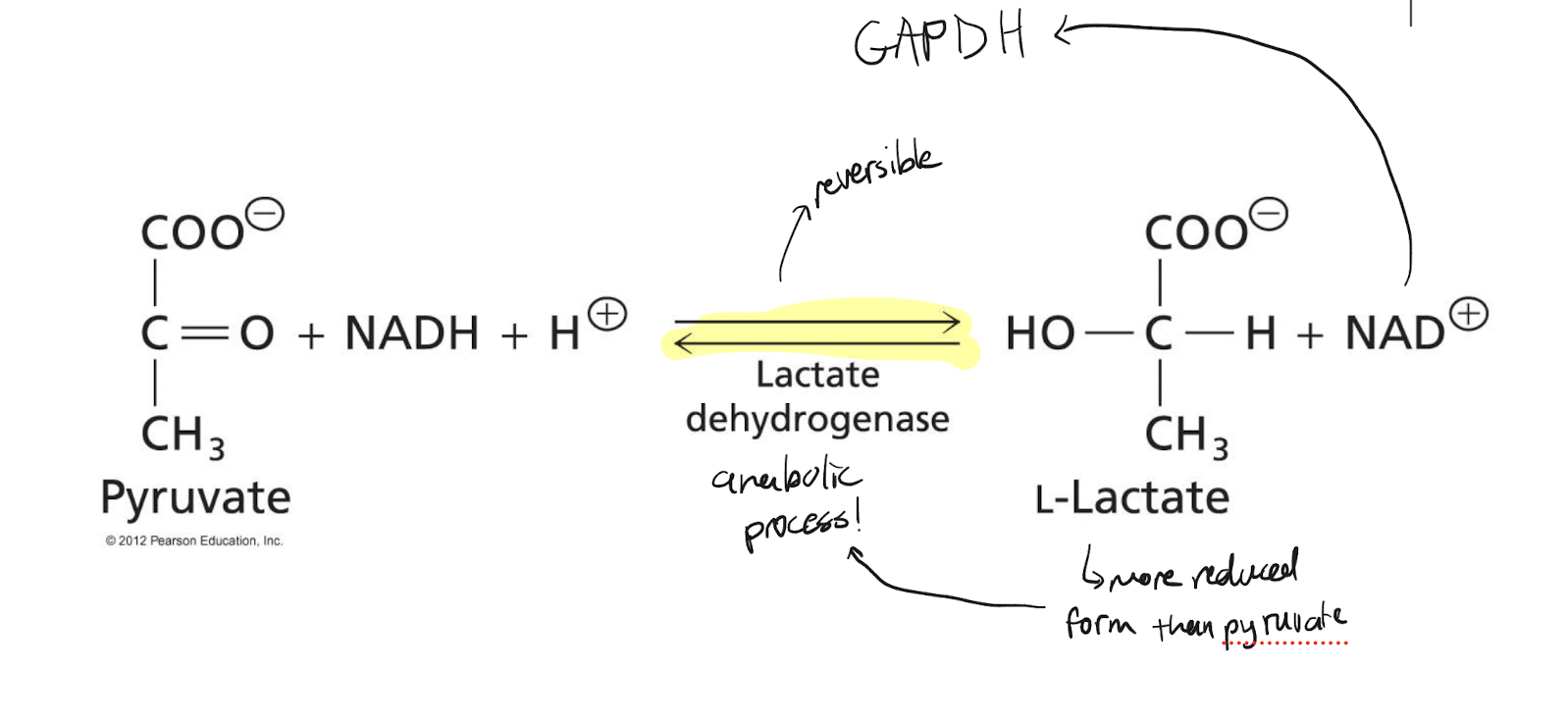
How is it ensured that the forward reaction of pyruvate reduction to lactate is favoured in anaerobic conditions? Explain the process and how it affects the pH of muscle and blood.
Lactate is a “dead-end” product because it cannot be consumed as fuel under anaerobic conditions, it must be exported out of the muscle cell in order to ensure the equilibrium stays forward.
A plasma membrane symporter exports protons and lactate out of the muscle (protons need to be exported from muscle because excess proton concentration can be damaging). As a result, the pH within muscle cells is slightly higher relative to in the blood
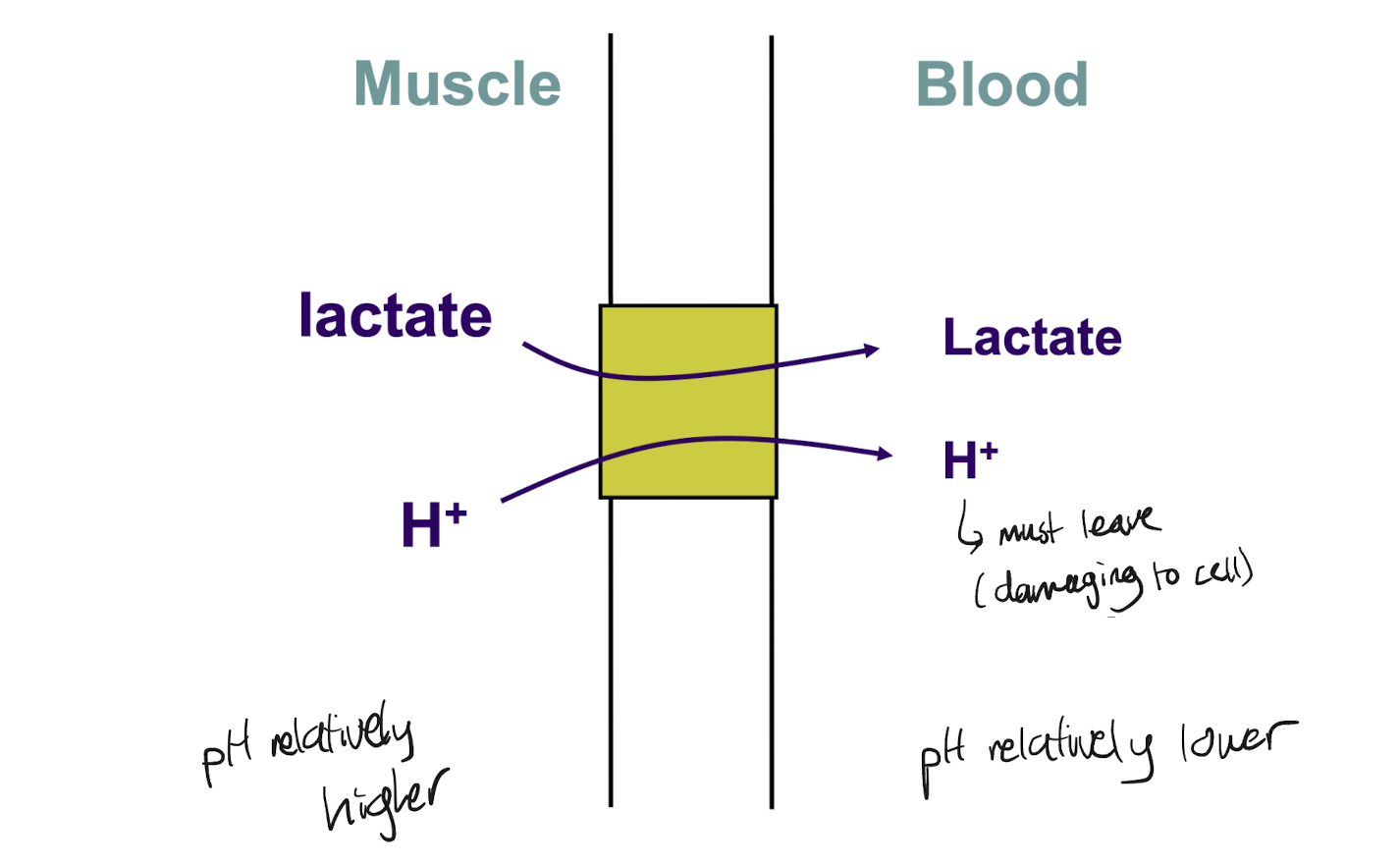
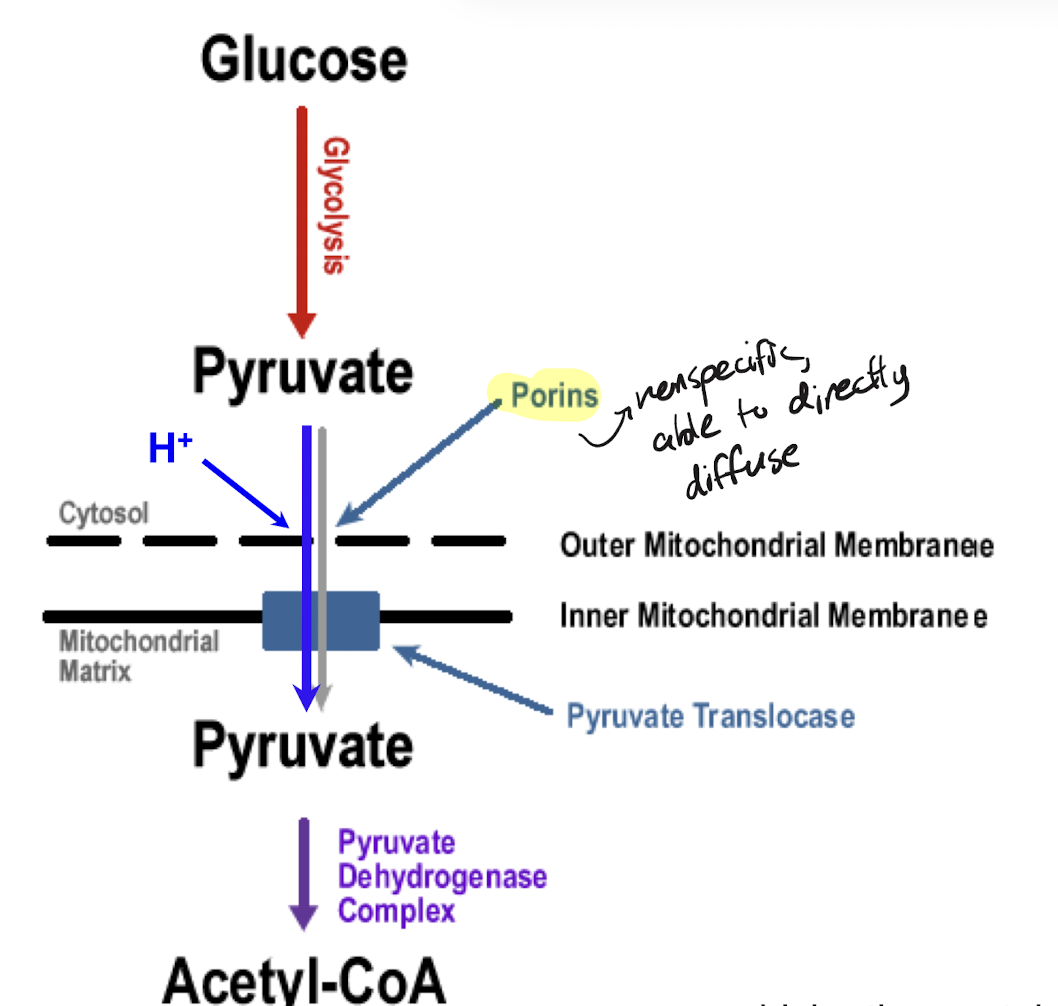
Describe how pyruvate is transported into the mitochondrial matrix to be converted to acetyl CoA.
Glycolysis in the cytosol creates pyruvate, which enters the outer mitochondrial membrane via unspecific porin. Pyruvate translocase moves the pyruvate into the inner mitochondrial membrane, where in the matrix pyruvate dehydrogenase complex is found
Why can the citric acid cycle not occur anaerobically?
PDC requires oxygen to function, so the linking reaction between glycolysis and CAC cannot happen anaerobically
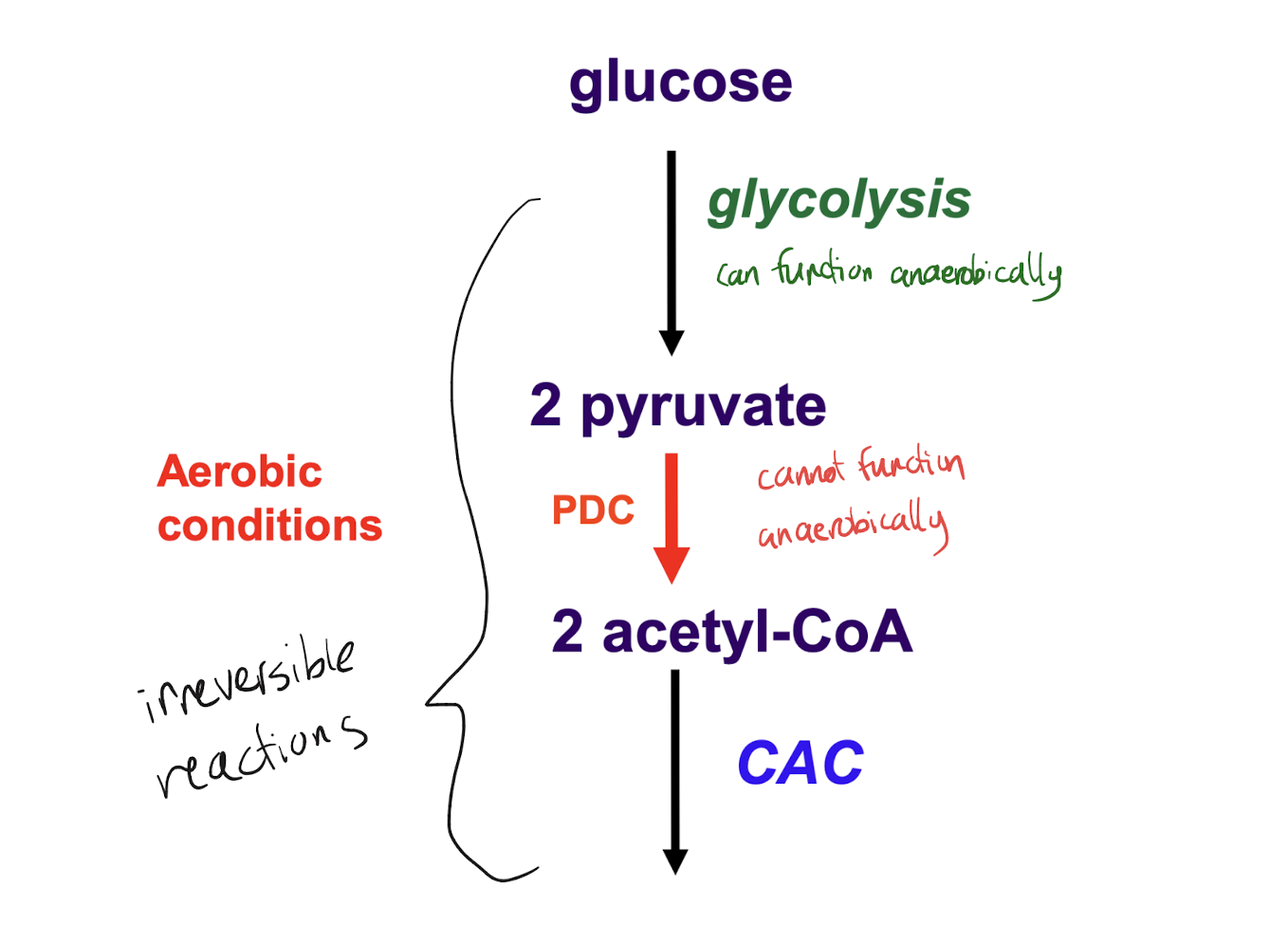
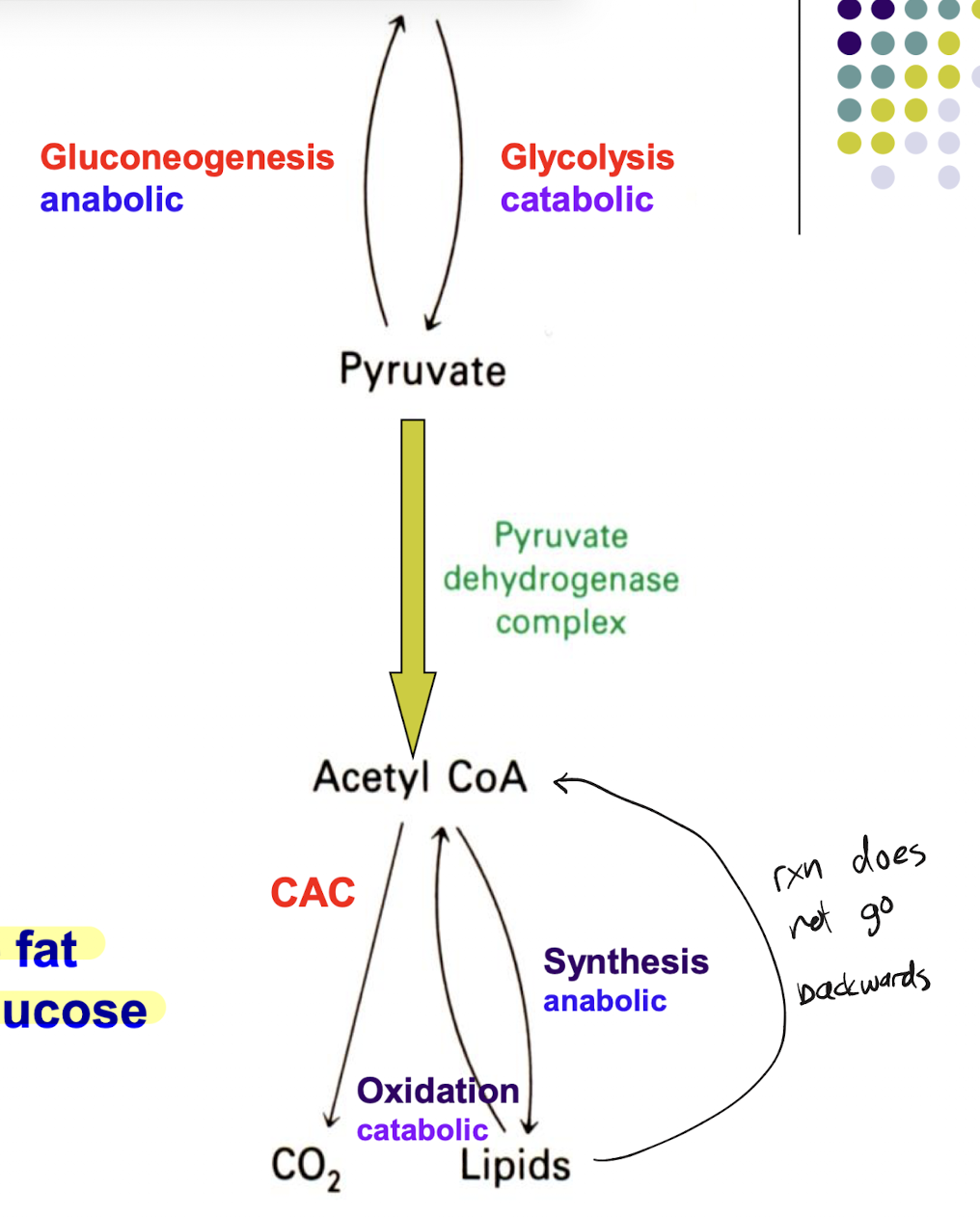
Glucose (can/cannot) be used to make fats, fats (can/cannot) be used to make glucose. Explain.
Can, cannot. Carbohydrate metabolism is irreversible due to the pyruvate dehydrogenase reaction being irreversible. Thus, once glucose is metabolized to acetyl CoA, the fats that are produced from acetyl CoA can no longer be reversibly made into glucose
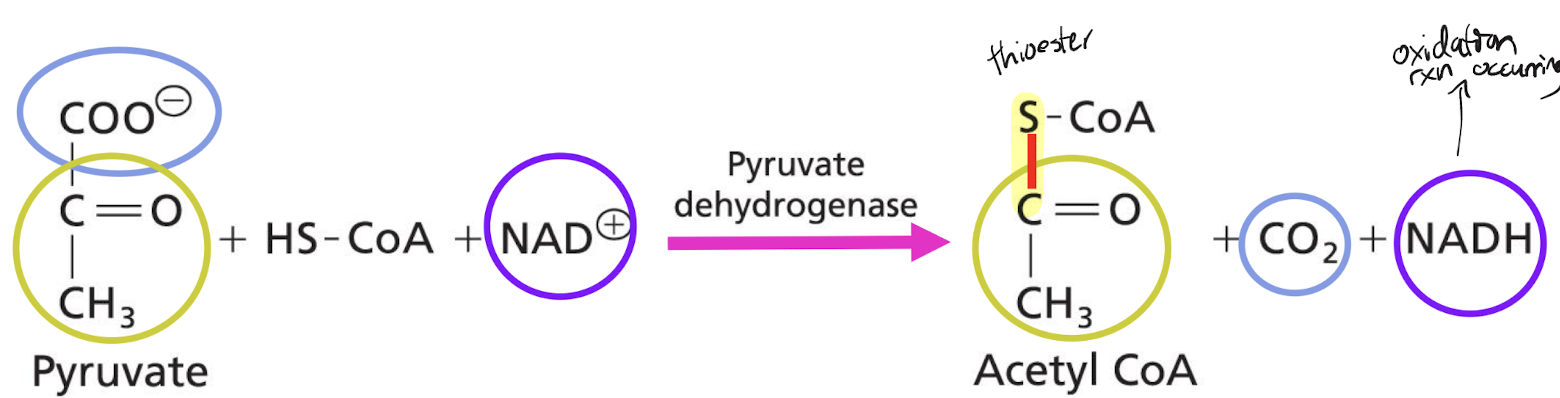
Explain the events of the pyruvate dehydrogenase reaction, including functional groups. Which cofactors does PDC need?
Decarboxylation: an enzyme of the PDC removes the carboxyl group off of pyruvate, giving CO2 as a product and leaving an acetate group
Oxidation: as the carboxyl leaves pyruvate, the molecule becomes oxidized and donates its electrons to NAD+, forming NADH
Transacetylation: the acetate forms a thioester bond with coenzyme A, generating acetyl CoA as a high energy intermediate
5 cofactors including CoA for transacetlyation and NAD+ for oxidation
How is the pyruvate dehydrogenase complex regulated directly? Explain, using enzymes and reactions.
Via covalent modification: phosphorylation of the complex when energy levels are high switches it off
At high energy levels, pyruvate dehydrogenase kinase phosphorylates the complex to switch off the activity of the complex
At low energy levels, pyruvate dehydrogenase phosphatase dephosphorylates the complex to activate the complex
How is the pyruvate dehydrogenase complex regulated indirectly? Explain, using activators and inhibitors.
Ca2+: allosteric activator of PDH phosphatase → indirectly activates the PDC
Acetyl CoA and NADH: allosteric activators of PDH kinase → indirectly inhibits the PDC (products of PDC/indicators that the system is at high energy)
Pyruvate, NAD+, CoA: allosteric inhibitors of PDH kinase → indirectly activates the PDC (substrates of PDC/indicators that system is at low energy)
ADP: allosteric inhibitor of PDH kinase → indirectly activates the PDC (indicative of activity/active hydrolysis of ATP, low system energy/energy needed)
How does the NAD+/NADH ratio determine the activity of the PDC?
High ratio = higher NAD+ concentration → more substrate present, system at low energy (high activity) → inhibits PDH kinase → activates PDC
Low ratio = higher NADH concentration → more product present, system at high energy (low activity) → activates PDH kinase → inhibits PDC
How does the CoA/Acetyl-CoA ratio determine the activity of the PDC?
High ratio = higher CoA concentration → more substrate present, system at low energy (high activity) → inhibits PDH kinase → activates PDC
Low ratio = higher acetyl-CoA concentration → more product present, system at high energy (low activity) → activates PDH kinase → inhibits PDC
What is lactate used for in aerobic conditions?
Metabolic fuel for aerobic tissue: can be reversibly catabolized back into pyruvate in aerobic conditions. Exported out of anaerobic cells and into aerobic cells