mince sec 2
 Call Kai
 Learn
Learn Practice Test
 Spaced Repetition
 Match
Match Flashcards
 Knowt Play
1/47

Earn XP
Description and Tags
mic. growth
Name | Mastery | Learn | Test | Matching | Spaced | Call with Kai | Chat |
|---|
No analytics yet
Send a link to your students to track their progress
48 Terms
simple pre review flow
what determines if a bacteria can function —→ quoroum sensing
six topics
Physical requirements |
Chemical/nutritional requirements |
Oxygen requirements |
Reproduction & growth curves |
Endospores |
Biofilms & quorum sensing |
Environment + nutrients determine whether a bacterium can function → favorable conditions allow metabolism and binary fission → populations grow exponentially → resources become limiting → stationary/death phase → some bacteria survive harsh conditions by forming endospores → bacteria can also organize into biofilms → quorum sensing coordinates group behavior.
Topic | Main question |
|---|---|
Physical requirements | What temperature, pH, and water conditions allow growth? |
Chemical/nutritional requirements | What materials and energy sources does a bacterium need? |
Oxygen requirements | Can the bacterium tolerate/use O₂ and its toxic byproducts? |
Reproduction & growth curves | How do bacteria divide and how does a population change over time? |
Endospores | How do some bacteria survive when conditions become terrible? |
Biofilms & quorum sensing | How do bacteria live and coordinate behavior as communities? |
topic 1: physical requirements
temperature (5 types and their optimum temps)
why does temp matter? flow too hot vs cold
most human pathogens are ?
can refrigeration/ freezing sterilize the food?
which one would survive refrigerator human intestinal pathogens vs soilbrone pathogens?
Ph (4 types )
why does ph matter?
why do we need buffer for bactrial media?
lab example? flow
water/ osmosis
Term |
|---|
Diffusion |
Osmosis |
Osmotic pressure |
Isotonic |
Hypotonic environment |
Hypertonic environment |
Plasmolysis |
Water activity |
Halophile |
Halotolerant |
groups these as temperature, pH, and osmotic pressure.
A. Temperature
Every species has a minimum, optimum, and maximum growth temperature. The optimum is where it divides fastest. This reflects evolutionary adaptation of enzymes, proteins, and membrane lipids to particular temperatures.
Term | Meaning | Approximate optimum/range | Important connection |
|---|---|---|---|
Psychrophile | Cold-loving | Best roughly 0–15°C | Adapted to genuinely cold environments |
Psychrotroph | Can grow at refrigerator temperatures but prefers somewhat warmer temperatures | ~4–25°C | Important in refrigerated food spoilage |
Mesophile | Moderate-temperature organism | ~20–45°C | Most human pathogens are mesophiles because the body is ~37°C |
Thermophile | Heat-loving | >50°C | Hot springs, hot environments |
Hyperthermophile | Extremely heat-loving | Very high temperatures | Some tolerate temperatures approaching boiling |
OpenStax makes the psychrophile vs psychrotroph distinction explicit, which is useful because psychrotroph appears as one of the professor's iClicker choices.
why does temp matter:
It is not simply that bacteria “like” certain temperatures.
Environmental temperature → selection for proteins/enzymes that function there + membrane lipids that maintain proper fluidity → organism grows best in that temperature range.
Too cold → reactions and membrane movement become too slow/rigid.
Too hot → proteins and other macromolecules lose function and membranes become excessively fluid.
High-yield professor points
Most human pathogens = mesophiles.
Refrigeration/freezing → slows microbial growth; it does NOT reliably sterilize food. The professor specifically emphasizes that bacteria present before refrigeration may still be there afterward.
That gives the reasoning for Critical Thinking #1:
Human intestinal pathogen → adapted near 37°C.
Soilborne plant pathogen → exposed to a much wider range of environmental temperatures.
Therefore, the soilborne plant pathogen would theoretically be more likely to grow at refrigerator temperature, because environmental organisms are more likely to have adaptations for lower temperatures.
2. pH
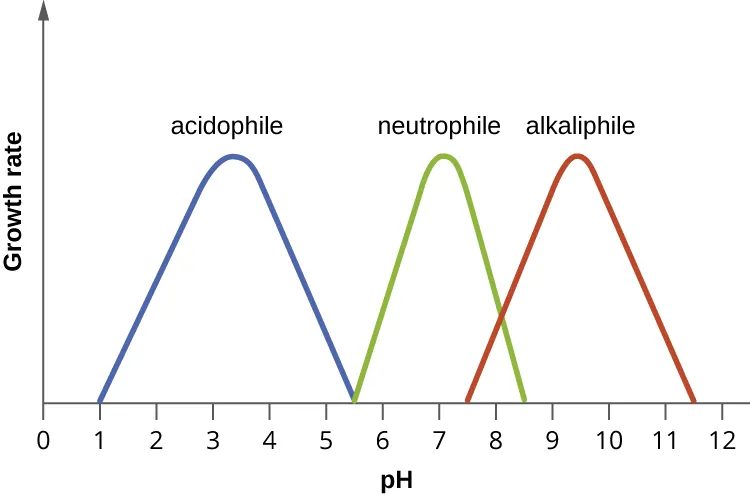
Most bacteria in this course prefer approximately neutral pH, around 6.5–7.5. Acidic conditions therefore inhibit many bacteria, which is why acidification can preserve food.
Term | Meaning |
|---|---|
Neutrophile | Grows best near neutral pH |
Acidophile | Grows best at acidic pH |
Alkaliphile | Grows best at basic/alkaline pH |
Buffer | Resists changes in pH |
OpenStax adds that acidophiles may have optima around pH 3, whereas alkaliphiles can grow optimally around pH 8–10.5.
Why does pH matter?
Bacteria carry out thousands of enzyme-mediated reactions. Enzymes depend on proper charge and shape.
pH moves too far from optimum → protein interactions/enzymes are disrupted → metabolism slows → growth stops.
Bacteria can also produce acid themselves during metabolism. If enough acid accumulates, they can inhibit their own growth, which is why bacterial media may contain buffers.
Phenol red broth — useful lab connection
The professor spends time on this because it will come back in lab:
Sugar in medium → bacterium ferments sugar → acidic products form → pH drops → phenol red turns yellow.
A Durham tube is the small inverted tube that can trap gas produced during fermentation.
So if she sees:
yellow broth → acid was produced → carbohydrate fermentation occurred
and
bubble in Durham tube → gas was produced.
3. Diffusion, osmosis, osmotic pressure & water activity
This section becomes much easier if she keeps solute movement separate from water movement.
Term | Correct meaning |
|---|---|
Diffusion | Net movement of particles from high → low concentration |
Osmosis | Diffusion of water across a selectively permeable membrane |
Osmotic pressure | Pressure generated because water is moving due to a solute concentration difference |
Isotonic | Similar effective solute concentration inside/outside → no net water movement |
Hypotonic environment | Less solute outside → water moves into cell |
Hypertonic environment | More solute outside → water moves out of cell |
Plasmolysis | In a walled cell, water loss in a hypertonic environment causes the plasma membrane to contract away from the wall |
Water activity | Amount of water available to microorganisms for growth |
Halophile | Requires/loves high salt |
Halotolerant | Does not require high salt but can tolerate it |
OpenStax's description is the cleanest conceptual rule:
water moves from the side with lower solute concentration / more available water → toward the side with higher solute concentration / less available water.
Important terminology correction
For bacterial cells:
Hypotonic outside → water enters → cell wall helps prevent bursting.
Hypertonic outside → water exits → cell dehydrates/plasmolyzes.
That is the correct distinction. OpenStax explicitly shows the bacterial wall protecting against swelling in a hypotonicenvironment and plasmolysis occurring in a hypertonic environment
Halophile vs halotolerant
Halophile = needs a salty environment.
Halotolerant = can tolerate salt but does not require it.
The professor uses skin staphylococci as examples of organisms that tolerate the salty skin environment

Why salt and sugar preserve food
This is Critical Thinking #2, and the professor specifically requires the phrase water activity.
The full-credit reasoning should be:
add lots of salt/sugar → outside becomes hypertonic → water moves out of microbial cells → cells dehydrate → available water/water activity decreases → bacteria cannot grow/divide efficiently → food is preserved.
4. Chemical and nutritional requirements
their energy source , carbon source and examples
Organism type |
|---|
Photoautotroph |
Chemoautotroph |
Chemoheterotroph |
Bacteria also need carbon, major elements, trace elements, and appropriate energy sources.
Nutritional terminology
The easiest way to decode these words is:
photo = light
chemo = chemical
auto = self / carbon from CO₂
hetero = other / carbon obtained from organic material
Organism type | Energy source | Carbon source | Example/concept |
|---|---|---|---|
Photoautotroph | Light | CO₂ | Cyanobacteria, plants |
Chemoautotroph | Inorganic chemicals | CO₂ | Some bacteria near hydrothermal vents |
Chemoheterotroph | Chemical compounds/organic matter | Organic carbon such as glucose | Humans and most pathogens |
The professor emphasizes that most bacteria discussed in medical microbiology are chemoheterotrophs.
Critical Thinking #5
Photoautotroph: uses light for energy and CO₂ as its carbon source.
Chemoheterotroph: obtains energy and carbon from organic chemical compounds, such as glucose.
Do not answer merely “one uses light and one uses chemicals”; she should mention the carbon source too.
5. CHNOPS and trace elements
does an organism only need energy / carbon source?
fastidious organism
CHNOPS = Carbon, Hydrogen, Nitrogen, Oxygen, Phosphorus, Sulfur.
Element | Major uses to remember |
|---|---|
C, H, O | Major components of organic molecules |
N | Proteins and nucleic acids |
P | Nucleic acids, phosphates |
S | Some amino acids/proteins and vitamins |
Trace elements | Needed in tiny quantities, often as enzyme cofactors |
Iron and zinc are examples of trace elements mentioned by the professor. A bacterium therefore needs not only an energy/carbon source, but also the elements necessary to construct cellular components and run enzymes.
A fastidious organism has additional nutritional requirements because it cannot synthesize certain compounds itself, so those nutrients must be supplied in its medium.
6. Oxygen: useful but dangerous
dangers flow
enzymes that could be protective
catalase vs peroxidase relation to peroxide
relation w/ O2 , growth pattern in gradient tube
Type |
|---|
Obligate aerobe |
Obligate anaerobe |
Facultative anaerobe |
Aerotolerant anaerobe |
Microaerophile |
connects oxygen tolerance to reactive oxygen species (ROS).
Using oxygen can generate damaging molecules such as superoxide radicals and hydrogen peroxide. If they are not neutralized, they can damage proteins, DNA, and membranes.
Detoxification flow
O₂ metabolism → superoxide radical (O₂⁻) → superoxide dismutase (SOD) converts it → H₂O₂ → catalase or peroxidase removes H₂O₂
Toxic molecule | Protective enzyme |
|---|---|
Superoxide radical | Superoxide dismutase (SOD) |
Hydrogen peroxide | Catalase and/or peroxidase |
OpenStax specifies that catalase converts H₂O₂ into water and oxygen, whereas peroxidases reduce peroxide using an electron donor such as NADH.
Oxygen categories
Type | Relationship with O₂ | Growth pattern in oxygen-gradient tube |
|---|---|---|
Obligate aerobe | Requires O₂ | At the top |
Obligate anaerobe | O₂ is harmful | At the bottom / away from O₂ |
Facultative anaerobe | Can grow without O₂ but grows better with it | Throughout tube, heaviest at top |
Aerotolerant anaerobe | Does not use O₂ but tolerates it | Fairly even throughout |
Microaerophile | Requires a small amount of O₂, less than atmosphere | Band slightly below top |
The professor explicitly connects these patterns to whether organisms possess enzymes that detoxify oxygen-derived radicals.
Most important distinction
Facultative anaerobe: oxygen helps it; it grows better with O₂.
Aerotolerant anaerobe: oxygen does not help it; it merely tolerates O₂.
Critical Thinking #3: Phagocytic cells ingest and sequester pathogens into a structure called a “phagolysosome” which contains singlet oxygen and superoxide radicals (among other molecules). Explain how this immune system strategy works against pathogens. What type of bacteria would you expect to be most vulnerable to oxygen radicals?
Phagocytes engulf bacteria and expose them to reactive oxygen species.
Pathogen engulfed → ROS such as superoxide generated → ROS attack DNA/proteins/membranes → pathogen damaged/killed.
The bacteria most vulnerable would be organisms that cannot detoxify ROS, particularly obligate anaerobes, which generally lack sufficient SOD/catalase/peroxidase defenses.
Binary fission
Bacteria reproduce asexually by binary fission.
This is also the type of division associated with mitochondria and chloroplasts, supporting their bacterial ancestry through endosymbiosis.
Four-step version she should know
1. Cellular contents/DNA are duplicated → 2. Cell elongates and chromosomes move toward opposite ends → 3. Plasma membrane pinches inward and new cell wall/septum forms → 4. Two daughter cells separate.
So Critical Thinking #4:
bacterial cell grows → DNA copies → FtsZ forms Z ring on the cytoplasmic membrane → cell pinches inward → septum forms → binary fission → two daughter cells

8. Generation time and logarithmic growth
Generation time = time required for a bacterial population to double.
Because every cell can divide:
1 → 2 → 4 → 8 → 16 → 32 → 64...
So population growth is exponential/logarithmic, not additive. The professor notes that some bacteria can double in around 20 minutes, although many take longer.
The useful equation is:
N=N0(2n)
where N0 is starting cells and n is number of generations.
Example:
1 cell after 10 generations → 1×210=1,024 cells.
Linear graph vs semilog graph
On a normal graph, exponential growth curves sharply upward.
On a semilog graph, exponential/log growth appears as a straight rising line because the population axis is logarithmic. The professor explicitly explains this distinction.
One Log Axis: Usually, the vertical axis ( y 𝑦 -axis) is logarithmic (values grow by powers like 1 0 1 , 1 0 2 , 1 0 3 ), and the horizontal axis ( x 𝑥 -axis) is linear (evenly spaced numbers like 1 , 2 , 3 ). This is called a log-linear plot
9. Bacterial growth curve
most important table in chapter
Phase | What cells are doing | Population change | Why |
|---|---|---|---|
Lag phase | Highly metabolically active; adjusting, repairing, making enzymes/proteins | Little/no population increase | Preparing to divide |
Log / exponential phase | Rapid binary fission | Exponential increase | Resources plentiful, conditions favorable |
Stationary phase | Some divide while others die | Dividing = dying | Nutrients decrease, waste accumulates, O₂ may become limiting |
Death / decline phase | Death exceeds division | Population decreases | Severe nutrient depletion/toxic waste |
The professor's slides specifically test:
“significant metabolic activity but little cell division” → lag phase
and
“number dying = number dividing” → stationary phase.
OpenStax adds a useful application: cells in log phase are often particularly susceptible to antibiotics that interfere with actively occurring processes such as cell-wall, DNA, or protein synthesis. Stationary-phase cells have shifted toward survival physiology and are often less susceptible.


Critical Thinking #6 when is bacterial growth logarithmic
Bacteria exhibit logarithmic growth when conditions favor repeated rapid division:
adequate nutrients + suitable temperature/pH/water/O₂ conditions → regular binary fission → 1 → 2 → 4 → 8 → 16…
Once resources become limiting, they leave log phase and approach stationary phase.

10. Endospores
Binary fission vs endospore
Vegetative cell vs endospore table (6)
sporulation
germination
This is a crucial distinction:
Binary fission = reproduction.
Endospore formation = survival. Endospores — survival, NOT reproduction
Some Gram-positive bacteria form endospores when conditions become unfavorable, particularly when nutrients are depleted. Endospores are dehydrated, dormant, metabolically inactive and extremely resistant.
Vegetative cell vs endospore
Vegetative cell | Endospore |
|---|---|
Metabolically active | Metabolically dormant |
Growing/dividing | Not growing/dividing |
Normal water content | Highly dehydrated |
Relatively sensitive to heat/radiation/chemicals | Highly resistant |
Normal bacterial state | Survival state |
Can perform binary fission | Cannot reproduce while dormant |
Sporulation
Nutrients become depleted → chromosome duplicated → asymmetric division creates a forespore → forespore becomes surrounded by additional membrane → cortex + tough protein spore coat develop → mother cell breaks down → mature endospore remains.
Terminology:
Forespore = developing spore compartment.
Endospore = mature dormant survival structure.
The spore contains a protected core containing the bacterial genome, surrounded by protective layers including the cortex and spore coat. Ordinary Gram staining does not stain endospores well; the lecture mentions malachite green as the special spore stain.
Germination
When favorable conditions return:
endospore → germinates → vegetative cell → metabolism and division resume.
That is exactly why germinate matters in Critical Thinking #7.
Clinically important spore-formers
Genus/species | Disease association |
|---|---|
Clostridium tetani | Tetanus |
Clostridium botulinum | Botulism |
Clostridium perfringens | Gas gangrene |
Bacillus anthracis | Anthrax |
OpenStax confirms clinically important endospore-forming organisms are predominantly Gram-positive Bacillus and Clostridium/Clostridioides species.
The professor also specifically connects honey → C. botulinum spores → infant botulism risk
endospores and what they do?
important for ? and disease like?
found in eukary vs prokary
is it reporduction
flow chart (endospore —> germination quick view)
why they make endospores ? and how it helps (5)
describe these
Term |
|---|
Vegetative cell |
Sporulation |
Endospore |
Germination |
sporulation flow chart
germination flow chart
who makes it? a few examples
lab connection? lab 7 (hint staining)
flow chart for lab
summary note
Endospore = a tough, dormant (dormir = sleeping state ) survival structure that preserves DNA made by some bacteria when conditions get bad.
Important for sterilization and diseases like anthrax/tetanus/botulism
p: Some bacteria make them
e: No true bacterial-type endospores
Endospore is NOT reproduction.
One bacterial cell makes one endospore, and later that endospore becomes one bacterial cell again.
Flow:
bad conditions → bacterium forms endospore → cell becomes dormant/resistant → conditions improve → germination → active bacterial cell returns
They form when there is stress like:
Stress | Why endospore helps |
|---|---|
Low nutrients | waits until food returns |
Heat | resists damage |
Drying/desiccation | protects DNA |
Chemicals/disinfectants | harder to kill |
Radiation | better DNA protection |
Important terms
Term | Meaning |
|---|---|
Vegetative cell | normal active growing bacterial cell |
Sporulation | process of forming an endospore |
Endospore | dormant resistant survival form |
Germination | endospore returns to active cell |
Sporulation flow chart
normal vegetative cell → stress/nutrient depletion → DNA copied → spore forms inside cell → tough spore coat develops → original cell breaks down → mature endospore released
Germination flow chart
favorable conditions return → endospore senses nutrients → spore coat opens/changes → water enters → metabolism restarts → vegetative cell grows again
Who makes them?
Mostly clinically important Gram-positive bacteria, especially:
Genus | Disease example |
|---|---|
Bacillus | Bacillus anthracis → anthrax |
Clostridium | C. tetani → tetanus |
Clostridium | C. botulinum → botulism |
Clostridium perfringens | gas gangrene |
Clostridioides difficile | pseudomembranous colitis / C. diff infection |
OpenStax specifically lists clinically important endospore-forming Gram-positive bacteria in Bacillus and Clostridium, including these examples.
Lab connection
Acid-fast/Endospore stains — Lab 7, so she should know endospores are hard to stain because of their tough structure.
Endospore stain idea:
heat helps stain enter endospore → endospore holds primary stain → vegetative cell takes counterstain → endospore and cell appear different colors
Clean note-card
Endospores are dormant, highly resistant survival structures made by some bacteria, especially Bacillus and Clostridium, during harsh conditions. They are not reproductive spores. When conditions improve, they germinate back into active vegetative cells.

11. Critical Thinking #8 — 250-million-year-old salt crystal
For the logic the professor is looking for:
A viable dormant bacterial form was recovered from the ancient salt crystal → extreme dehydration/nutrient deprivation would prevent ordinary vegetative growth → an endospore can preserve the genome in a metabolically dormant, highly resistant form for extremely long periods → once placed in favorable laboratory conditions, it can germinate.
For the course framing, she would predict Gram-positive, because the major bacterial endospore-formers discussed in class are Gram-positive.
The lecture itself presents the ancient-isolate claim and also notes that there is scientific controversy surrounding it, so she should treat “250 million years” as the setup of the question rather than as something she needs to prove independently.
12. Critical Thinking #12 — why tetanus is associated with puncture wounds
what is obligate Anaerobiosis ?
This question combines endospores + oxygen requirements.
C. tetani is an endospore-forming obligate anaerobe.
Superficial cut → exposed to atmospheric O₂ → unfavorable for vegetative C. tetani growth.
Deep puncture wound → damaged tissue/deeper region with little O₂ → endospore can germinate → vegetative C. tetani grows → toxin can be produced.
So the key characteristic explaining the pattern is obligate anaerobiosis, aided by the organism's ability to survive outside those conditions as an endospore. The question appears explicitly in the professor's critical-thinking set.
13. Quorum sensing — bacteria measuring population density
Quorum sensing is cell-to-cell chemical communication that allows bacteria to coordinate gene expression based on population density.
The signal molecules are called autoinducers.
Core mechanism
Few bacteria → each releases autoinducer → signal concentration stays low → threshold not reached → group genes remain off
then:
population grows → many cells release autoinducer → autoinducer accumulates → threshold (“quorum”) reached → autoinducer binds receptors → signaling alters gene expression → many bacteria activate the same behavior together.
Examples from the lecture include:
bioluminescence, virulence-factor production, motility, competence, conjugation, sporulation, and biofilm-related behaviors.
Bioluminescence: One of the earliest discovered examples (in Vibrio fischeri), where bacteria light up only when crowded, such as inside the light organ of a bobtail squid.
Virulence-factor production: Pathogens hold off on releasing damaging toxins until their numbers are large enough to overwhelm a host's immune system.
Motility: Swimming or swarming behaviors are often coordinately regulated to help bacterial communities spread or migrate to better environments.
Competence: The ability to take up DNA from the environment (genetic transformation) is turned on at high densities to share useful traits.
Conjugation: Plasmid transfer and bacterial "mating" can be density-dependent, helping spread traits like antibiotic resistance through the community.
Sporulation: Turning into resilient spores is a group decision when resources run low and population density peaks.
Biofilm-related behaviors: Building, maintaining, and dispersing from protective slime matrices rely heavily on shared chemical signals
OpenStax adds the molecular distinction:
Gram-negative bacteria → commonly use acyl-homoserine lactone signals.
Gram-positive bacteria → commonly use small peptide signals.
She probably does not need those molecule names unless the professor asks beyond the lecture, but she should absolutely know autoinducer → threshold → altered gene expression.
Critical Thinking #10: P. aeruginosa is an opportunistic pathogen that produces extracellular proteases only when its cell density is high. What do we call this type of cellular communication? (a full credit answer will require a sentence or two to describe the process)
If P. aeruginosa only produces extracellular proteases when cell density becomes high:
cells produce autoinducers → bacterial population increases → autoinducer concentration reaches threshold → signal is detected → protease genes are turned on throughout the population.
That process is quorum sensing.
EPS
what it is?
is it sugar protein or lipid or mixed?
why it matters?
function? (5)
EPS vs capsule vs slime layer
flow
why important medically? flow?
efflux pumps and EPS flow
Extracellular polymeric substance
EPS is the sticky extracellular polymeric substance matrix secreted by bacteria in biofilms. It helps bacteria attach, stay hydrated, communicate, form structured communities, and resist antibiotics and immune defenses.
EPS = extracellular polymeric substances.
It is the sticky hydrated gel/matrix that bacteria secrete in a biofilm.
It is mostly polysaccharides, but can also contain proteins, nucleic acids/DNA, and lipids.
OpenStax says EPS makes up a large part of the biofilm matrix and helps maintain biofilm structure and function.
EPS = the “glue + shield” of a biofilm
Flow:
free-floating bacteria → attach to surface → secrete EPS → cells stick better → biofilm forms → protected bacterial community
Function | Meaning |
|---|---|
Adhesion | helps bacteria stick to tissues, teeth, catheters, surfaces |
Biofilm structure | holds cells together in a matrix |
Hydration | keeps cells from drying out |
Protection | blocks immune cells, predators, disinfectants, antibiotics |
Channels | allows nutrients, gases, and waste to move through biofilm |
OpenStax notes EPS channels allow movement of nutrients, waste, and gases, while also keeping cells hydrated and sheltering them from predators like protozoa or white blood cells
EPS vs capsule vs slime layer
Glycocalyx = general outer sticky coating.
Capsule = organized, firmly attached glycocalyx.
Slime layer = loose, messy glycocalyx.
EPS = extracellular polymeric matrix especially important in biofilms.
flow:
bacteria attach → EPS production increases → cells become sessile/stuck → biofilm matures → water channels form → cells communicate by quorum sensing → some cells disperse to colonize new sites
medically important
EPS protects bacteria inside biofilms, so infections on things like catheters, implants, teeth, or tissues can be harder to clear.
flow:
biofilm EPS barrier → antibiotic penetration reduced → immune cells struggle to reach bacteria → slow-growing cells survive → infection persists
OpenStax specifically connects EPS in biofilms with protection from the immune system and antibiotic treatments.
Efflux pumps also matter in biofilms. OpenStax says biofilm-associated bacteria can show increased efflux pump production, which helps explain why biofilms resist antibiotics better than free-floating bacteria.
flow:
biofilm forms → EPS slows antibiotic diffusion → cells change behavior → efflux pumps increase → antibiotics pumped out → infection persists
So the idea is not that the inhibitor kills the bacterium by itself. It helps the antibiotic work better.

14. Biofilms
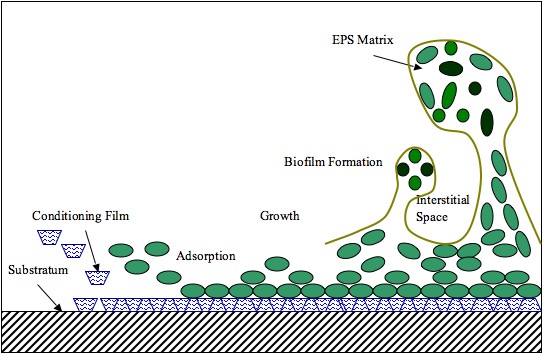
A biofilm is an organized community of microorganisms attached to a surface and embedded in an EPS (extracellular polymeric substance) matrix.
Surfaces can be living or nonliving: teeth, catheters, contact lenses, shower curtains, implants, natural aquatic surfaces, etc.
Term | Meaning |
|---|---|
Planktonic cell | Free-living/free-floating microbial cell |
Sessile cell | Attached, surface-associated cell |
Biofilm | Community of attached microorganisms embedded in a matrix |
EPS | Extracellular polymeric substance forming the biofilm matrix/slime |
Quorum sensing | Chemical communication that allows population-density-dependent coordination |
Autoinducer | Small signaling molecule used in quorum sensing |
Dispersal | Cells leave the mature biofilm and become planktonic again |
OpenStax describes EPS as a hydrated matrix made mainly of polysaccharides but also containing proteins, nucleic acids and lipids. It provides structure, retains water, and helps protect cells.
Biofilm life cycle
Planktonic bacterium approaches surface → attachment → becomes sessile → cells divide → EPS produced → microcolonies develop → mature three-dimensional biofilm with water channels → some cells detach/disperse → colonize a new location.
The professor's transcript specifically notes that flagella/fimbriae assist early attachment, followed by loss of motility as cells settle into the community.
15. Why do biofilms form towers instead of one solid blob?
This is a major professor application question.
A huge solid mass would cause cells in the center to become isolated from their environment.
Instead:
tower-like biofilm + water channels → nutrients/O₂ can enter → wastes can leave → deeper bacteria remain viable.
The professor compares these channels to a circulation system supplying cells and removing waste.
OpenStax similarly describes channels that distribute nutrients, waste, and gases through the EPS matrix.
16. Why biofilms are medically important
defense mechanisms (5)
Bacteria in biofilms are generally harder to eliminate than free-floating cells and are especially associated with chronic infections. The professor connects them to medical devices, contact lenses, dental caries, and long-term infections.
OpenStax gives the useful mechanistic explanation rather than just saying “EPS protects them”:
Biofilm feature | Why it increases persistence |
|---|---|
EPS matrix | Can slow penetration/diffusion of antimicrobial agents |
Deep cells grow slowly | Many antibiotics work best on metabolically active/dividing bacteria |
Altered gene expression | Biofilm cells can adopt more resistant phenotypes, including increased efflux |
Close cell proximity | Facilitates exchange of genetic material, including resistance genes |
Physical community | Helps withstand immune attack and environmental stress |
that explains the professor's iClickers:
Biofilm bacterium → MORE resistant to antibiotics.
Biofilm-associated infections → typically CHRONIC.
17. Critical Thinking #9 — pink slime in the shower
The pink slime is a biofilm; the professor specifically mentions Serratia marcescens as a common example in the lecture.
A complete answer:
Bacteria attach to the shower surface → produce EPS → form an organized biofilm. The biofilm helps cells remain attached, retain water, coordinate behavior, and gain protection from environmental stresses/antimicrobials. They form towers separated by water channels rather than one solid mass so water can deliver nutrients and remove wastes from cells throughout the community.
That directly answers every component of the professor's question.
18. Critical Thinking #11 — alien bacterium
Given:
psychrophile + halophile + obligate aerobe
infer the environment:
Psychrophile → cold planet/environment
Halophile → highly salty environment
Obligate aerobe → oxygen must be available
So its home environment was likely cold, salty, and oxygenated. This is exactly the kind of application problem where she should translate the prefixes rather than memorize the scenario.
Critical-thinking answers: the 12-question checklist
These are the professor's exact conceptual targets at the end of the transcript.
# | What she must recognize |
|---|---|
1 | Soilborne plant pathogen more likely to tolerate refrigerator temperatures; intestinal pathogens are usually mesophiles adapted near 37°C. |
2 | Salt/sugar → hypertonic environment → water leaves cells → water activity decreases → growth inhibited. |
3 | ROS damage cells; organisms lacking detox enzymes, especially obligate anaerobes, are most vulnerable. |
4 | Binary fission: duplicate contents/DNA → elongate/segregate → septum/new wall → separate. |
5 | Photoautotroph = light + CO₂; chemoheterotroph = chemical/organic food for energy and carbon. |
6 | Log growth = exponential doubling under favorable, resource-rich conditions. |
7 | Vegetative = active/hydrated; endospore = dormant/dehydrated/resistant; favorable conditions cause spore to germinate. |
8 | Course logic: dormant endospore survived harsh salt/dehydration; likely Gram-positive spore former. |
9 | Pink slime = biofilm; EPS protects/organizes; towers and water channels permit nutrient delivery + waste removal. |
10 | Quorum sensing: autoinducers accumulate with cell density → threshold → coordinated gene expression/protease production. |
11 | Psychrophile + halophile + obligate aerobe → cold + salty + oxygenated environment. |
12 | C. tetani is an endospore-forming obligate anaerobe; deep puncture gives low-O₂ environment favorable for growth after germination. |
Things not to mix up
Don't confuse |
|---|
Diffusion vs osmosis |
Hypotonic vs hypertonic |
Halophile vs halotolerant |
Psychrophile vs psychrotroph |
Facultative vs aerotolerant anaerobe |
Lag vs stationary |
Binary fission vs sporulation |
Sporulation vs germination |
Forespore vs endospore |
Planktonic vs sessile |
Biofilm vs quorum sensing |
EPS vs capsule |
Don't confuse | Correct distinction |
|---|---|
Diffusion vs osmosis | Diffusion = particles; osmosis = water |
Hypotonic vs hypertonic | Hypotonic outside → water in; hypertonic outside → water out |
Halophile vs halotolerant | Halophile requires/prefers salt; halotolerant merely tolerates it |
Psychrophile vs psychrotroph | Psychrophile truly cold-adapted; psychrotroph can grow refrigerated but often prefers warmer |
Facultative vs aerotolerant anaerobe | Facultative benefits from O₂; aerotolerant does not use it but survives it |
Lag vs stationary | Lag = metabolically preparing; stationary = division = death |
Binary fission vs sporulation | Binary fission = reproduction; sporulation = survival |
Sporulation vs germination | Vegetative → endospore = sporulation; endospore → vegetative = germination |
Forespore vs endospore | Forespore = developing structure; endospore = mature dormant structure |
Planktonic vs sessile | Planktonic = free-floating; sessile = attached in community |
Biofilm vs quorum sensing | Biofilm = physical/community structure; quorum sensing = communication mechanism |
EPS vs capsule | EPS is the extracellular matrix/slime supporting a biofilm; individual bacterial glycocalyx structures can contribute to it |
mega lecture flow
Suitable temperature + pH + water activity + nutrients + compatible O₂ conditions → enzymes and metabolism function → vegetative bacteria undergo binary fission → population enters exponential/log growth → nutrients fall/wastes accumulate → stationary then death phase → some Gram-positive bacteria sporulate into resistant endospores and later germinate when conditions improve → other bacteria attach to surfaces and make EPS → mature biofilms form → autoinducers accumulate with cell density → quorum sensing coordinates gene expression, virulence, and community behavior.
Microbial Metabolism I — Enzymes & EnergyMaster picture first
Nutrients enter the cell → catabolic pathways break them down → energy + metabolic intermediates are released → enzymes control every reaction → some energy is captured in electron carriers such as NADH and in ATP → ATP powers anabolic reactions → inhibitors regulate pathways so the cell only makes what it needs.
And this is where the next lectures are headed:
Glucose → glycolysis → pyruvate → Krebs cycle → electron carriers such as NADH/FADH₂ → electron transport system → lots of ATP
or, when respiration is not used:
Glucose → glycolysis → pyruvate → fermentation → NAD⁺ regenerated → glycolysis can continue.
The professor emphasizes that cells do not extract all the energy from glucose in one enormous reaction. They release it in a series of controlled enzymatic steps so that useful energy can be captured rather than lost all at once. That is the central idea of metabolism.
Metabolism
= all cellular chemical reactions
Metabolism includes essentially every chemical reaction occurring in the cell.
There are two large sides of metabolism:
Process | What happens | Energy |
|---|---|---|
Catabolism | Complex molecules → simpler molecules | Releases energy |
Anabolism | Simple molecules → larger/complex molecules | Requires energy |
The professor connects catabolism with hydrolysis and anabolism with dehydration synthesis.
OpenStax adds useful terminology:
Catabolic reactions are generally exergonic → they release usable energy.
Anabolic reactions are generally endergonic → they require an input of energy.
The important relationship is not that these are two unrelated processes:
Catabolism of nutrients → releases energy → energy captured as ATP/electron carriers → ATP powers anabolism → cell builds proteins, DNA, RNA, lipids, peptidoglycan, etc.
Example: glucose
Glucose does two things for a cell:
Glucose → catabolism → ATP/energy
but also:
Glucose → metabolic intermediates → amino acids, nucleotides, fatty acids, sugars → macromolecules → new cell
The professor specifically points out that glycolysis and Krebs do not only make energy; their intermediate molecules become raw materials for biosynthesis.
So:
Metabolism is not just “getting ATP.” It is simultaneously getting energy and building material.
enzyme
Enzymes make metabolism possible
An enzyme is a biological catalyst: it speeds up a chemical reaction without itself being permanently consumed.
Basic flow:
enzyme + substrate → enzyme–substrate complex → reaction occurs → product released → enzyme available again
The substrate is the molecule the enzyme acts on.
The active site is the region of the enzyme where the substrate binds.
The professor emphasizes that the enzyme remains unchanged enough after the reaction to be reused repeatedly.
Why do cells need enzymes?
Many biologically useful reactions are energetically possible but would happen far too slowly at ordinary cellular temperature, pH, and pressure.
Enzymes solve that problem by lowering the activation energy.
Activation energy
Activation energy = initial energy barrier that must be overcome before a reaction proceeds.
Think:
Reactants → [energy hill] → products
Without enzyme:
large energy hill → reaction very slow
With enzyme:
smaller energy hill → reaction happens rapidly under normal cellular conditions
Important:
Enzymes lower activation energy. They do NOT change the overall energy difference between reactants and products.
The professor's slide summarizes this as enzymes being specific, reducing the energy needed for the reaction, and placing substrates in the correct orientation.
How enzymes lower activation energy
One major mechanism is simply putting molecules in the right place and orientation.
Instead of:
molecule A randomly collides with molecule B thousands of times → eventually right orientation
an enzyme does:
A binds active site + B binds active site → enzyme positions them correctly → bond forms → product
Enzymes can therefore catalyze both:
building reactions → smaller substrates joined
and
breakdown reactions → one substrate split into products.
4. Enzyme specificity + induced fit
Enzymes are usually specific because the active site's shape and chemistry match particular substrates.
Do not imagine the active site as a completely rigid lock, though.
OpenStax adds an important concept:
Induced fit
substrate begins binding → enzyme changes shape slightly → active site fits substrate/transition state more closely → reaction becomes easier
So:
specific substrate approaches → active-site interactions occur → induced fit → reaction → product released
This explains why one enzyme acts on particular molecules but not every molecule in the cell.
Critical Thinking: streptokinase
The professor asks why injecting bacterial streptokinase does not give someone a Streptococcus infection and why it acts on its intended target.
Two separate ideas:
Streptokinase protein ≠ living Streptococcus bacterium
→ it cannot reproduce
→ therefore injecting purified enzyme does not establish a bacterial infection.
Then:
enzyme specificity → molecular shape/chemistry determines what it interacts with → it does not simply digest every tissue indiscriminately.
More precisely, streptokinase activates plasminogen → plasmin, and plasmin breaks down fibrin clots; but the professor's conceptual target is clearly enzyme specificity.
5. Major classes of enzymes
Enzyme class |
|---|
Oxidoreductase |
Transferase |
Hydrolase |
Lyase |
Isomerase |
Ligase |
Enzyme class | What it does | Example |
|---|---|---|
Oxidoreductase | Oxidation-reduction reactions | Lactate dehydrogenase |
Transferase | Transfers functional groups | Phosphate/amino-group transfer |
Hydrolase | Breaks bonds by adding water | Lipase, protease, sucrase |
Lyase | Removes/adds groups without using water in the same way as hydrolases | Isocitrate lyase |
Isomerase | Rearranges atoms within a molecule | Glucose-phosphate isomerase |
Ligase | Joins molecules together | DNA ligase |
The lecture stresses the common enzyme suffix “-ase.”
Critical Thinking #1
Transferase, ligase, oxidoreductase → all are enzymes → the “-ase” ending is the clue.
Then use the beginning of the name to infer the job.
6. Temperature, pH, and enzyme function
This directly connects to the previous lecture on why microorganisms have optimum temperature and pH ranges.
Temperature
As temperature initially rises:
molecules move faster → collisions increase → reaction rate rises
But eventually:
temperature too high → weak interactions holding protein's 3-D structure are disrupted → enzyme unfolds/denatures → active site changes → substrate no longer fits → activity crashes
The professor specifically emphasizes that cold is different:
lower temperature → molecules move more slowly → enzyme activity slows
but the enzyme usually is not permanently denatured.
Warm it back up → activity can return.
High heat, in contrast, can produce irreversible denaturation. This is one reason moist heat/autoclaving kills microbes by damaging proteins.
pH
Changing pH changes the charges on amino-acid side chains.
extreme pH → charged/polar interactions change → protein folding and/or active-site chemistry changes → enzyme loses activity
The professor's iClicker specifically emphasizes:
temperature/pH effects commonly involve hydrogen bonds, hydrophobic interactions, and charges on acidic/basic amino acids, rather than simply cutting the protein's peptide backbone.
OpenStax addition: substrate concentration
One other useful factor:
more substrate → more enzyme–substrate encounters → reaction rate rises
until:
all active sites are occupied → enzyme saturation → adding more substrate no longer substantially raises the rate.
That is worth understanding even though the lecture does not emphasize it heavily.
7. Cofactors, coenzymes, apoenzymes, holoenzymes
Not every enzyme works as protein alone.
Some enzymes require an additional nonprotein helper.
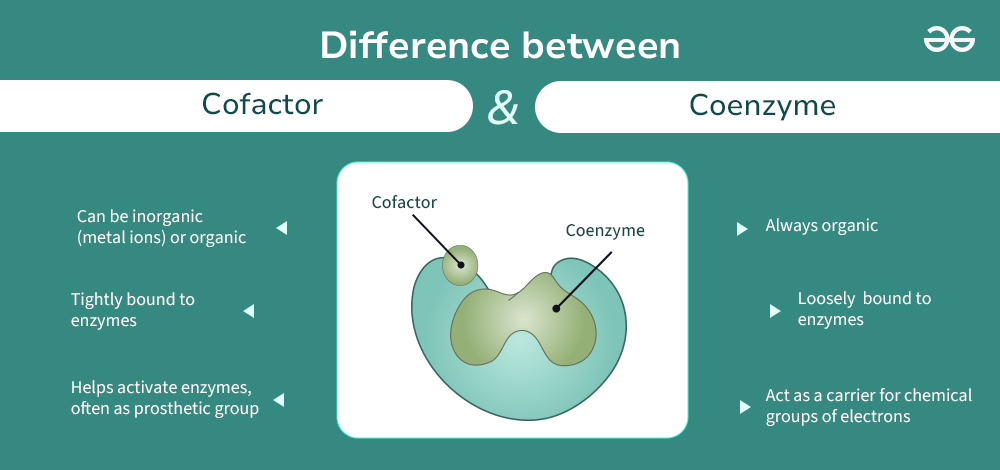
Term | Meaning |
|---|---|
Cofactor | Usually an inorganic helper, often a metal ion |
Coenzyme | Organic helper molecule, often vitamin-derived |
Apoenzyme | Protein portion without required helper → inactive |
Holoenzyme | Apoenzyme + necessary helper → active functional enzyme |
The professor summarizes it as:
holoenzyme = apoenzyme + cofactor/coenzyme.
Examples
Cofactors:
Mg²⁺, Zn²⁺, Fe²⁺/iron-sulfur groups
Coenzymes:
NAD⁺/NADH, FAD/FADH₂, CoA
Many coenzymes are derived from vitamins:
niacin → NAD⁺
riboflavin → FAD/FMN
pantothenic acid → CoA
The professor specifically connects vitamins to these central metabolic pathways.
Important flow
Apoenzyme alone → inactive
apoenzyme + required cofactor/coenzyme → holoenzyme → substrate can bind/react → catalysis


8. Critical Thinking: EDTA + DNase The question says:
EDTA binds Mg²⁺ → DNase cannot degrade stored DNA.
This is a very good application of the previous concept.
Reason:
DNase requires Mg²⁺ as a cofactor → EDTA chelates/removes free Mg²⁺ → DNase loses required cofactor → enzyme cannot function properly → DNA is protected.
This is exactly why knowing cofactor matters beyond memorizing its definition.
9. Enzyme inhibition
There are two major types emphasized here:
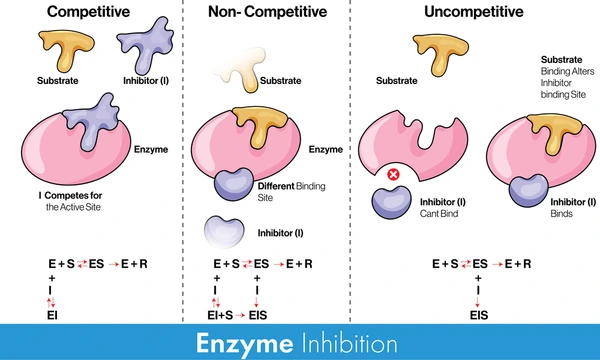
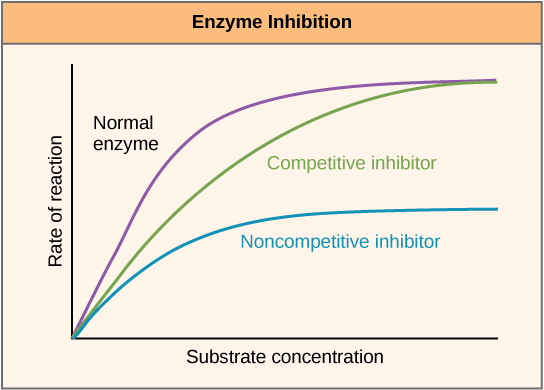
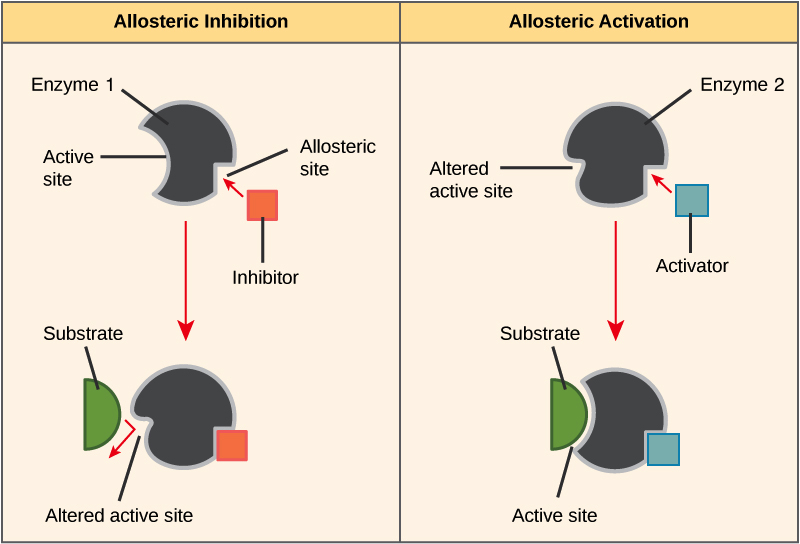
Feature | Competitive inhibitor | Noncompetitive/allosteric inhibitor |
|---|---|---|
Binding site | Active site | Allosteric site |
Competes directly with substrate? | Yes | No |
Often resembles substrate? | Yes | Not necessary |
Main result | Substrate cannot occupy active site | Enzyme shape/activity changes |
Important biological use | Drugs | Regulation + drugs/toxins |
The professor explicitly defines these two mechanisms this way.
Competitive inhibition
substrate normally binds active site
but:
competitive inhibitor resembles substrate → inhibitor occupies active site → substrate blocked → reaction decreases
Important antibiotic example: sulfanilamide
Bacteria use PABA to synthesize folic acid.
Sulfanilamide resembles PABA enough to compete for the enzyme's active site.
Flow:
PABA normally enters folate pathway → folic acid produced → bacterial nucleotides/DNA/RNA can be made
but:
sulfanilamide resembles PABA → occupies enzyme active site → folate pathway blocked → bacterial growth stops
OpenStax adds one excellent reason this can selectively affect bacteria:
bacteria synthesize folate, whereas humans obtain folate from the diet.
The lecture also mentions trimethoprim, which inhibits another enzyme later in the bacterial folate pathway; the drugs may be used together because they block sequential steps.
10. Noncompetitive / allosteric inhibition
An allosteric site is a regulatory binding site different from the active site.
Flow:
inhibitor binds allosteric site → enzyme's conformation changes → active site no longer works properly / substrate affinity falls → reaction slows or stops
This can be reversible or irreversible.
The professor's major toxin example is cyanide, which inhibits cytochrome c oxidase in the electron transport chain, shutting down cellular respiration. which blocks oxygen from accepting electron
Blocks Electron Transfer: Cyanide prevents cytochrome c oxidase from passing electrons to oxygen, which is the final electron acceptor.
Halts Proton Pumping: Because electrons cannot flow through the final step, the entire chain backs up, stopping the pumping of protons across the inner mitochondrial membrane.
Stops ATP Production: Without a proton gradient, ATP synthase cannot spin to create adenosine triphosphate (ATP), the primary energy carrier for cells.
Causes Rapid Cell Death: High-energy tissues—like the heart and brain—rapidly exhaust their remaining fuel and die, leading to rapid systemic failure and death


11. Feedback inhibition
This is one of the most important concepts in this lecture.
Suppose:
A → B → C → D
and D is the final product.
If the cell already has plenty of D, continuing to make it wastes nutrients and ATP.
So:
D accumulates → D binds allosterically to an enzyme near the beginning of the pathway → enzyme activity decreases → pathway slows/stops
When D falls:
D dissociates → enzyme active again → pathway resumes
That is negative feedback / feedback inhibition.
Mega-flow
low end product → first enzyme ON → pathway runs → end product accumulates → end product binds allosteric site → enzyme changes shape → pathway OFF → product gets used → inhibitor concentration falls → pathway ON again
This gives the cell automatic metabolic control.
12. Critical Thinking: ATP and ADP regulating phosphofructokinase
The professor asks you to predict the effect based on energy status.
Phosphofructokinase is necessary for glycolysis.
If the cell has lots of ATP:
ATP high = cell already has abundant energy → no need to burn as much glucose → ATP acts as an allosteric inhibitor → glycolysis slows
If ADP is high:
ADP high = ATP has been used / cell needs energy → phosphofructokinase activity increases → glycolysis speeds up → more ATP can be produced
So think:
high ATP → STOP / slow energy production
high ADP → GO / increase energy production
That is feedback regulation applied to energy metabolism.
13. Redox reactions
This sounds harder than it is.
Formal rule
Oxidation = LOSS of electrons
Reduction = GAIN of electrons
Mnemonic:
OIL RIG
Oxidation Is Loss, Reduction Is Gain
Because an electron lost by one molecule has to go somewhere:
molecule A loses electrons → A oxidized → molecule B receives those electrons → B reduced
Therefore oxidation and reduction always occur together: redox reaction.
The professor's slides summarize redox as gain/loss of electrons and note that in cellular reactions the electrons are commonly transferred along with hydrogen.
The useful biology shortcut
In many of the reactions in this course:
gain H/electrons → reduction
lose H/electrons → oxidation
Not a universal chemistry rule, but very useful for the pathways she will learn here.
Example: pyruvate → lactate
NADH loses electrons/H → NAD⁺
Therefore:
NADH is oxidized.
Those electrons/H are transferred to pyruvate:
pyruvate gains them → lactate
Therefore:
pyruvate is reduced.
So:
NADH → NAD⁺ = oxidation
pyruvate → lactate = reduction
14. Oxidized vs reduced electron carriers
This becomes extremely important next lecture.
Carrier | Oxidized form | Reduced form |
|---|---|---|
NAD | NAD⁺ | NADH |
FAD | FAD | FADH₂ |
NADP | NADP⁺ | NADPH |
Reduced forms carry high-energy electrons.
So she should immediately think:
NAD⁺ = empty-ish electron carrier
NADH = loaded electron carrier
Then:
NADH carries electrons to another pathway → loses electrons → NAD⁺ regenerated.
This is one of the most important concepts for glycolysis/Krebs/ETC.
15. Why reduced molecules contain more usable energy
fatty molecules
The professor wants the conceptual relationship:
more reduced → more high-energy electrons / usually more C–H bonds → greater potential energy
more oxidized → less extractable energy
Therefore:
fatty molecules → highly reduced → lots of energy
while:
CO₂ → carbon already maximally oxidized → essentially no additional energy to extract from it
This is why cellular respiration can be thought of as gradually oxidizing glucose toward CO₂ while capturing the released energy.
16. ATP — the cell's immediate energy currency
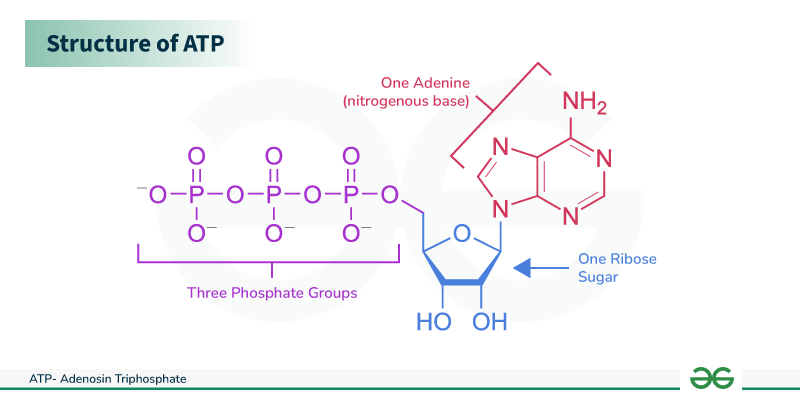
ATP = adenosine triphosphate
Structure:
adenine + ribose = adenosine
plus:
3 phosphate groups
Think of ATP as the cell's short-term spendable energy, not its long-term storage.
The professor's analogy is good:
ATP = cash/checking account
fat/glycogen = savings account
ATP is continuously:
made → used → remade → used
ATP cycle
energy from catabolism → ADP + Pi → ATP
then:
ATP → ADP + Pi → energy becomes available to drive cellular work
That work includes:
biosynthesis, active transport, movement, DNA/protein synthesis, etc.
Critical Thinking #9
“How does ATP serve as a carrier of energy?”
Full answer:
Energy released from catabolic reactions is used to phosphorylate ADP and form ATP. ATP then transfers that stored chemical energy to energy-requiring processes when ATP is dephosphorylated/hydrolyzed to ADP + Pi. The ADP can then be phosphorylated again, so ATP continuously cycles between charged and discharged forms.
17. Three ways cells make ATP
The slides introduce three terms now because they will appear repeatedly later.
Mechanism | Basic idea | Where you'll see it |
|---|---|---|
Substrate-level phosphorylation | Enzyme directly transfers a phosphate from another molecule to ADP | Glycolysis, Krebs |
Oxidative phosphorylation | Electron transport creates energy gradient used to produce ATP | Electron transport system |
Photophosphorylation | Light energy drives ATP formation | Photosynthetic organisms |
Do not make her memorize the full mechanisms of oxidative phosphorylation yet. The professor is just setting up the terminology.
One OpenStax nuance worth knowing for later: oxidative phosphorylation is associated with an electron transport system. In aerobic respiration O₂ is the final electron acceptor, but some microbes can also carry out anaerobic respiration using other final electron acceptors. That broader distinction becomes more useful once the ETC is covered.
Where this lecture connects to the next lectures
The professor closes with this overall metabolic map:
Respiration
Glucose → glycolysis → pyruvate → further oxidation/Krebs → NADH + FADH₂ produced → electron transport system → much ATP
Fermentation
Glucose → glycolysis → pyruvate → fermentation → NADH gives electrons away → NAD⁺ regenerated → NAD⁺ returns to glycolysis
The big thing to understand now is why NAD⁺ regeneration matters:
glycolysis requires NAD⁺ → if all NAD⁺ became NADH and stayed that way, glycolysis would stop → fermentation converts NADH back to NAD⁺ → glycolysis can keep running.
She doesn't need every product yet; that is the next lecture.
Critical-thinking questions: what she should be able to explain
Question | Core reasoning she should know |
|---|---|
1. Transferase, ligase, oxidoreductase? | All are enzymes; “-ase” indicates enzyme. Name tells reaction type. |
2. Streptokinase? | Purified enzyme is not a living bacterium, so no infection; enzyme specificity limits what it acts on. |
3. Apoenzyme → holoenzyme? | Add a cofactor or coenzyme. |
4. Vitamins + enzymes? | Many vitamins are precursors/components of coenzymes, which allow enzymes to catalyze reactions. |
5. EDTA + DNase? | EDTA chelates Mg²⁺ → removes necessary cofactor → DNase loses activity → DNA protected. |
6. Competitive vs noncompetitive? | Competitive = active site; noncompetitive = allosteric site/conformational change. End products can use allosteric inhibition for feedback regulation. |
7. Sulfanilamide? | Resembles PABA → competitively blocks bacterial folate synthesis → bacteria cannot grow normally. |
8. ATP vs ADP on phosphofructokinase? | High ATP → inhibit/slow glycolysis; high ADP → activate/increase glycolysis. |
9. ATP energy carrier? | Catabolism provides energy to make ATP → ATP hydrolysis/dephosphorylation releases usable energy → ADP recycled back to ATP. |
Do not mix these up
Terms |
|---|
Catabolism vs anabolism |
Substrate vs enzyme |
Active site vs allosteric site |
Activation energy vs overall reaction energy |
Cofactor vs coenzyme |
Apoenzyme vs holoenzyme |
Competitive vs noncompetitive inhibition |
Oxidation vs reduction |
NAD⁺ vs NADH |
ATP vs long-term energy storage |
Feedback inhibition vs permanent enzyme destruction |
Terms | Correct distinction |
|---|---|
Catabolism vs anabolism | Break down/release energy vs build/require energy |
Substrate vs enzyme | Substrate changes; enzyme catalyzes and is reusable |
Active site vs allosteric site | Substrate-binding site vs separate regulatory site |
Activation energy vs overall reaction energy | Enzyme lowers the barrier, not the overall energy difference |
Cofactor vs coenzyme | Usually inorganic helper vs organic helper |
Apoenzyme vs holoenzyme | Inactive protein alone vs complete active enzyme |
Competitive vs noncompetitive inhibition | Active-site competition vs allosteric conformational effect |
Oxidation vs reduction | Lose electrons vs gain electrons |
NAD⁺ vs NADH | Oxidized carrier vs reduced/high-energy electron carrier |
ATP vs long-term energy storage | ATP = immediate energy currency; fats/glycogen = longer-term stores |
Feedback inhibition vs permanent enzyme destruction | Reversible regulation based on pathway needs vs enzyme damage |
mega flow
Nutrients such as glucose enter cell → catabolic enzymes break molecules down step-by-step → electrons and energy are released → NAD⁺/FAD accept electrons and become NADH/FADH₂ → some released energy is captured as ATP → ATP supplies energy for anabolic pathways → anabolic enzymes use metabolic intermediates to build proteins, DNA/RNA, lipids, peptidoglycan, etc. → enzyme activity depends on correct 3-D structure, active-site specificity, cofactors/coenzymes, temperature and pH → cells control enzymes with competitive or allosteric inhibition → accumulated end product can allosterically inhibit an early enzyme through feedback inhibition → energy production therefore rises when the cell needs energy and slows when energy/products are already abundant.
And the bridge into the next lecture is:
Glucose → glycolysis → pyruvate → either respiration/Krebs/ETC OR fermentation → electrons continuously transferred by redox reactions → NAD⁺ regenerated and/or ATP produced → ATP powers the cell.
That is the base I would want her to have completely solid before moving into glycolysis and Krebs