Priv Pilot 3rd Exam
 Call Kai
 Learn
Learn Practice Test
 Spaced Repetition
 Match
Match Flashcards
 Knowt Play
1/46

Earn XP
Description and Tags
Aaaa
Name | Mastery | Learn | Test | Matching | Spaced | Call with Kai | Chat |
|---|
No analytics yet
Send a link to your students to track their progress
47 Terms
VS0 is defined as the
stalling speed or minimum steady flight speed in the landing configuration
What regulation allows a private pilot to perform preventive maintenance?
14 CFR 43.3
How soon after the conviction for driving while intoxicated by alcohol or drugs shall it be reported to the FAA’s Security and Hazardous Materials Safety Office?
No later than 60 days after the motor vehicle action.
Each recreational or private pilot is required to have a flight review at least once
every 24 calendar months
To act as pilot in command of an aircraft carrying passengers, the pilot must have made three takeoffs and landings within the preceding 90 days in an aircraft of the same
category, class, and type, if a type rating is required
The takeoffs and landings required to meet the recency of experience requirements for carrying passengers in a tailwheel airplane
must be to a full stop
A certificated private pilot may not act as pilot in command of an aircraft towing a glider unless there is entered in the pilot’s logbook a minimum of
100 hours of pilot-in-command time in the aircraft category, class, and type, if required, that the pilot is using to tow a glider.
To act as pilot in command of an aircraft towing a glider, a pilot is required to have made within the preceding 24 months
at least three actual or simulated glider tows while accompanied by a qualified pilot
If a pilot is operating under BasicMed, what is the maximum speed at which they may fly?
250 KIAS
Where may an aircraft’s operating limitations be found if the aircraft has an Experimental or Special. light-sport airworthiness certificate?
Attached to the Airworthiness Certificate
Which best describes the flight conditions under which flight crewmembers are specifically required to keep their safety belts and shoulder harnesses fastened?
Safety belts during takeoff and landing and while en route; shoulder harnesses during takeoff and landing.
What action is required when two aircraft of the same category converge, but not head-on?
The aircraft on the left shall give way.
Which aircraft has the right-of-way over the other aircraft listed?
Aircraft towing other aircraft
Except when necessary for takeoff or landing, what is the minimum safe altitude required for a pilot to operate an aircraft over congested areas?
An altitude of 1,000 feet above the highest obstacle within a horizontal radius of 2,000 feet of the aircraft.
Except when necessary for takeoff or landing, what is the minimum safe altitude for a pilot to operate an aircraft anywhere?
An altitude allowing, if a power unit fails, an emergency landing without undue hazard to persons or property on the surface.
Except when necessary for takeoff or landing, what is the minimum safe altitude required for a pilot to operate an aircraft over other than a congested area?
An altitude of 500 feet AGL, except over open water or sparsely populated area, which requires 500 feet from any person, vessel, vehicle, or structure.
According to 14 CFR part 91, at what minimum altitude may an airplane be operated unless necessary for takeoff and landing?
An altitude allowing for an emergency landing without undue hazard, if a power unit fails.
Except in Alaska, during what time period should lighted position lights be displayed on an aircraft?
Sunset to sunrise
Unless each occupant is provided with supplemental oxygen, no person may operate a civil aircraft of US registry above a maximum cabin pressure altitude of
15000 feet MSL
When operating an aircraft at cabin pressure altitudes above 12500 feet MSL up to and including 14000 feet MSL, supplemental oxygen shall be used during
that flight time in excess of 30 minutes at those altitudes
When is Automatic Dependent Surveillance Broadcast (ADS-B) Out equipment required?
In Class E airspace above 10,000 ft MSL, except at and below 2500 ft AGL
What type of ADS-B equipment is required in Class A airspace?
ADS-B Out that operates on the frequency of 1090 MHz.
A parachute composed of nylon, rayon, or other synthetic fibers must have been packed by a certificated and appropriately rated parachute rigger within the preceding
180 days
An approved parachute constructed of natural fibers may be carried in an aircraft for emergency use if it has been packed by an appropriately rated parachute rigger within the preceding
60 days
The responsibility for ensuring that an aircraft is maintained in an airworthy condition is primarily that of the
Owner or operator
The responsibility for ensuring that maintenance personnel make the appropriate entries in the aircraft maintenance records indicating the aircraft has been approved for return to servicel ies with the
Owner or operator
No person may use an ATC transponder unless it has been tested and inspected within at least the preceding
24 calendar months
Which records or documents shall the owner of operator of an aircraft keep to show compliance with an applicable Airworthiness Directive?
Aircraft maintenance records
Under what condition could an aircraft’s engine logbook show no previous operating history?
When the aircraft’s engine has been rebuilt by the manufacturer.
The operator of an aircraft that has been involved in an accident is required to file an NTSB accident report within how many days?
10
Altitude-induced hypoxia is caused by what atmospheric condition?
Insufficient partial pressure of the inhaled oxygen.
The illusion associated with landing on a narrower than usual runway may result in the pilot flying a
lower approach with the risk of striking objects along the approach path or landing short.
Risk management, as part of the aeronautical decision making (ADM) process, relies on which features to reduce the risks associated with each flight?
Situational awareness, problem recognition, and good judgement.
What often leads to spatial disorientation or collision with ground/obstacles when flying under VFR?
Continual flight into instrument conditions
What information should be entered in item 16, “Destination Aerodome”, for a VFR day flight?
The ICAO four-letter indicator of destination airport if no stopover for more than 1 hour is anticipated.
If a true heading of 135 degrees results in a ground track of 130 degrees and a true airspeed of 135 knots results in a groundspeed of 140 knots, the wind should be from
246 degrees and 13 knots
On a cross-country flight, point A is crossed at 1500 hours and the plan is to reach point B at 1530 hours. Use the following information to determine the indicated airspeed required to reach point B on the schedule.
137 knots
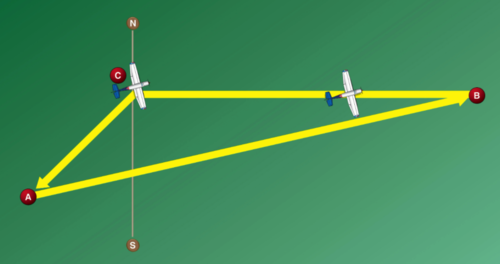
The line from point A to point B of the wind triangle represents
true heading and airspeed
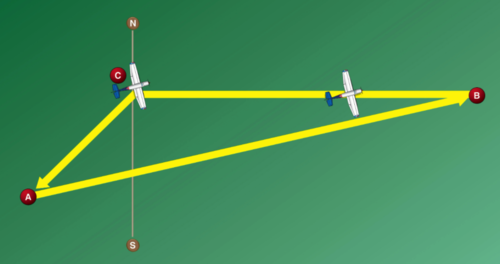
The line from point C to point B of the wind triangle represents
groundspeed and true course
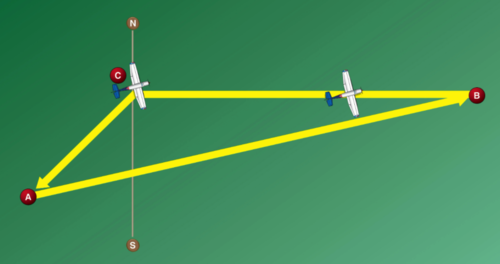
The line from point C to point A of the wind triangle represents
Wind direction and velocity
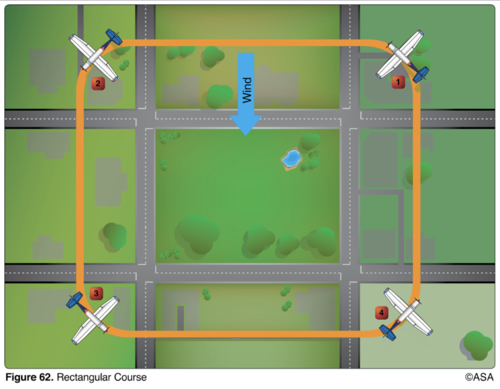
In flying the rectangular course, when would the aircraft be turned less than 90 degrees?
Corners 1 and 4
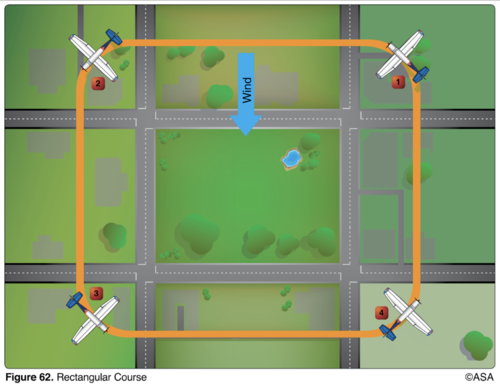
In flying the rectangular course, when should the aircraft bank vary from a steep bank to a medium bank?
Corner 3
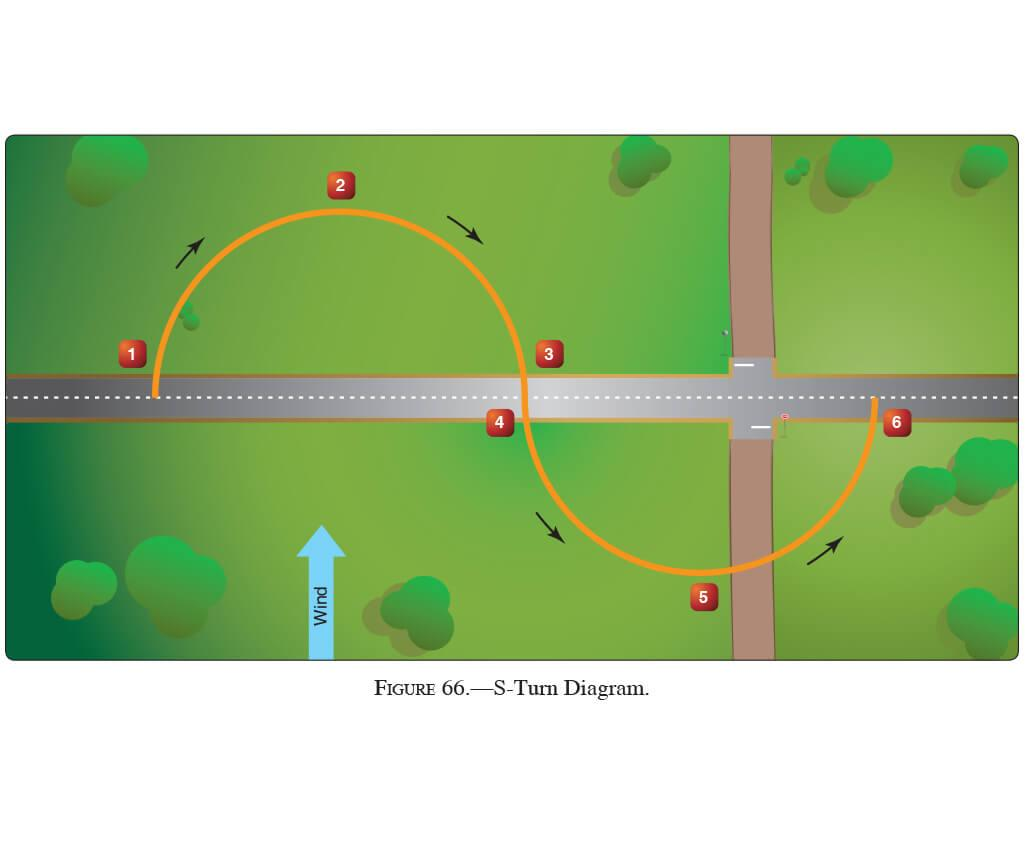
While practicing S-turns, a consistently smaller half-circle is made on one side of the road than on the other, and this turn is not completed before crossing the road or reference line. This would most likely occur in turn
4-5-6 because the bank is increased too rapidly during the early part of the turn.