Oligopoly (4)
 Call Kai
 Learn
Learn Practice Test
 Spaced Repetition
 Match
Match Flashcards
 Knowt Play
1/15

There's no tags or description
Looks like no tags are added yet.
Name | Mastery | Learn | Test | Matching | Spaced | Call with Kai | Chat |
|---|
No analytics yet
Send a link to your students to track their progress
16 Terms
Characteristics of Oligopoly
Most markets are imperfectly competitive
(Market structures where firms do have some market power and can influence prices i.e.monopolistic, oligopoly & monopoly)Most imperfectly competitive industries operate in an oligopoly (A market structure in which a few large firms dominate the industry with each firm having significant market power) market structure
E.g., Banks, insurance companies, department stores, supermarkets, petrol retailers, sport stores etc.
High barriers to entry and exit | High concentration ratio |
|---|---|
|
|
Interdependence of firms | Product differentiation |
|
|
Calculate concentration Ratios
The most commonly used concentration ratios (Reveals what percentage of the total market share a specific number of firms have e.g five-firm concentration ratio)in the UK are the five-firm, ten-firm, and twenty-firm concentration ratios
A five-firm concentration ratio of around 60% is considered to be an oligopoly
A one-firm concentration ratio of 100% would be a pure monopoly- A market structure in which there is a single seller selling a unique good/service
The UK Competition and Markets Authority (CMA) defines a monopoly as a firm with more than 25% market share
It prevents mergers or acquisitions from taking place which would give one firm more than 25% market share
Collusive Behaviour
Collusive behaviour in oligopolies occurs when firms cooperate to fix prices and restrict output
They cease to compete as vigorously as they can
Non collusive behaviour
Non collusive behaviour in oligopolies occurs when firms actively compete to maintain/increase market share
Reasons for Collusion
Few firms/competitors | This makes it relatively easy for each firm to understand other competitors' actions and responses, or to collaborate on prices/output |
|---|---|
Similar costs | Firms face almost identical costs as any remaining competitors have all experienced economies of scale |
Similar revenue | Competitors' goods/services sell for similar prices as there is little incentive to lower them as other firms would respond by keeping their market share the same but decreasing the profits |
High barriers to entry | The barriers to entry make it unlikely that new entrants will emerge to disrupt the status quo |
Ineffective regulation | A lack of regulation empowers firms to collude as there is little consequence for their actions |
Brand loyalty | There is usually a high degree of brand loyalty in oligopoly markets and firms have an established market share. This decreases the benefits of competition as consumers are unlikely to change brands |
Types of Collusion
Collusion can be overt or tacit
The net effect of collusion is that a group of firms end up acting like a monopoly in the market
Overt Collusion
Overt collusion occurs when firms explicitly agree to limit competition or raise prices (price fixing)
A cartel (Occurs when a group of firms providing the same (or substitute) products join together to limit output & raise prices e.g OPEC (oil producing exporting countries). The group effectively acts as a monopoly) is the most restrictive form of collusion and is illegal in most countries
The consequences of overt collusion include:
Higher prices for consumers
Less output in the market
Poor quality products and/or customer service
Less investment in innovation
In what way does Overt collusion happen ?
Overt collusion often happens in the following ways
Price fixing - Occurs when competitors agree a fixed price for all of their competing products & it usually higher than the market equilibrium price would be
Setting output quotas which limit supply and naturally results in price increases
Agreements to block new firms from entering the industry
Agreements to pay suppliers the same price thereby driving down prices in the supply chain (monopsony power) - Occurs when there is a single buyer of a good/service in a market giving the buyer considerable market power over the seller
Tacit collusion
Tacit collusion occurs when firms avoid formal agreements but closely monitor each other's behaviour usually following the lead of the largest firm in the industry
The most common form of tacit collusion is price leadership or price matching
This occurs when firms monitor the price of the largest firm in the industry and then adjust their prices to match
It is difficult for regulators to prove that collusion has occurred
It provides similar benefits to firms as overt collusion, but perhaps not to the same degree
It has similar consequences for consumers as overt collusion, but perhaps not to the same degree
What is game theory ?
Game theory is a mathematical framework which is used by firms to ensure optimal decisions are made in a strategic setting where there is a high level of interdependence (such as in oligopoly markets)
Any game has three elements
The players - (firms)
The strategies available to the players
The payoffs (outcomes) that each player receives for each combination of strategies
What was game theory first illustrated using ?
It was first illustrated using a simple model called The Prisoners Dilemma
Two criminals are caught after a train robbery (Carol and Doug)
The prosecutor does not have much evidence
The criminals are guilty but have agreed with each otherthat they will deny all involvement
The prosector wants one (or both) to confess
The strategies and payoffs available to the prisoners are presented in a payoff matrix
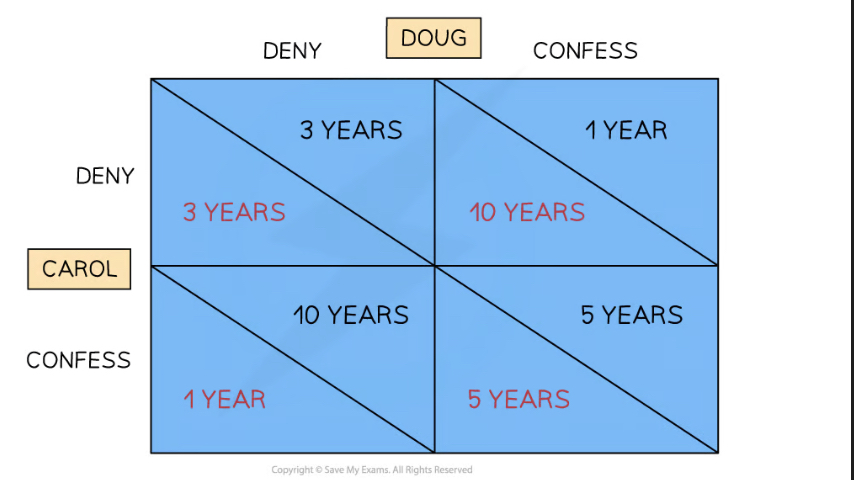
A prisoner's dilemma payoff matrix which illustrates game theory - Diagram Analysis
If Carol and Doug stick to their plan and deny involvement, they each get 3 years jail time
If Doug confesses and indicates Carol's involvement, then Doug gets a lenient sentence of 1 year and Carol gets 10 years
If Carol confesses and indicates Doug's involvement, then Carol gets a lenient sentence of 1 year and Doug gets 10 years
There is a strong incentive to collude as it will yield the most beneficial outcome for Carol and Doug (3 years each)
Fearing the worst, both players decide to confess and receive 5 years each
This outcome is called the dominant strategy as it carries the least risk
How firms use game theory
Firms typically use game theory in the following situations:
When making decisions to raise or lower prices
When making decisions about new advertising and branding initiatives
When making decisions about investment in product innovation
When making decisions on product bundling e.g. combined phone and broadband package
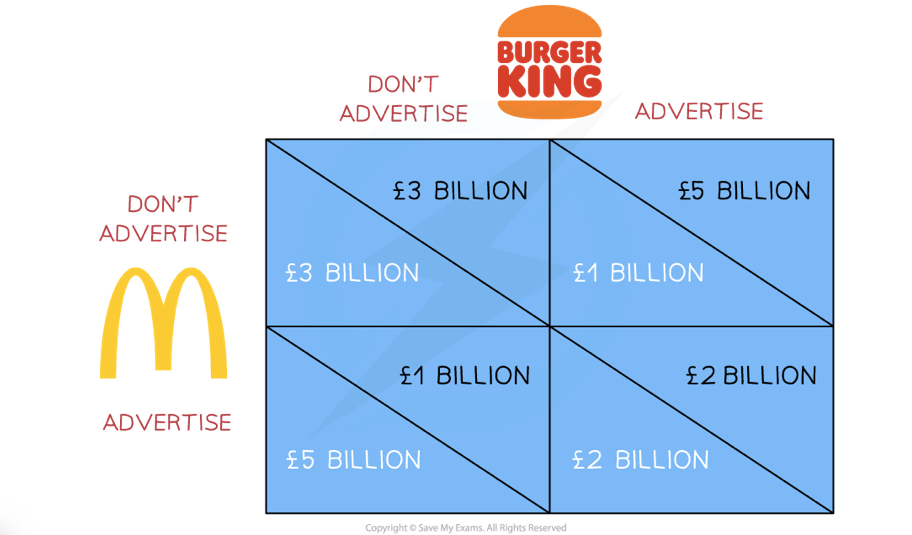
Below is a payoff matrix representing the strategic options available to Burger King and McDonald's when making advertising decisions
The £ payoffs represent the likely profits for each combination of choices selected
A payoff matrix which illustrates the strategies and payoffs available to firms when they are deciding to advertise or not to advertise - Diagram Analysis
If Burger King and McDonald's collude and agree not to advertise (top left), they can each enjoy £3 bn. in profits
There is a strong incentive to collude
If Burger King advertises and McDonald's does not, then Burger King's profits are £5 bn. and McDonald's are £1 bn.
If McDonald's advertises and Burger King does not, then McDonald's profits are £5 bn. and Burger King's are £1 bn.
Both firms decide to advertise and receive £2 bn. of profits each
This outcome is called the dominant strategy as it carries the least risk
The risk of collusion is that one player will cheat and by doing so, get ahead
Price Competition
Firms in an oligopoly market engage in three types of price competition
Price wars: occur when competitors repeatedly lower prices to undercut each other in an attempt to gain or increase market share. This often occurs when there is a lower level of non - price competition (Competition that is not based on price but on branding, product differentiation & marketing) and where firms find it difficult to collude (either formal or tacit)
Predatory pricing: this is the practice of lowering prices when a new competitor joins the industry in order to drive them out. Prices are often lowered to a point below the cost of production. Once they have left the market, prices are raised again. This pricing strategy is usually illegal as it is anticompetitive
Limit pricing: occurs when firms set a limit on how high the price will go in the industry. A lower price reduces profit and disincentivize other firms from joining the industry. The greater the barriers to entry the higher the limit price is likely to be as firms are already disincentivized
Types of Non- Price Competition
Firms engage in a wide range of non - price competition (Competition that is not based on price but on branding, product differentiation & marketing) strategies
The aim is to increase product differentiation, develop or increase brand loyalty, and to increase market share
A Range of Strategies Used in Non-Price Competition
Loyalty cards and rewards | Branding | Packaging | Celebrity/influencer endorsement |
Corporate sponsorship e.g. Nike sponsoring Rafael Nadal | After sales service | Delivery policies | Product warranties |