Bio - Unit 1 - Water
 Call Kai
 Learn
Learn Practice Test
 Spaced Repetition
 Match
Match Flashcards
 Knowt Play
1/35

There's no tags or description
Looks like no tags are added yet.
Name | Mastery | Learn | Test | Matching | Spaced | Call with Kai | Chat |
|---|
No analytics yet
Send a link to your students to track their progress
36 Terms
Buoyancy
The force that counteracts the force of gravity. The high density of liquid water creates high buoyancy, allowing less dense materials to float. Air, being much less dense than water, is much less buoyant as well.
Viscosity
Resistance to flow and is related to how much energy is needed to change the shape of a liquid. Water has low viscosity compared with other liquids, but greater viscosity than air.
Thermal conductivity
The ability of a substance to transfer heat when there is a temperature difference. Water has a high thermal conductivity compared with other liquids (except liquid metals). Air has a much lower thermal conductivity than water.
Specific heat capacity
How much energy is needed to raise the temperature of a substance. Water has a high specific heat capacity. Air has a much lower specific heat capacity than water.
Why is water a dipolar molecule?
Oxygen is more electronegative than hydrogen, which causes the shared pair of electrons to be pulled slightly closer to the oxygen atom. This results in a slight negative charge on the oxygen, and a slight positive charge on the hydrogen atoms.
Why do hydrogen bonds form between water molecules?
Due to the weak electrostatic attraction between the slightly positively charged hydrogen atom of one water molecule, and the slightly negatively charged oxygen atom of another.
What are ions?
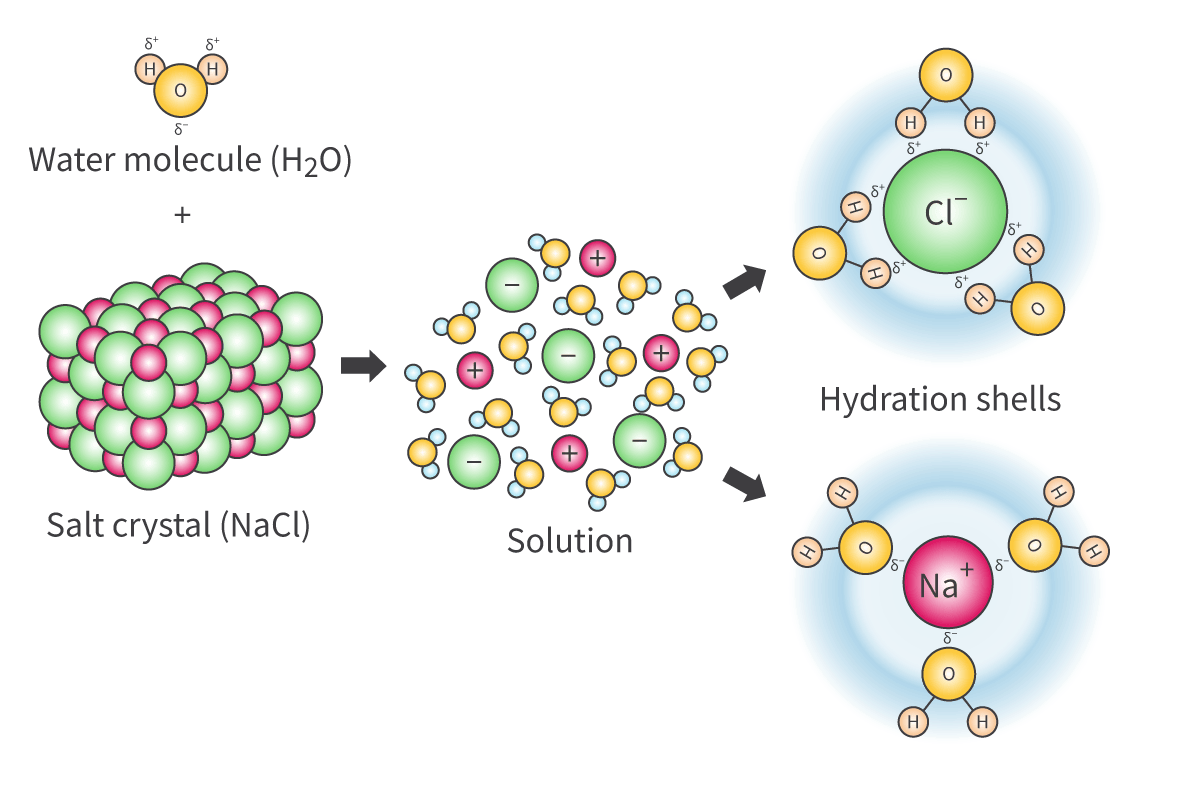
Atoms that have either lost or gained electrons, and as a result they have either a positive or negative charge.
Why can water dissolve a substance?
If the force of attraction between ions and water molecules is greater than the force of attraction between oppositely charged ions, water has the ability to dissolve the substance.
What are hydration shells?
Dynamic layers of water molecules that form around a dissolved ion or molecule (solute) in an aqueous solution. These water molecules arrange themselves in a specific orientation due to attractive forces, creating a structured layer around the solute.
What is dissolution?
The process of solute particles moving and becoming evenly spread out in a solvent.
Solutes
A substance that dissolves in a solvent (water)
Homogenous
Evenly distributed.
A solution
The homogenous mixture formed when a solute is dissolved in a solvent.
Selectively permeable membrane
A membrane which does not allow the free movement of all molecules and is permeable only to certain molecules.
Osmosis
Osmosis is the movement of water molecules across a selectively permeable membrane from an area of lower solute concentration to an area of higher solute concentration until both solutions have equal solute concentrations, resulting in a state of dynamic equilibrium.
Hypertonic
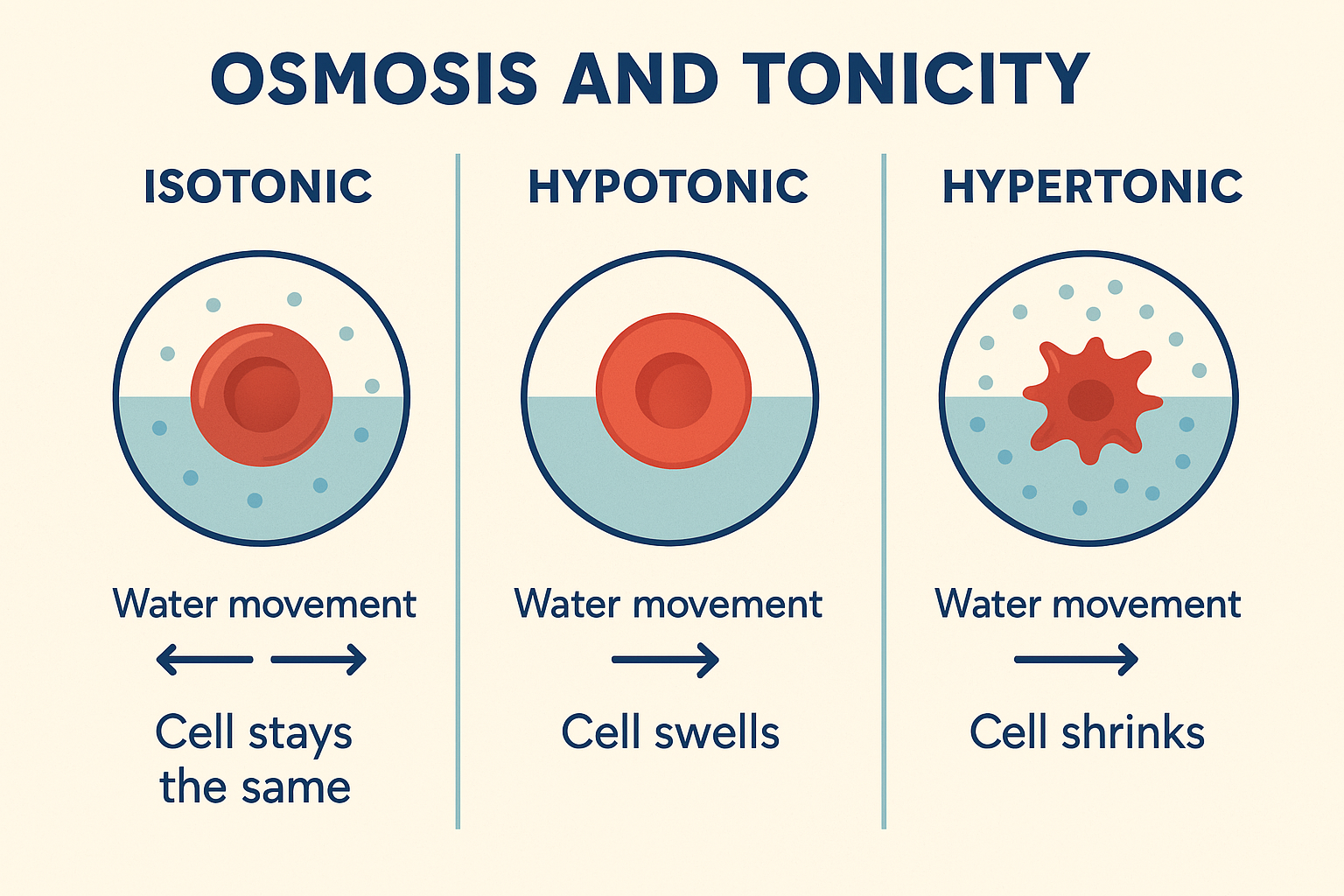
A solution with a higher solute concentration (a higher osmotic concentration or osmolarity) is referred to as hypertonic,
Hypotonic
A solution with a lower solute concentration (a lower osmolarity) is called hypotonic
Isotonic
Water always flows from a hypotonic solution to a hypertonic solution until they become isotonic, having the same solute concentration.
What happens to a cell in a hypertonic solution?
If a cell is placed in a hypertonic solution, where there is a higher solute concentration, there will be a net movement of water out of the cell and into the surrounding solution. This leads to the cell shrinking and becoming crenated if it is an animal cell, or undergoing plasmolysis if it is a plant cell.
What happens to a cell in a hypotonic solution?
If a cell is placed in a hypotonic solution, where there is a lower solute concentration, there will be a net movement of water from the solution into the cell, causing it to swell. If the cell is an animal cell it may burst if too much water moves into the cell, a process called lysis.
What happens to a cell in an isotonic solution?
If a cell is placed in an isotonic solution, there will be equal movement of water into and out of the cell, resulting in a state called dynamic equilibrium (Figure 3). There will be no change in the shape or size of a cell in an isotonic solution.
The relationship between a solution, a solute and a solvent.
A solute dissolves in a solvent to form a solution.
Waters formula
H2O. Two hydrogen atoms attached to an oxygen atom by a covalent bond.
Biotic
Associated with living or once-living organisms in an ecosystem.
Abiotic
Associated with non-living components of an ecosystem.
What are living things made up of?
Living things are made up of one or more cells, and each cell contains cytoplasm, a water-based fluid.
Metabolism
The total set of life-sustaining chemical reactions in the body.
Electronegativity
A measure of how strongly the nucleus of an atom attracts the electrons it shares with another atom.
Electronegativity is influenced by:
The number of protons in the nucleus. Protons are positively charged and therefore attract the negatively charged electrons.
The number of orbital levels in the atom. More orbital levels will decrease the pull on the shared electrons because they will be further away from the nucleus, and because the other negatively charged electrons will shield them from the positive charge of the nucleus.
Why is water a polar covalent bond?
Oxygen is more electronegative than hydrogen. Therefore, overall, the oxygen atom attracts the shared electrons more strongly than does the hydrogen atom. The uneven sharing of electrons is a polar covalent bond.
How is a water molecule polar?
As the shared electrons spend more time with the oxygen atom, the oxygen side of the atom has a partial negative charge, making it the negative pole. The hydrogen side has a partial positive charge, making it the positive pole.
Geometry of the water molecule
The hydrogen atoms are at an angle (104.5°), not in a straight line. This is because the pairs of electrons repel each other, so they move as far apart as possible in three dimensions.
How do you draw water
When drawing water, the element symbol is used to represent the atoms and a solid line is used to show a covalent bond. The superscript + and − symbols show the charge of the atom, and the small delta (δ) shows that the charge is partial.

What is a hydrogen bond?
The partially positive hydrogen side of one water molecule is attracted to the partially negative charge on the oxygen side of other water molecules. An intermolecular force, known as a hydrogen bond, holds the molecules together.
Cohesion
Cohesion pulls water molecules together. The force of cohesion may counteract gravity.