Ch 7: Meiosis
 Call Kai
 Learn
Learn Practice Test
 Spaced Repetition
 Match
Match Flashcards
 Knowt Play
1/39

Name | Mastery | Learn | Test | Matching | Spaced | Call with Kai |
|---|
No analytics yet
Send a link to your students to track their progress
40 Terms
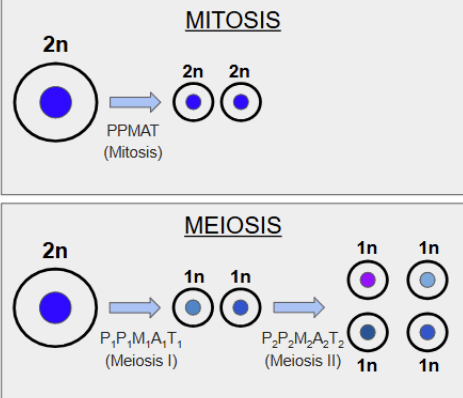
Both mitosis and meiosis…
begin with a diploid (2n) cell
undergo the PPMAT stages and cytokinesis
Differences between miosis and mitosis…
Mitosis
only undergoes one round of division
produces 2 genetically identical diploid (2n) cells
Meiosis
undergoes two rounds of division
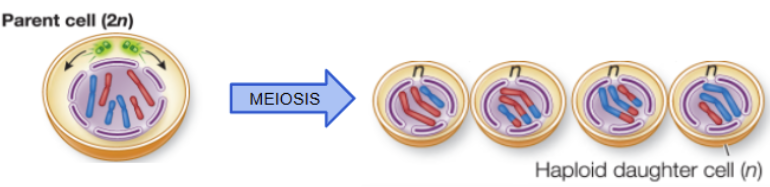
produces 4 genetically unique haploid (1n) gametes
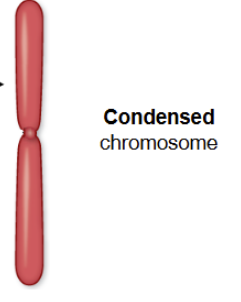
Chromosome definition
long strand of DNA
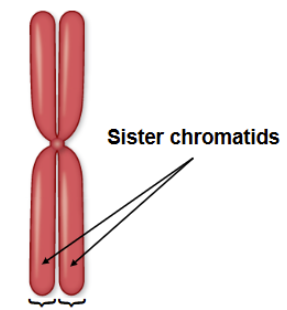
Replicated chromosome defintion
after S phase, chromosomes are now composed of two identical copies called sister chromatids
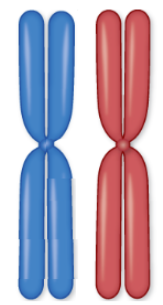
What are homologous chromosomes?
a pair of matching chromosomes, one inherited from each parent (contain the same genes, though may have different versions)
Humans are diploid, meaning…
we have two sets of chromosomes per somatic cell (body tissue cell)
23 homologous pairs = 46 total chromosomes
Gametes are haploid, meaning…
each gamete (eggs and sperm) only contains one copy of each chromosome
Gametes vs. somatic cells
Gametes: created during meiosis in animals
Somatic cells: created during mitosis in animal cells
Prophase vs. Prophase I
homologous chromosomes pair to form tetrads
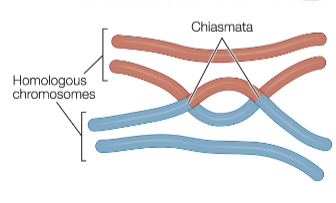
crossing over occurs between homologs at chiasmata
sections of DNA are exchanges (increases genetic variation)
crossing over can occur at any point along the length of the homologous chromosomes —> this exchange is very important in producing genetic diversity
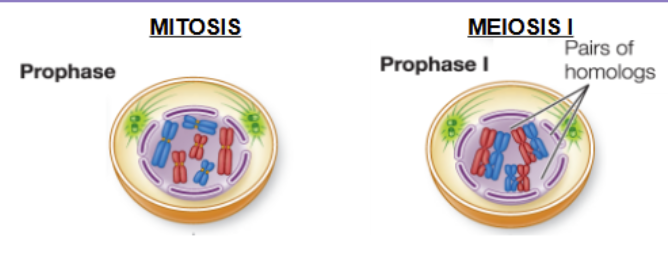
What is genetic recombination?
rearrangement of DNA sequences by breaking and rejoining chromosome segments
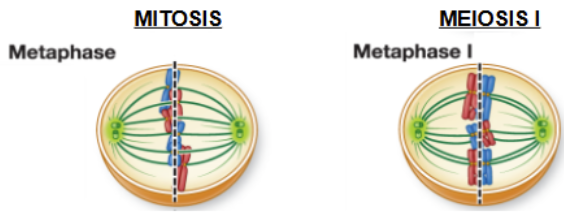
Metaphase vs. Metaphase I
homologous pairs are attached at chiasmata, so they line up together
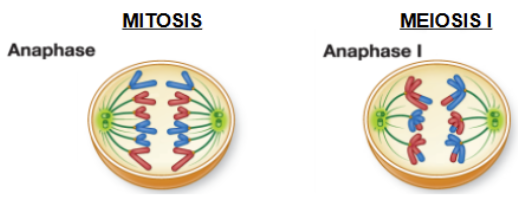
Anaphase vs. Anaphase I
Homologous chromosome pairs are pulled apart —> centrosomes do NOT separate, so each chromosome still contains two sister chromatids
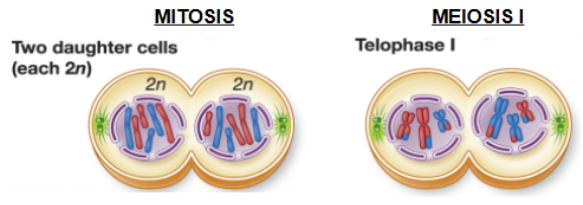
Telophase vs. Telophase I
same process for both
but, meiosis I results in cells containing half the number of chromosomes as the parent cell (one copy of each homologous pair) and those chromosomes are replicated
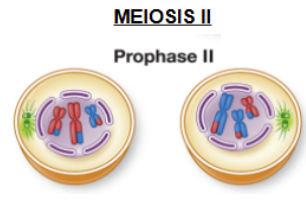
Prophase II
follows cytokinesis
meiosis II is almost identical to mitosis
however, the starting cells are haploid (not diploid)
the resulting daughter cells from meiosis will only get one copy of each chromosome
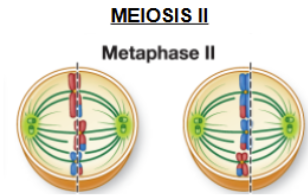
Metaphase II
replicated chromosomes are lined up individually along the equatorial plate by the spindle
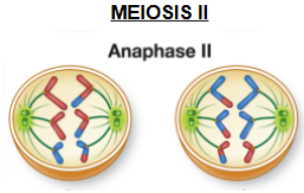
Anaphase II
the chromosomes are pulled in half; daughter chromosomes are segregated into separate cells during Telophase II and cytokinesis
Product of meiosis
four genetically distinct haploid (n) gametes
number cells increases from 1 to 4
number of chromosomes per cell decreases 6 to 3 (for example)
every cell has a unique combination of genetic material
What is aneuploidy?
an abnormal number of chromosomes in a cell
What is nondisjunction?
homologous chromosomes or sister chromatids fail to separate during anaphase
What is the result of nondisjunction?
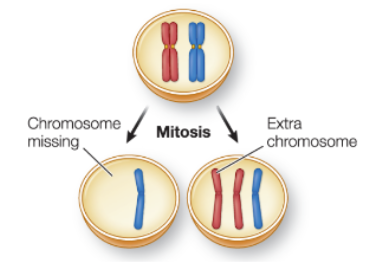
one daughter nucleus has an extra chromosome
one is missing a chromosome
What causes aneuploidy?
nondisjunction
Mitotic aneuploidy common occurs in…
cancer cells
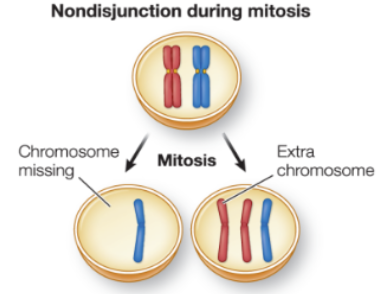
Example of nondisjunction in mitosis
sister chromatids fail to separate —> one cell lacks a red daughter chromosome, and the other has an extra
Example of nondisjunction in meiosis
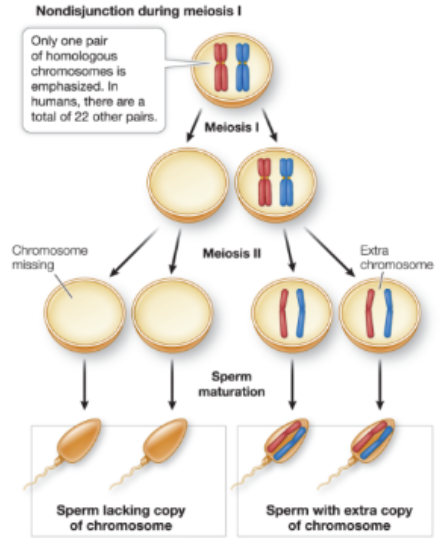
homologous pair fails to separate in Anaphase I —> results in 4 gametes with 2 missing chromosome (n-1) and two with extra copy (n+1)
this can also occur in Anaphase II, with sister chromatids not separating
Nondisjunction in meiosis in sperm
if those sperm fertilize a normal egg..
two monosomic zygotes (2n-1) —> missing chromosome
two trisomic zygotes (2n+1) —> extra chromosome
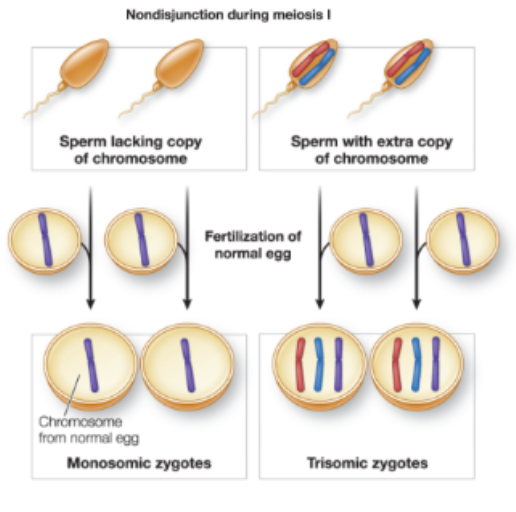
Most human embryos from aneuploid zygotes…
do not survive
What is Trisomy 21?
down syndrome; one of the few viable aneuploidies
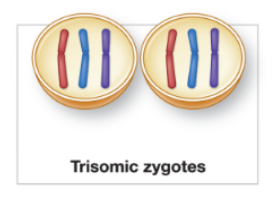
Down syndrome karyotype?
only chromosome 21 is trisomic (extra copy), while all others are diploid; people with down syndrome have 47 chromosomes instead of 46
What is polyploidy?
organisms with triploid (3n), tetraploid (4n), and even higher numbers
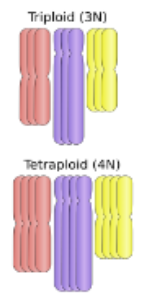
How does polyploidy occur?
failure of the spindle to form
failure of cytokinesis
polyspermy = more than one sperm fertilizes the egg
common in plants and fungi but rarely beneficial in animals
Polyploidy is important in…
agriculture!
What would happen if cell division was unregulated?
Unicellular: population growth and crash (overuse of resources)
Multicellular: cells might not benefit the organism as a whole (could lead to cancer or non-functional tissues)
How is cell division regulated in eukaryotes?
highly regulated by internal signals; 4 checkpoints ensure that the DNA is replicated and passed on properly
G1 checkpoint: requires sufficient resources within the cell, lack of DNA damage, and external signals
S checkpoint: must be no DNA damage and completed replication
G2 checkpoint: must be no DNA damage
M checkpoint
How are checkpoints for regulation regulated?
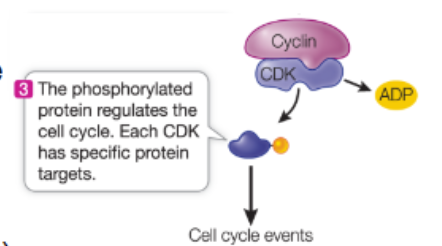
by cyclin-dependent kinases (CDKs)
CDKs are activated by binding to cyclin
cyclins are synthesized when the cell received signals telling it that is can pass through a checkpoint
CDKs phosphorylate checkpoint proteins that regulate these checkpoints
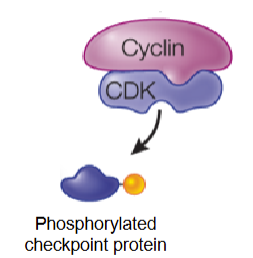
Regulation via CDKs
specific cyclin produced in response to cell signals
cyclin binds to CDK
specific proteins attach are are phosphorylated
phosphorylated proteins then regulate the cell cycle
retinoblastoma protein (RB) blocks cell cycle progression until phosphorylated
Ways cells can die…
necrosis
apoptosis
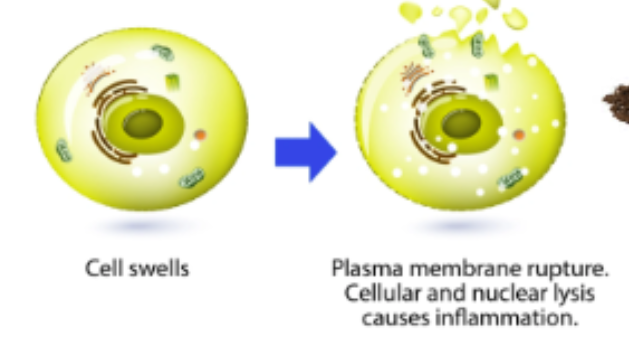
Necrosis
cell is damaged or starved of oxygen/nutrients
cell swells and bursts, causing inflammation
when an organism dies, all of its cells die via necrosis
Apoptosis
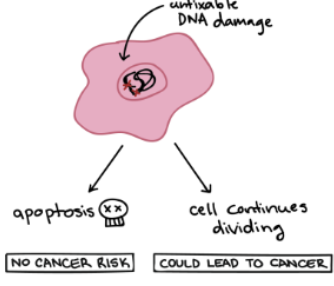
genetically programmed cell death —> beneficial cell death for the organism if the cell is:
malfunctioning
infected
no longer needed
reached its Hayflick limit
most human somatic cells can only divide 40-60x
Cells that lack a Hayflick limit…
stem cells: cells that can develop into many different specialized cells; important for growth and repair of tissues
cancer cells: malignant cells that divide without restraint; do not require external signals or respond to cell cycle checkpoints
What cell cycle regulation mutations can lead to cancer?
all can result in unregulated cell division, which can lead to cancer
cells produce mutated CDKs that do not need cyclins
cells produce cyclins w/o cell division signals
cells lack functional checkpoint proteins
cells lack functional apoptosis machinery