BIO EXAM 1 100%
 Call Kai
 Learn
Learn Practice Test
 Spaced Repetition
 Match
Match Flashcards
 Knowt Play
1/33

There's no tags or description
Looks like no tags are added yet.
Name | Mastery | Learn | Test | Matching | Spaced | Call with Kai | Chat |
|---|
No analytics yet
Send a link to your students to track their progress
34 Terms
Describe an ATOM
An atom is the basic unit of matter. It’s the smallest particle of an element that has that element’s chemical properties. ATOM = nucleus (proton + neutron) and orbitals (electrons)
Describe MOLECULES
Groups of two or more bonded atoms — act as a unit.
Describe ELEMENTS
Pure substances that cannot be broken down further by chemistry. Each element is defined by its number of protons and has unique properties.
Describe COMPOUNDS
Molecules of different elements bonded together.
An atom’s outermost shell…
determines its chemical reactivity. The valence shell (outer shell) determines bonding behavior—atoms with nearly full or nearly empty shells are most reactive.
Atomic mass is determined by…
NUMBER of protons + neutrons in the nucleus
Different elements have different…
valence electron counts
A covalent bond occurs when…
electrons are shared between two atoms to complete their octets. Covalent bonds form by electron sharing, creating a stable configuration for each atom.
Electron transfer forms ___ bonds.
IONIC
Which best describes atoms linked together by an ionic bond?
The negative charge of one atom is attracted to the positively charge of the other atom, creating oppositely charged ions that attract electrostatically.
Lower pH means ___ H+.
Lower pH means higher H+ (hydrogen)
___ bonds are within a water molecule (O—H).
Covalent bonds are within a water molecule
(O—H).
Ice is ___ dense than liquid water (it floats) due to an lattice formed by hydrogen bonds.
Ice is LESS dense than liquid water (it floats) due
to an lattice formed by hydrogen bonds.
Why is water a good solvent?
Polar water molecules surround and interact with polar sugar molecules, helping them dissolve.
‘Like dissolves like’
What demonstrates the property of water cohesion?
Water can move up a tall pine tree from roots to
leaves.
What is the name of this molecule (branched glucose polymer, animal storage)?
Glycogen. A highly branched polysaccharide of
glucose used for energy storage in animals.
Lactose is a __accharide (glucose + galactose)
DISACCHARIDE
Cellulose is an unbranched β-glucose polymer in ___. (ONLY ___!)
PLANT CELL WALLS. ONLY PLANTS!
Fructose is a ___saccharide
MONOSACCHARIDE (single sugar unit)
Sucrose is a ___accharide (glucose + fructose).
DISACCHARIDE
Glucose + fructose → disaccharide via dehydration synthesis
Fatty acids are ___, not sugars.
LIPIDS
Carbohydrates join via ___; ___ removes water to form the bond; ___ adds water to break it.
Carbohydrates join via glycosidic linkages; dehydration removes water to form the bond; hydrolysis adds water to break it.
Carbohydrate molecules…
Carbohydrate molecules are the body's most readily available
source of energy.
Glucose and other carbohydrates are quick
energy sources; they feed directly into glycolysis
and cellular respiration.
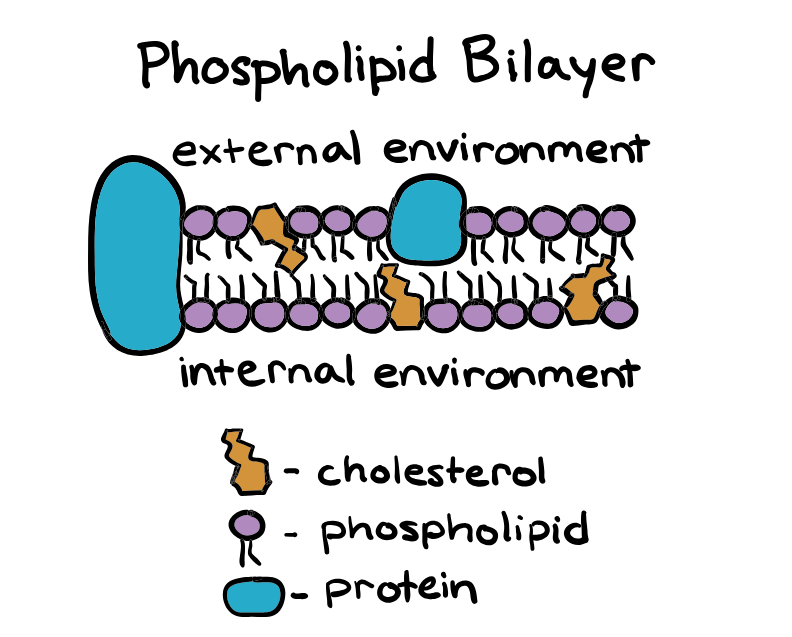
___ (lipids) form membrane core (bilayer)
Phospholipids form membrane core.
The amphipathic property of phospholipids can be described as ________.
a polar region that dissolves in water and a nonpolar
region that faces away from water.
Phospholipids have hydrophilic (polar) heads and
hydrophobic (nonpolar) tails; in water they
arrange into bilayers.
A shortage of steroids in the body would result in a shortage of:
sex hormones and plasma membranes.
Steroids include cholesterol (membrane component) and are precursors to steroid hormones (e.g., estrogen, testosterone).
Triacylglycerols are primary ___ lipids.
Triacylglycerols are primary energy storage lipids.
Glycogen is a ___.
Glycogen is a carbohydrate.
A fatty acid with no double bonds between carbon atoms is…
A fatty acid with no double bonds between carbon atoms is saturated. No C=C double bonds → saturated with hydrogens
Chains are straight and pack tightly (solid fats).
___ has 1 or more double bonds
___ has multiple double bonds
Unsaturated has 1 or more double bonds, Polyunsaturated has multiple double bonds
___ are components of lipids but do
not form bilayers alone.
___ helps regulate fluidity but
doesn’t form the bilayer core.
Fatty acids are components of lipids but do
not form bilayers alone.
Cholesterol helps regulate fluidity but
doesn’t form the bilayer core.
Fluid mosaic model: phospholipid bilayer +
proteins + cholesterol (animals) → ___
permeable!!
SELECTIVELY PERMEABLE
Proteins are polymers of amino acids linked by
___.
• Shape determines ___/___! (Think
paperclip example from class)
Proteins are polymers of amino acids linked by
peptide bonds.
• Shape determines structure/function! (Think
paperclip example from class)
___ build nucleic acids.
Nucleotides build nucleic acids.