PHARM WEEK 4
 Call Kai
 Learn
Learn Practice Test
 Spaced Repetition
 Match
Match Flashcards
 Knowt Play
1/148

There's no tags or description
Looks like no tags are added yet.
Name | Mastery | Learn | Test | Matching | Spaced | Call with Kai | Chat |
|---|
No analytics yet
Send a link to your students to track their progress
149 Terms
Why does chemotherapy cause hair loss, GI upset, and bone-marrow suppression?
It damages all fast-dividing cells (cancer + hair + GI lining + bone marrow).
What is a benign tumor?
Slow-growing + does not metastasize (spread).
What is mesenchyme?
Early tissue that develops into bone + muscle + connective tissue.
Why can chemotherapy cause tumor lysis syndrome (TLS)?
Rapid cancer-cell death → cell contents enter blood → electrolyte problems + ↑ uric acid.
Why does uric acid increase after massive cancer-cell death?
DNA breaks down → uric acid forms.
How can chemotherapy-related uric acid damage the kidneys?
Uric acid crystals collect in kidneys → ↓ urine output + acute kidney injury.
How is kidney injury from high uric acid prevented?
IV fluids + allopurinol.
How does allopurinol work?
Blocks new uric acid formation.
Which findings suggest tumor lysis syndrome?

What class is cyclophosphamide (Cytoxan)?
Alkylating agent (nitrogen mustard).
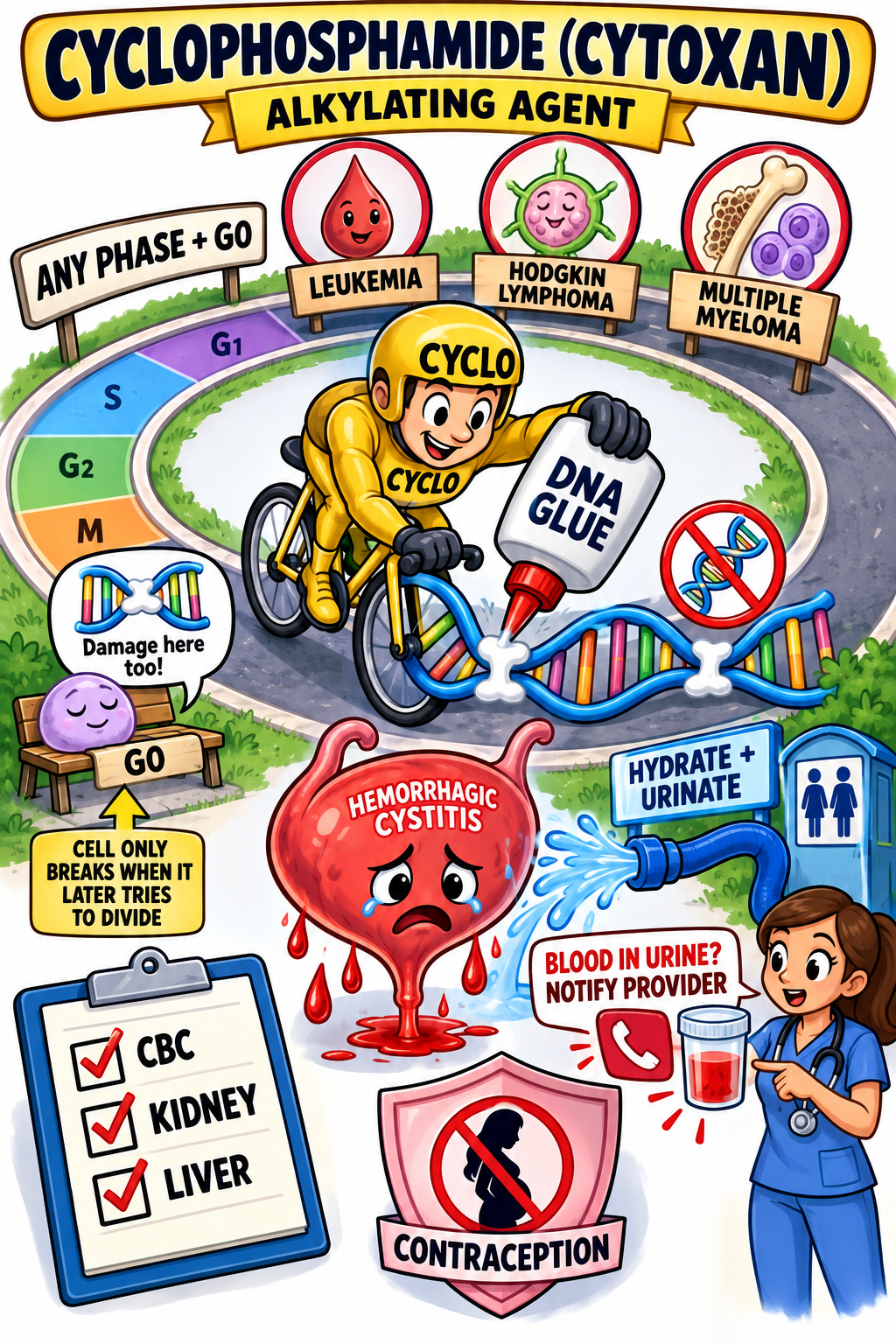
How do alkylating drugs kill cancer cells?
Cross-links DNA → prevents DNA replication + cell division.
Are alkylating drugs cell-cycle specific?
No → damage DNA during any phase (including G₀).
Why might alkylating damage during G₀ not cause immediate cell death?
Damage becomes deadly when the cell later tries to copy DNA + divide.
How does cyclophosphamide work?
Cross-links DNA → stops replication + cell division.
Which cancers may cyclophosphamide treat?
Leukemias + Hodgkin lymphoma + multiple myeloma.
What is cyclophosphamide’s signature toxicity?
Hemorrhagic cystitis (bleeding/inflammation of bladder).
“Cyclo → cystitis.”
How can hemorrhagic cystitis be prevented?
What labs are monitored with cyclophosphamide?
CBC + kidney function + liver function.
What pregnancy teaching is given for cyclophosphamide?
Use contraception during treatment and for the recommended time afterward.

What class is cisplatin (Platinol)?
Platinum alkylating-like agent.
How does cisplatin work?
Cross-links DNA → stops replication → cancer-cell death.
Which cancers may cisplatin treat?
Testicular + ovarian + bladder + lung + head/neck cancers.
What are cisplatin’s major toxicities?
Nephrotoxicity + ototoxicity + severe N/V + neuropathy + bone-marrow suppression.
What is the priority action before cisplatin?
Give vigorous hydration → protects kidneys (prevent nephrotoxicity).
What should the nurse monitor during cisplatin therapy?
Creatinine/BUN + urine output + hearing + sensation + CBC/electrolytes.
Which cisplatin finding is most urgent?
↓ urine output or ↑ creatinine → possible kidney injury.
Before cisplatin, the patient has elevated creatinine and low urine output. What should the nurse do?,
Hold the drug + notify provider.
What teaching should a patient receiving cisplatin understand?
Report ↓ urine + hearing changes + ringing in ears + numbness/tingling.

What class is methotrexate (MTX)?
Antimetabolite → antifolate.
How does methotrexate work?
Blocks folic acid → stops DNA synthesis.
Which cell-cycle phase does methotrexate affect?
S phase (DNA synthesis).
Besides cancer, what condition may methotrexate treat?
Rheumatoid arthritis.
What are methotrexate’s major adverse effects?
Bone-marrow suppression + thrombocytopenia/bleeding + hepatotoxicity; alopecia may occur.
What should a patient avoid while taking methotrexate?
Pregnancy + alcohol.
Why should alcohol be avoided with methotrexate?
Both damage the liver → ↑ hepatotoxicity.
A patient taking methotrexate develops fever and mouth sores. What should the nurse do?
Notify provider → possible toxicity + bone-marrow suppression + infection.
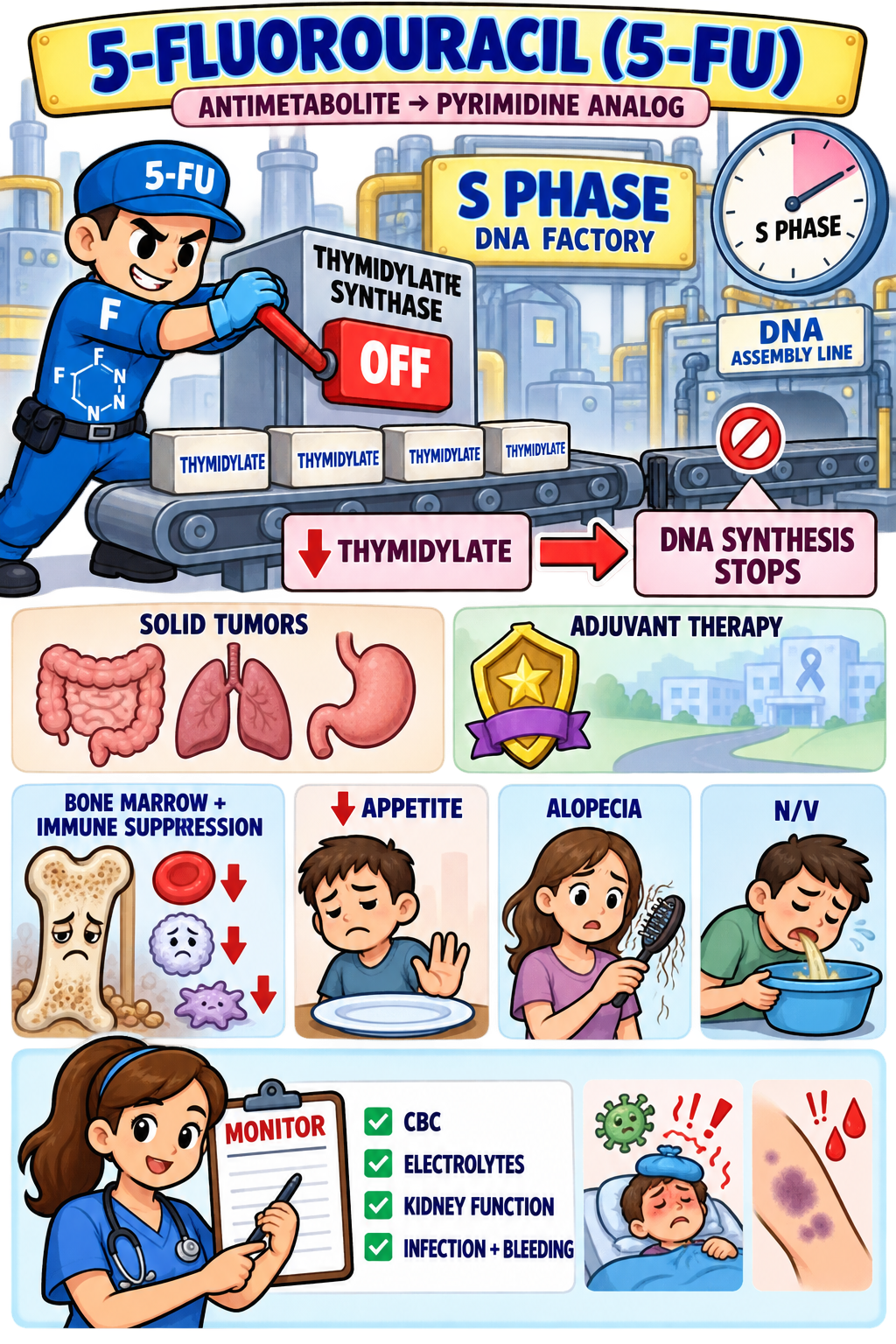
What class is 5-fluorouracil (5-FU)?
Antimetabolite → pyrimidine analog.
How does 5-FU work?
Blocks thymidylate formation → no DNA synthesis.
Which cell-cycle phase does 5-FU affect?
S phase.
What cancers commonly receive 5-FU?
Mainly solid tumors; also used as adjuvant therapy.
What adverse effects occur with 5-FU?
Bone-marrow suppression + infection risk + ↓ appetite + alopecia + N/V.

What class includes doxorubicin and daunorubicin?
Antitumor antibiotics → anthracyclines.
How do anthracyclines work?
Damage DNA → stop cancer-cell growth → apoptosis.
What is doxorubicin’s signature toxicity?
Cardiotoxicity (mnemonic: Doxo damages the heart).
What heart problems can doxorubicin cause?
Dilated cardiomyopathy + heart failure + ↓ LVEF.
Which history is most concerning before doxorubicin?
Heart failure or cardiomyopathy.
Which findings suggest doxorubicin cardiotoxicity?
Dyspnea + crackles + edema + rapid weight gain + fatigue + ↓ LVEF.
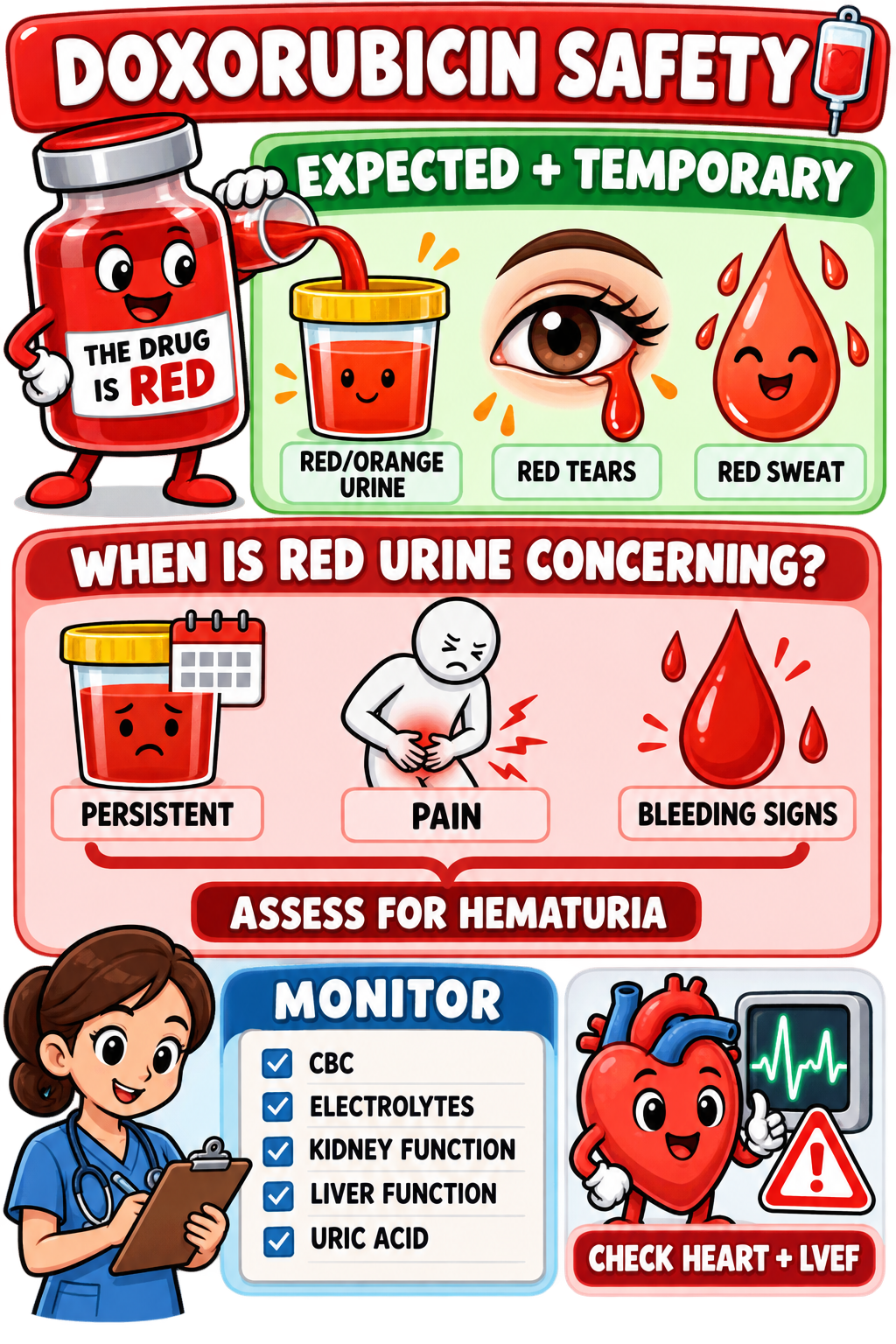
What expected color change may occur with doxorubicin?
Red/reddish-orange urine + sweat + tears.
Why does doxorubicin cause reddish-orange urine?
The drug itself is red (usually expected + temporary).
When is red urine after doxorubicin concerning?
When it persists or occurs with pain/bleeding signs → assess for hematuria.
What labs are monitored with anthracyclines?
CBC + electrolytes + kidney function + liver function + uric acid.

What class includes vincristine and vinblastine?
Vinca alkaloids → mitotic inhibitors.
How do vinca alkaloids work?
Disrupt microtubules during mitosis → M-phase arrest + apoptosis.
What is vincristine’s main toxicity?
Neurotoxicity/peripheral neuropathy.
(mnemonic: VinCRISTINE → CRIppled nerves).
What is vinblastine’s main toxicity?
Bone-marrow suppression.
How are vincristine and vinblastine different?
Vincristine → more nerve damage; vinblastine → more bone-marrow suppression.
Which findings suggest vinca-drug neurotoxicity?
Tingling + numbness + burning pain + muscle weakness + unsteady gait + ↓ reflexes.
A patient receiving vincristine develops muscle weakness. What should the nurse do?
Notify provider → possible neurotoxicity.
Why is central venous access preferred for vinca drugs?
Extravasation can cause severe tissue damage.
What is the most important vincristine administration warning?
IV only; never give intrathecally (fatal).

What class is tamoxifen (Soltamox)?
Selective estrogen receptor modulator (SERM).
How does tamoxifen treat breast cancer?
Competes with estrogen at receptors → slows estrogen-dependent tumor growth.
Who may receive tamoxifen?
Premenopausal + postmenopausal patients with ER-positive breast cancer; may prevent cancer in high-risk patients.
What are tamoxifen’s most serious risks?
DVT + PE + uterine/endometrial cancer
DVT; sudden dyspnea/chest pain → PE; abnormal vaginal bleeding → uterine cancer.