ACLS PALS (Study Guide version)
 Call Kai
 Learn
Learn Practice Test
 Spaced Repetition
 Match
Match Flashcards
 Knowt Play
1/37

There's no tags or description
Looks like no tags are added yet.
Name | Mastery | Learn | Test | Matching | Spaced | Call with Kai | Chat |
|---|
No analytics yet
Send a link to your students to track their progress
38 Terms
Cardiac Arrest vs. Myocardial Infarction (MI)
which is electric and ischemic
Can one lead to the other
CA: Sudden, abrupt loss of heart function (cardiac electrical malfunction) w/ unexpected timing
Electrical system malfunction
MI: Death/dysfunction of myocardial tissue due to ischemia
Ischemic tissue damage
MI is a predisposing heart condition that can trigger cardiac arrest
List the 5 Hs and Ts (underlying causes of cardiac arrest)
Hypovolemia | Toxins | |
Hypoxia | Tamponade (cardiac) | |
Hydrogen ion (acidosis) | Tension pneumothorax | |
Hyper/Hypokalemia | Thrombosis (coronary/MI) | |
Hypothermia | Thrombosis (pulmonary/PE) |
What are the steps in cardiac arrest Chain of Survival
Early recognition/activation of emergency response
Early high quality CPR
Rapid defibrillation
Basic and advanced EMS/resuscitation
Post-arrest care
How does timing affect outcomes
Earlier each link occurs, the better the outcome
Survival drops rapidly with delays in CPR/defibrillation
Adult BLS healthcare provider steps
Ensure scene safety
Check responsiveness
Shout for help/activate emergency response
Retrieve AED (automated external defibrillator)
Check breathing & pulse
Immediately begin CPR
2 person CPR when 2nd rescuer arrives
Apply AED, follow prompts to shock
When/who should get AED
Lone rescuer retrieves AED first
If not alone, send someone else and start CPR
Apply as soon as available and shock if rhythm is shockable
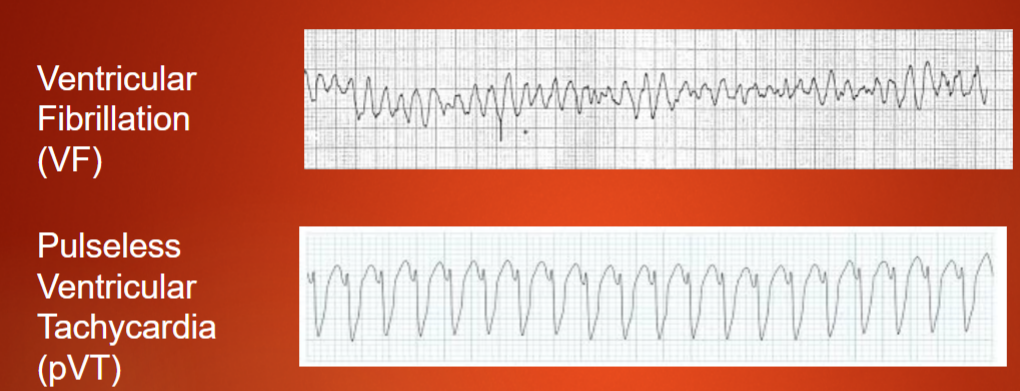
Which cardiac arrest rhythms are shockable
Ventricular Fibrillation (VF)
Pulseless Ventricular Tachycardia (pVT)
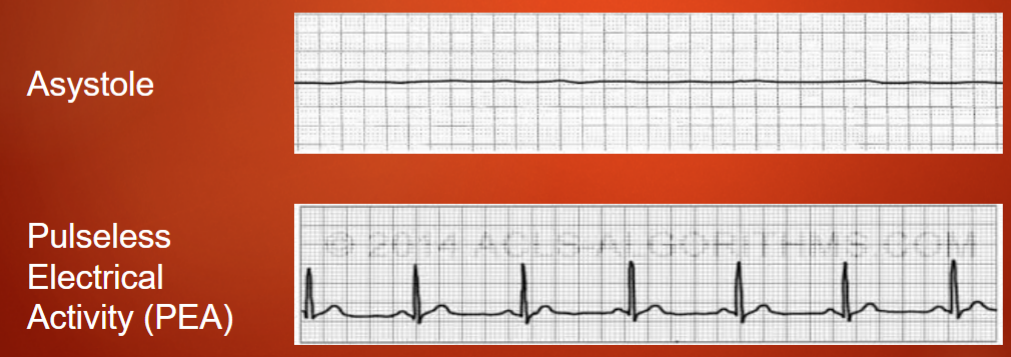
Which cardiac arrest rhythms are non-shockable
Asystole
Pulseless Electrical Activity (PEA)
Cardiac arrest medication
1st: Epinephrine 1mg IVP Q 3-5min (no max dose)
2nd: Amiodarone 300mg first dose, may repeat once with 150mg (max 2.2g/day)
given after first round of epinephrine
Alternative: Lidocaine
What do you check for with each cycle
Rhythm (every 2 mins) and pulse
HR typically at or above how many bpm
Tachycardia ≥ 100bpm
Symptomatic/unstable ≥ 150bpm
Main non-pharm intervention for tachycardia
Synchronized cardioversion
Vagal maneuvers
for Supraventricular Tachycardia (SVT) specifically
Initial medication to slow conduction (HR)
Adenosine
Beta blockers/ND-CCBs for what type of arrythmias
Stable, narrow complex tachyarrhythmias
Afib
Aflutter
SVT
Sinus tachycardia
Bradycardia is HR below how many bpm
HR < 50bpm (causing symptoms)
Main non-pharm intervention for bradycardia
Transcutaneous pacing (TCP)
Transvenous pacing (TVP) may be used if not responsive to TCP
Medications to increase HR
Atropine
Dopamine and Epinephrine if persistent bradyarrhythmia with symptoms
Main difference with pediatric cardiac arrest
Weight based dosing throughout
Lower initial defibrillation energy (2J/kg up to 4J/kg, max 10J/kg)
Epinephrine dosed 0.01 mg/kg
ECPR considered for in hospital arrest w/ a cardiac diagnosis
Define the following
Appropriate compression rate
Compression depth
Compression to ventilation ratio for adult patient
100-120/min
At least 2 inches
No advanced airway- 30:2
Advanced airway- 1 breath every 6 seconds
Describe Extracorporeal Membrane Oxygenation & Extracorporeal CPR (ECMO/ECPR)
ECMO- temporary life support machine that pumps and oxygenates a patient's blood outside the body
ECPR- emergency procedure that uses a specific type of ECMO during a cardiac arrest
Venoarterial ECMO used during cardiac arrest
requires adequate vascular access and specialized equipment
Replaces chest compressions and the advanced airway/rescue breaths
Are ECMO/ECPR preferred/recommended over an advanced airway
NO
insufficient evidence to rec routine use
may be considered where it can be rapidly implemented
What are the four cardiac arrest rhythms
Which are shockable and non-shockable
Shockable
Ventricular Fibrillation (VF)
Pulseless Ventricular Tachycardia (pVT)
Non-Shockable
Asystole
Pulseless Electrical Activity (PEA)
Epinephrine
Class
Indications- Emergency situation & Rhythms
ADRs
Sympathomimetic
Used in any pulseless cardiac arrest (emergency situation) and all rhythms
Tachyarrhythmias, Myocardial ischemia, Hypokalemia, Tremors
Amiodarone
Class
Indications- Emergency situation & Rhythms
ADRs
Antiarrhythmic (Class III)
Used in cardiac arrest after first round of Epi
Shockable rhythms: VF or pVT
Hypotension, Bradycardia, Negative inotropic effects
Lidocaine
Class
Indications- Emergency situation & Rhythms
ADRs
Antiarrhythmic (sodium channel blocker)
Alternative to amiodarone
Cardiac arrest and shockable rhythms (VF & pVT)
Hypotension, Bradycardia, Negative inotropic effects
What is used for Hypovolemia
Fluid boluses (NS, LR)
Colloids (albumin)
What is used for Hyperkalemia
Calcium chloride
Insulin plus dextrose
Sodium bicarbonate
What is used for Metabolic Acidosis
Sodium Bicarbonate
What is used for Thrombosis
Thrombolytics (e.g. Tenecteplase)
Epinephrine dosing Adult vs. Pediatric
Adult: 1mg IVP every 3-5 min (no max)
Pediatric: 0.01 mg/kg (0.1 mL/kg of 1:10,000) IV/IO every 3-5 min
ET route 0.1 mg/kg (0.1 mL/kg of 1:1000)
What is the preferred route of administration
IV
Central line preferred
Peripheral IV acceptable if no central access
First alternative route of administration
IO (intraosseous)
Last option route (for some meds)
ET (endotracheal) - last resort
Treatment for Torsades de Pointes
Polymorphic ventricular tachycardia
QTc Prolongation is precursor
Magnesium Sulfate 1-2g IVP over 1-2 min (may repeat)
Types of tachycardia
Atrial vs. Ventricular
Narrow vs. Wide complex (wide ≥0.12 sec)
Regular vs. Irregular
Monomorphic vs. Polymorphic
How do differences impact non-pharm and pharm treatment in tachycardia
Narrow/Regular is treated w/ adenosine or vagal maneuvers
Wide/Irregular gets unsynchronized defibrillation
Stable narrow complex gets Beta blockers/ND-CCBs
Cardioversion energy differs by width/regularity
Narrow Regular: 50-100J
Narrow Irregular: 12-200J
Wide Regular: 100J
Types of Bradycardia
Sinus bradycardia
1st degree AV block
2nd degree AV block Type I (Wenckebach)
2nd degree AV block Type II
3rd degree (complete) AV block
How do differences impact non-pharm and pharm treatment in bradycardia
All types can be treated w/ Atropine/pacing if symptomatic
Higher grade blocks (2nd Type II & 3rd) more likely to need pacing since they are less responsive to atropine