QUIZLET COPY GI
 Call Kai
 Learn
Learn Practice Test
 Spaced Repetition
 Match
Match Flashcards
 Knowt Play
1/73

There's no tags or description
Looks like no tags are added yet.
Name | Mastery | Learn | Test | Matching | Spaced | Call with Kai | Chat |
|---|
No analytics yet
Send a link to your students to track their progress
74 Terms
Murphy's Sign
-Examine for ...
-How to:
-Positive sign =
-Examine for cholecystitis
-Deep palpation of RUQ along subcostal margin, ask patient to take a deep breath
-Positive sign = sharp, sudden pain and/or cessation of inspiration due to the inflamed gallbladder being pushed against your hand

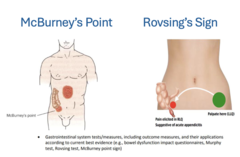
McBurney's Point/Sign
-Examine for ...
-How to:
-Positive sign =
-Examine for appendicitis
-Anatomical landmark located 1/3 of the way between right ASIS and umbilicus
-Positive sign = pain/tenderness present and may be increased by direct palpation
Kehr's Sign
-Examine for ...
-Positive sign =
-Examine for splenic rupture
-Positive sign = palpation of LUQ elicits left shoulder pain
-May also indicate diaphragm or other peritoneal pathology

Aortic Aneurysm
Abnormal dilatation or outpouching of vessel wall due to degeneration or weakening of the elastin and protein fibers
Thoracic aortic aneurysm
-above diaphragm
-more life threatening
Abdominal aortic aneurysm (AAA)
-occur 4x more often than thoracic
-carry significant familial risk
Aortic Aneurysm & Dissection
-Palpation
-Palpation just left of umbilicus for enlarged, pulsating mass greater than 3 cm
Dissection/Rupture
Intimal tear creates a false lumen between the layers of the vessel wall, most likely to occur in aneurysms > 5cm
Aortic Aneurysm & Dissection: S&S
This is a medical emergency!
sudden, excruciating chest or upper back pain that migrates superior or inferior based on path of dissection, cardiogenic or hypovolemic shock, syncope, hypertension, reduced or absent pulses, murmur of aortic regurgitation, pleural effusion, neurologic compromise
Management of Aneurysm
-Nonsurgical: pharmaceutical (antihypertensives, anticoagulants)
-Surgical: resection, grafting, or repair via endovascular access or open incision
GI Diagnostic Procedures
Xray, CT, MRI, ultrasound, endoscopy, colonoscopy
endoscopy
scope entered through esophagus to duodenum to view stomach
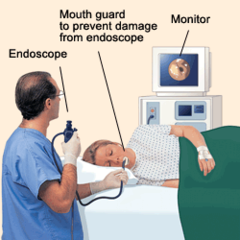
colonoscopy
examination of the colon using a flexible colonoscope

Pneumoperitoneum
-what is it?
-what causes it?
-irration of ... causes...
-Free air or gas within the peritoneal cavity
-Common after laparoscopic surgery due to use of CO2 to inflate the abdomen leaves residual air bubbles behind
-Irritation on the phrenic nerve causes referred pain to shoulders (more commonly right side)
Typical Abdominal Surgical Precautions
-Do not ... items .. pounds
-Avoid movements that ...
-... for bed mobility
-... may be the most comfortable position while in bed
-Do not....
-Encourage ..
-Avoid ...
-An ... may be indicated
-Do not lift, push, pull items > 10 pounds
-Avoid movements that require you to over activate or stretch your abdominal muscles (Sitting straight up from a supine position, overtwisting your trunk, overextending backward)
-Logroll for bed mobility
-A pillow under the knees or sidelying may be the most comfortable position while in bed
-Do not bear down or hold your breath, splint with a pillow for coughing
-Encourage at least 3-5 "walks" per day: Mobility = Motility
-Avoid low seated surfaces
-An abdominal binder may be indicated
Antiemetic
prevents nausea and vomiting
1. ondansetron (Zofran)
2. metoclopramide (Reglan)
Antidiarrheal
1. atropine (Lomitil)
2. loperamide (Imodium)
GI irritation
famotidine (Pepcid)
Laxatives
1. psyllium (Metamucil)
2. docusate (Colace)
3. mineral oil (Fleet enema)
4. Fleet glycerin suppositories
5. lactulose
6. MiraLax
7. Dulcolax
8. Senokot
Proton Pump Inhibitors
1. omeprazole (Prilosec)
2. esomeprazole (Nexium)
3. lansoprazole (Prevacid)
4. pantoprazole (Protonix)
Esophageal Conditions: Dysphagia
Difficulty swallowing
-Oropharyngeal or esophageal
-Neuromuscular or structural
Esophageal Conditions: Dysphagia
diagnostic procedures
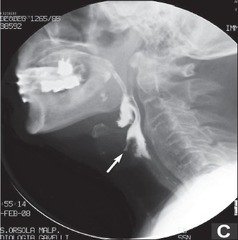
1. Barium Swallow Study
2. manometry
3. Esophagogastroduodenoscopy (EGD)
4. Upper GI Xray Series
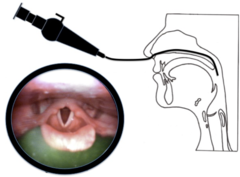
5. fiberoptic endoscopic evaluation of swallowing (FEES)
Fiberoptic Endoscopic Evaluation of Swallowing (FEES)
a laryngoscopic technique for viewing swallowing
Barium Swallow Study
Diagnostic procedure to assess the upper gastrointestinal tract
Esophageal Conditions: Dysphagia treatment
Airway protection & nutrition maintenance is the priority
-Alternative means of nutrition
-Modified diet consistency
Dysphagia: PT consideration
caloric deficit impacting activity tolerance, fluid & electrolyte imbalance, positioning to reduce risk of aspiration
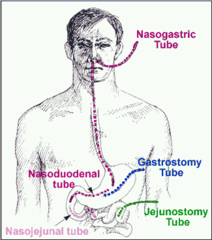
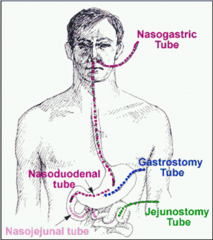
Enteral nutrition
Administered through a variety of tubes & routes directly into GI system
Parenteral nutrition
-Administered through ... with long-term usage requiring ...
-Terminate in the ... for ...
· Also used for ...
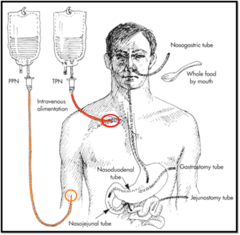
-Administered through intravenous access with long-term usage requiring central venous catheter (CVC)
-Terminate in the heart for direct administration of nutrition
· Also used for medications and therapeutic procedures
Enteral nutrition includes
NG, PEG, PEJ
Parental nutrition includes
CVC: Groshong, Hickman, port
Peripherally inserted central catheter (PICC)- typically in upper arm
Nasograstric tube (NG)
tube inserted through the nose into the stomach

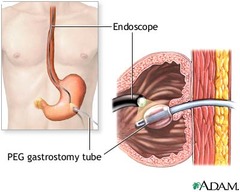
PEG tube (percutaneous endoscopic gastrostomy)
an endoscopic procedure in which a tube is passed into a patient's stomach through the abdominal wall and mostly provides a means of feeding or oral intake
PEJ tube
percutaneous endoscopic jejunostomy tube - feeding tube
Varices
-what is it?
-strong association with:
-risk for:
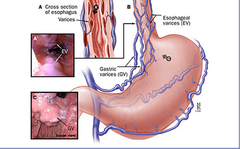
-Dilated blood vessels in the lower third of the esophagus
-Strong association with portal hypertension, alcohol abuse, liver disease
-Risk for hemorrhage - eventual need for banding and/or resection
Varices
PT considerations
monitor for s/s of bleeding
Vomiting blood
hematemesis
Vomiting blood
Esophagectomy
-what is it?
-when is it used?
-invasiveness?
-the surgical removal of all or part of the esophagus
-esophagectomy is only primary treatment following chemotherapy and/or radiation
(for esophageal cancer)
-Advancements in minimally invasive surgery, but classically a very invasive, intense procedure with open incisions and thoracotomy
Esophagectomy
oral intake
Restricted oral intake until safe airway is established and diagnostics reveal no "leaks"
Esophagectomy PT considerations
PT Considerations: airway clearance, safe positioning to reduce aspiration risk, normal to have chest tube and surgical drain(s), standard postoperative effects
Stomach Conditions: Hemorrhage
-Upper (UGIB):
-commonly caused by:
-Upper (UGIB): esophagus, stomach, duodenum
-Commonly caused by ulcers, erosion, varices
-Peptic ulcer disease (PUD): most commonly caused by H. pylori infection or chronic NSAID use
(UGIB) Hematemesis
Hematemesis: fresh, bright blood in vomit
(UGIB) coffee ground emesis
"coffee ground" emesis: dark, gastric-acid exposed blood
(UGIB) Melena
Melena: black, tarry feces from blood moving through the entire GI tract - strong, rotten iron-like odor
(UGIB) Stomach Conditions: Hemorrhage
interventions:
PT considerations:
Interventions: blood transfusions, surgery to resect or cauterize the source
PT Considerations: immediate notification, monitor CBC, dietary restrictions
Stomach Conditions: Cancer
most common malignant tumor
Adenocarcinoma is most common malignant tumor - very rare for benign tumors
Stomach Conditions: Cancer
.... following chemo and radiation
Gastrectomy and anastomosis following chemotherapy and/or radiation
Stomach Conditions: Cancer
PT considerations
PT Considerations: dietary restrictions, standard postoperative effects
Intestinal Conditions: Hemorrhage
Lower (LGIB):
Lower (LGIB): colon or anorectum
Intestinal Conditions: Hemorrhage (LGIB)
-commonly caused by
-diagnostic procedures
-Commonly caused by inflammatory disease, ischemia, colitis, lesions (hemorrhoids), polyps, or cancer
-Diagnostic Procedures: endoscopy, colonoscopy, or both
Intestinal Conditions: Hemorrhage (LGIB):
S&S
-Hematochezia: fresh, bright blood in feces
-Bright red blood per rectum (BRBPR)
Intestinal Conditions: Hemorrhage (LGIB):
intervention
PT considerations
-Interventions: blood transfusions, surgery to resect or cauterize the source
-PT Considerations: monitor CBC, watch for S/S during bowel movement, dietary restrictions
Varices: CBC
pt presents with...
RBC, hemoglobin, and hematocrit decrease
acute anemia
pt presents with pallor, fatigue, and decreased activity tolerance
ileostomy/colostomy
Diseased section of colon or ileum removed + stoma + bag

Intestinal Conditions: Inflammatory diseases
nonsurgical
-Pharmacological agents to treat bowel symptoms and source of inflammation or infection
-Dietary and activity modifications
-Psychotherapy
Intestinal Conditions: Inflammatory diseases
surgical
-Resection with or w/out ostomy creation
-Parastomal hernia occurrence is nearly 50%
-Ostomy may be permanent or reversed later depending on disease process
Intestinal Conditions: Inflammatory diseases
PT considerations
PT Considerations: identify lines and drains, communicate with nursing to manage ostomy bag contents, monitor fluid & nutritional intake, electrolyte panel, standard postoperative effects
Abdominal Hernia common locations
inguinal, femoral, ventral, incisional, umbilical
Abdominal Hernia types
-Reducible: contents replaced within the surrounding musculature
-Irreducible or incarcerated: cannot be replaced
-Strangulated: compromised circulation, potentially fatal
Abdominal Hernia S&S
Distension, N/V, observable or palpable bulge, paresthesia with nerve compression, pain
Abdominal Hernia
nonsurgical
surgery
-Nonsurgical management in asymptomatic cases
-Surgery: reduction with reinforcement using mesh, wiring, fascia, or muscle flap
Abdominal Hernia
PT considerations
strict adherence to abdominal precautions, consider muscle flap source to avoid overuse, very commonly will use abdominal binder for external cueing and surgical site reinforcement
Hiatal Hernia is
Protrusion in an upward direction through the esophagus hiatus of the diaphragm into the thoracic cavity
Hiatal Hernia
S&S
Mimic *GERD*, dysphagia, epigastric or chest pain, dyspnea, hoarseness
Hiatal Hernia
-Nonsurgical management:
-Surgery:
-Nonsurgical management: lifestyle modifications and acid-reducers
-Surgery: reduction and repair
Hiatal Hernia
PT
-mixture of esophageal positions and abdominal precautions
-diaphragmatic breathing likely painful (accessory m breathing is okay)
Intestinal Conditions: Obstruction
mechanical
adhesions, tumor, herniation, inflammation
Ileus
Functional inhibition of normal bowel propulsion and motility most commonly caused by surgery, hypokalemia, peritonitis, trauma, spinal fractures, narcotics
(constipation after surgery)
Intestinal Conditions: Obstruction
S&S
Sudden onset of crampy pain, distension, N/V, lack of gas or bowel movements, high-pitched or absent bowel sounds
Intestinal Conditions: Obstruction
-Nonsurgical management:
-Surgery
-Nonsurgical management: NG or OG tube suction
"stomach pumping"
-Surgery: resection of blockage
Intestinal Conditions: Obstruction
PT
drain management, Mobility = Motility, monitor fluid & electrolytes due to quick shifts in fluid balance
Intestinal Conditions: Tumors
-... that may affect...
-Colorectal cancer is...
-Commonly associated with ...
-Benign, malignant, or metastatic neoplasms that may affect normal GI motility and function
-Colorectal cancer is third most common cancer worldwide
Second leading cause of cancer-related death
-Commonly associated with genetic predisposition and lifestyle factors as risk ↑ with age
Intestinal Conditions: Tumors management
-Resection with or w/out ostomy creation with chemotherapy and/or radiation
-Ostomy may be permanent or reversed later depending on disease process
Anorectal Conditions
-similar...
-includes:
-Similar etiologies & management as intestinal conditions
-Inflammation, obstruction, perforations, fistula, fissure, hemorrhage, tumor
Anorectal Conditions
S&S
PT:
-Most common sign is painful bowel movement & bloody stools
-PT Considerations: only difference is for transanal surgical approach which may restrict ability to sit and/or type of sitting surface