PHARM ANA
 Call Kai
 Learn
Learn Practice Test
 Spaced Repetition
 Match
Match Flashcards
 Knowt Play
1/129

There's no tags or description
Looks like no tags are added yet.
Name | Mastery | Learn | Test | Matching | Spaced | Call with Kai | Chat |
|---|
No analytics yet
Send a link to your students to track their progress
130 Terms
Any substance or combination of substances presented as having properties for treating or preventing disease in human beings/ and or animals. Closely resembles drug definition
Medical product / Drug product
Medical product / Drug product is any substance or combination of substances that may be used in or administered to human beings and/or animals with a view either restoring, correcting or modifying physiological functions by exerting a ___, ___, or ___, or to making a ___.
pharmacological, immunological, metabolic action, medical diagnosis
___+ ___ = MEDICAL PRODUCT
API
EXCIPIENT
also medical products but the difference is that these lack clinical trials
Food and health supplements
Any substance or combination thereof, intended to be used for manufacturing of a medical product
API
API aims to:
○ Furnish a pharmacologic activity in the diagnosis, cure, mitigation, treatment or prevention of disease
○ Affect the structure and function of the body
Any constituent of a medicinal product that is inactive. Should ideally be ___
Excipient
inert
Excipient is intended for:
○ Ensure ease of use and production.
○ Ensure absorption of API
○ Ensure preparation has an acceptable shelf-life
○ Ensure good palatability
is defined as the process in which different chemical substances, including active ingredient and excipients, are combined to produce a final medical product. It aims to develop a preparation that is both stable, and acceptable to the patient (in terms of ___)
Formulation
good bioavailability
___ was once indicated for ___ but later on was discovered to have hair growth properties.
Minoxidil
HPN (hypertension)
A branch of analytical chemistry that uses various techniques to evaluate the quality, safety, and efficacy of pharmaceutical products
Pharmaceutical analysis
Involves a series of processes for the identification, determination, quantitation, and purification of substances or combination of substances.
Pharmaceutical analysis
Pharmaceutical analysis is the main function of ___ in the field of ___
Quality Control
industrial pharmacy
what are the difference of Pharmaceutical analysis and Analytical chem?
Analytical chem focuses on biological specimens
defined as the needs of the patient with regards to their medication therapy needs.
Pharmaceutical care
Pharmaceutical care four distinct components:
○ The medication is appropriate
○ The medication is safe
○ The medication is effective
○ The patient is adherent/compliant
contracted for transfer of technology. These companies manufacture products for other companies.
Toll manufacturers
Pharmaceutical care in systems level
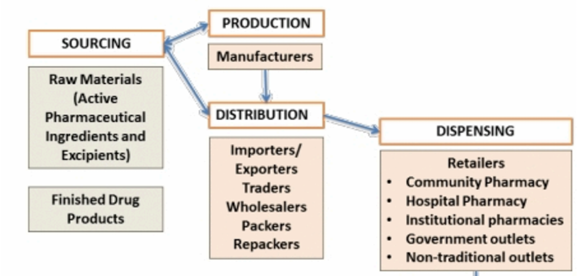
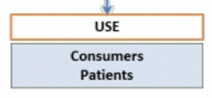
Pharmaceutical care in patient level
Totality features. Conformance to standards and specifications
Quality
The manufacturer’s internally-made requirements for the product and approved by regulatory bodies.
Specifications
The official requirements and for raw materials and finished product. Specification for the general use
Standards / Monograph
collection of monograph
compendia
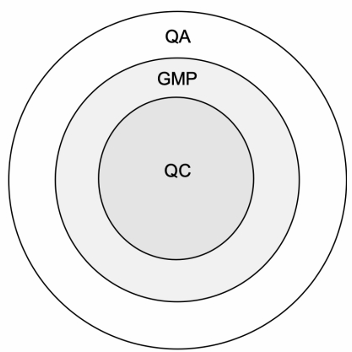
A wide-ranging concept, which covers all matters that influence quality of the product. Oversees the manufacturing firm. This includes ___
Quality Assurance
Auditing
Ensures consistency and control of products produced through appropriate quality standards and specifications. Has ___ (but focuses more on ___). This includes ___
Good Manufacturing Practice
9 chapters
production
Performance evaluation
Part of the GMP concerned with sampling, specifications and testing, and with the organization, documentation and release procedures.
Quality Control
Monograph/standards include
identity
strength/potency
purity
performance
To identify if the API is the medicine that it claims to be
Identity
To quantify the labelled claim
Strength/Potency
To determine the impurities that may be present in a medicine.
Purity
To predict and demonstrate the pharmacokinetics of a medicine. Involved in ___
Performance
FPQC
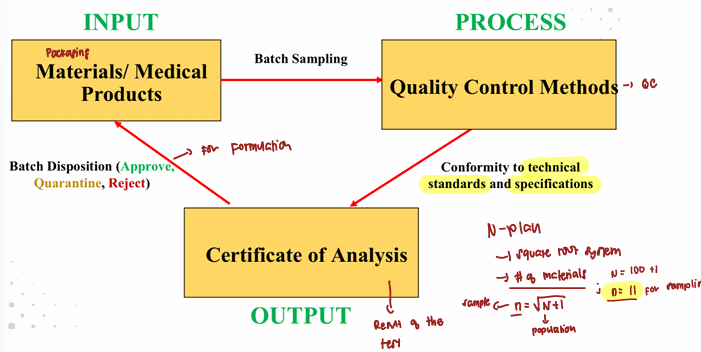
document that is given after QC is completed which shows all the total tests done in the batch sample
Certificate of analysis
Input, process, output cycle
Assures that policies are followed. Cooperates with ___ (e.g., PIC/S, GMP, GLP, FDA, etc.) FPQG. Prepares the ___. Perform ___. ___-based
QA
regulatory agencies
Quality Manual and SOPs
Audit and Monitoring
Process-based
Tests compliance of raw materials, and packaging materials. Perform ___. Monitors environmental procedures. ___-based
QC
in-process quality control (IPQC), raw material quality control (RMQC), and finished product quality control (FPQC)
Product-based
Validation Parameters includes:
Accuracy
Precision
a test if it is fit for its intended use
ANALYTICAL VALIDATION PARAMETERS
Refers to the closeness of test results to the true value
Accuracy
Degree of agreement among individual tests when the method is applied repeatedly to multiple samplings of a homogenous sample
Precision
types of precision
INTRA-ASSAY PRECISION
INTRA-LABORATORY PRECISION
INTER-LABORATORY PRECISION
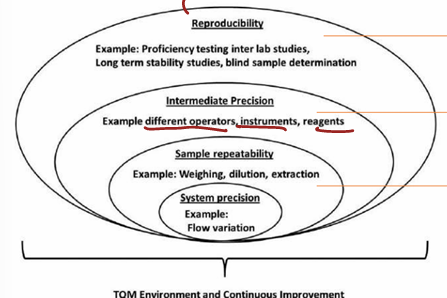
Sample repeatability. ex: Weighing, dilution, extraction
INTRA-ASSAY PRECISION (diff lab; repeatability)
Intermediate Precision. ex: Different operators, instruments, reagents
INTRA-LABORATORY PRECISION (within the same lab)
Reproducibility. ex: Proficiency testing inter lab studies, Long term stability studies, blind sample determination. Where transfer of technology happens
INTER-LABORATORY PRECISION (reproducibility)
Capacity to remain unaffected by deliberate variations in methods
Robustness/ Rigidity (ruggedness)
Ability to assess the analyte in the presence of other substances. What sets it apart, assesses purity
Specificity
Ability to discriminate between small differences in analyte concentration
Sensitivity
Produce results directly proportional to the concentration of the analyte
Linearity
Lowest and highest concentration of your analyte where you can produce accurate, precise and linear results.
Range
2 methods for test of impurities
LOD: limit of detection
LOQ: limit of quantitation
Reveals the identity of the elements and compounds in a sample. Presence or absence of a component. ex: Phytochemical screening
Qualitative Analysis
Indicates the amount/ concentration/ potency of each substance in the sample. Aka?
Quantitative Analysis
ASSAY
Amount of Sample
Ultramicro ( < 1 mg)
Micro (1-10 mg)
Semimicro/Meso (10-100 mg)
Macro (> 100 mg)
Amount of Sample (Analyte level)
Major (1-100%)
Minor (0.1-1%)
Trace (100 ppb -100 ppm)
Ultratrace ( < 100 ppb)
2 types of sample desired
Proximate Analysis
Ultimate Analysis
identifying a class/group of substances ■ ex: assay of flavonoid content in plants
Proximate Analysis
identifying a specific substance/compound. ex: total caffeine assay test, carbon content of gasoline, atropine content of deadly nightshade
Ultimate Analysis
3 types of material
Chemical - chemical reactions/reagents
Biological - living organisms/systems
Physical - particle size, melting/boiling point / help of instruments
Nature of Method
Classical - Titrimetry (general or chemical method)
Instrumental - UV-Vis (based on physical)
Special/Miscellaneous - moisture content (water content for crude drugs)
Identity Tests
Physical Method - specific gravity, refractive index, optical rotation
Chemical Method - visible reactions
Gross Physical Appearance - organoleptic
Limit Tests
Gross Impurities - gross dirt, insoluble matter
Chemical Impurities - trace metals, ion, degradation products
Biological Impurities - viable microbes (specific to non-specific strains), metabolic products
Potency
Instrumental Methods - HPLC, UV Spectro, Gas Chromatography
Chemical - Titrimetric
Biological Method - live animals, excised organs or tissues, biological products such as proteins, blood
Packaging
Material type – plastic, glass
Special properties – transparent, collapsible, easy to drain
Integrity – lightness, bulk-free
Dosage-Form Specific Tests
Tablets, capsules – dissolution, disintegration
Implants – disintegration
Parenteral – BET/ LAL, tonicity test
visible reactions, detection of incidences of adulteration (debasement/lowering the quality of article)
Chemical
Addition of inferior material
Sophistication/true adulteration
Entirely different from one requested
Substitution
Add through accident, ignorance, carelessness
Admixture
Quality destroyed by microorganism
Spoilage
Quality impaired due to environment, insects, etc.
Deterioration
assessment of the material based on physical properties
Physical
ratio of density of a substance to that of a reference substance at a specified volume and temperature • Evaluated using a ___.
Specific Gravity
pycnometer
description of how light propagates through a medium • measured within a controlled wavelength and temperature • using an ___ • for liquid dosage forms
Refractive Index
ABBE refractometer
ability of the substance to rotate plane polarized light • measure in the angle of rotation that may be positive or negative • Evaluated using a ___. • Remember racemic mixtures (50:50 right and left enantiomers)
Optical Activity
polarimeter
capacity of a solute to dissolve in a solvent in a specific temperature and pressure • Parts of solvent required to dissolve 1 part of solute
Solubility
it is the maximum temperature at which a substance transitions from a solid to a liquid state
Melting point
it is the maximum temperature at which a substance transitions from a liquid to a gas state
Boiling point
the use of analytical equipment to determine the properties of a materia
Instrumental
uses wavenumbers to identify the functional groups present in a substance
Infrared Spectroscopy
Infrared Spectroscopy identify functional groups
primary apparatus
Infrared Spectroscopy (shaking of atoms)
vibratory
Infrared Spectroscopy: ___ are directly proportional to transmittance
wavenumbers
primarily uses the ___ as well as absorption intensities in the characterization of the substance • used for ___ identification • ___ (produces colors)
UV-Vis Spectroscopy
absorption maxima and minima
secondary
excitation
In UV-Vis Spectroscopy, ___ is directly proportional to absorbance but inversely proportional to ___
absorption maxima
transmittance
In UV-Vis Spectroscopy, ___ is inversely proportional to absorbance
transmittance
uses the ___ in a plate either made of cellulose with an appropriate support ■ the intensity and color of the spots is directly proportional to ___
Thin Layer Chromatography
Rf value
concentration
uses the ___ in the characterization of the substance
High Performance Liquid Chromatography
retention time
through a ___; if there is an increase in concentration, color intensity also ___
Thin Layer Chromatography
densitometer
increases
use of animals
Biologic Assay
used for antimicrobial substances and preservatives. either ___ or ___
Microbial Assay
Cylinder Plate Method
Turbidimetric Method
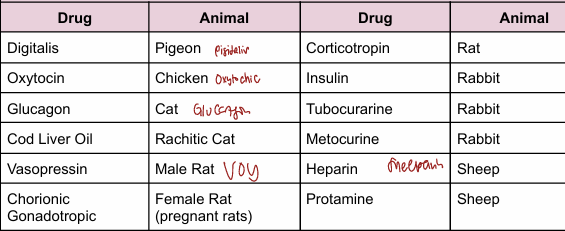
Animals Used in Testing of Drugs
substance used to prevent microbial growth
Preservatives
the most common human skin yeast
Candida albicans
major air and soil fungal contaminant
Aspergillus niger
the most common gram (-) fermentative enteric bacteria
Escherichia coli
the most common water-borne gram (-) non-fermentative bacteria
Pseudomonas aeruginosa
the most common gram (+) bacterial pathogen
Staphylococcus aureus
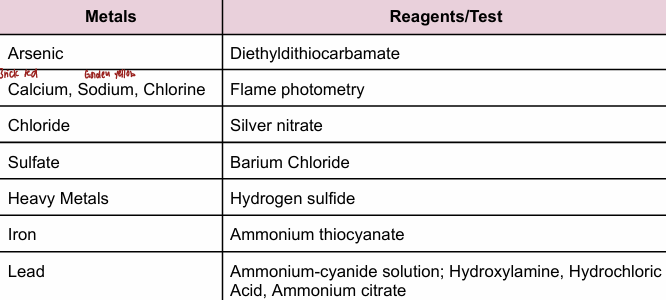
Allowable content: Should be ___
Limit Tests
less than 1 ppm
Determines the amount of volatile matter of any kind that is driven of under the conditions specified
Loss on Drying (LOD)
Water Content Determination
Method I: Titrimetry (Karl Fischer Reagent)
Method II: Azeotropic Distillation (Toluene Moisture Apparatus)
Method III: Gravimetric (Convection oven)
Weigh pre-oven weight then measure after oven, times 100
Method III: Gravimetric (Convection oven)