Structure 1.1 - models of the particulate nature of matter
 Call Kai
 Learn
Learn Practice Test
 Spaced Repetition
 Match
Match Flashcards
 Knowt Play
1/20

There's no tags or description
Looks like no tags are added yet.
Name | Mastery | Learn | Test | Matching | Spaced | Call with Kai | Chat |
|---|
No analytics yet
Send a link to your students to track their progress
21 Terms
How is matter generally classified?
basic distinction into pure substances and mixtures, then within pure substances, elements and compounds and within mixtures heterogeneous and homogeneous solutions.
What is an element?
the primary constituents of matter, which cannot be chemically broken down into simpler substances.
What is an atom?
the smallest particle of an element to show the characteristic properties of that element.
What is a compound?
combinations of more than one element, chemically bonded in a fixed ratio.
What is a mixture?
combinations of more than one element or compound in no fixed ratio.
Explain the difference between a homogeneous and heterogeneous mixture. Give an example of each.
homogeneous, mixtures have uniform compositions and properties throughout for example, a solution of salt and water or the metal alloy bronze, which is tin and copper.
Heterogeneous mixtures have non-uniform compositions and properties throughout for example, oil and water.
Additionally and heterogeneous mixtures one can observe the separate components, but that's not possible in a homogeneous mixture. Similarly, the components of a mixture can be easy to separate if they have a distinct physical property, separation techniques often depend on the physical property.
Explain filtration and crystallization
A separation technique were solid, separated from either a liquid or a gas using a membrane.
The solid is collected, and the filtrate passes through.
For example, sand and salt have different solubilities in water and can be separated by adding water which will dissolve the salt, or, salvation. The collective sand is the residue and the salt water solution is the filtrate.
Water can be further separated from the salt by evaporation which leaves behind the salt crystals. This is crystallization.
Simply put crystallization is a separation technique used to separate a dissolved, soluble solid (solute) from a liquid (solvent) by forming pure solid crystals.
Explain distillation and give examples
a separation technique separating a solvent from a solute.
The solvent has a lower boiling point than the solute meaning it vaporizes earlier as temperatures rise. Thus, it can be collected as a gas and passes into the condensing tube, which is surrounded by cold flowing water, which condenses it into the pure solvent, which is collected into the beaker at the bottom.
One would separate water from seawater with this method or, and alcohol from water.
Explain paper chromatography give an example
a separation technique where small spots of solution containing the samples being tested are placed on the baseline of the chromatography paper.
The paper is suspended to ensure it is saturated. Different components, have different affinities for the water in the paper and so they separate as the solvent moves up the paper.
One can use this method to separate the different pigments in food colouring.
What is the kinetic molecular theory?
the kinetic molecular theories and model used to explain physical properties of matter (solids, liquids, and gases) and changes of state.
What determines the state of matter at different given temperatures and pressures
the state of matter given temperature and pressure is determined by the strength of the inter particle forces or intermolecular forces that exist between the particles relative to its average kinetic energy.
Substances are solid if intermolecular forces are sufficiently strong to keep the particles in a position at a given temperature and pressure. However, if the particle forces aren't strong enough, the substance will be in a liquid phase or the gas state.
What is a fluid give an example?
some examples of fluids or liquids and gases since they have the ability to flow. Liquids take the shape of their container.
What is diffusion?
in the process of diffusion particles of a substance spread out more evenly. This occurs as a result of their random movements, and most commonly occurs with liquids and gases.
What is kinetic energy?
kinetic energy denoted (Ek) is the energy associated with movement or motion. It is determined. by the mass, M, and speed or velocity, V, of a substance via the following relationship: EK 1/ 2 mv2

What is the relationship between mass velocity and kinetic energy explain the cause
the average kinetic energy of all particles at the same temperatures the same. Because of this, there's an inverse relationship between mass and velocity. Particles with a smaller mass will diffuse more quickly than those that are heavier at the same temperature.

What is a solution?
solutions are typically mixtures of two components. The less abundant one is the solute and the more abundant one is the solvent. Solutions can be solid liquid or gases, but the solvent is usually a liquid thus will usually see the aqueous state symbol.
How do particles change states, give some examples.
as the movement or in other words, the kinetic energy of particles increases with temperature they overcome their intermolecular forces and change state. This state change happens at fixed temperatures and pressures for each and every substance.
For example, solid water or ice changes to a liquid at a temperature above 0°C, which is its melting point.
Another example liquid mercury changes to gas at its boiling point at a temperature of 357°C.
The key is that these processes are all reversible liquid freeze and become solids at the same temperature as the solid melts. A gas or vapour condenses at the same temperature as a liquid boils.
Explain, sublimation and deposition
some substances are capable of changing directly between the solid and gases states via processes known as sublimation (solid to a gas) and deposition (gas to a solid).
What is boiling point, how is it dependent on atmospheric pressure?
boiling point is the temperature at which the vapour pressure is equal to the external pressure. As a liquid is heated more particles enter the vapour state and the vapour pressure increases when the vapour pressure reaches the external atmospheric pressure the liquid boils. Thus when the external pressure is lower, the vapour pressure needed to boil is reduced, and the boiling point occurs at a lower temperature.
What's the relationship between temperature and state change?
the kinetic energy of the particles of a substance depends on the temperature. Thus one temperature decreases the average kinetic energy of the particles also decreases, and vice versa.
What is absolute temperature?
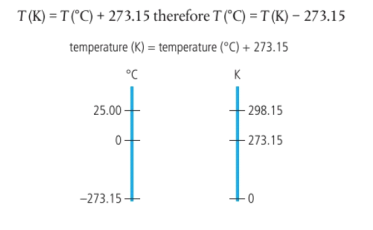
Temperature in Kelvin (K) is known as the absolute temperature. Absolute zero is known as -273°C and is the lowest possible temperature attainable as this is the temperature where all movement stops Kelvin is the SI unit for temperature. The absolute temperature is directly proportional to the average kinetic energy of its particles. A temperature increase of 1°C is also an increase of one kelvin which makes converting between the two scales really easy.
The conversion is: T(K) = T(°C) + 273.15