Proteolysis & the Ubiquitin System
 Call Kai
 Learn
Learn Practice Test
 Spaced Repetition
 Match
Match Flashcards
 Knowt Play
1/28

There's no tags or description
Looks like no tags are added yet.
Name | Mastery | Learn | Test | Matching | Spaced | Call with Kai | Chat |
|---|
No analytics yet
Send a link to your students to track their progress
29 Terms
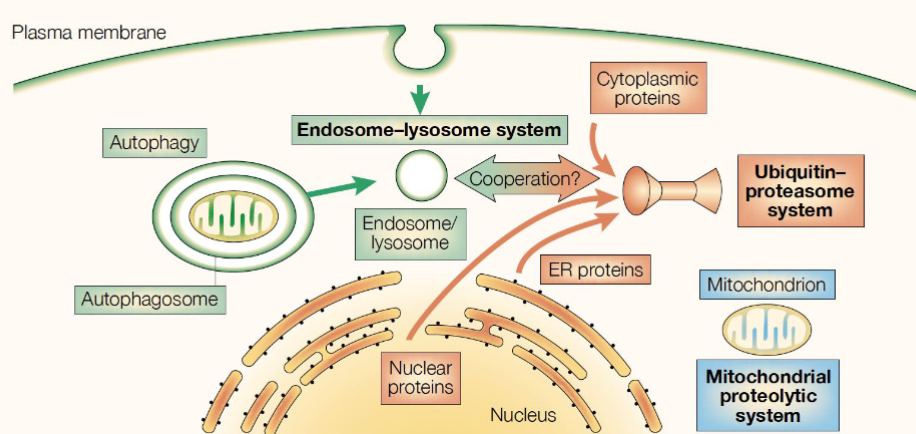
2 Major Proteolytic Pathways
peptide bonds are cleaved by proteases for processing and degradation
the proteosome and lysosome constitute 2 major proteolytic machineries in eukaryotic cells
proteasome: Degrades specific proteins tagged with ubiquitin (misfolded proteins) → produces short peptides
lysosome: breaks down proteins/organelles/aggregates and can go all to way to single AA’s for recycling
Ubiquitin Proteasome System
degradation by the ubiquitin proteasome system is a 2-step process
proteins to be degraded are first marked by ubiquitin (by ATP-dependent E1–E3 enzymes) and then degraded into short peptides by the proteasome
proteasome is the degradation machinery for proteins will cleave off ubiquitin for recycling and then cleave the substrate into shorter peptides

Ubiquitin
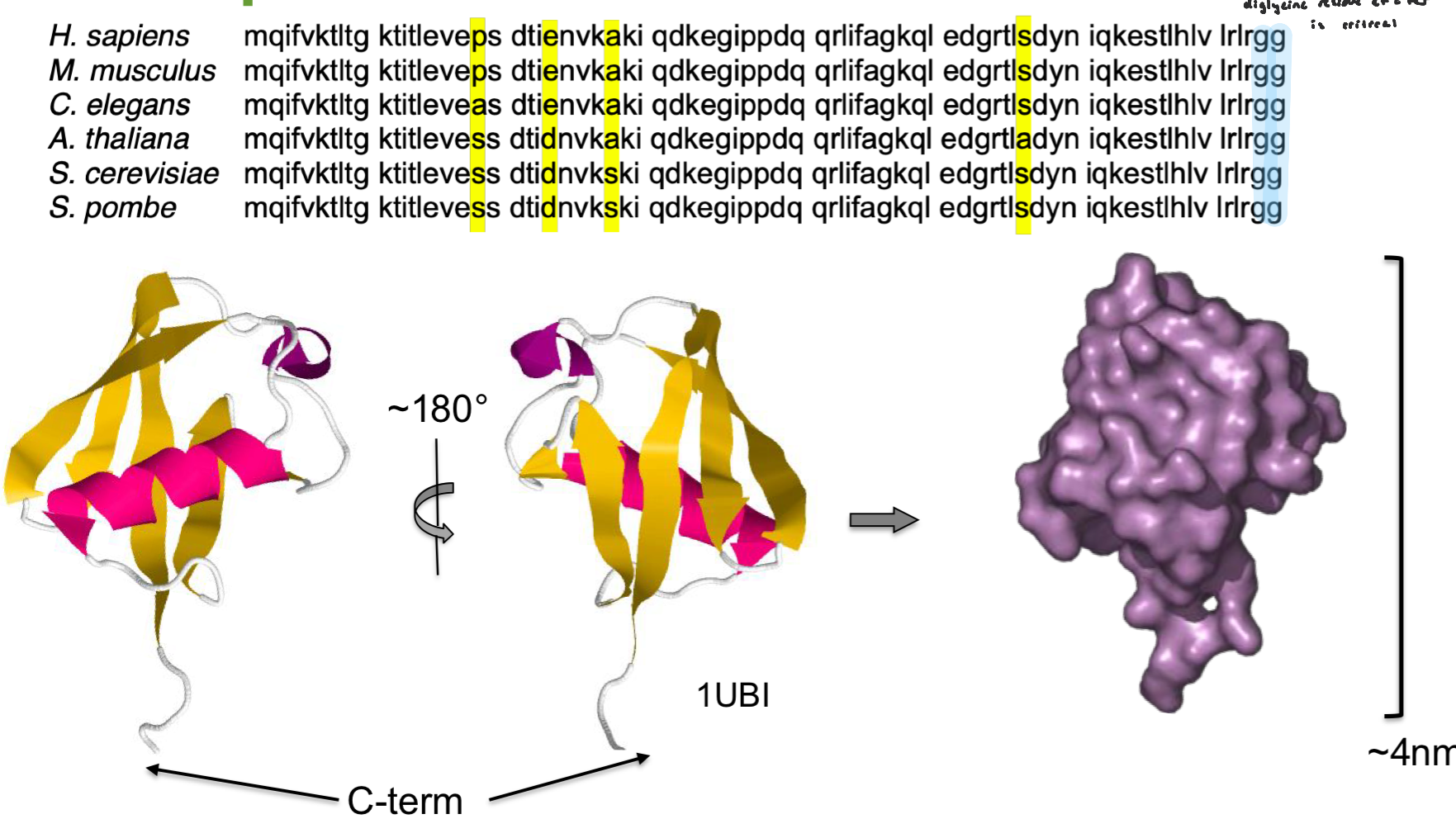
small, abundant, globular protein conserved across all eukaryotic cells
76 AA’s
over 95% identical b/w yeast + human
the di-glycine residue at the C-ter is critical
ubiquitin belongs to a family of small proteins that can be conjugated (covalently linked) to substrate proteins via its carboxyl group at a glycine (G76)
Ubiquitylation
the process that leads to the post-translational modification of conjugating ubiquitin to a substrate protein
ubiquitylation occurs mostly on lysine residues

Ubiquitylation: Isopeptide bond
when conjugated to a substrate, ubiquitin forms a stable isopeptide bond that has the same properties as a peptide bond
very stable and only cleaved by de-ubiquitinylating enzymes (deubiquitinase, DUBs, a type or protease)
b/w carboxyl group of G76 and amine of modified Lys on substrate

Ubiquitin Cascade
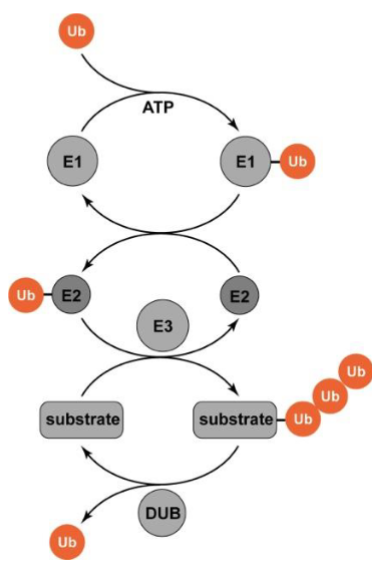
Ubiquitylation is mediated by a 3-step process (ubiquitin cascade)
ubiquitin is first activated by the ubiquitin actiating enzyme (E1) in an ATP-dependent manner
E1 forms a thioester bond w/ ubiquitin and transfers it to E2 (b/w Cys of E1 active site and ubiquitin)
E1 Cys performs nucleophilic attack on ester bond => thioester bond
E2 (ubiquitin conjugating enzyme): formation of thioester bond b/w Cys group of E2 and ubiquitin and carries ubiquitin
Conjugation of ubiquitin onto substrate Lys by ubiquitin ligase E3 to form isopeptide bond
from the E2~Ub, ubiquitin is either directly transferred to the substrate w/ the help of a RING-containing E3 or via a 3rd thioester bond on a HECT or RBR E3 (classes of E3 enzymes)
E3 Transfer from E2: Ring
most cases, the E3 ligase has a ring motif that recruits the E2 enzymes and then ubiquitin is transferred from Lys on E2 to Lys on substrate to form isopeptide bond
E3 ligase acts as an intermediate to bring the substrate into vicinity of E2 and stimulate nucleophilic attack from deprotonated Lys on substrate to form isopeptide bond, and thus transfers ubiquitin from E2 to Lys of substrate
E3 Transfer from E2: HECT/RBR
HECT: homologous to E6AP C-ter
RBR: ring b/w ring domain
both have Lys that forms an additional thioester bond b/w ubiquitin + Cys before transferring to Lys of substrate

Ubiquitin Cascade: Abundance of each enzyme
the ubiquitin cascade has large arrays of proteins to be conjugate
the specificity for a substrate is imparted by the E3 alone or in conjuction with the E2
each E3 ligase is regulated differently, so that not all proteins are ubiquitinylated at the same time
each E3 recognizes only a subset of substrates
there are over 500 E3s encoded in the human genome each targeting a few to a large array of substrates
there are also 300-400 proteins that have ubiquitin binding domains that can recognize ubiquitin molecules

Poly-ubiquitination
multiple ubiquitin moieties can be added to form a poly-ubiquitin chain in a processive manner or via multiple substrate E3 association-dissociation cycles
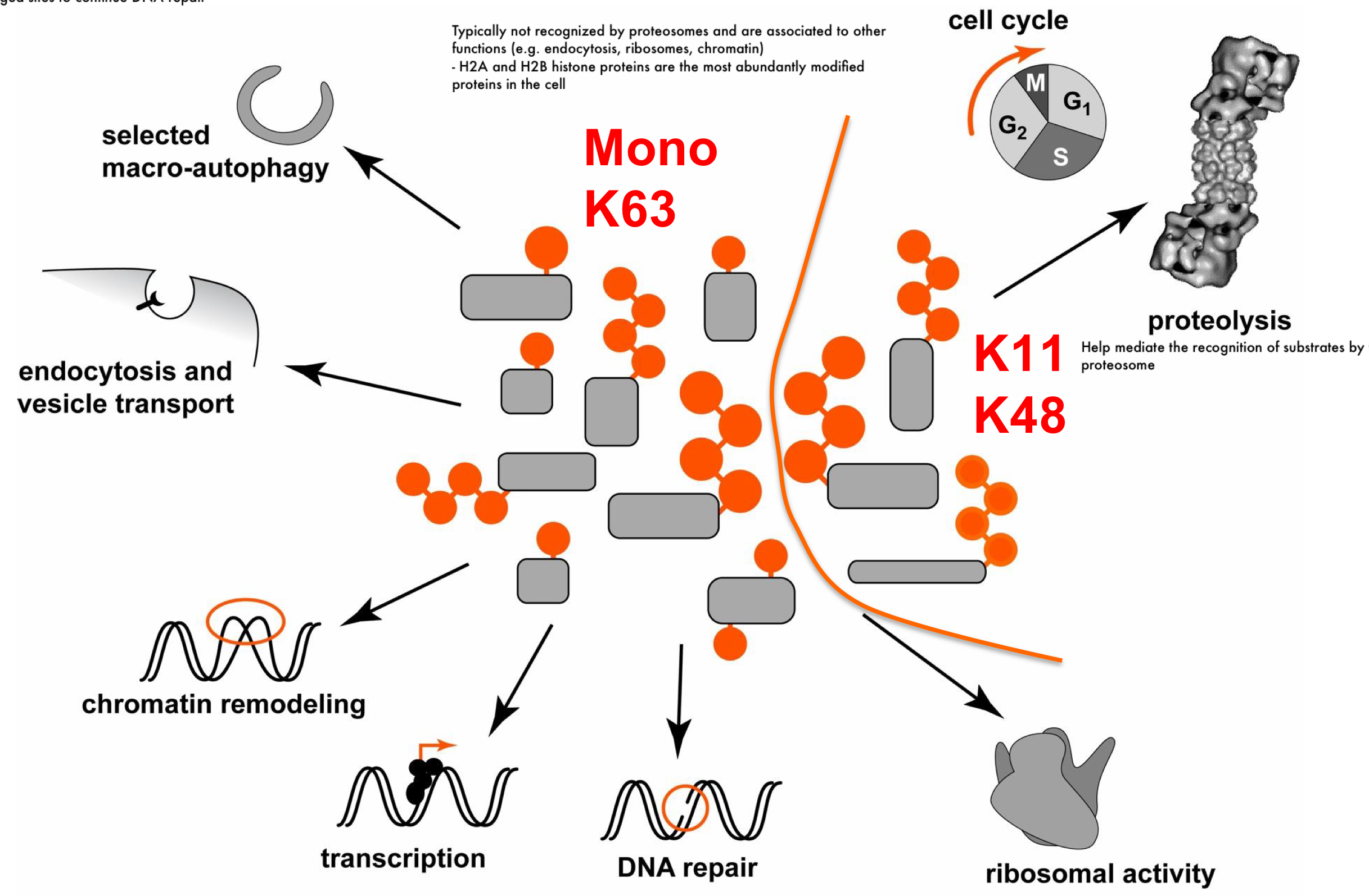
there are 7 Lys (+ the amino terminal) on ubiquitin that can be used to conjugate successive ubiquitin to form a poly-ubiquitin chain
the first ubiquitin that is attached to the substrate is now conjugated by another ubiquitin and so on (Add another ubiquitin onto the previous ubiquitin)


Deubiquitinase
i.e ubiquitin protease, DUB, that can break isopeptide bonds
can reverse the ubiquitin cascade reaction in an ATP-independent manner
generates free ubiquitin moiety that can be recycled into the system
Polyubiquitylation & the Ubiquitin Code
substrates can be modified in different manners depending on the combination of E2 & E3, and sometimes a DUB
different functions are associated to different type of ubiquitin linkages that form the ubiquitin code
diff messages are associated to diff types of ubiquitin chains
polyubiquitylation of histone H2As is utilized as a key message during DNA repair process, where it can recruit specific proteins to the damaged sites to continue DNA repair

Proteasome
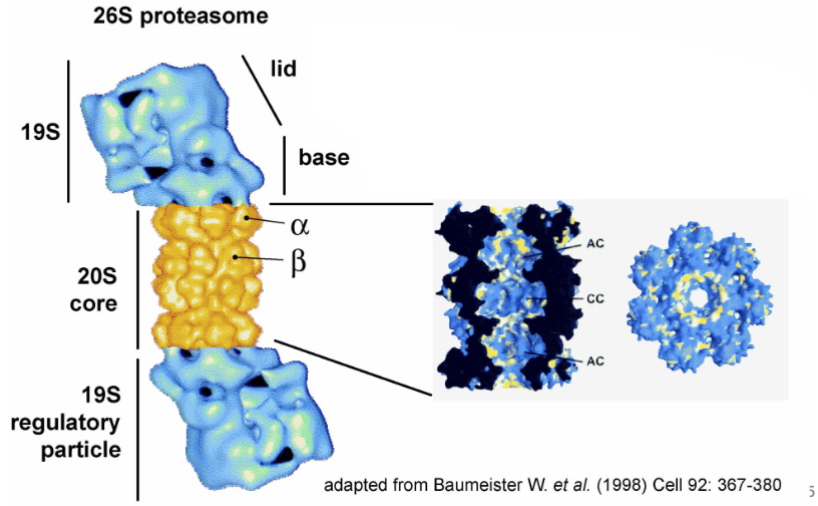
small 2.5 megDa multi subunit complex over 30 proteins
the 26S proteasome is composed of one 20s core complex and 1- 2 19S regulatory particle(s)
targets for degradation of poly-ubiquitylated proteins
Proteasome: 20S
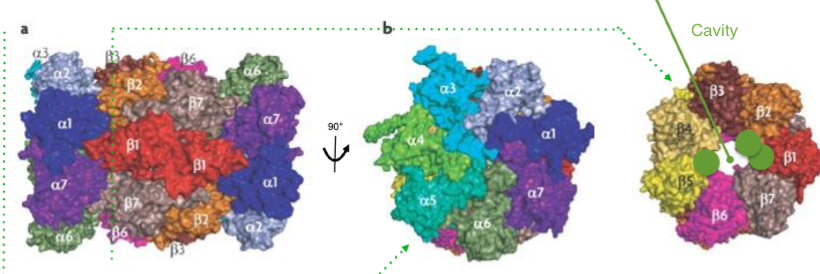
the 20S has a hollow barrel shape; the barrel shape is formed by 4 diff rings
the 7 ⍺-subunits (outer rings) form the gate that controls entry to the 20S
the ⍺-subunits will be in ca closed conformation when 20S alone is in the cell, preventing entry of proteins
in absence of 19S, proteins typically cannot access the inside chamber
proteolytic activity resides inside the cavity
3/7 β-subunits are Thr proteases that have caspcase/trypsin/chemotrypsin-like activities
β1: capase-like, cleaves after acidic residues
β2: trypsin-like, cleaves after basic residues
β-5: chemotrypsin-like, cleaves after hydrophobic residues
with 3 distinct proteases, the 26S proteosome can degrade any type of polypeptide
Proteasome: 19S Subunits
19S subunits regulate entry of the substrate into the 20S chamber
function: unfold the substrates to mediate the translocations and also mediate the opening the ⍺-subunits so that the polypeptide can enter the 20s
19s base region sites on top of the 20S
6 ATPases form the base
the rest of the lid subunit will mediate recognition and processing before entry
Proteasome Mechanism
the 19S recognizes polyubiquitinated proteins (substrate) via ubiquitin binding proteins (Rpn10, Rpn13) (1)
the substrate is position at the 19S base; disordered regions begin to translocate into the ATPase ring (2)
when this occurs, there’s a rearrangement of 19s subunits so that there is an active site of deubiquinase that sites ontop of the ATPase ring
Rpn11 deubiquitinase removes the ubiquitin chain (3) from the substrate and is recycled (not degraded)
coupled to translocation
substrate unfolding (ATP-dependent) allows full translocation of substrate into the 20S and substrate protein is unfolded
the β-subunits of the 20S cleave the protein into shorter peptides, which diffuse out and are further degraded into AA’s for recyling

Proteasome: Target Pathways
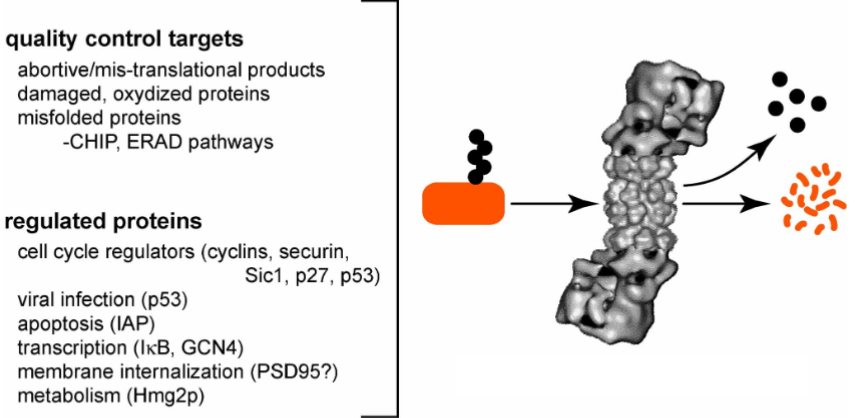
there are 2 major classes of proteasome substrates
proteins targeted by a protein quality control pathway and proteins degraded by a regulated pathway
Ubitquitin Attachments
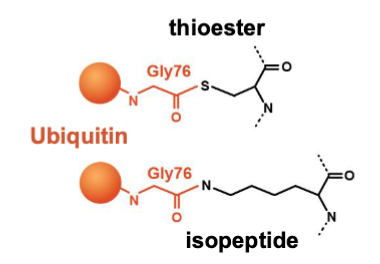
thioester and isopeptide
both are covalent bonds and are resistant to SDS denaturation
thioester is more labile and dissociates upon exposure to a reducing agent (e.g. DTT)
isopeptide can only be cleaved by a specialized protease
thioester is first catalyzed in an ATP-dependent manner by E1 or following the transfer from E1 to E2 (and E2 to E3 in some cases)
the isopeptide is formed following the nucleophilic attack of the thioester by the deprotonated lysine
Inhibition of Proteasome Proteolytic Activity
there are several potent inhibitors of the proteasome
there are 3 proteasome inhibitors, as well as two small molecule docking substrates to E3 (revlimid and pomalidomide) that are used to treat some cancers

In Vitro Ubiquitination Reactions
require E1, E2, E3, ATP, ubiquitin and a substrate and can be inhibited by specific elements/ mutations
In vitro Proteasomal Degradation Assays
require the 26S proteasome, a poly-ubiquitinated substrate and ATP
they can also be inhibited by specific elements