Economics
 Call Kai
 Learn
Learn Practice Test
 Spaced Repetition
 Match
Match Flashcards
 Knowt Play
1/91

There's no tags or description
Looks like no tags are added yet.
Name | Mastery | Learn | Test | Matching | Spaced | Call with Kai | Chat |
|---|
No analytics yet
Send a link to your students to track their progress
92 Terms
Draw Basic Two Sector Circular Flow Model
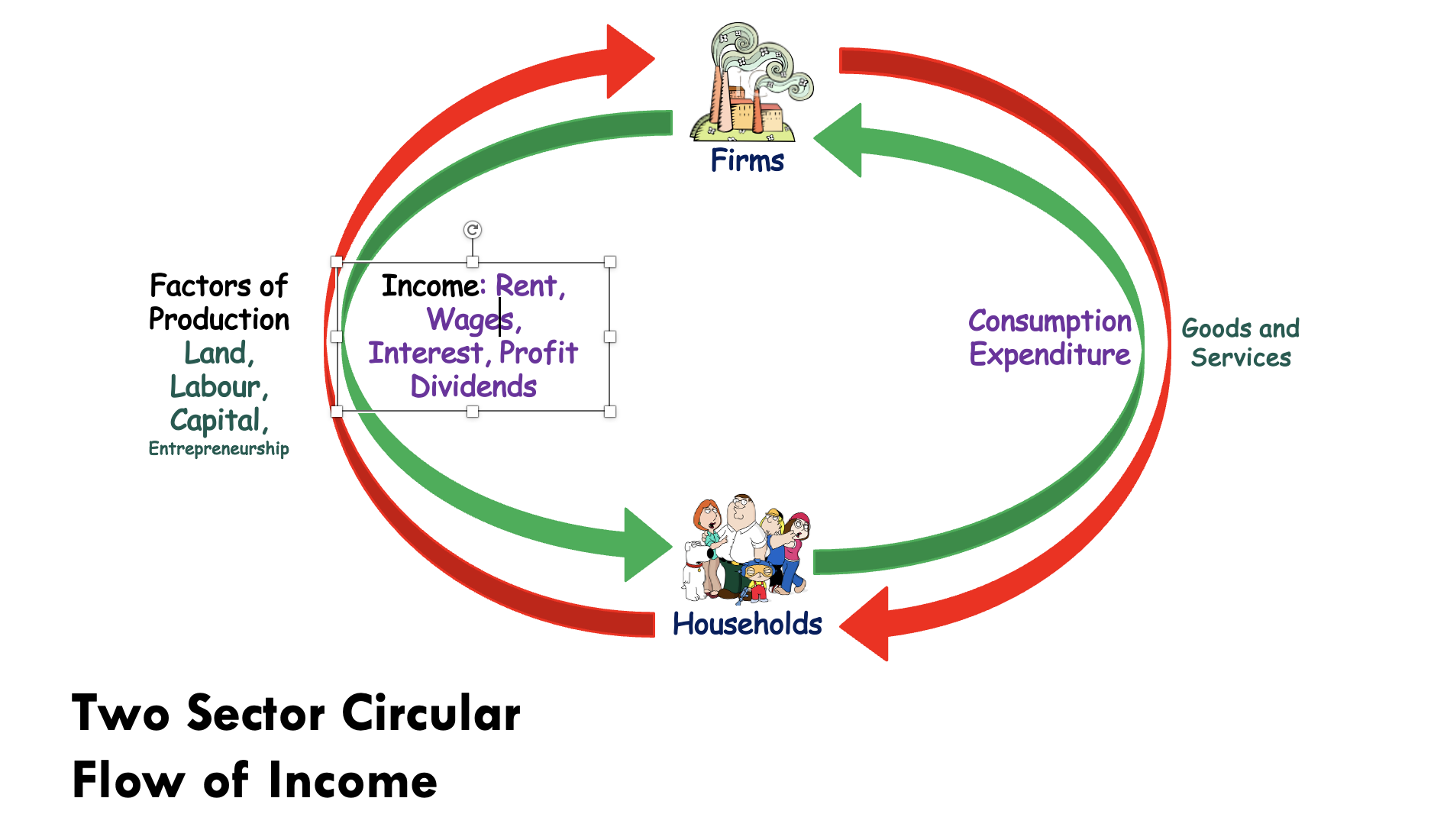
Households
Receive income (wages & salaries & investments), and then purchase goods and services from firms.
Firms
Hire land and capital inputs to produce goods and services, earning revenue/profits from sales. And pay wages and rent.
Assumptions of basic Two Sector Circular flow model
Assumes that only households and firms are involved in the economy, with households providing factors of production and firms providing goods and services. It also implies that all income is spent on consumption. That there is no government intervention and no overseas trade.
What is the point of Basic Two Sector Circular Flow Model
Think about economy as a continuous flow of money/G&S between people who make them and people who buy them
Leakages From Economy
Taxation (take from wages and off prices of goods), Savings (Households may not spend all their income), Imports (households and firms may spend on imports)
Factor income
Income gained by employees for labor spent on goods within the economy
Draw Circular Flow of Income
This is an open economy
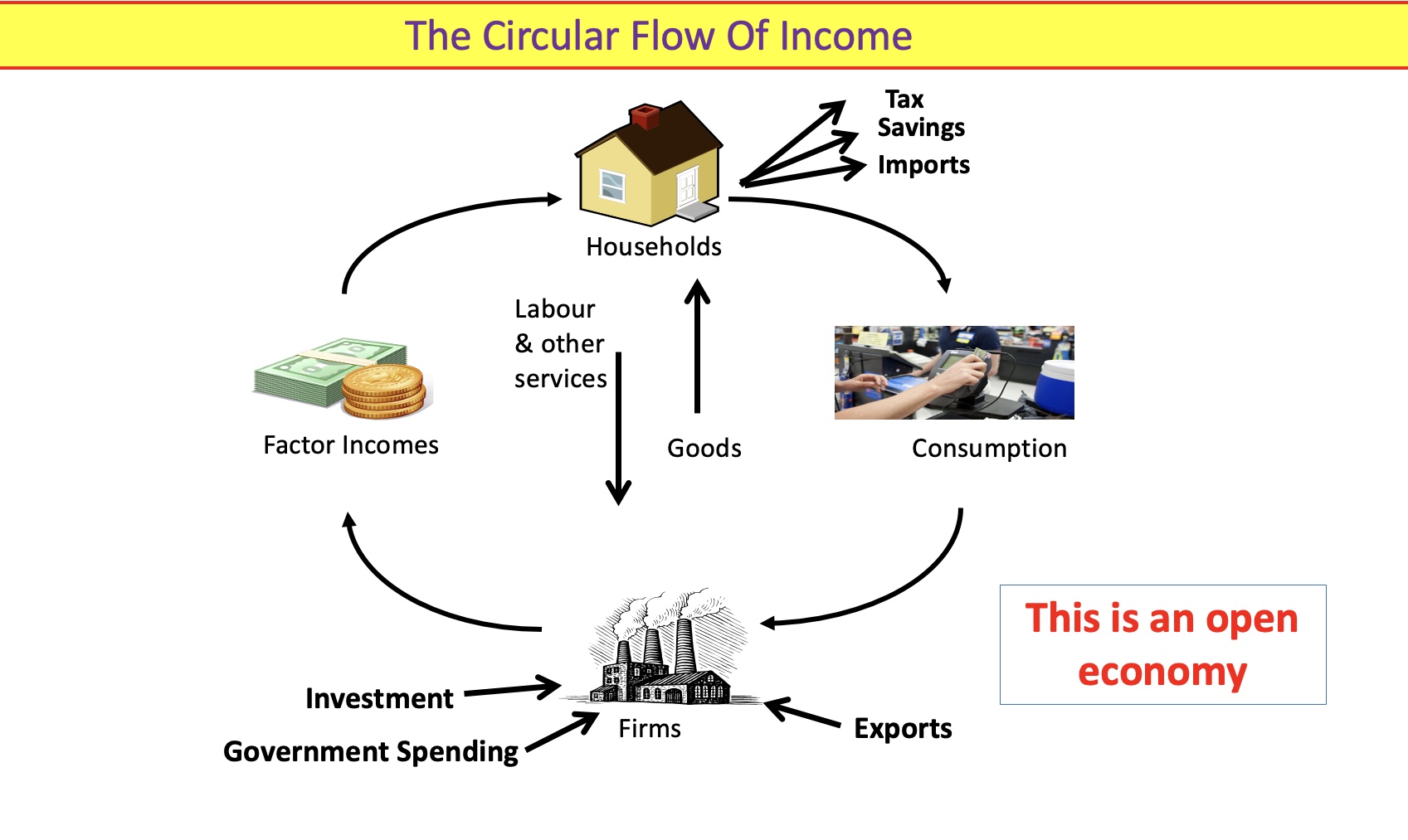
Injections from outside economy
Government spending (money spent by government on Medicare, defence, welfare benefits, education), Investment (money spent by firms on capital goods), Exports (goods sold by Australian firms abroad so outside money comes in).
Which of the following defines the circular flow of income
An economic model to illustrate how money flows around the economy
Which of the following is the correct term for spending by firms on building, machinery and training?
Investment
What would happen to the Australian economy if a foreign country decided to buy more goods and services from Australia?
Injections into the economy would increase
The circular flow demonstrates that the economy is in equilibrium when?
Income = output = expenditure
Economic Event: A survey reports a rise in confidence for UK manufacturing firms
Investment is most effected and income is most likely to increase
Economic Event: The British pound rises in value by 10% against the US dollar
Exports are the most effected with income likely to decrease
Economic event: The government decides to increase the UK road building programme by 800 million Pounds for 2013-14
Government Spending is the most effected with income likely to increase
Economic Event: The prices of many consumer goods ad services stat to fall, and people start to expect further price reductions in the future.
Savings is the most effected with income likely to increase
Define circular flow of income
Shows how money moves through an economy in a constant loop from firms to households and back again.
What is meant by the terms leakage and injection? Examples
Leakage = Is the money which leaves the economy which can occur in an open market, through taxation.
Injection = Is the money which is added back into the economy in an open market an example includes government spending.
Real-life Australia Example of Exports/Injections
Iron ore sold to China and India
Students from Asia coming to Australia to study at University
Japan buys our natural gas
America buys our gold
Real-life Australia Example of Imports/Leakages
Australia buying from South Korea or Japan
Buying electronics from India, China or Taiwan
Buying machinery from South Africa
Buying lamb from New Zealand
If Injections are greater than Leakages then?
Income rises
If Leakages are greater than Injections then?
Income Falls
If Injections are equal to leakages then?
Income stays the same
Draw detailed version of Circular flow of income
Define Business in circular flow of income
They hire land, labour & capital inputs when making products for which they pay wages and rent.
Define Government in circular flow of income
Collect taxes to fund spending on public services
Define External Sector in circular flow of income
The government buys imports from other countries and overseas businesses and consumers buy our products known as exports.
Example Exam Question: Sales from firms to other countries are falling in the UK due to strong British Pound, discuss what would happen ti the circular flow and economy?
Cause a fall in exports due to high value of currency
Fall in exports means injections into economy will decrease
Firms sell less products to foreign consumers
This may force firms to cut back, causing unemployment
Drops income for workers in households
Falls in consumer spending may be a result of this event
Define Macro equilibrium
The value of the output produced by firms must equal the value of income paid to resource owners, in turn must equal value of spending by households to produce output.
Macro economics equation
∑O = ∑Y = ∑E
Where O = Output, Y = Income, E = Expenditure, ∑ = Sum of
Explain Capital Market & Financial Sector
How money moves from households to businesses through financial system and what happens when unbalanced.
Explain Basic Flow in Financial Sector
Households save a portion of the income
Financial institutions (banks) pool these savings
Funds are then lent to businesses to invest in capital equipment
Explain Equilibrium in Financial Sector
Is when Savings (S) = Investment (I)
Means every dollar saved by households is being borrowed and spent by firms on new capital
Explain Disequilibrium in Financial Sector
Is when Savings (S) < Investment (I)
Sometimes firms want to invest more than households save due to seeing opportunities for innovation and wanting to expand/upgrade technology
This signals that firms are borrowing more than what is currently being saved
It can put upward pressure on interest rates as banks compete for limited supply of savings
Factor Market: Saving is greater than investment
Flow of income in economy contracts
Total spending is less than output
Unsold stocks of goods held by firms increase
Firms cut production
Households receive less income
Consumption & savings fall
Factor Market: Investment is greater than savings
Flow of economy expands
Total spending is more than output
Unsold stocks of goods held by firm decrease
Firms increase production
Households receive more income
Consumption & savings rise
When is level of income stable?
Only when aggregate levels of savings and investment are equal will level of income be constant
Disequilibrium in other Markets
Overseas sector if M does not equal X
Government Sector if T does not equal G
What is Aggregate Perspective?
Sum of parts is more important than the individual sectors
What happens if (S+T+M) > (I+G+X)
Aggregate withdrawals are greater than injection so producer output and household income will fall
What happens if (S+T+M) < (I+G+X)
Aggregate injections are greater than withdrawals so household income and producer output will rise
If (S+T+M) = (I+G+X) outline what happens in the economy if Imports increase by $20bn and all other things remain the same
(S+T+M) > (I+G+X). Therefore, there is a leakage of $20bn from the circular flow. Economy in Disequilibrium.
If (S+T+M) = (I+G+X) outline what happens in the economy if taxes increase by $30bn and exports increase by $30bn.
Leakages = injections. Therefore, the economy will remain unchanged. Economy is in equilibrium.
Reasons why individuals save
Financial Security
Build Wealth
Lack of confidence in the economy
Reasons why firms invest
Increase spending on capital
Improve capital
Produce G&S which they expect to increase profit
How to calculate percentage of income households are saving from circular flow:
S/Y*100 or Savings divided by income times 100
What happens to the circular flow diagram if there is an increase in investment in machinery from $400 to $600 and an initial investment of $2000?
(C+I) now exceeds current levels of output and income
This expands output of firms sector
Increases level of income earned during next period by amount of initial investment from $2000 to $2200
How to Calculate Consumption in circular flow diagram: (Income)
Percentage of amount spent time the income (%*Y)
How to calculate savings from circular flow diagram: (Income)
Percentage Saved times income (2nd%*Y)
After an increase in investment what happens within the economy in the circular flow of income?
Higher levels of consumption expenditure creates extra demand for G&S
Firms produce more output to meet demand and employ more factors of production
Income rises
Economy will continuer to expand after initial increase until new equilibrium is reduced
Saving will again equal investment
Discuss this statement: Equilibrium is usually temporary
Level of economic activity is always changing because it consists of independent individuals/groups seeking to improve their own welfare
Therefore, the level of savings and investment will change again as firms & households respond to events in the economy
What would happen in the economy if planned savings exceed investment?
Economy will initially be in disequilibrium
Savings are greater than investment which is a leakage from the circular flow model
The level of income an output in economy must contract
Less G&S will be purchased by households, so firms will cut their output as they notice their stocks are rising
The might cut overtime of staff or perhaps lay off some employees
The aggregate level of income in the economy will fall in next time period
New equilibrium will be at a lower level of income
What is aggregate expenditure?
The total planned spending in the economy
Define Consumer Spending
Spending by households on goods and services
Includes durable goods, non-durable goods and services
Examples of Consumer Spending
Food
Clothings
Transport
Appliances
Entertainment
Health
Education Services
Determinants of Consumer spending (Rises)
Disposable income rises
Household wealth rises
Interest Rates falls
Household confidence rises
Define Business Investment
Spending by firms on capital goods used to produce goods and services
Investment is usually more volatile than consumption
Examples of Business Investment
Machinery
Equipment
Factories
Warehouses
Research
Development inventories
Determinants of Business Investment (Rise)
Expected profitable rises
Interest rates fall
New technology is introduced
Business confidence rises
Define Government Spending
Spending by Commonwealth State and local governments on goods, services and infrastructure
Transfer payments are not included
What is the difference between Current expenditure and Capital expenditure?
Current Expenditure is spending on goods and services now
Capital Expenditure is spending on infrastructure and long-lasting assets
Examples of Government Spending
Schools
Hospitals
Roads
Defence
Public Sector Wages
Net Exports (Differences between Exports and Imports)
Exports is spending by overseas buyers on Australian goods and services. It adds to GDP.
Imports is spending by Australians on overseas goods and services. Imports are subtracted from GDP.
Net Exports are positive when exports are greater than imports
Define Disposable income
Is the income households have available to spender save after income tax, plus any transfer payments the receive
Why Disposable income affects consumer spending
When households have more money available they can afford higher levels pf consumption
When disposable income falls, households usually reduce spending or delay non-essential purchases
Likely effect of Disposable income on Consumer Spending
Rising disposable income usually increases consumer spending
Falling disposable income usually reduces consumer spending
Define Household Wealth
The value of assets owned by households, such as housing, savings, shares and superannuation, minus debts
Why household wealth affects consumer spending
When wealth rises households may feel more financially secure
This can increase confidence and reduce the need for precautionary saving
Likely effect of Household wealth on Consumer Spending
Rising wealth usually increases consumer spending
Falling wealth can make households more cautious and reduce spending
Define Interest Rates
Are the cost of borrowing money and the reward for saving money
Why Interest Rates affect consumer spending
Lower interest rates make borrowing cheaper and reduce return from saving
This can encourage households to borrow and spend, especially on durable goods
Higher interest rates usually do the opposite
Likely effect of Interest Rates on Consumer Spending
Falling interest rates usually increase consumer spending
Rising interest rates usually reduce consumer spending and increase saving
Define Household Confidence and Expectations
Confidence refers to how positive households feel about the future, including job security, income and economic conditions
Why Household confidence affects Consumer Spending
If households expect strong employment and rising incomes, they are more willing to spend now
If they expect unemployment, recession or financial pressure, they may delay spending and save more
Likely effect of Household confidence on Consumer Spending
Higher confidence usually increases consumer spending
Lower confidence usually reduces consumer spending
Consumer Spending Determinants Exam links
Disposable income = In a paragraph response explain cause first them link it to household spending and aggregate expenditure;
Household Wealth = This is often called the wealth effect;
Interest Rates = Affect both the cost of credit and the incentive to share;
Household Confidence = Confidence mainly affect discretionary spending, especially purchases that can be postponed
Define Expected Profitability and rate of return
Firms invest when they expect the investment will generate future revenue and profit
The expected rate of return is the expected profit from an investment as a percentage of its cost
Why expected profitability and rate of return affects Business investment
If expected profitability rises, more investment projects become worthwhile
If expected profitability falls, firms are more likely to postpone or cancel investment
Likely effect of Expected Profitability and rate of return on Business Investment
Higher expected profitability usually increases business investment
Lower expected profitability usually reduces investment
Define Interest Rates (Firms)
For firms interest rate represent the cost of borrowing money to finance investment
List 5 limitations of using GDP as a measure of economic growth
Population isn’t accounted for
Social Wellbeing is not included
Life Expectancy is not accounted for
Environmental Impacts are not accounted for
Volunteering is not included
List measures of economic growth that does not include GDP
GDP per capita
HDI
HPI
OACO (Better life Index)
Example of an economic bad
Pollution
Waste
Litter
Drivers of Potential growth
Population - number of people in the working age population
Participation - proportion of those who work and their working hours
Productivity - amount of output produced per hour worked
Average population rate, migration growth, fertility rate
1.4% over past 40 years
60% of population growth
Fertility rate has been declining for the last 30 years
Why does population growth contribute to economic growth?
Larger population increases the size of economy, more demand for good and services. And it increases size of labour force.
Why does migration promote growth often more than natural population increase?
Transfer of wealth, knowledge, and skills from overseas. Workers generally are skilled to enter on VISA
Slows aging of population
Positive fiscal impact (they pay taxes, low welfare burden)